
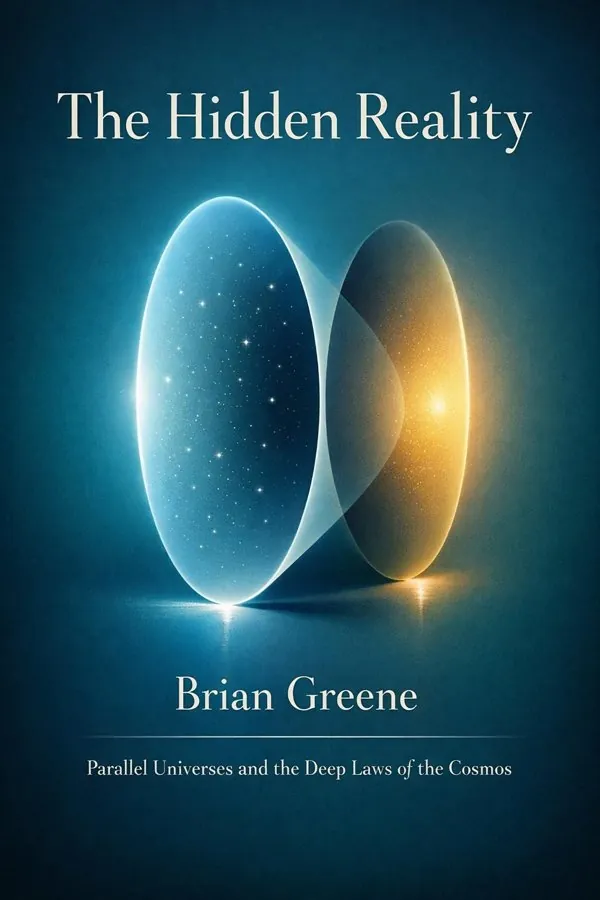
The Hidden Reality: Parallel Universes and the Deep Laws of the Cosmos: Summary & Key Insights
by Brian Greene
 10 min7 chaptersAudio available
What Is The Hidden Reality: Parallel Universes and the Deep Laws of the Cosmos About?
The Hidden Reality: Parallel Universes and the Deep Laws of the Cosmos by Brian Greene is a space_physics book spanning 7 pages. In this book, physicist Brian Greene explores the concept of the multiverse — the idea that our universe may be just one of many. He examines various scientific theories that suggest the existence of parallel universes, including string theory, inflationary cosmology, and quantum mechanics. Greene presents complex ideas in accessible language, guiding readers through the implications of these theories for our understanding of reality, space, and time.
This FizzRead summary covers all 7 key chapters of The Hidden Reality: Parallel Universes and the Deep Laws of the Cosmos in approximately 10 minutes, distilling the most important ideas, arguments, and takeaways from Brian Greene's work. Also available as an audio summary and Key Quotes Podcast.
The Hidden Reality: Parallel Universes and the Deep Laws of the Cosmos
In this book, physicist Brian Greene explores the concept of the multiverse — the idea that our universe may be just one of many. He examines various scientific theories that suggest the existence of parallel universes, including string theory, inflationary cosmology, and quantum mechanics. Greene presents complex ideas in accessible language, guiding readers through the implications of these theories for our understanding of reality, space, and time.
Who Should Read The Hidden Reality: Parallel Universes and the Deep Laws of the Cosmos?
This book is perfect for anyone interested in space_physics and looking to gain actionable insights in a short read. Whether you're a student, professional, or lifelong learner, the key ideas from The Hidden Reality: Parallel Universes and the Deep Laws of the Cosmos by Brian Greene will help you think differently.
- ✓Readers who enjoy space_physics and want practical takeaways
- ✓Professionals looking to apply new ideas to their work and life
- ✓Anyone who wants the core insights of The Hidden Reality: Parallel Universes and the Deep Laws of the Cosmos in just 10 minutes
Want the full summary?
Get instant access to this book summary and 100K+ more with Fizz Moment.
Get Free SummaryAvailable on App Store • Free to download
Key Chapters
When cosmologists first realized that the early universe underwent a brief but staggering period of rapid expansion—inflation—it transformed our view of cosmic origins. Inflation solved deep puzzles: it explained the extraordinary uniformity of cosmic background radiation and the flatness of space itself. But soon, the mathematics began to reveal something even more profound. Inflation, once started, doesn’t necessarily stop everywhere at once. Quantum fluctuations cause inflation to end in some regions even as it continues elsewhere. The result is eternal inflation—a cosmic ferment, forever spawning bubble-like regions where inflation ceases, each becoming its own universe.
In this picture, our universe is one bubble floating in an infinite sea of expanding space. Other bubbles—other universes—materialize from fluctuations, each with its own set of physical parameters. Some may host matter and stars, others may be barren, shaped by different underlying constants. This is the inflationary multiverse: a panorama where physical existence replicates itself endlessly, driven by the same expansion that gave birth to ours.
Through this model, we encounter both wonder and philosophical discomfort. If infinite universes exist, then even our most intimate experience becomes one instance among countless duplicates. There may be versions of you reading these words in other bubbles, each slightly different, each a natural outcome of cosmic diversity. The idea challenges our sense of uniqueness, yet it also broadens our perspective. Inflation, driven by the same equations of quantum field theory that govern particle behavior, offers a scientific framework for imagining an infinite cosmos—one where universes continuously bloom like cosmic flowers.
In scientific terms, the inflationary multiverse emerges naturally when we push inflationary theory to its logical limits. It is not an arbitrary invention but an unavoidable consequence of quantum randomness interacting with expansion. Whether or not we can test this idea remains unsettled; the bubbles lie far beyond our observational reach. Still, the notion that our universe is but one of many reflects a deep coherence between cosmology and quantum mechanics—the small scales and the vast scales joined in a dance of perpetual creation.
As our understanding of fundamental particles deepened, physics advanced toward unifying all forces into a single theoretical framework. String theory emerged as a daring candidate for that unification. Its premise is simple in form yet profound in implication: what we think of as point-like particles are, in truth, tiny vibrating strings. Their modes of vibration determine the properties of particles—mass, charge, and interaction. But string theory doesn’t stop there. To be consistent mathematically, these strings must vibrate in spaces of more than three dimensions of space; they require additional hidden dimensions curled up so tightly that we cannot perceive them.
The story then expands further. In higher-dimensional versions of string theory, entire universes may exist as vast membranes—‘branes’—floating in a higher-dimensional arena. Our universe might be a three-dimensional brane embedded in a higher-dimensional space, with other branes drifting nearby. In such a cosmos, parallel universes are not abstract possibilities but physical entities separated by dimensions we do not experience.
Imagine reality as a sheet alongside other sheets, each vibrating with its own cosmic frequency. Collisions between branes could even ignite phenomena like the Big Bang, a cosmic event of unimaginable energy when two universes collide and reset their internal contents. This notion provides a fascinating alternative to a singular beginning; it suggests cycles of creation driven by brane dynamics.
From here, the possibility of extra dimensions enriches how we think about space itself. What we call empty space may conceal immense structure—hidden dimensions and membranes out of reach of direct observation. In this vision, our existence is one manifestation in a vast, multidimensional ensemble, a universe whose local physics arises from the geometry of our brane. The brane multiverse ties tightly to string theory’s mathematics, offering a vivid, if speculative, portrait of parallel worlds woven into the very structure of space-time.
+ 5 more chapters — available in the FizzRead app
All Chapters in The Hidden Reality: Parallel Universes and the Deep Laws of the Cosmos
About the Author
Brian Greene is an American theoretical physicist, mathematician, and author. He is a professor at Columbia University and co-founder of the World Science Festival. Greene is known for his work on string theory and for popularizing science through books such as 'The Elegant Universe' and 'The Fabric of the Cosmos'.
Get This Summary in Your Preferred Format
Read or listen to the The Hidden Reality: Parallel Universes and the Deep Laws of the Cosmos summary by Brian Greene anytime, anywhere. FizzRead offers multiple formats so you can learn on your terms — all free.
Available formats: App · Audio · PDF · EPUB — All included free with FizzRead
Download The Hidden Reality: Parallel Universes and the Deep Laws of the Cosmos PDF and EPUB Summary
Key Quotes from The Hidden Reality: Parallel Universes and the Deep Laws of the Cosmos
“When cosmologists first realized that the early universe underwent a brief but staggering period of rapid expansion—inflation—it transformed our view of cosmic origins.”
“As our understanding of fundamental particles deepened, physics advanced toward unifying all forces into a single theoretical framework.”
Frequently Asked Questions about The Hidden Reality: Parallel Universes and the Deep Laws of the Cosmos
The Hidden Reality: Parallel Universes and the Deep Laws of the Cosmos by Brian Greene is a space_physics book that explores key ideas across 7 chapters. In this book, physicist Brian Greene explores the concept of the multiverse — the idea that our universe may be just one of many. He examines various scientific theories that suggest the existence of parallel universes, including string theory, inflationary cosmology, and quantum mechanics. Greene presents complex ideas in accessible language, guiding readers through the implications of these theories for our understanding of reality, space, and time.
More by Brian Greene
Until the End of Time: Mind, Matter, and Our Search for Meaning in an Evolving Universe
Brian Greene
10 min
The Fabric of the Cosmos: Space, Time, and the Texture of Reality
Brian Greene
10 min
The Elegant Universe: Superstrings, Hidden Dimensions, and the Quest for the Ultimate Theory
Brian Greene
10 minYou Might Also Like
The Means Of Prediction
Mark P. Silverman
10 min
AstroTech
Various Authors
10 min
Black Holes and Time Warps: Einstein’s Outrageous Legacy
Kip S. Thorne
10 min
Dark Matter and the Dinosaurs: The Astounding Interconnectedness of the Universe
Lisa Randall
10 min
Helgoland
Carlo Rovelli
10 min
Hyperspace: A Scientific Odyssey Through Parallel Universes, Time Warps, and the 10th Dimension
Michio Kaku
10 minBrowse by Category
Ready to read The Hidden Reality: Parallel Universes and the Deep Laws of the Cosmos?
Get the full summary and 100K+ more books with Fizz Moment.