
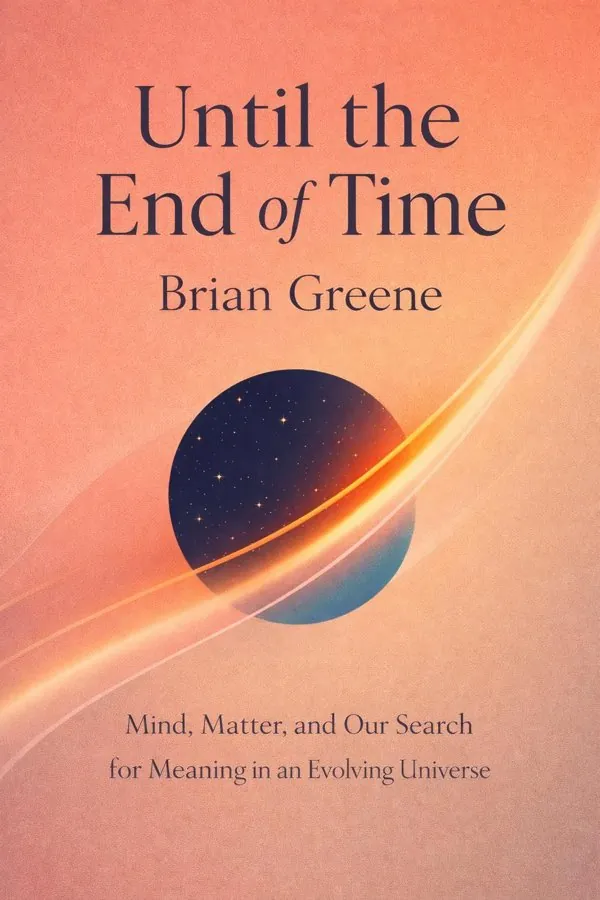
Until the End of Time: Mind, Matter, and Our Search for Meaning in an Evolving Universe: Summary & Key Insights
by Brian Greene
 10 min9 chaptersAudio available
Key Takeaways from Until the End of Time: Mind, Matter, and Our Search for Meaning in an Evolving Universe
The most personal questions often begin with the most impersonal facts.
We do not merely live in time; we live in a universe where time seems to move one way.
One of the book’s most powerful insights is that simplicity at the foundation does not prevent richness at higher levels.
Life can feel miraculous, but Greene insists that its emergence becomes more intelligible when seen as part of the universe’s broader thermodynamic story.
Few facts are stranger than this: particles and fields arranged in the right way can produce the felt experience of being someone.
What Is Until the End of Time: Mind, Matter, and Our Search for Meaning in an Evolving Universe About?
Until the End of Time: Mind, Matter, and Our Search for Meaning in an Evolving Universe by Brian Greene is a popular_sci book spanning 11 pages. What does it mean to search for purpose in a universe that will not last forever? In Until the End of Time, Brian Greene takes on one of humanity’s oldest questions with the tools of modern physics, evolutionary biology, neuroscience, and philosophy. He begins with the birth of the cosmos and follows the long chain of events that led to stars, planets, life, consciousness, language, art, religion, and science itself. From there, he pushes further, asking not only how meaning arises, but whether it can endure in a universe governed by entropy and destined for decline. What makes this book so compelling is Greene’s ability to connect the largest scales imaginable with the most intimate aspects of human life. He shows that our emotions, beliefs, and ambitions are not separate from cosmic history but are expressions of it. The book matters because it refuses easy consolation while still defending wonder, creativity, and moral seriousness. Greene writes not as a detached speculator but as one of the world’s best-known theoretical physicists, a Columbia professor, and the acclaimed author of The Elegant Universe and The Fabric of the Cosmos. His authority gives the science weight; his humanity gives the book its soul.
This FizzRead summary covers all 9 key chapters of Until the End of Time: Mind, Matter, and Our Search for Meaning in an Evolving Universe in approximately 10 minutes, distilling the most important ideas, arguments, and takeaways from Brian Greene's work. Also available as an audio summary and Key Quotes Podcast.
Until the End of Time: Mind, Matter, and Our Search for Meaning in an Evolving Universe
What does it mean to search for purpose in a universe that will not last forever? In Until the End of Time, Brian Greene takes on one of humanity’s oldest questions with the tools of modern physics, evolutionary biology, neuroscience, and philosophy. He begins with the birth of the cosmos and follows the long chain of events that led to stars, planets, life, consciousness, language, art, religion, and science itself. From there, he pushes further, asking not only how meaning arises, but whether it can endure in a universe governed by entropy and destined for decline.
What makes this book so compelling is Greene’s ability to connect the largest scales imaginable with the most intimate aspects of human life. He shows that our emotions, beliefs, and ambitions are not separate from cosmic history but are expressions of it. The book matters because it refuses easy consolation while still defending wonder, creativity, and moral seriousness. Greene writes not as a detached speculator but as one of the world’s best-known theoretical physicists, a Columbia professor, and the acclaimed author of The Elegant Universe and The Fabric of the Cosmos. His authority gives the science weight; his humanity gives the book its soul.
Who Should Read Until the End of Time: Mind, Matter, and Our Search for Meaning in an Evolving Universe?
This book is perfect for anyone interested in popular_sci and looking to gain actionable insights in a short read. Whether you're a student, professional, or lifelong learner, the key ideas from Until the End of Time: Mind, Matter, and Our Search for Meaning in an Evolving Universe by Brian Greene will help you think differently.
- ✓Readers who enjoy popular_sci and want practical takeaways
- ✓Professionals looking to apply new ideas to their work and life
- ✓Anyone who wants the core insights of Until the End of Time: Mind, Matter, and Our Search for Meaning in an Evolving Universe in just 10 minutes
Want the full summary?
Get instant access to this book summary and 100K+ more with Fizz Moment.
Get Free SummaryAvailable on App Store • Free to download
Key Chapters
The most personal questions often begin with the most impersonal facts. Greene opens with the startling idea that everything we care about—memory, love, art, morality, grief, ambition—depends on conditions set in motion nearly fourteen billion years ago. The Big Bang is not presented as a dramatic explosion into empty space, but as the emergence and expansion of space itself, governed from the start by precise physical laws. As the universe cooled, particles formed, then atoms, then stars, then heavier elements forged in stellar cores and supernovae. The carbon in our cells and the oxygen we breathe are the products of ancient cosmic processes.
This is one of Greene’s central moves: he bridges cosmology and identity. Human beings are not accidental outsiders observing the universe from a distance. We are arrangements of matter that the universe has produced through lawful evolution. That perspective makes our existence feel both fragile and astonishing. A kitchen table, a tree, and a human brain all arise from the same underlying ingredients, yet only certain arrangements of matter become capable of reflection.
A practical way to absorb this idea is to reframe ordinary life through deep time. Looking at a child, a city skyline, or a piece of music becomes different when you remember that each depends on the long arc from quarks to galaxies to biochemistry to culture. This perspective can reduce ego while increasing gratitude.
Actionable takeaway: when everyday concerns feel overwhelming, zoom out. Spend a few minutes tracing any object—or yourself—back through chemistry, stars, and cosmic history to recover a wider, steadier sense of perspective.
We do not merely live in time; we live in a universe where time seems to move one way. Greene explains that the reason we remember the past instead of the future, age instead of becoming younger, and watch eggs break instead of spontaneously reassemble is entropy. The Second Law of Thermodynamics says that, in an isolated system, entropy tends to increase. In simple terms, orderly states are less probable than disordered ones, and so physical systems naturally evolve toward greater disorder.
This scientific principle does far more than explain melting ice or cooling coffee. It underwrites the arrow of time itself. The universe appears to have begun in an extraordinarily low-entropy state, and everything from galaxy formation to biological metabolism unfolds against that backdrop. Local pockets of order—stars, cells, civilizations—can arise, but only by increasing disorder elsewhere. Life does not defy entropy; it temporarily rides its gradients.
Greene’s larger point is existential. Much of what gives life urgency comes from irreversibility. Moments pass. Bodies age. Civilizations change. Memory matters because events do not reset. Even meaning is shaped by time’s one-way flow: promises, regrets, achievements, and legacies all depend on it.
In daily life, entropy offers a useful lens. A cluttered room, a neglected relationship, or a disorganized calendar drifts toward disorder unless energy is invested. Maintenance is not failure; it is how local order survives in a universe that does not preserve it for free.
Actionable takeaway: treat order as an active practice. Whether in your home, work, or relationships, build small routines of renewal, because meaningful structures persist only when energy is deliberately supplied.
One of the book’s most powerful insights is that simplicity at the foundation does not prevent richness at higher levels. Greene shows how a universe governed by relatively concise mathematical laws can generate breathtaking complexity. From elementary particles interacting through basic forces emerge atoms, molecules, stars, planetary systems, cells, ecosystems, economies, and minds. Complexity is not evidence that physics has failed; it is evidence of what simple rules can produce when repeated across vast scales and durations.
This is the logic of emergence. A single water molecule does not have a wave, a current, or a whirlpool, yet many molecules together do. Likewise, a single neuron does not contain a thought, but immense networks of neurons can generate memory, imagination, and self-awareness. Greene uses emergence to connect the hard sciences with lived reality. Chemistry is not a betrayal of physics, biology is not a betrayal of chemistry, and consciousness is not a betrayal of biology. Each level introduces new patterns and explanations appropriate to its scale.
This matters beyond science because it challenges reductionism in its cruder form. Knowing the atoms in a violin does not explain a symphony. Knowing the biology of the brain does not, by itself, capture the meaning of a poem. Higher-level truths remain real and useful even when grounded in lower-level processes.
In practical terms, emergence helps us think better about organizations, families, and societies. Group behavior often cannot be understood by examining individuals alone; interactions create new dynamics.
Actionable takeaway: when facing a complex problem, ask what level of explanation fits it best. Do not assume the smallest components tell the whole story; often the pattern emerges only when you step back and examine the system.
Life can feel miraculous, but Greene insists that its emergence becomes more intelligible when seen as part of the universe’s broader thermodynamic story. Living systems maintain their internal order by taking in energy and exporting entropy. Plants capture sunlight. Animals consume chemical energy. Cells build and repair themselves while contributing to the universe’s larger drift toward disorder. In this view, life is not a cosmic exception but a sophisticated way matter behaves under the right conditions.
Greene traces the long path from chemistry to biology and from simple replicators to Darwinian evolution. Once systems capable of reproduction with variation emerge, natural selection begins to shape them. Traits that improve survival and reproduction tend to persist. Over immense spans of time, this process yields adaptation, diversity, and eventually creatures able to model their surroundings and reflect on their own existence.
The practical importance of this idea is that life’s apparent design does not require prewritten cosmic intention. Complex biological features can arise incrementally through selection acting on random variation. That understanding can deepen respect for the natural world. Every organism embodies a long history of trial, error, adaptation, and inheritance.
It also clarifies human vulnerability. Our bodies are not engineered for perfection; they are evolutionary compromises. We hunger for sugar, fear exclusion, and carry cognitive biases because these traits once had survival value or came bundled with useful adaptations.
Actionable takeaway: use evolutionary thinking to understand your instincts without becoming ruled by them. When you notice stress reactions, cravings, or status anxieties, ask which ancient survival pattern may be operating—and then choose whether it still serves your present life.
Few facts are stranger than this: particles and fields arranged in the right way can produce the felt experience of being someone. Greene treats consciousness as one of the deepest mysteries in science and philosophy. The brain is clearly central—damage specific regions and capacities change—but explaining how neural activity becomes subjective awareness remains profoundly difficult. Why should electrochemical processes give rise to the redness of red, the pain of loss, or the texture of thought?
Rather than offering easy certainty, Greene maps the terrain honestly. Neuroscience can increasingly identify correlates of consciousness and explain mechanisms of perception, attention, memory, and decision-making. Yet the hard problem—why there is “something it is like” to be a conscious organism—still resists complete explanation. This humility is part of the book’s appeal. Greene shows that scientific seriousness includes admitting what we do not yet understand.
He also links consciousness to meaning. Experience matters because there is an experiencer. Beauty, suffering, hope, awe, and love are not abstract variables; they are lived realities made possible by conscious minds. Even if consciousness is fully natural, that does not make it trivial. It may be among the most remarkable emergent features of the cosmos.
In everyday terms, this chapter encourages attentiveness. If consciousness is rare and precarious, then moments of awareness are precious. Listening deeply, noticing beauty, and cultivating mental clarity are not sentimental acts; they are ways of honoring the astonishing phenomenon we embody.
Actionable takeaway: set aside brief periods each day for undistracted awareness—walking, breathing, observing, or listening—to remember that consciousness itself is one of life’s greatest, and most fragile, gifts.
A central tension in Greene’s book is that science may strip away comforting illusions without stripping away value. If the universe does not provide an obvious built-in purpose for humanity, does meaning collapse? Greene’s answer is no. Meaning need not be written into the stars to be real in human life. It can arise from relationships, creativity, knowledge, ethical commitments, beauty, and the projects through which conscious beings orient themselves.
This is not a cheap relativism where anything goes. Some meanings are shallow, brittle, or destructive; others are durable because they connect us to truth, care, and shared flourishing. Greene suggests that science changes the setting of the human drama, but not the significance of the drama from within. A parent caring for a child, a researcher pursuing discovery, a friend keeping a promise, an artist creating beauty—these are meaningful because conscious beings experience and value them, not because the cosmos stamps them with eternal certification.
The practical challenge is psychological. Many people quietly assume that if meaning is not objective in a cosmic sense, it must be fake. Greene invites a more mature view: meanings are constructed, but construction is not deception. Laws, institutions, marriages, constitutions, and symphonies are human creations too, yet they profoundly shape reality.
This perspective can be liberating. Instead of waiting for the universe to announce your purpose, you can participate in forming it through action, love, understanding, and responsibility.
Actionable takeaway: write down three sources of meaning you actively choose—such as family, service, learning, or creativity—and schedule regular time for them, treating meaning as a practice to build rather than a mystery to passively await.
Perhaps the book’s most haunting sections concern the distant future. Greene follows current physics toward a universe in which stars burn out, galaxies drift apart, matter decays, and usable energy dwindles. Whether through heat death or related long-term scenarios, the cosmos appears headed not toward climax but toward exhaustion. On the largest scales, structure gives way to darkness and dilution. Even the achievements of civilizations, however grand, may ultimately vanish.
This can sound nihilistic, but Greene treats it as clarifying rather than paralyzing. Finitude is not only a cosmic fact; it is a human one. Because things end, they matter now. Mortality sharpens attachment, responsibility, and wonder. A sunset is beautiful partly because it does not last. A life matters not despite its limits, but within them.
Greene also emphasizes that transcendence need not mean literal permanence. We “outlast” ourselves through influence, memory, culture, and the reshaping of other minds and lives. No legacy is eternal, but it can still be real and morally weighty. The absence of everlasting endurance does not erase significance on human timescales.
Practically, thinking about endings can improve decision-making. Petty disputes shrink when viewed against mortality. Delayed conversations become harder to justify. The future of the universe may be unimaginably remote, but the reminder of impermanence can recalibrate our present priorities.
Actionable takeaway: use finitude as a filter. Ask yourself regularly, “If time is limited, what deserves my energy most?” Then move one meaningful action—an apology, a creation, a visit, a commitment—from someday to today.
The book ends on a note that is neither traditionally religious nor emotionally barren: wonder itself may be one of humanity’s most honest responses to existence. Greene argues that scientific understanding, far from draining awe, can intensify it. To know that galaxies formed from quantum fluctuations, that life emerged through chemical and evolutionary pathways, and that consciousness appeared within matter does not reduce reality. It makes it more astonishing.
This final idea ties the book together. We seek explanations because we are meaning-hungry creatures, but not every unanswered question requires a consoling myth. Sometimes the mature stance is reverent uncertainty: to investigate rigorously, feel deeply, and live ethically without pretending to possess final answers. Greene models a worldview in which intellectual honesty and existential richness can coexist.
In practical life, wonder is not just an emotion; it is an orientation. It encourages curiosity instead of dogmatism, humility instead of arrogance, and appreciation instead of numbness. People who retain wonder tend to ask better questions, notice more, and connect more deeply with both science and art. In a distracted culture, wonder is also a discipline—a refusal to let familiarity dull the extraordinary.
You do not need a telescope or a laboratory to practice it. You can find it in a child learning language, in music moving a crowd, in the night sky, in the improbable fact of consciousness, or in the chain of events that brought this moment into being.
Actionable takeaway: cultivate one weekly ritual of wonder—stargazing, reading science, visiting art, walking in nature, or journaling about existence—to keep curiosity and gratitude alive amid routine.
All Chapters in Until the End of Time: Mind, Matter, and Our Search for Meaning in an Evolving Universe
About the Author
Brian Greene is an American theoretical physicist, mathematician, and professor at Columbia University, widely known for making complex scientific ideas accessible to general audiences. Trained at Harvard and Oxford, Greene has conducted influential research in string theory and fundamental physics, focusing on the deep structure of space, time, and matter. Beyond academia, he has become one of the world’s most prominent science communicators through bestselling books, documentaries, lectures, and media appearances. His major works include The Elegant Universe, The Fabric of the Cosmos, The Hidden Reality, and Until the End of Time. Greene is admired for combining technical rigor with clarity, imagination, and philosophical range, helping readers connect cutting-edge physics to enduring human questions about existence, consciousness, and meaning.
Get This Summary in Your Preferred Format
Read or listen to the Until the End of Time: Mind, Matter, and Our Search for Meaning in an Evolving Universe summary by Brian Greene anytime, anywhere. FizzRead offers multiple formats so you can learn on your terms — all free.
Available formats: App · Audio · PDF · EPUB — All included free with FizzRead
Download Until the End of Time: Mind, Matter, and Our Search for Meaning in an Evolving Universe PDF and EPUB Summary
Key Quotes from Until the End of Time: Mind, Matter, and Our Search for Meaning in an Evolving Universe
“The most personal questions often begin with the most impersonal facts.”
“We do not merely live in time; we live in a universe where time seems to move one way.”
“One of the book’s most powerful insights is that simplicity at the foundation does not prevent richness at higher levels.”
“Life can feel miraculous, but Greene insists that its emergence becomes more intelligible when seen as part of the universe’s broader thermodynamic story.”
“Few facts are stranger than this: particles and fields arranged in the right way can produce the felt experience of being someone.”
Frequently Asked Questions about Until the End of Time: Mind, Matter, and Our Search for Meaning in an Evolving Universe
Until the End of Time: Mind, Matter, and Our Search for Meaning in an Evolving Universe by Brian Greene is a popular_sci book that explores key ideas across 9 chapters. What does it mean to search for purpose in a universe that will not last forever? In Until the End of Time, Brian Greene takes on one of humanity’s oldest questions with the tools of modern physics, evolutionary biology, neuroscience, and philosophy. He begins with the birth of the cosmos and follows the long chain of events that led to stars, planets, life, consciousness, language, art, religion, and science itself. From there, he pushes further, asking not only how meaning arises, but whether it can endure in a universe governed by entropy and destined for decline. What makes this book so compelling is Greene’s ability to connect the largest scales imaginable with the most intimate aspects of human life. He shows that our emotions, beliefs, and ambitions are not separate from cosmic history but are expressions of it. The book matters because it refuses easy consolation while still defending wonder, creativity, and moral seriousness. Greene writes not as a detached speculator but as one of the world’s best-known theoretical physicists, a Columbia professor, and the acclaimed author of The Elegant Universe and The Fabric of the Cosmos. His authority gives the science weight; his humanity gives the book its soul.
More by Brian Greene
The Fabric of the Cosmos: Space, Time, and the Texture of Reality
Brian Greene
10 min
The Hidden Reality: Parallel Universes and the Deep Laws of the Cosmos
Brian Greene
10 min
The Elegant Universe: Superstrings, Hidden Dimensions, and the Quest for the Ultimate Theory
Brian Greene
10 minYou Might Also Like
Structures: Or Why Things Don"t Fall Down
J.E. Gordon
10 min
The Road to Wigan Pier
George Orwell
10 min
Bonk: The Curious Coupling of Science and Sex
Mary Roach
10 min
First Bite: How We Learn to Eat
Bee Wilson
10 min
In Pursuit Of The Unknown: 17 Equations That Changed The World
Ian Stewart
10 min
Napoleon's Buttons: 17 Molecules That Changed History
Penny Le Couteur and Jay Burreson
10 minBrowse by Category
Ready to read Until the End of Time: Mind, Matter, and Our Search for Meaning in an Evolving Universe?
Get the full summary and 100K+ more books with Fizz Moment.