
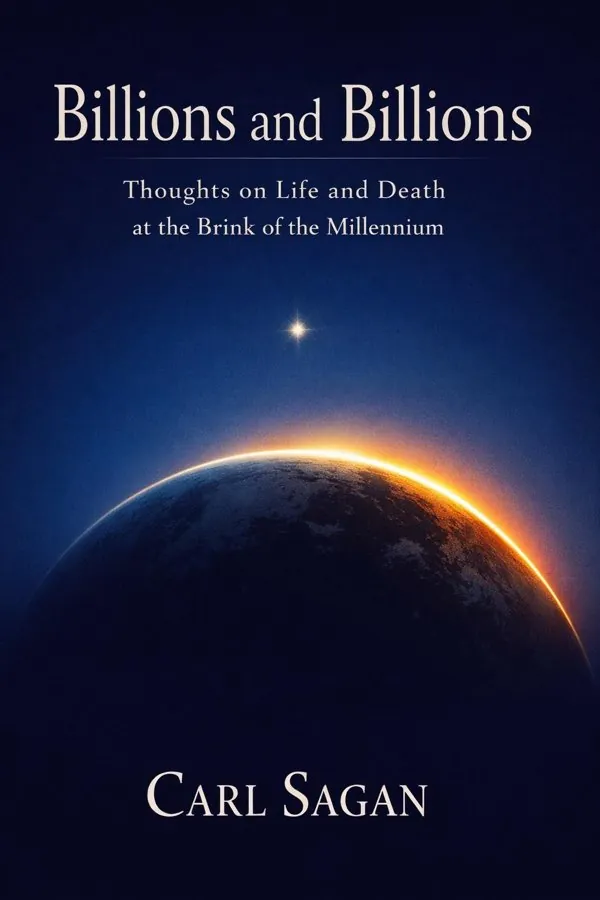
Billions and Billions: Thoughts on Life and Death at the Brink of the Millennium: Summary & Key Insights
by Carl Sagan
 10 min9 chaptersAudio available
Key Takeaways from Billions and Billions: Thoughts on Life and Death at the Brink of the Millennium
The most dangerous problems often grow quietly, one small increase at a time.
Civilizations do not get to negotiate with physics.
If life emerged on Earth, why assume the universe did it only once?
The greatest danger to humanity may be a technology that works exactly as designed.
People do not only suffer from ignorance; they suffer from confidence without evidence.
What Is Billions and Billions: Thoughts on Life and Death at the Brink of the Millennium About?
Billions and Billions: Thoughts on Life and Death at the Brink of the Millennium by Carl Sagan is a popular_sci book spanning 8 pages. Billions and Billions is Carl Sagan’s final collection of essays, written with the clarity, moral seriousness, and cosmic perspective that made him one of the world’s most beloved science communicators. In these pages, Sagan moves effortlessly from the scale of galaxies to the fragility of Earth, from climate change and nuclear war to the search for extraterrestrial life, skepticism, ethics, illness, and mortality. The result is not just a science book, but a meditation on how to live intelligently and responsibly in a dangerous, beautiful universe. What makes this book enduring is its blend of scientific rigor and human feeling. Sagan never treats science as a cold body of facts. For him, science is a way of thinking, a tool for survival, and a source of wonder. He shows how bad reasoning can threaten civilization, while disciplined curiosity can deepen both wisdom and compassion. Writing near the end of his life, Sagan brings unusual urgency to questions about the future of humanity and the meaning of death. Few authors have matched his ability to connect planetary issues, public responsibility, and personal reflection in one lucid, moving work.
This FizzRead summary covers all 9 key chapters of Billions and Billions: Thoughts on Life and Death at the Brink of the Millennium in approximately 10 minutes, distilling the most important ideas, arguments, and takeaways from Carl Sagan's work. Also available as an audio summary and Key Quotes Podcast.
Billions and Billions: Thoughts on Life and Death at the Brink of the Millennium
Billions and Billions is Carl Sagan’s final collection of essays, written with the clarity, moral seriousness, and cosmic perspective that made him one of the world’s most beloved science communicators. In these pages, Sagan moves effortlessly from the scale of galaxies to the fragility of Earth, from climate change and nuclear war to the search for extraterrestrial life, skepticism, ethics, illness, and mortality. The result is not just a science book, but a meditation on how to live intelligently and responsibly in a dangerous, beautiful universe.
What makes this book enduring is its blend of scientific rigor and human feeling. Sagan never treats science as a cold body of facts. For him, science is a way of thinking, a tool for survival, and a source of wonder. He shows how bad reasoning can threaten civilization, while disciplined curiosity can deepen both wisdom and compassion. Writing near the end of his life, Sagan brings unusual urgency to questions about the future of humanity and the meaning of death. Few authors have matched his ability to connect planetary issues, public responsibility, and personal reflection in one lucid, moving work.
Who Should Read Billions and Billions: Thoughts on Life and Death at the Brink of the Millennium?
This book is perfect for anyone interested in popular_sci and looking to gain actionable insights in a short read. Whether you're a student, professional, or lifelong learner, the key ideas from Billions and Billions: Thoughts on Life and Death at the Brink of the Millennium by Carl Sagan will help you think differently.
- ✓Readers who enjoy popular_sci and want practical takeaways
- ✓Professionals looking to apply new ideas to their work and life
- ✓Anyone who wants the core insights of Billions and Billions: Thoughts on Life and Death at the Brink of the Millennium in just 10 minutes
Want the full summary?
Get instant access to this book summary and 100K+ more with Fizz Moment.
Get Free SummaryAvailable on App Store • Free to download
Key Chapters
The most dangerous problems often grow quietly, one small increase at a time. Sagan uses population growth to show how humanity can drift into crisis without dramatic warning signs. A planet may seem vast, but when billions of people require food, water, energy, land, and waste disposal, physical limits begin to matter. What concerns him is not simply the number of people alive, but the multiplying effect of consumption, technology, and inequality. A crowded planet with fragile ecosystems is more vulnerable to famine, conflict, disease, and environmental breakdown.
Sagan’s signature move is to connect numbers to moral imagination. Statistics can feel abstract, but he reminds us that every added strain on forests, oceans, soils, and atmosphere affects real lives. Population growth becomes especially dangerous when combined with poverty, poor education, and political short-termism. The problem is not solved by panic or coercion, but by intelligence and human dignity. Historically, societies that improve women’s education, access to healthcare, reproductive freedom, and child survival rates tend to stabilize population growth more effectively than those that rely on force.
The issue remains practical today. Rapid urbanization, water stress, food insecurity, and migration pressures all show how demographic trends shape the future. Even at the household level, choices about consumption matter: diet, energy use, transportation, and waste all scale upward when repeated across billions of people.
Sagan urges readers to think in planetary terms without losing sight of individual rights. The challenge is to build a civilization that can endure, not merely expand. Actionable takeaway: pay attention to how personal choices and public policies affect long-term sustainability, and support education, healthcare, and evidence-based family planning as humane solutions.
Civilizations do not get to negotiate with physics. Long before climate change became a mainstream political issue, Sagan recognized that altering the atmosphere through greenhouse gases could reshape the conditions that make human life possible. He explains the greenhouse effect in straightforward terms: gases such as carbon dioxide trap heat, and enough additional trapping changes global temperature, weather patterns, sea levels, and ecosystems. His comparisons with Venus and Mars are especially powerful, showing that planetary climates can shift dramatically under the influence of atmospheric chemistry.
What makes Sagan persuasive is his refusal to oversimplify. He does not claim that every detail is settled or every prediction exact. Instead, he stresses how responsible societies make decisions under uncertainty. When the risks are enormous and the mechanisms are scientifically plausible, waiting for perfect certainty becomes reckless. This is one of his most important lessons: uncertainty is not ignorance, and it is not an excuse for inaction.
The practical implications are everywhere. Energy systems, transportation infrastructure, agricultural planning, and urban design all depend on whether leaders take climate science seriously. A city investing in flood control, a farmer adapting crop choices, or a family reducing fossil fuel consumption are all responding to the same underlying reality: Earth’s atmosphere is not an unlimited dumping ground.
Sagan also warns against the politics of denial, where ideology distorts evidence until short-term convenience overwhelms long-term survival. In that sense, climate change is not only an environmental issue but a test of civilization’s maturity.
Actionable takeaway: treat climate science as a guide for prudent action, and support decisions in daily life and public policy that reduce emissions, improve resilience, and respect scientific evidence.
If life emerged on Earth, why assume the universe did it only once? Sagan approaches the search for extraterrestrial life not as fantasy, but as a scientific question rooted in chemistry, astronomy, and probability. The universe contains billions of galaxies, each with billions of stars, and many of those stars likely host planets. Under such conditions, it would be astonishing if Earth were uniquely alive. Yet he is equally careful not to confuse possibility with proof. Wonder must be disciplined by evidence.
This balance is central to Sagan’s method. He invites readers to imagine microbial life on Mars, ocean worlds beneath icy crusts, or intelligent civilizations around distant stars, while insisting that extraordinary claims require extraordinary evidence. The search itself has value even before discovery. It pushes advances in planetary science, robotics, radio astronomy, chemistry, and our understanding of how life begins. It also forces us to reflect on what intelligence is, what civilization means, and whether technological species tend to survive their own power.
The topic becomes practical in surprising ways. Efforts to detect biosignatures on exoplanets, study extreme life on Earth, or monitor radio signals all build tools that improve science more broadly. On a philosophical level, contemplating alien life can reduce human arrogance. National rivalries look smaller when viewed against cosmic timescales.
Sagan also warns against credulity. UFO stories, unsupported sightings, and sensational claims should be examined carefully, not embraced because they are exciting. Scientific openness means being willing to follow the evidence wherever it leads, including toward disappointment.
Actionable takeaway: cultivate cosmic curiosity, but pair it with disciplined skepticism; support science that expands knowledge of life’s origins, planetary habitability, and humanity’s place in the universe.
People do not only suffer from ignorance; they suffer from confidence without evidence. One of Sagan’s lifelong themes is the struggle between science and pseudoscience. In this book, as elsewhere, he argues that science is more than a collection of discoveries. It is a way of testing claims, correcting errors, and resisting self-deception. Pseudoscience offers easy certainty, emotional comfort, and dramatic stories, but it usually avoids the hard work of verification. That makes it attractive, especially in times of fear and confusion.
Sagan is not attacking wonder, spirituality, or imagination. He is defending standards. If a claim about alien visitation, miracle cures, prophecy, or supernatural intervention cannot survive scrutiny, that matters. False beliefs can waste money, distort policy, exploit the vulnerable, and undermine public trust in real expertise. The danger grows when media systems reward attention over accuracy and when citizens stop asking how we know what we think we know.
This idea has countless everyday applications. Evaluating health advice, viral rumors, financial promises, political claims, or sensational headlines all requires the habits Sagan champions: asking for evidence, checking sources, considering alternative explanations, and remaining willing to revise conclusions. Scientific thinking is not reserved for laboratories. It is a civic survival skill.
Importantly, Sagan emphasizes humility. Real science often says, “We do not know yet.” That answer may feel less satisfying than certainty, but it is more honest and often more productive. A mature mind can tolerate ambiguity while still seeking truth.
Actionable takeaway: build a personal habit of skeptical inquiry—ask what the evidence is, whether a claim is testable, and what would count as disproof before accepting confident assertions.
A civilization that thinks only in election cycles may not survive geological and technological realities. Sagan repeatedly returns to the idea that humanity’s future depends on expanding the timescale of its moral concern. Problems like climate change, biodiversity loss, weapons proliferation, and resource depletion develop over decades or centuries, yet political systems often reward immediate advantage. This mismatch creates a dangerous form of collective shortsightedness.
Sagan argues that science helps us think long term because it reveals deep history and possible futures. Evolution shows how long life has struggled to flourish. Astronomy reminds us that worlds can perish. Ecology teaches that complex systems can be damaged in ways that are difficult to reverse. Against that background, human civilization appears both impressive and precarious. We are powerful enough to alter the planet, but not exempt from consequence.
Long-term thinking does not require pessimism. On the contrary, Sagan believes foresight is an expression of hope. Investing in education, public health, sustainable energy, scientific research, and international cooperation are all ways of honoring future generations. The same is true in personal life. Saving resources, supporting institutions that outlast us, and teaching children how to reason are forms of responsibility across time.
He also implies that maturity means learning to care about people we will never meet. Future human beings cannot vote, lobby, or complain in the present, so ethics must speak for them. That is one reason scientific literacy matters: it helps us see delayed consequences before they become irreversible.
Actionable takeaway: make at least one major decision—personal, professional, or political—using a 20- or 50-year horizon, and favor choices that remain beneficial beyond your own immediate interests.
Mortality gives urgency to every question about meaning. In the most intimate essays of the book, Sagan reflects on illness, suffering, love, and the prospect of death. Because these pages were written near the end of his life, they carry a distinct emotional force. Yet he does not abandon reason in the face of mortality. Instead, he shows that scientific understanding and deep feeling can coexist. One need not believe comforting falsehoods to experience awe, gratitude, or tenderness.
Sagan rejects easy sentimentality. He does not pretend death is welcome or painless. What he offers is a more demanding kind of consolation: the recognition that to have lived at all in this ancient universe is extraordinary. Human consciousness, however temporary, is part of the cosmos becoming aware of itself. Love, family, memory, and curiosity matter precisely because life is finite, not despite it.
There is practical wisdom here. In a culture that often avoids serious conversations about death, Sagan models honesty without despair. His reflections encourage readers to appreciate relationships, confront medical realities clearly, and resist exploitative beliefs that prey on fear. He also demonstrates the value of dignity in illness: maintaining intellectual integrity while accepting vulnerability.
These essays remind us that science does not strip life of meaning. It can sharpen meaning by replacing illusion with perspective. To know that we are made of star-born matter, briefly alive on a small world, is not a diminishment. It is a profound invitation to cherish existence.
Actionable takeaway: have one honest conversation about mortality—with yourself, a loved one, or in writing—and let that clarity guide how you spend time, attention, and affection.
The turning of a calendar can expose what a culture fears and hopes. As the millennium approached, Sagan used the symbolic moment not to indulge apocalyptic excitement, but to examine how humans think about progress, destiny, and historical change. Round numbers tempt people into mystical thinking, predictions of doom, or exaggerated claims of renewal. Sagan treats these reactions as clues to deeper needs: our longing for significance, order, and reassurance in an uncertain world.
He reminds readers that dates themselves are human conventions. The universe does not recognize centuries or millennia. Yet the emotions tied to these markers are real, and they can shape politics, religion, markets, and public imagination. This makes millennial thinking worth examining. It reveals how easily societies can confuse symbolism with substance. A new era does not arrive because the digits change; it arrives because people change their institutions, values, and actions.
Sagan’s broader point is ethical. Instead of waiting for history to transform us, we must choose what kind of civilization we want to become. Do we value evidence over superstition, cooperation over tribal hatred, stewardship over exploitation, and humility over arrogance? These are the questions hidden beneath end-of-era excitement.
This insight applies beyond the year 2000. Elections, anniversaries, crises, and technological milestones often generate the same emotional atmosphere. They can become excuses for irrationality or opportunities for reflection. Sagan urges the latter.
Actionable takeaway: when a symbolic moment feels charged with meaning, pause and ask what concrete values and actions would actually justify calling it a new beginning.
Perhaps the deepest lesson in Billions and Billions is that scale should make us humbler, not smaller. Sagan constantly shifts perspective: from cells to civilizations, from Earth to the cosmos, from individual mortality to cosmic time. These vast comparisons are not meant to diminish human worth. They are meant to puncture vanity, ideological certainty, and the illusion that our local conflicts are the center of reality. Humility, in Sagan’s view, is not self-contempt but accuracy.
This perspective has moral consequences. If Earth is a tiny, rare world in an enormous universe, then its living systems deserve protection. If human knowledge is limited, then dogmatism becomes dangerous. If every culture and nation occupies the same fragile planet, then cooperation is not sentimental idealism but practical necessity. Cosmic perspective can enlarge responsibility by making narrow identities less absolute.
Humility also improves thinking. It encourages us to say “I might be wrong,” to revise beliefs, and to learn from evidence rather than defend ego. In science, this attitude drives discovery. In public life, it can soften polarization. In personal life, it can make us more patient, less reactive, and more open to complexity.
Sagan’s achievement is to link grandeur with modesty. The universe is astonishingly vast, and that fact should inspire wonder. But wonder is healthiest when joined to restraint, compassion, and intellectual honesty. We are neither the center of creation nor meaningless accidents. We are responsible participants in a much larger story.
Actionable takeaway: practice one act of intellectual humility this week—revise a view, admit uncertainty, or listen seriously to evidence that challenges your assumptions.
All Chapters in Billions and Billions: Thoughts on Life and Death at the Brink of the Millennium
About the Author
Carl Sagan (1934–1996) was an American astronomer, astrophysicist, author, and master science communicator whose work shaped public understanding of the cosmos. A professor at Cornell University, he contributed to research on planetary atmospheres and played an important role in several NASA missions, including projects exploring Venus, Mars, and the outer planets. Sagan became internationally famous through his television series Cosmos and a series of bestselling books that made complex scientific ideas accessible to millions. He was also a public advocate for nuclear disarmament, environmental responsibility, and critical thinking. His writing combined scientific rigor with poetic wonder, helping readers see both the fragility of Earth and the immensity of the universe. Billions and Billions stands as one of his final and most personal works.
Get This Summary in Your Preferred Format
Read or listen to the Billions and Billions: Thoughts on Life and Death at the Brink of the Millennium summary by Carl Sagan anytime, anywhere. FizzRead offers multiple formats so you can learn on your terms — all free.
Available formats: App · Audio · PDF · EPUB — All included free with FizzRead
Download Billions and Billions: Thoughts on Life and Death at the Brink of the Millennium PDF and EPUB Summary
Key Quotes from Billions and Billions: Thoughts on Life and Death at the Brink of the Millennium
“The most dangerous problems often grow quietly, one small increase at a time.”
“Civilizations do not get to negotiate with physics.”
“If life emerged on Earth, why assume the universe did it only once?”
“The greatest danger to humanity may be a technology that works exactly as designed.”
“People do not only suffer from ignorance; they suffer from confidence without evidence.”
Frequently Asked Questions about Billions and Billions: Thoughts on Life and Death at the Brink of the Millennium
Billions and Billions: Thoughts on Life and Death at the Brink of the Millennium by Carl Sagan is a popular_sci book that explores key ideas across 9 chapters. Billions and Billions is Carl Sagan’s final collection of essays, written with the clarity, moral seriousness, and cosmic perspective that made him one of the world’s most beloved science communicators. In these pages, Sagan moves effortlessly from the scale of galaxies to the fragility of Earth, from climate change and nuclear war to the search for extraterrestrial life, skepticism, ethics, illness, and mortality. The result is not just a science book, but a meditation on how to live intelligently and responsibly in a dangerous, beautiful universe. What makes this book enduring is its blend of scientific rigor and human feeling. Sagan never treats science as a cold body of facts. For him, science is a way of thinking, a tool for survival, and a source of wonder. He shows how bad reasoning can threaten civilization, while disciplined curiosity can deepen both wisdom and compassion. Writing near the end of his life, Sagan brings unusual urgency to questions about the future of humanity and the meaning of death. Few authors have matched his ability to connect planetary issues, public responsibility, and personal reflection in one lucid, moving work.
More by Carl Sagan
You Might Also Like
Structures: Or Why Things Don"t Fall Down
J.E. Gordon
10 min
The Road to Wigan Pier
George Orwell
10 min
Bonk: The Curious Coupling of Science and Sex
Mary Roach
10 min
First Bite: How We Learn to Eat
Bee Wilson
10 min
In Pursuit Of The Unknown: 17 Equations That Changed The World
Ian Stewart
10 min
Napoleon's Buttons: 17 Molecules That Changed History
Penny Le Couteur and Jay Burreson
10 minBrowse by Category
Ready to read Billions and Billions: Thoughts on Life and Death at the Brink of the Millennium?
Get the full summary and 100K+ more books with Fizz Moment.