
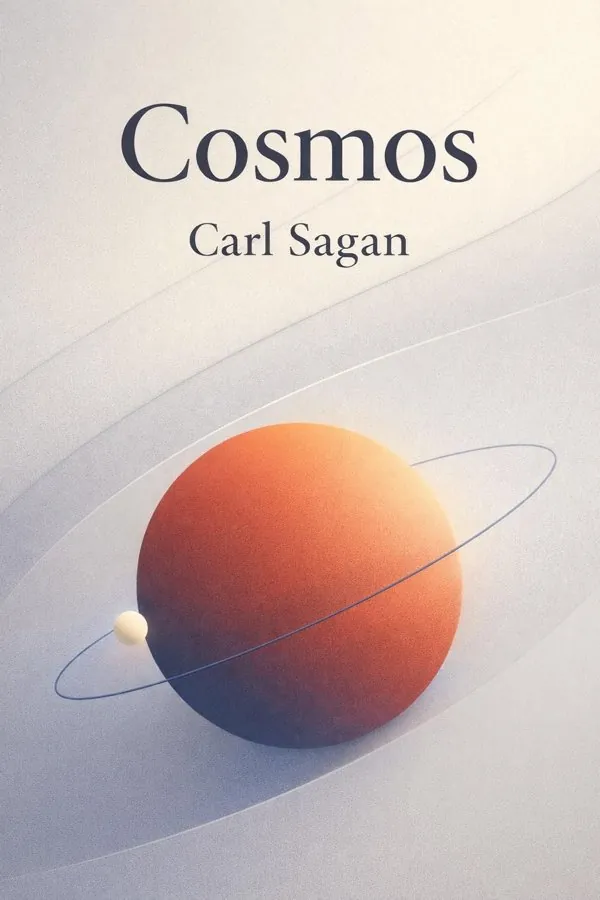
Cosmos: Summary & Key Insights
by Carl Sagan
 10 min9 chaptersAudio available
Key Takeaways from Cosmos
The most humbling truth in science may be that we live on a tiny world adrift in a vast, ancient universe.
One of Sagan’s most beautiful insights is that life is not separate from the universe—it is an expression of it.
Progress begins when we stop assuming that appearances tell the full truth.
Other planets are not merely destinations for curiosity; they are warnings, comparisons, and mirrors.
The more we learn about the universe, the more urgent one question becomes: what kind of civilization are we becoming?
What Is Cosmos About?
Cosmos by Carl Sagan is a popular_sci book spanning 5 pages. Cosmos is Carl Sagan’s invitation to see the universe not as a distant abstraction, but as the grand context for every human question. First published in 1980, the book moves across billions of years and unimaginable distances to explore the birth of stars, the evolution of life, the rise of civilization, and the fragile future of our species. Yet it is never only about astronomy. Sagan uses the story of the universe to ask deeper questions: How do we know what is true? Why does science matter? And what place does humanity occupy in the vast cosmic order? What makes Cosmos enduring is its rare combination of scientific rigor and poetic wonder. Sagan was not only a leading astronomer and planetary scientist, but also one of the greatest science communicators of the modern era. Drawing on his work in planetary exploration and his gift for lucid explanation, he transforms complex ideas into a thrilling human journey. The result is a book that expands the mind, sharpens skepticism, and rekindles awe. Cosmos matters because it teaches us that understanding the universe is also a way of understanding ourselves.
This FizzRead summary covers all 9 key chapters of Cosmos in approximately 10 minutes, distilling the most important ideas, arguments, and takeaways from Carl Sagan's work. Also available as an audio summary and Key Quotes Podcast.
Cosmos
Cosmos is Carl Sagan’s invitation to see the universe not as a distant abstraction, but as the grand context for every human question. First published in 1980, the book moves across billions of years and unimaginable distances to explore the birth of stars, the evolution of life, the rise of civilization, and the fragile future of our species. Yet it is never only about astronomy. Sagan uses the story of the universe to ask deeper questions: How do we know what is true? Why does science matter? And what place does humanity occupy in the vast cosmic order?
What makes Cosmos enduring is its rare combination of scientific rigor and poetic wonder. Sagan was not only a leading astronomer and planetary scientist, but also one of the greatest science communicators of the modern era. Drawing on his work in planetary exploration and his gift for lucid explanation, he transforms complex ideas into a thrilling human journey. The result is a book that expands the mind, sharpens skepticism, and rekindles awe. Cosmos matters because it teaches us that understanding the universe is also a way of understanding ourselves.
Who Should Read Cosmos?
This book is perfect for anyone interested in popular_sci and looking to gain actionable insights in a short read. Whether you're a student, professional, or lifelong learner, the key ideas from Cosmos by Carl Sagan will help you think differently.
- ✓Readers who enjoy popular_sci and want practical takeaways
- ✓Professionals looking to apply new ideas to their work and life
- ✓Anyone who wants the core insights of Cosmos in just 10 minutes
Want the full summary?
Get instant access to this book summary and 100K+ more with Fizz Moment.
Get Free SummaryAvailable on App Store • Free to download
Key Chapters
The most humbling truth in science may be that we live on a tiny world adrift in a vast, ancient universe. Sagan opens Cosmos with the image of the “cosmic ocean,” a metaphor for the immense unknown surrounding human life. We stand on its shore like beginners—curious, vulnerable, and only just learning how to read the tides. This image frames the entire book: science is humanity’s vessel for exploring reality beyond instinct, superstition, and local experience.
Sagan explains that the scale of the cosmos is almost beyond ordinary comprehension. Our planet is one world around one star among hundreds of billions in the Milky Way, which itself is only one galaxy among hundreds of billions more. Yet this realization does not diminish us. Instead, it gives our existence context. Our species is small in size, but immense in possibility because we can ask questions about the whole.
This idea has practical consequences. It shifts everyday concerns into perspective. Career anxiety, political tribalism, and personal vanity look different when seen against cosmic time. The cosmic viewpoint can also encourage humility in public life, reminding us that all human boundaries are local inventions on a shared planet.
In modern terms, this perspective applies whenever we confront global problems such as climate change, war, or misinformation. Thinking cosmically means recognizing that Earth is not an endless resource or a stage for competing egos, but a rare habitat.
Actionable takeaway: When a problem feels overwhelming or your worldview feels narrow, deliberately zoom out. Use the cosmic perspective to cultivate humility, gratitude, and a stronger sense of shared human destiny.
One of Sagan’s most beautiful insights is that life is not separate from the universe—it is an expression of it. The atoms in our bodies were forged in ancient stars, and the processes that govern galaxies also govern chemistry, biology, and consciousness. In this sense, life is the cosmos becoming aware of itself. That claim is poetic, but it is also scientific: evolution links all living things in one continuous story.
Sagan traces how simple molecules, under the right conditions, can organize into greater complexity. Over vast spans of time, life evolves from microscopic beginnings into forests, insects, whales, and eventually reflective minds capable of music, mathematics, and memory. Humanity is therefore not a miraculous interruption of nature, but one of its outcomes.
This perspective encourages respect for biological kinship. It helps us understand why biodiversity matters and why human arrogance toward other forms of life is misguided. The same evolutionary history that gave rise to us also produced coral reefs, birdsong, and microbial ecosystems. In practical life, this can change how we think about environmental stewardship, medicine, and our treatment of animals.
It also offers a powerful antidote to alienation. If you feel disconnected from the world, Sagan reminds you that you are not an outsider looking into nature. You are nature, arranged in a form capable of wonder.
Actionable takeaway: Strengthen your sense of connection by learning one evolutionary fact each week—about your body, another species, or ecosystems. Let that knowledge deepen your respect for life and your responsibility toward it.
Progress begins when we stop assuming that appearances tell the full truth. In this section, Sagan revisits the scientific revolution that overturned humanity’s naive picture of the heavens. For most of history, Earth seemed fixed and central, while the stars and planets revolved around us. It took generations of observers and thinkers—especially Kepler and his predecessors—to show that planets move according to elegant physical laws rather than divine whim or geometric perfection.
Sagan presents this history not simply as a chronology of discoveries, but as a lesson in how knowledge advances. Kepler’s breakthrough came from patience, mathematical honesty, and a willingness to abandon cherished assumptions. He discovered that planets move in ellipses, not circles, because he followed evidence rather than tradition. This moment matters because it marks a shift from authority-based belief to testable understanding.
The lesson remains highly practical. In business, education, medicine, and personal decision-making, we often cling to neat stories that are emotionally satisfying but factually weak. Real understanding usually requires us to revise our models when reality does not cooperate. For example, a company may assume customers behave one way until data reveals the opposite. A person may assume a habit is harmless until health evidence says otherwise.
Sagan’s larger point is that the universe is lawful and intelligible, but only to minds disciplined enough to question themselves. Scientific thinking is not cold certainty; it is informed self-correction.
Actionable takeaway: The next time your expectations conflict with evidence, resist defending your original belief. Ask instead: What would I have to change my mind about if I truly wanted to understand reality?
Other planets are not merely destinations for curiosity; they are warnings, comparisons, and mirrors. Sagan uses worlds such as Venus and Mars to show how planetary science can illuminate Earth’s past and future. Venus, once imagined as a tropical paradise beneath clouds, turned out to be a furnace of extreme heat and pressure, shaped by a runaway greenhouse effect. Mars, by contrast, appears cold, dry, and subdued, yet preserves clues to a more active history.
By comparing planets, Sagan demonstrates that worlds evolve. Atmospheres change, climates shift, and surface conditions can become hospitable or catastrophic depending on chemistry, radiation, geology, and time. This comparative approach is one of the book’s most powerful contributions because it links astronomy to environmental responsibility. Earth is not guaranteed stability simply because it is home.
The relevance today is obvious. Discussions of global warming, ecological fragility, and planetary stewardship are far clearer when we understand that climate is governed by physical processes, not human wishes. Venus is not a prediction of Earth in a simplistic sense, but it is a dramatic example of what happens when atmospheric systems spiral beyond balance.
On an individual level, this chapter also teaches the value of comparison in thought. We often understand our own conditions better by contrasting them with alternatives. In medicine, economics, and public policy, comparative analysis reveals what is unique, fragile, and worth preserving.
Actionable takeaway: Treat Earth as a precious experiment in planetary balance. Support one habit or policy that protects climate stability—whether reducing waste, conserving energy, or backing evidence-based environmental action.
The more we learn about the universe, the more urgent one question becomes: what kind of civilization are we becoming? Sagan asks us to imagine humanity from an external perspective, as if distant observers were judging whether Earth had matured enough to join a larger cosmic community. In that light, our technological brilliance and moral immaturity stand side by side. We can study galaxies, yet still divide ourselves through war, prejudice, and short-term greed.
This chapter expands the cosmic perspective into an ethical one. If Earth is a tiny world in a vast darkness, then nationalism, sectarian hatred, and reckless destruction appear tragically provincial. Sagan does not argue for bland uniformity; he argues for planetary responsibility. We need institutions, values, and habits of thought that reflect our shared vulnerability and common fate.
The idea is practical in many domains. Global health, nuclear risk, climate change, AI governance, and space exploration all require cooperation beyond tribe or nation. Even in local life, “speaking for Earth” means acting as a citizen of a wider human project. It can shape how we teach children, consume media, and respond to conflict.
Sagan also implies that representing Earth requires intellectual integrity. We cannot speak for the planet while rejecting evidence, glorifying ignorance, or allowing propaganda to dominate public life. A civilization worthy of survival must be both compassionate and reality-based.
Actionable takeaway: In one area of your life—politics, work, education, or family discussion—replace a narrow us-versus-them frame with a planetary one. Ask what choice best serves humanity as a whole, not just your immediate group.
Ignorance is not the greatest danger; the greatest danger is certainty without evidence. Throughout Cosmos, Sagan defends science not as a collection of facts, but as a way of thinking that protects us from self-deception. Scientific inquiry asks for proof, welcomes doubt, and remains open to correction. In a world full of myths, ideologies, and persuasive nonsense, this mindset is a form of civilizational defense.
Sagan shows that many false beliefs endure not because they are convincing, but because they are comforting. People prefer stories that flatter human importance, confirm inherited traditions, or promise easy answers. Science often does the opposite. It unsettles. It reveals inconvenient truths. But precisely for that reason, it is trustworthy. Its power lies in methods that work even when our intuitions fail.
This idea applies daily. When reading news, evaluating health claims, or deciding whom to trust, scientific thinking helps us ask better questions: What is the evidence? Can this be tested? Is there another explanation? Have independent observers reached the same result? These habits are increasingly essential in an age of viral misinformation and algorithmic manipulation.
Sagan’s defense of skepticism is not cynical. He does not ask us to reject wonder, but to anchor wonder in reality. The universe is astonishing enough without fantasy.
Actionable takeaway: Adopt one scientific habit in everyday life: before accepting a striking claim, pause and verify it through at least two credible sources. Small acts of skepticism build intellectual resilience.
Human beings struggle to grasp deep time because our lives are too short and our intuitions too local. To solve this, Sagan compresses the history of the universe into a single “cosmic calendar,” with the Big Bang on January 1 and the present moment at the end of December 31. In this scale, stars and galaxies emerge early, Earth forms in September, dinosaurs appear late in December, and all of recorded human history occupies only the final seconds.
This device does more than simplify astronomy. It transforms our emotional relationship to time. We begin to see how recent our species is, how ancient the processes behind us are, and how little of reality is captured by the span of a human lifetime. That realization can produce humility, but also urgency. If civilization is so young, then its continuation is not guaranteed.
Practically, the cosmic calendar helps in any situation where scale matters. It reminds us not to confuse recency with importance or personal memory with history. In leadership, research, and education, long-range thinking often leads to better decisions than immediate gratification. It also helps us appreciate incremental progress. The scientific method, democratic institutions, and cultural achievements may seem slow, but on a longer timeline they are astonishing developments.
Sagan’s underlying lesson is that wisdom requires temporal perspective. To understand who we are, we must situate ourselves within processes vastly larger than ourselves.
Actionable takeaway: When making a major decision, ask not only how it affects next week or next year, but how it fits into a 10-year or 100-year perspective. Long-term thinking is one of the rarest and most valuable human skills.
If the universe is so vast, it is difficult to believe that intelligence emerged only once. Sagan explores the possibility of extraterrestrial life not as science fiction, but as a serious scientific question. The enormous number of stars, planets, and potentially habitable environments makes the existence of other life plausible, perhaps even likely. Yet the silence we observe raises another mystery: if intelligent civilizations exist, where are they?
For Sagan, the search for extraterrestrial intelligence is really a mirror held up to humanity. Whether or not we detect another civilization, the very question forces us to confront what intelligence means, how long civilizations survive, and what signals they leave behind. It also highlights the fragility of technological cultures. A society may develop radio telescopes and spaceflight, but destroy itself before it can travel far or communicate effectively.
This has practical value even if contact never comes. Thinking about alien life encourages interdisciplinary inquiry across astronomy, biology, engineering, and philosophy. It also expands moral imagination. When we consider how we would present ourselves to another species, we are prompted to ask what is best about humanity—and what is embarrassing.
On a personal level, this idea nurtures curiosity and tolerance. A mind prepared to imagine radically different forms of life is often better able to understand human difference as well.
Actionable takeaway: Use cosmic questions to sharpen human self-reflection. Discuss with others what message, image, or value you would send to represent Earth. The answer reveals what you believe humanity should become.
Civilization is not a permanent achievement; it is a delicate chain of memory. Sagan repeatedly reminds readers that knowledge can be lost as well as gained. Libraries burn, cultures collapse, dogma replaces inquiry, and entire worlds of understanding can disappear when societies stop valuing evidence and learning. Scientific progress is therefore not automatic. It depends on institutions, education, freedom of thought, and the difficult work of preserving what has been discovered.
One of the enduring themes of Cosmos is that humans are storytellers, but the stories that endure shape civilization for better or worse. A society that teaches critical thought, historical awareness, and scientific literacy equips itself to solve problems. A society that glorifies ignorance becomes vulnerable to manipulation and decline. Sagan’s reflections on the Library of Alexandria symbolize both humanity’s brilliance and its recurring failures to protect knowledge.
This idea matters today in the age of endless information. Access to data is not the same as wisdom. We need systems that distinguish truth from noise and teachers who cultivate disciplined curiosity. In everyday life, preserving knowledge can be as simple as reading deeply, teaching children how to think, or supporting institutions that defend scholarship and open inquiry.
Sagan’s warning is also hopeful: every generation can renew the chain. We inherit the accumulated labor of minds we never met, and we can pass it on improved.
Actionable takeaway: Become an active steward of knowledge. Read primary sources, support education, and share one scientifically grounded idea each week in a way that helps others think more clearly.
All Chapters in Cosmos
About the Author
Carl Sagan (1934–1996) was an American astronomer, astrophysicist, planetary scientist, and acclaimed science communicator. A professor at Cornell University, he played a major role in advancing public understanding of science while contributing to serious research on planetary atmospheres, the possibility of extraterrestrial life, and the exploration of the solar system. Sagan worked on several NASA-related missions and helped shape humanity’s scientific view of worlds such as Venus and Mars. He became internationally famous through his bestselling books and the television series Cosmos: A Personal Voyage, which brought the wonder of the universe to millions. Admired for his rare ability to combine scientific precision with poetic language, Sagan remains one of the most influential popularizers of science in modern history.
Get This Summary in Your Preferred Format
Read or listen to the Cosmos summary by Carl Sagan anytime, anywhere. FizzRead offers multiple formats so you can learn on your terms — all free.
Available formats: App · Audio · PDF · EPUB — All included free with FizzRead
Download Cosmos PDF and EPUB Summary
Key Quotes from Cosmos
“The most humbling truth in science may be that we live on a tiny world adrift in a vast, ancient universe.”
“One of Sagan’s most beautiful insights is that life is not separate from the universe—it is an expression of it.”
“Progress begins when we stop assuming that appearances tell the full truth.”
“Other planets are not merely destinations for curiosity; they are warnings, comparisons, and mirrors.”
“The more we learn about the universe, the more urgent one question becomes: what kind of civilization are we becoming?”
Frequently Asked Questions about Cosmos
Cosmos by Carl Sagan is a popular_sci book that explores key ideas across 9 chapters. Cosmos is Carl Sagan’s invitation to see the universe not as a distant abstraction, but as the grand context for every human question. First published in 1980, the book moves across billions of years and unimaginable distances to explore the birth of stars, the evolution of life, the rise of civilization, and the fragile future of our species. Yet it is never only about astronomy. Sagan uses the story of the universe to ask deeper questions: How do we know what is true? Why does science matter? And what place does humanity occupy in the vast cosmic order? What makes Cosmos enduring is its rare combination of scientific rigor and poetic wonder. Sagan was not only a leading astronomer and planetary scientist, but also one of the greatest science communicators of the modern era. Drawing on his work in planetary exploration and his gift for lucid explanation, he transforms complex ideas into a thrilling human journey. The result is a book that expands the mind, sharpens skepticism, and rekindles awe. Cosmos matters because it teaches us that understanding the universe is also a way of understanding ourselves.
More by Carl Sagan

You Might Also Like

Structures: Or Why Things Don"t Fall Down
J.E. Gordon
10 min
The Road to Wigan Pier
George Orwell
10 min
Bonk: The Curious Coupling of Science and Sex
Mary Roach
10 min
First Bite: How We Learn to Eat
Bee Wilson
10 min
In Pursuit Of The Unknown: 17 Equations That Changed The World
Ian Stewart
10 min
Napoleon's Buttons: 17 Molecules That Changed History
Penny Le Couteur and Jay Burreson
10 minBrowse by Category
Ready to read Cosmos?
Get the full summary and 100K+ more books with Fizz Moment.