
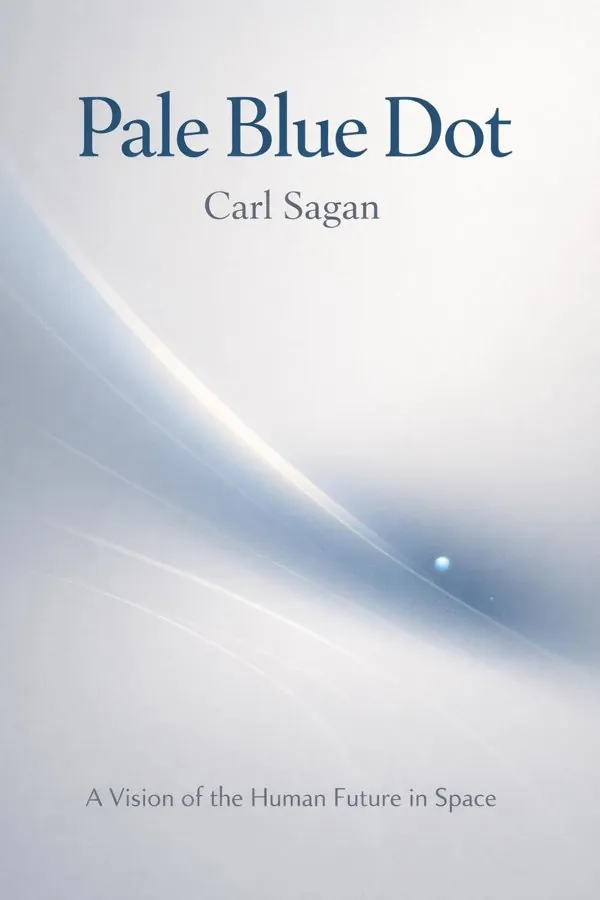
Pale Blue Dot: A Vision of the Human Future in Space: Summary & Key Insights
by Carl Sagan
 10 min9 chaptersAudio available
Key Takeaways from Pale Blue Dot: A Vision of the Human Future in Space
One of humanity’s deepest illusions is the belief that reality was arranged around us.
A powerful truth runs through modern science: we are probably not special in the ways we once imagined.
Exploration changes not only what we know, but what we imagine is possible.
Perhaps the most transformative question in science is also one of the oldest: are we alone?
Civilizations often behave as if the ground beneath them is permanent.
What Is Pale Blue Dot: A Vision of the Human Future in Space About?
Pale Blue Dot: A Vision of the Human Future in Space by Carl Sagan is a popular_sci book spanning 8 pages. What changes when humanity sees Earth not as the center of existence, but as a tiny speck drifting through a vast and indifferent cosmos? In Pale Blue Dot, Carl Sagan uses that question to build one of the most moving and intellectually clarifying arguments in modern popular science. Inspired by the iconic Voyager 1 photograph of Earth taken from billions of kilometers away, Sagan reflects on what the image reveals about our insignificance, our uniqueness, and our responsibility to one another. The book is not just about astronomy. It is about perspective: how science reshapes human self-understanding, challenges arrogance, and invites maturity. Sagan writes with the rare authority of someone who was both a frontline scientist and a master communicator. An astronomer, planetary researcher, and one of the most influential science educators of the twentieth century, he combines evidence, history, philosophy, and moral urgency into a deeply human vision of the future. Pale Blue Dot matters because it asks us to think bigger than national borders, ideological conflicts, and short-term politics. It argues that if humanity is to survive and flourish, we must become wiser stewards of Earth while also daring to explore beyond it.
This FizzRead summary covers all 9 key chapters of Pale Blue Dot: A Vision of the Human Future in Space in approximately 10 minutes, distilling the most important ideas, arguments, and takeaways from Carl Sagan's work. Also available as an audio summary and Key Quotes Podcast.
Pale Blue Dot: A Vision of the Human Future in Space
What changes when humanity sees Earth not as the center of existence, but as a tiny speck drifting through a vast and indifferent cosmos? In Pale Blue Dot, Carl Sagan uses that question to build one of the most moving and intellectually clarifying arguments in modern popular science. Inspired by the iconic Voyager 1 photograph of Earth taken from billions of kilometers away, Sagan reflects on what the image reveals about our insignificance, our uniqueness, and our responsibility to one another. The book is not just about astronomy. It is about perspective: how science reshapes human self-understanding, challenges arrogance, and invites maturity.
Sagan writes with the rare authority of someone who was both a frontline scientist and a master communicator. An astronomer, planetary researcher, and one of the most influential science educators of the twentieth century, he combines evidence, history, philosophy, and moral urgency into a deeply human vision of the future. Pale Blue Dot matters because it asks us to think bigger than national borders, ideological conflicts, and short-term politics. It argues that if humanity is to survive and flourish, we must become wiser stewards of Earth while also daring to explore beyond it.
Who Should Read Pale Blue Dot: A Vision of the Human Future in Space?
This book is perfect for anyone interested in popular_sci and looking to gain actionable insights in a short read. Whether you're a student, professional, or lifelong learner, the key ideas from Pale Blue Dot: A Vision of the Human Future in Space by Carl Sagan will help you think differently.
- ✓Readers who enjoy popular_sci and want practical takeaways
- ✓Professionals looking to apply new ideas to their work and life
- ✓Anyone who wants the core insights of Pale Blue Dot: A Vision of the Human Future in Space in just 10 minutes
Want the full summary?
Get instant access to this book summary and 100K+ more with Fizz Moment.
Get Free SummaryAvailable on App Store • Free to download
Key Chapters
One of humanity’s deepest illusions is the belief that reality was arranged around us. For much of history, people imagined Earth as the fixed center of creation, surrounded by perfect celestial spheres and governed by divine intention. Sagan shows how science steadily dismantled that comforting picture. First Copernicus displaced Earth from the center of the Solar System. Then Kepler, Galileo, Newton, and later modern astronomy revealed that our Sun is one ordinary star among hundreds of billions in one ordinary galaxy among countless others. The universe did not shrink our importance out of cruelty; it expanded our understanding.
Sagan treats this shift not as a blow to human dignity, but as a sign of intellectual growth. The move from an Earth-centered worldview to a cosmos-centered one teaches humility, but also wonder. We are not the center of the universe, yet we are a part of it, capable of studying its age, structure, and laws. That is extraordinary. Scientific progress here is not just technical. It is psychological and ethical. Once we stop assuming that nature exists for us alone, we become more open to evidence, more skeptical of tribal myths, and more respectful of reality.
A practical application of this idea is learning to question inherited assumptions in all areas of life. Just as astronomy asked whether Earth truly sits at the center, we can ask whether our culture, politics, or personal identity deserve automatic centrality. This habit encourages intellectual honesty and tolerance.
Actionable takeaway: regularly step outside your own default viewpoint and ask, “What evidence would I need to know whether my perspective is actually central, or just familiar?”
A powerful truth runs through modern science: we are probably not special in the ways we once imagined. Sagan uses the Copernican principle to explain that our place in the universe is unlikely to be privileged. Earth is not the center, the Sun is not unique, and the Milky Way is not the only meaningful stage for life and intelligence. This principle is not an insult to humanity. It is a discipline against arrogance.
The moral force of the Copernican principle lies in its balance. On one hand, it strips away vanity. It warns us against assuming that our current beliefs, institutions, or species occupy the final or highest position in reality. On the other hand, it deepens our appreciation for what is genuinely rare: conscious life, moral choice, and the fragile conditions that make civilization possible. Sagan’s point is that humility and significance are not opposites. We can be cosmically small and still deeply responsible.
This idea applies far beyond astronomy. In politics, it challenges nationalism by reminding us that borders are human inventions drawn on one tiny world. In religion and ideology, it discourages the certainty that one tribe was uniquely favored by the universe. In everyday life, it softens egotism. Our problems may feel central, but from a wider perspective they are often temporary and manageable.
Sagan also suggests that modesty is scientifically productive. Once we stop assuming that Earth is the only place life could arise, we begin seriously searching for life elsewhere. Once we stop treating our species as the final answer, we become more thoughtful about our future evolution and responsibilities.
Actionable takeaway: when making judgments, test your conclusions against a wider frame. Ask, “Would this still seem absolute if I viewed it from a planetary or cosmic perspective?”
Exploration changes not only what we know, but what we imagine is possible. Sagan devotes significant attention to the Voyager missions because they symbolize a turning point in human history: the moment our machines began to move confidently through the outer Solar System, sending back detailed portraits of worlds once seen only as points of light. Voyager transformed Jupiter, Saturn, Uranus, and Neptune from abstract names into real places with storms, rings, moons, and dynamic geologies.
For Sagan, these missions prove that curiosity, engineering, and patience can radically enlarge civilization’s horizon. Before spacecraft, the outer planets were remote mysteries. After Voyager, they became destinations for thought and future action. We discovered volcanic eruptions on Io, the complex atmosphere of Titan, intricate ring systems, and icy moons that hinted at hidden oceans and chemical potential. Such findings did more than satisfy curiosity. They reshaped planetary science and broadened the search for habitable environments.
Voyager also represents something emotionally important: humanity’s ability to project mind into deep space. A robotic probe is not alive, but it carries our questions, our instruments, and our desire to know. In that sense, exploration is a form of collective self-extension.
In practical terms, the Voyager story argues for sustained investment in long-term projects whose payoff may not be immediate. Scientific missions, public research, and education often seem expensive in the short run, but they generate knowledge, innovation, and inspiration that compound across generations.
Actionable takeaway: support at least one long-horizon effort in your own life or community, whether scientific, educational, or creative. Meaningful exploration often begins with patience before it produces visible results.
Perhaps the most transformative question in science is also one of the oldest: are we alone? Sagan approaches this not as fantasy, but as a rigorous scientific problem. Given the immense number of stars, planets, and possible environments in the universe, it would be remarkably narrow-minded to assume that life emerged only once. Yet Sagan is equally careful not to confuse possibility with proof. The proper response is neither credulous belief nor dismissive skepticism, but disciplined inquiry.
He explores how life might arise under a wide range of conditions and how the chemistry of planets and moons could produce environments favorable to biology. Mars, Europa, Titan, and worlds orbiting distant stars become scientifically meaningful not because we know they host life, but because they expand the menu of places where life might be possible. Sagan’s genius is to make this search feel both intellectually serious and emotionally profound. Finding even microbial life elsewhere would tell us that biology is common in the cosmos. Finding intelligent life would alter philosophy, religion, and human self-understanding forever.
There is a practical lesson here about evidence-based wonder. Many people swing between blind belief in extraterrestrials and total indifference. Sagan models a better path: remain open, ask precise questions, design better tools, and let the data speak. This method applies to medicine, politics, and everyday decision-making just as much as to astrobiology.
The search for life also sharpens our appreciation for Earth. Until proven otherwise, this planet is the only known world that hosts life. That fact alone makes preserving it non-negotiable.
Actionable takeaway: cultivate curiosity without gullibility. When confronting extraordinary claims, stay open-minded but insist on strong evidence.
Civilizations often behave as if the ground beneath them is permanent. Sagan argues that this is a dangerous illusion. Earth is precious, but it is not invulnerable. Asteroid impacts, ecological collapse, nuclear war, engineered pathogens, and long-term astronomical changes all remind us that a single-planet species lives with concentrated risk. For Sagan, space exploration is not escapist fantasy. It is part of a serious strategy for long-term survival.
He does not claim that we should abandon Earth or imagine Mars as an easy substitute. In fact, one of his core points is that no nearby world is remotely as welcoming as our own. But that is precisely why we must think strategically. Developing the ability to detect dangerous asteroids, build resilient technologies, create off-world habitats, and eventually establish self-sustaining communities beyond Earth increases the odds that human culture, knowledge, and life itself can endure.
This argument reframes the common criticism that space programs distract from earthly problems. Sagan’s answer is that mature societies must do both: care for Earth and plan beyond it. Insurance is not pessimism; it is prudence. We buy fire alarms not because we expect disaster tomorrow, but because ignoring low-probability, high-consequence threats is irresponsible.
A practical version of this idea appears in everyday resilience planning. Families save emergency funds. Cities prepare for rare disasters. Organizations back up critical data. The same logic scales to civilization.
Actionable takeaway: think in terms of resilience. Whether for personal life or public policy, identify one major risk you usually ignore and take one concrete step to reduce your dependence on a single point of failure.
Distance can reveal what intimacy hides. The famous pale blue dot image shows Earth as a tiny speck suspended in a sunbeam, barely visible against the blackness of space. Sagan turns that image into one of the most memorable meditations on human vulnerability ever written. Every empire, religion, war, romance, invention, and generation unfolded on that almost invisible point. Seen from far enough away, many of our obsessions begin to look tragically small.
But the lesson is not despair. It is stewardship. The photograph compresses environmental ethics, geopolitics, and moral philosophy into a single visual fact: there is nowhere else, at least for now, where our species can live as it does here. Earth’s atmosphere is thin, its climate delicately balanced, and its biosphere astonishingly complex. Space does not make our planet seem unimportant. It makes it seem irreplaceable.
Sagan connects this perspective to a critique of war, greed, and ecological neglect. If all human suffering and triumph occurs on one fragile world, then reckless destruction becomes harder to justify. National rivalries still matter, but they shrink beside the larger truth of shared dependence.
In daily life, this idea can alter behavior in surprisingly practical ways. It encourages support for environmental policy, climate responsibility, conservation, and education. It can also affect personal choices: reduced waste, more thoughtful consumption, and greater empathy toward people whose lives are tied to the same planetary systems as our own.
Actionable takeaway: choose one habit this week that reflects planetary stewardship, such as reducing energy waste, supporting conservation, or learning more about a local ecological issue.
Humanity’s next great step may not be technological alone, but civilizational. Sagan argues that we are living through a transition in which our powers have become planetary while our loyalties often remain tribal. We can alter the climate, split the atom, transmit information globally, and send spacecraft to other worlds. Yet we still organize ourselves around narrow identities that evolved for a much smaller world. The result is dangerous: species-level power without species-level maturity.
To become a planetary species means developing institutions, ethics, and habits that match the scale of our influence. It means recognizing that pandemics, nuclear risk, atmospheric change, biodiversity loss, and asteroid defense do not respect borders. It also means understanding that science is one of the few truly global languages we possess. The laws of physics apply everywhere. Evidence can be shared across nations. Cooperative research becomes a model for broader cooperation.
Sagan does not imagine a simplistic utopia. Conflict will not vanish. But he insists that if we continue treating global problems as though they were local inconveniences, we will repeatedly fail. A planetary civilization would teach history differently, invest in global monitoring systems, strengthen scientific literacy, and cultivate identity at multiple levels: local, national, and human.
This has immediate relevance. Anyone working across cultures, participating in global markets, or following international crises already lives in a partially planetary reality. The challenge is to make our moral imagination catch up.
Actionable takeaway: expand one part of your identity beyond tribe. Read news from another region, support an international scientific effort, or frame one issue you care about in terms of shared human consequences.
One of Sagan’s recurring concerns is that ignorance becomes especially dangerous when paired with power. Advanced technology in the hands of populations that do not understand science creates fertile ground for superstition, manipulation, and catastrophic mistakes. Pale Blue Dot is therefore also a defense of scientific thinking itself. Science matters not only because it produces rockets and telescopes, but because it trains the mind to distinguish what is true from what is merely comforting.
Sagan values skepticism, but not cynicism. Skepticism asks for evidence and welcomes correction. Cynicism assumes that truth is inaccessible or irrelevant. The first strengthens democracy and inquiry; the second corrodes them. By urging readers to adopt a scientific habit of mind, Sagan is calling for intellectual self-defense against propaganda, pseudoscience, and wishful thinking.
This theme connects directly to public life. Societies must make decisions about health, energy, environment, weapons, and education. If those choices are driven by ideology rather than evidence, the consequences can be enormous. On a personal level, scientific literacy improves how we evaluate headlines, health claims, financial promises, and moral panics.
The deeper point is that wonder and rigor belong together. Sagan refuses the false choice between enchantment and critical thought. The universe is more astonishing when understood accurately, not less.
Actionable takeaway: adopt one scientific habit in everyday life. Before accepting a claim, ask what the evidence is, whether the source is reliable, and what alternative explanations might also fit the facts.
A change in scale can become a change in conscience. Sagan’s most enduring contribution in this book is not a single scientific claim, but a moral sensibility grounded in the cosmic perspective. When we see Earth from afar, many of the stories we tell to justify cruelty begin to weaken. The people we fear, envy, or hate are sharing the same thin atmosphere on the same tiny world. History’s vanities look smaller. Compassion becomes more rational.
This perspective does not solve ethical questions automatically, but it reframes them. Why should we be kind, avoid war, preserve beauty, and invest in future generations? Because all known human possibility exists here, on a lonely speck in a vast dark. The cosmic perspective makes our divisions look contingent and our common fate undeniable. It invites a mature patriotism that loves home without pretending home is the whole universe.
Sagan also links this view to hope. If we are small, then humility is appropriate. But if we are the part of the cosmos that has become conscious of itself, then our choices matter immensely. Meaning is not handed down by centrality. It is created through responsibility, curiosity, and care.
In practical life, this can soften conflict and widen empathy. It may alter how we raise children, vote, consume media, and speak about people outside our group. Cosmic perspective is not escapism; it is moral recalibration.
Actionable takeaway: the next time a conflict feels all-consuming, pause and zoom out. Ask what response would still seem wise, humane, and proportionate if viewed from the scale of one shared planet.
All Chapters in Pale Blue Dot: A Vision of the Human Future in Space
About the Author
Carl Sagan (1934-1996) was an American astronomer, astrophysicist, planetary scientist, and renowned science communicator. He made important contributions to the study of planetary atmospheres, the possibility of extraterrestrial life, and the scientific goals of major space missions. Beyond academic research, Sagan became one of the world’s most recognized public intellectuals through bestselling books such as Cosmos, The Dragons of Eden, and Pale Blue Dot, as well as the landmark television series Cosmos. His gift was the ability to explain complex scientific ideas with clarity, poetic force, and human depth. Sagan believed science was not only a method of discovery but also a source of humility, wonder, and ethical responsibility. His work continues to influence readers, scientists, educators, and anyone interested in humanity’s future in the universe.
Get This Summary in Your Preferred Format
Read or listen to the Pale Blue Dot: A Vision of the Human Future in Space summary by Carl Sagan anytime, anywhere. FizzRead offers multiple formats so you can learn on your terms — all free.
Available formats: App · Audio · PDF · EPUB — All included free with FizzRead
Download Pale Blue Dot: A Vision of the Human Future in Space PDF and EPUB Summary
Key Quotes from Pale Blue Dot: A Vision of the Human Future in Space
“One of humanity’s deepest illusions is the belief that reality was arranged around us.”
“A powerful truth runs through modern science: we are probably not special in the ways we once imagined.”
“Exploration changes not only what we know, but what we imagine is possible.”
“Perhaps the most transformative question in science is also one of the oldest: are we alone?”
“Civilizations often behave as if the ground beneath them is permanent.”
Frequently Asked Questions about Pale Blue Dot: A Vision of the Human Future in Space
Pale Blue Dot: A Vision of the Human Future in Space by Carl Sagan is a popular_sci book that explores key ideas across 9 chapters. What changes when humanity sees Earth not as the center of existence, but as a tiny speck drifting through a vast and indifferent cosmos? In Pale Blue Dot, Carl Sagan uses that question to build one of the most moving and intellectually clarifying arguments in modern popular science. Inspired by the iconic Voyager 1 photograph of Earth taken from billions of kilometers away, Sagan reflects on what the image reveals about our insignificance, our uniqueness, and our responsibility to one another. The book is not just about astronomy. It is about perspective: how science reshapes human self-understanding, challenges arrogance, and invites maturity. Sagan writes with the rare authority of someone who was both a frontline scientist and a master communicator. An astronomer, planetary researcher, and one of the most influential science educators of the twentieth century, he combines evidence, history, philosophy, and moral urgency into a deeply human vision of the future. Pale Blue Dot matters because it asks us to think bigger than national borders, ideological conflicts, and short-term politics. It argues that if humanity is to survive and flourish, we must become wiser stewards of Earth while also daring to explore beyond it.
More by Carl Sagan

You Might Also Like

Structures: Or Why Things Don"t Fall Down
J.E. Gordon
10 min
The Road to Wigan Pier
George Orwell
10 min
Bonk: The Curious Coupling of Science and Sex
Mary Roach
10 min
First Bite: How We Learn to Eat
Bee Wilson
10 min
In Pursuit Of The Unknown: 17 Equations That Changed The World
Ian Stewart
10 min
Napoleon's Buttons: 17 Molecules That Changed History
Penny Le Couteur and Jay Burreson
10 minBrowse by Category
Ready to read Pale Blue Dot: A Vision of the Human Future in Space?
Get the full summary and 100K+ more books with Fizz Moment.