
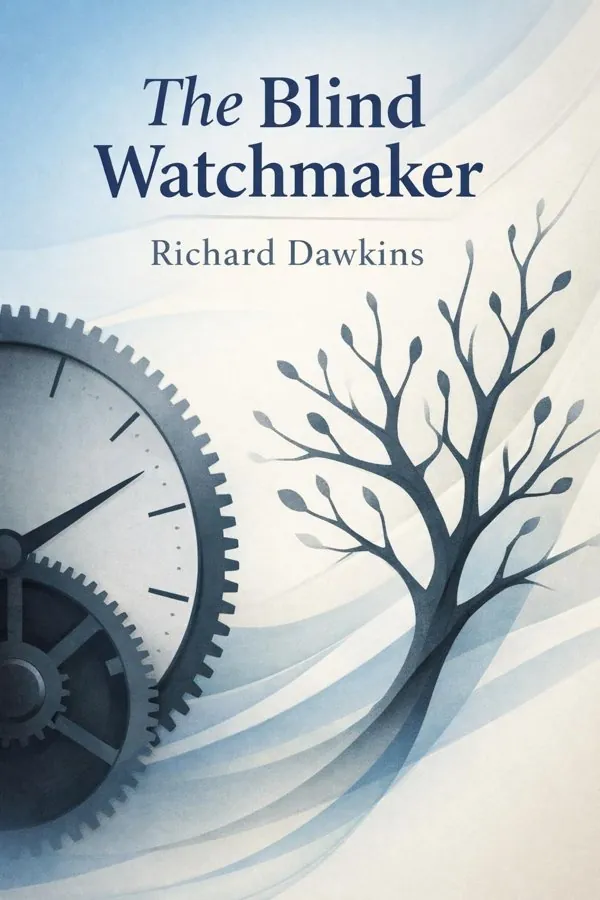
The Blind Watchmaker: Why the Evidence of Evolution Reveals a Universe Without Design: Summary & Key Insights
 10 min9 chaptersAudio available
Key Takeaways from The Blind Watchmaker: Why the Evidence of Evolution Reveals a Universe Without Design
The most deceptive thing about life is how purposeful it seems.
One of the most persistent misunderstandings about evolution is the claim that it says complex life arose by random accident.
Sometimes the best way to understand nature is to build a simplified model of it.
Few organs seem more obviously designed than the eye.
Behind the visible drama of evolution lies an invisible medium of inheritance: DNA.
What Is The Blind Watchmaker: Why the Evidence of Evolution Reveals a Universe Without Design About?
The Blind Watchmaker: Why the Evidence of Evolution Reveals a Universe Without Design by Richard Dawkins is a life_science book spanning 10 pages. Richard Dawkins’s The Blind Watchmaker is one of the clearest and most forceful defenses of evolution by natural selection ever written for a general audience. Taking aim at the old claim that biological complexity must imply an intelligent designer, Dawkins argues that living organisms only look designed. In reality, they are the products of a long, cumulative, undirected process that can build extraordinary complexity without foresight, intention, or planning. The book’s central metaphor—the “blind watchmaker”—captures this idea perfectly: natural selection creates the appearance of design, but it does so blindly. What makes this book matter is not only its scientific argument, but also its ability to correct common misunderstandings about evolution. Dawkins explains why randomness alone cannot account for life, why cumulative selection can, and how features such as eyes, wings, and intricate behaviors can arise step by step. Drawing on biology, probability, genetics, and computer models, he shows how Darwin’s insight remains one of the most powerful explanatory ideas in science. As an evolutionary biologist and acclaimed science communicator, Dawkins writes with authority, clarity, and urgency, making this book a landmark for anyone who wants to understand how complexity emerges in nature.
This FizzRead summary covers all 9 key chapters of The Blind Watchmaker: Why the Evidence of Evolution Reveals a Universe Without Design in approximately 10 minutes, distilling the most important ideas, arguments, and takeaways from Richard Dawkins's work. Also available as an audio summary and Key Quotes Podcast.
The Blind Watchmaker: Why the Evidence of Evolution Reveals a Universe Without Design
Richard Dawkins’s The Blind Watchmaker is one of the clearest and most forceful defenses of evolution by natural selection ever written for a general audience. Taking aim at the old claim that biological complexity must imply an intelligent designer, Dawkins argues that living organisms only look designed. In reality, they are the products of a long, cumulative, undirected process that can build extraordinary complexity without foresight, intention, or planning. The book’s central metaphor—the “blind watchmaker”—captures this idea perfectly: natural selection creates the appearance of design, but it does so blindly.
What makes this book matter is not only its scientific argument, but also its ability to correct common misunderstandings about evolution. Dawkins explains why randomness alone cannot account for life, why cumulative selection can, and how features such as eyes, wings, and intricate behaviors can arise step by step. Drawing on biology, probability, genetics, and computer models, he shows how Darwin’s insight remains one of the most powerful explanatory ideas in science. As an evolutionary biologist and acclaimed science communicator, Dawkins writes with authority, clarity, and urgency, making this book a landmark for anyone who wants to understand how complexity emerges in nature.
Who Should Read The Blind Watchmaker: Why the Evidence of Evolution Reveals a Universe Without Design?
This book is perfect for anyone interested in life_science and looking to gain actionable insights in a short read. Whether you're a student, professional, or lifelong learner, the key ideas from The Blind Watchmaker: Why the Evidence of Evolution Reveals a Universe Without Design by Richard Dawkins will help you think differently.
- ✓Readers who enjoy life_science and want practical takeaways
- ✓Professionals looking to apply new ideas to their work and life
- ✓Anyone who wants the core insights of The Blind Watchmaker: Why the Evidence of Evolution Reveals a Universe Without Design in just 10 minutes
Want the full summary?
Get instant access to this book summary and 100K+ more with Fizz Moment.
Get Free SummaryAvailable on App Store • Free to download
Key Chapters
The most deceptive thing about life is how purposeful it seems. Wings appear made for flying, eyes seem engineered for seeing, and ecosystems often look like carefully balanced systems. This intuition lies behind the classic watchmaker argument, most famously expressed by William Paley: if a watch implies a watchmaker, then surely complex organisms imply a designer. Dawkins takes this appealing analogy seriously, then dismantles it by showing that apparent design does not require conscious design.
His key point is that biology is full of structures that look planned because natural selection preserves what works. Over immense spans of time, tiny improvements accumulate. The result is something that can seem expertly crafted, even though no mind shaped it. Natural selection is not an intelligent agent imagining an outcome and then producing it. It is a filtering process. Variations arise; some happen to survive and reproduce better in a given environment; those variations spread.
A practical example is camouflage. A moth does not decide to become bark-colored. Rather, individuals whose coloring better hides them from predators tend to survive and leave more offspring. Over generations, the population comes to look astonishingly well suited to its surroundings. To a casual observer, this can feel like evidence of intention. Dawkins asks us to resist that feeling and examine the mechanism instead.
This idea matters beyond biology. Human beings are pattern-seekers, and we often infer purpose where there is only process. Understanding the difference helps us think more clearly not just about evolution, but about complexity in general.
Actionable takeaway: When something in nature looks designed, ask not “Who made it?” but “What cumulative process could have produced it?”
One of the most persistent misunderstandings about evolution is the claim that it says complex life arose by random accident. Dawkins shows why this is false and why the confusion persists. Variation contains random elements, but natural selection is decisively non-random. It preserves useful changes and discards harmful ones. That distinction changes everything.
To make the point vivid, Dawkins contrasts pure chance with cumulative selection. If you tried to create a meaningful sentence by randomly arranging letters all at once, the odds would be absurdly low. But if you preserved partial successes and built on them step by step, the task would become manageable. Evolution works in the second way, not the first. Small improvements do not vanish each generation; they are inherited and refined.
This insight explains how elaborate structures can emerge without any grand guiding intelligence. Consider antibiotic resistance in bacteria. Random mutations occur, but when antibiotics are present, mutations that confer resistance are favored. The outcome is not luck in the ordinary sense. It is the cumulative result of variation plus selective retention. The same logic applies across biology, from beak shape in birds to enzyme efficiency in cells.
The practical application of this idea is profound. It helps us understand why evolutionary change can be both undirected and highly effective. It also clarifies why selective pressures matter so much in medicine, agriculture, and conservation. Whenever conditions favor one variant over another, cumulative change follows.
Dawkins’s broader lesson is intellectual discipline: never confuse “not planned” with “purely random.” Many powerful systems generate order through repeated selection.
Actionable takeaway: Replace the phrase “evolution is random” with a more accurate one: “variation is partly random, but selection is cumulative and directional in its effects.”
Sometimes the best way to understand nature is to build a simplified model of it. Dawkins uses computer-generated “biomorphs” to show how strikingly complex forms can arise from simple starting rules and selective choice. These digital shapes are not living organisms, but they serve as a powerful analogy for evolution. Small changes in an underlying set of instructions can produce large differences in visible form, and repeated selection can steer these forms toward surprising complexity.
The important lesson is not that organisms are literally designed on a computer, but that complexity does not require a blueprint drafted in advance. If a limited set of rules can generate rich variation, and if selection can preserve favorable forms, then we should not be shocked that natural processes can create intricate biological structures.
A useful comparison is selective breeding. Dog breeds vary enormously in size, skull shape, coat type, and behavior, yet all descend from wolves. Human breeders did not create these variations from scratch; they amplified naturally occurring differences by selecting certain traits over many generations. Biomorphs dramatize the same principle in compressed form.
This matters because many critics of evolution implicitly assume that complexity must be assembled all at once. Dawkins shows that form can unfold from iterative selection acting on modest variation. In modern science and technology, similar principles appear in machine learning, optimization, and artificial evolution, where repeated filtering of outcomes can yield unexpectedly sophisticated results.
The deeper philosophical point is humbling: our intuition is poorly tuned to gradual emergence. We often underestimate what simple rules, repeated over time, can produce.
Actionable takeaway: When confronted by complexity, look for the underlying rules and selection pressures rather than assuming hidden intention or top-down design.
Few organs seem more obviously designed than the eye. Its precision, coordination, and usefulness have long made it a favorite example for critics of evolution. Dawkins confronts this challenge directly, arguing that the eye is not a problem for Darwinism but one of its strongest showcases. The reason is that an eye does not need to appear fully formed. It can evolve through a long series of improvements, each of which provides a real advantage.
Imagine the simplest light-sensitive patch of cells. Even that offers value: it can help an organism distinguish light from dark. A slight depression in that patch improves directional sensitivity. A deeper cup shape sharpens it further. A narrowing opening works like a primitive pinhole camera. Transparent tissue over the opening can gradually improve protection and refraction, eventually becoming a lens. None of these stages requires foresight. Each only needs to be better than what came before.
Dawkins emphasizes that critics often demand impossible standards, asking evolution to explain the finished eye in one leap. But biology does not work by leaps from nothing to perfection. It works by modification of existing structures. Across living species, we can even observe a wide range of visual systems that resemble plausible intermediate stages.
This chapter has practical significance because it teaches a general scientific habit: break big mysteries into plausible increments. Whether in biology, engineering, or personal learning, progress often occurs through workable transitions, not dramatic jumps. The eye is a reminder that complexity can be assembled from functionality at every stage.
Actionable takeaway: When a biological structure seems too complex to evolve, ask what simpler version might still have been useful and selectable.
Behind the visible drama of evolution lies an invisible medium of inheritance: DNA. Dawkins explains that natural selection can only build complexity if successful traits are reliably passed on, and DNA provides the necessary memory system. It stores information, transmits it across generations, and allows small variations to accumulate over time. Without such a mechanism, evolution would have no way to preserve adaptive gains.
What makes DNA especially important in Dawkins’s account is that it links chance and necessity. Mutations and recombinations introduce variation, but inheritance ensures continuity. Natural selection can then act on those inherited differences. In effect, DNA makes cumulative selection possible by preventing evolution from starting over in every generation.
A practical example is lactase persistence in some human populations. In societies with a long history of dairy farming, genetic variants that allow adults to digest lactose became advantageous and spread. DNA records that adaptation, connecting environmental conditions, reproductive success, and inherited biological change. Similar logic applies to disease susceptibility, crop breeding, and the evolution of pathogens.
Dawkins also highlights how genes are not magical instruction manuals for fixed destiny. Their effects depend on developmental processes and environmental contexts. Still, they are the units through which inheritance becomes stable enough for selection to shape life’s complexity.
Understanding DNA deepens our grasp of evolution and also grounds modern fields such as genomics, medicine, ancestry research, and biotechnology. It reveals that life is both historical and dynamic: every organism carries a molecular archive of past selection while remaining open to future change.
Actionable takeaway: Think of DNA as evolution’s memory—an information system that lets useful changes persist long enough for complexity to emerge.
Nature is not a static museum of finished designs. It is a restless field of competition, adaptation, and counter-adaptation. Dawkins emphasizes evolutionary arms races to show that many traits make sense only when seen in relation to other evolving organisms. Predators improve; prey respond. Parasites become more effective; hosts develop defenses. Mates become choosier; display traits become more elaborate. Complexity often arises because evolution is relational, not solitary.
This dynamic helps explain why organisms can appear extravagantly well equipped. A gazelle’s speed is impressive on its own, but its deeper meaning appears when paired with the hunting abilities of predators. Likewise, toxic newts and resistant snakes, flowering plants and pollinators, or immune systems and viruses all illustrate cycles in which one adaptation changes the selective landscape for another.
The practical importance of this idea is immense. In public health, understanding arms races clarifies why overusing antibiotics can intensify selection for resistant microbes. In agriculture, pests can evolve around pesticides, forcing repeated innovation. In conservation, introducing or removing a species can ripple through coevolved relationships in unexpected ways.
Dawkins uses these examples to undermine simplistic notions of perfect design. Many traits are not signs of ideal planning but of contingent struggle. Evolution produces local solutions under pressure, often at great cost. A trait may be “good enough” for present competition rather than globally optimal.
This chapter broadens Darwinism from a story of isolated adaptation to a story of ongoing interaction. Life evolves within webs of response, and understanding those webs explains much of nature’s drama.
Actionable takeaway: When analyzing any adaptation, ask what opposing force—predator, parasite, rival, or environment—may have helped shape it.
A common objection to Darwinism asks: even if natural selection explains life’s diversity, how did life begin in the first place? Dawkins makes an essential distinction here. The origin of life and the evolution of life are related but separate questions. Natural selection requires self-replicating entities capable of variation and inheritance. It does not, by itself, explain how the first such entities arose. But acknowledging that gap does not weaken the explanatory power of evolution once replication exists.
Dawkins warns against using our current uncertainty about life’s beginnings as an excuse to reintroduce design. A mystery is not evidence for a designer. The scientific task is to explore plausible chemical pathways by which replicators could emerge from nonliving matter. This is difficult, but difficulty is not impossibility.
The practical value of this distinction is intellectual honesty. Science advances by separating questions rather than collapsing them into one. We can investigate prebiotic chemistry, self-organizing molecules, and early replicators without confusing those issues with the later branching and adaptation of living forms. In fact, modern research into RNA-world hypotheses, autocatalytic systems, and planetary chemistry follows exactly this strategy.
Dawkins’s point also offers a broader lesson in reasoning. When an explanation does not cover everything, that is not a reason to reject what it does explain well. Evolution by natural selection remains the best account of biological complexity after life begins, even if the earliest steps toward life are still under investigation.
Actionable takeaway: Keep separate the question “How did replication first arise?” from “How did complex organisms evolve after replication began?”
Perhaps the most important correction Dawkins offers is that evolution is blind. Natural selection does not plan ahead, aim for perfection, or move toward a predetermined goal. It works only with what exists now, favoring traits that improve reproductive success in current conditions. This blindness is central to understanding both the power and the limitations of evolution.
The phrase “blind watchmaker” captures a paradox: the process produces structures that look artfully designed, yet it has no vision of future outcomes. This explains why evolution often yields awkward compromises rather than elegant engineering. The recurrent laryngeal nerve in giraffes, for example, takes a famously inefficient route because it evolved by modifying inherited anatomy rather than redesigning from scratch. Such quirks are exactly what we would expect from blind tinkering.
This idea helps us resist teleological thinking—the tendency to speak as though species evolve because they “need” something or because nature “wants” progress. In reality, lineages change only when heritable variations affect survival and reproduction. Many species remain relatively stable for long periods not because they have reached some cosmic endpoint, but because current selection pressures do not strongly favor change.
The practical application is significant in fields that deal with evolving systems. In viruses, tumors, and ecological populations, change occurs opportunistically, not strategically. Predicting outcomes requires understanding immediate selective pressures, not imagined long-term intentions.
Dawkins’s larger lesson is philosophical as well as biological: powerful order can emerge without purpose. Accepting that fact reshapes how we interpret nature and ourselves.
Actionable takeaway: Avoid language that gives evolution intentions; instead, describe which variations were favored under which conditions.
Human intuition is poorly suited to the timescales, probabilities, and cumulative processes that govern evolution. Dawkins argues that much resistance to Darwinism comes not from evidence but from mental habits. We are drawn to stories with agents, goals, and sudden transformations. Evolution offers none of these. It is gradual, statistical, and impersonal, which makes it harder to grasp and easier to distort.
One common misunderstanding is the belief that evolution is “just a theory,” using theory in the everyday sense of a guess. In science, a theory is a well-supported explanatory framework. Another is the assumption that if humans evolved from earlier primates, modern apes should have disappeared. Dawkins clarifies that evolution branches; one lineage can give rise to multiple descendants. Yet another confusion is equating complexity with superiority, as if evolution were a ladder rather than a branching tree.
These misunderstandings matter because poor reasoning has practical consequences. Misreading evolution can distort science education, public health decisions, and debates about biotechnology or environmental policy. More broadly, it can encourage people to dismiss one of science’s most powerful explanatory tools because it clashes with intuition.
Dawkins’s method is to replace intuition with disciplined imagination. He uses analogies, numerical reasoning, and vivid examples to help readers think on evolutionary terms. The result is not merely acceptance of a scientific theory, but training in a more rigorous way of understanding evidence.
Actionable takeaway: Whenever evolution feels implausible, examine whether the problem lies in the evidence—or in the limits of everyday intuition about time, chance, and gradual change.
All Chapters in The Blind Watchmaker: Why the Evidence of Evolution Reveals a Universe Without Design
About the Author
Richard Dawkins is a British evolutionary biologist, ethologist, and bestselling author known for his influential work in explaining evolution to general readers. Educated at Oxford, where he studied under Nobel laureate Nikolaas Tinbergen, Dawkins later became a fellow of New College, Oxford, and built a distinguished academic career in animal behavior and evolutionary theory. He rose to international prominence with The Selfish Gene, which popularized a gene-centered view of natural selection. His later books, including The Blind Watchmaker, helped establish him as one of the most prominent science communicators of his generation. Dawkins is also well known for his outspoken defense of scientific reasoning, secularism, and atheism. His writing combines conceptual rigor, vivid analogy, and a talent for making complex biological ideas accessible to broad audiences.
Get This Summary in Your Preferred Format
Read or listen to the The Blind Watchmaker: Why the Evidence of Evolution Reveals a Universe Without Design summary by Richard Dawkins anytime, anywhere. FizzRead offers multiple formats so you can learn on your terms — all free.
Available formats: App · Audio · PDF · EPUB — All included free with FizzRead
Download The Blind Watchmaker: Why the Evidence of Evolution Reveals a Universe Without Design PDF and EPUB Summary
Key Quotes from The Blind Watchmaker: Why the Evidence of Evolution Reveals a Universe Without Design
“The most deceptive thing about life is how purposeful it seems.”
“One of the most persistent misunderstandings about evolution is the claim that it says complex life arose by random accident.”
“Sometimes the best way to understand nature is to build a simplified model of it.”
“Few organs seem more obviously designed than the eye.”
“Behind the visible drama of evolution lies an invisible medium of inheritance: DNA.”
Frequently Asked Questions about The Blind Watchmaker: Why the Evidence of Evolution Reveals a Universe Without Design
The Blind Watchmaker: Why the Evidence of Evolution Reveals a Universe Without Design by Richard Dawkins is a life_science book that explores key ideas across 9 chapters. Richard Dawkins’s The Blind Watchmaker is one of the clearest and most forceful defenses of evolution by natural selection ever written for a general audience. Taking aim at the old claim that biological complexity must imply an intelligent designer, Dawkins argues that living organisms only look designed. In reality, they are the products of a long, cumulative, undirected process that can build extraordinary complexity without foresight, intention, or planning. The book’s central metaphor—the “blind watchmaker”—captures this idea perfectly: natural selection creates the appearance of design, but it does so blindly. What makes this book matter is not only its scientific argument, but also its ability to correct common misunderstandings about evolution. Dawkins explains why randomness alone cannot account for life, why cumulative selection can, and how features such as eyes, wings, and intricate behaviors can arise step by step. Drawing on biology, probability, genetics, and computer models, he shows how Darwin’s insight remains one of the most powerful explanatory ideas in science. As an evolutionary biologist and acclaimed science communicator, Dawkins writes with authority, clarity, and urgency, making this book a landmark for anyone who wants to understand how complexity emerges in nature.
Compare The Blind Watchmaker: Why the Evidence of Evolution Reveals a Universe Without Design
More by Richard Dawkins
You Might Also Like
The Selfish Gene
Richard Dawkins
10 min
Awakenings
Oliver Sacks
10 min
Parasite Rex: Inside the Bizarre World of Nature's Most Dangerous Creatures
Carl Zimmer
10 min
The Atlas of Life on Earth
Various
10 min
The Book of Humans: The Story of How We Became Us
Adam Rutherford
10 min
The Horse
Wendy Williams
10 minBrowse by Category
Ready to read The Blind Watchmaker: Why the Evidence of Evolution Reveals a Universe Without Design?
Get the full summary and 100K+ more books with Fizz Moment.