
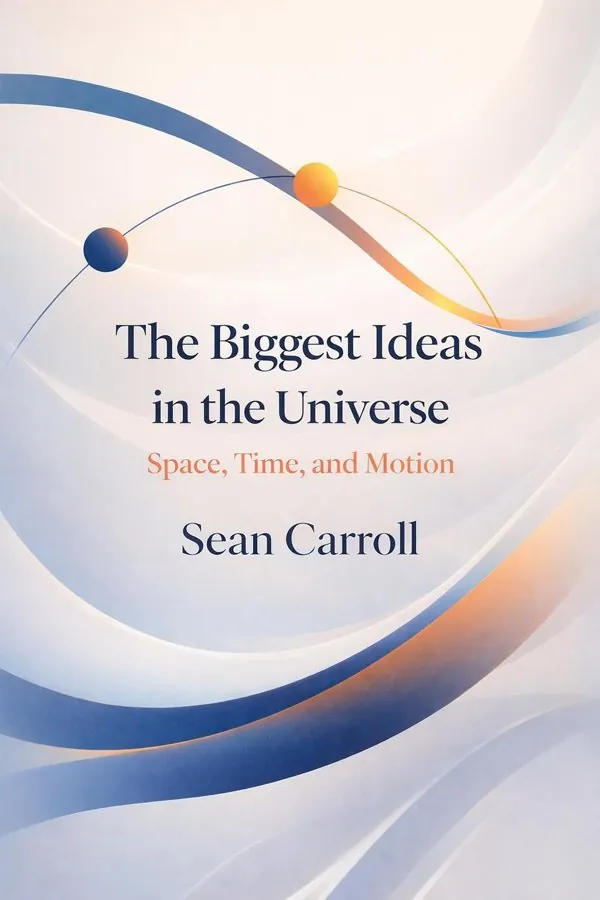
The Biggest Ideas in the Universe: Space, Time, and Motion: Summary & Key Insights
by Sean Carroll
 10 min11 chaptersAudio available
What Is The Biggest Ideas in the Universe: Space, Time, and Motion About?
The Biggest Ideas in the Universe: Space, Time, and Motion by Sean Carroll is a space_physics book spanning 11 pages. In this book, theoretical physicist Sean Carroll explains the fundamental principles of physics in clear, accessible language. He explores the biggest ideas that shape our understanding of the universe—space, time, motion, and the laws that govern them—bridging the gap between complex mathematical concepts and intuitive human understanding. Carroll’s approach invites readers to grasp the beauty and coherence of modern physics without requiring advanced technical background.
This FizzRead summary covers all 11 key chapters of The Biggest Ideas in the Universe: Space, Time, and Motion in approximately 10 minutes, distilling the most important ideas, arguments, and takeaways from Sean Carroll's work. Also available as an audio summary and Key Quotes Podcast.
The Biggest Ideas in the Universe: Space, Time, and Motion
In this book, theoretical physicist Sean Carroll explains the fundamental principles of physics in clear, accessible language. He explores the biggest ideas that shape our understanding of the universe—space, time, motion, and the laws that govern them—bridging the gap between complex mathematical concepts and intuitive human understanding. Carroll’s approach invites readers to grasp the beauty and coherence of modern physics without requiring advanced technical background.
Who Should Read The Biggest Ideas in the Universe: Space, Time, and Motion?
This book is perfect for anyone interested in space_physics and looking to gain actionable insights in a short read. Whether you're a student, professional, or lifelong learner, the key ideas from The Biggest Ideas in the Universe: Space, Time, and Motion by Sean Carroll will help you think differently.
- ✓Readers who enjoy space_physics and want practical takeaways
- ✓Professionals looking to apply new ideas to their work and life
- ✓Anyone who wants the core insights of The Biggest Ideas in the Universe: Space, Time, and Motion in just 10 minutes
Want the full summary?
Get instant access to this book summary and 100K+ more with Fizz Moment.
Get Free SummaryAvailable on App Store • Free to download
Key Chapters
We begin with the fundamental instrument through which we measure reality: numbers. Physics demands precision, and numbers give us that power. But they also bring subtlety — they tell us not only how much of something there is but what kind of something it is. Units and dimensions, so easily glossed over, form the scaffolding of understanding. When we say length, time, mass, or charge, we are specifying different ways of interacting with the universe.
Numbers alone are meaningless without context. The speed of light, for instance, isn’t just a large number — it’s the conversion rate between space and time itself. A unit change in distance corresponds to a unit change in duration; that’s what makes light so central to both relativity and quantum theory. The trick is to think dimensionally — every quantity has a kind, and mixing kinds carelessly is what blinds us. Physicists, therefore, think not in bare numbers but in dimensional relationships. That’s why Newton had to invent consistent units before mechanics could advance.
Understanding quantities also means realizing that mathematics describes relationships, not objects. The measurement of temperature is not the heat itself, but the quantified relationship between molecules’ motion and our sensory apparatus. In this awareness lies the beginning of scientific humility — realizing that quantification is our way of approaching truth, not replacing it. Every number is a lens, shaped by how we perceive reality, and by dissecting that lens, we make our perception clearer.
The moment we introduce change, we invite calculus into our world. Calculus, far from being an abstract invention, is a way of capturing the essence of motion — the precise description of how quantities vary. When Newton and Leibniz developed it, their intention wasn’t to complicate life but to express an obvious truth: that the world never stands still.
A derivative measures how a quantity responds — how position depends on time, how velocity transforms into acceleration. It’s the grammar of motion: the derivative answers 'how fast,' the integral responds 'how much.' To understand change mathematically is to hold the power to predict, because the future is always inscribed in the current rate of transformation.
I show readers that calculus is less about memorizing formulas and more about intuiting behavior. When you look at a graph of velocity, its slope tells you acceleration; when you integrate that acceleration, you retrieve the journey’s velocity. The conceptual leap lies in recognizing that infinitesimal quantities — so small that they seem to vanish — contain vast knowledge when properly arranged. Through calculus, you begin to see the continuity of nature, the smoothness in what might seem chaotic.
+ 9 more chapters — available in the FizzRead app
All Chapters in The Biggest Ideas in the Universe: Space, Time, and Motion
About the Author
Sean Carroll is an American theoretical physicist and cosmologist known for his work on quantum mechanics, gravity, and the philosophy of science. He is a research professor at Johns Hopkins University and has written several popular science books that make complex scientific ideas accessible to general audiences.
Get This Summary in Your Preferred Format
Read or listen to the The Biggest Ideas in the Universe: Space, Time, and Motion summary by Sean Carroll anytime, anywhere. FizzRead offers multiple formats so you can learn on your terms — all free.
Available formats: App · Audio · PDF · EPUB — All included free with FizzRead
Download The Biggest Ideas in the Universe: Space, Time, and Motion PDF and EPUB Summary
Key Quotes from The Biggest Ideas in the Universe: Space, Time, and Motion
“We begin with the fundamental instrument through which we measure reality: numbers.”
“The moment we introduce change, we invite calculus into our world.”
Frequently Asked Questions about The Biggest Ideas in the Universe: Space, Time, and Motion
The Biggest Ideas in the Universe: Space, Time, and Motion by Sean Carroll is a space_physics book that explores key ideas across 11 chapters. In this book, theoretical physicist Sean Carroll explains the fundamental principles of physics in clear, accessible language. He explores the biggest ideas that shape our understanding of the universe—space, time, motion, and the laws that govern them—bridging the gap between complex mathematical concepts and intuitive human understanding. Carroll’s approach invites readers to grasp the beauty and coherence of modern physics without requiring advanced technical background.
More by Sean Carroll
The Particle at the End of the Universe: How the Hunt for the Higgs Boson Leads Us to the Edge of a New World
Sean Carroll
10 min
From Eternity to Here: The Quest for the Ultimate Theory of Time
Sean Carroll
10 min
The Big Picture: On the Origins of Life, Meaning, and the Universe Itself
Sean Carroll
10 minYou Might Also Like
The Means Of Prediction
Mark P. Silverman
10 min
AstroTech
Various Authors
10 min
Black Holes and Time Warps: Einstein’s Outrageous Legacy
Kip S. Thorne
10 min
Dark Matter and the Dinosaurs: The Astounding Interconnectedness of the Universe
Lisa Randall
10 min
Helgoland
Carlo Rovelli
10 min
Hyperspace: A Scientific Odyssey Through Parallel Universes, Time Warps, and the 10th Dimension
Michio Kaku
10 minBrowse by Category
Ready to read The Biggest Ideas in the Universe: Space, Time, and Motion?
Get the full summary and 100K+ more books with Fizz Moment.