
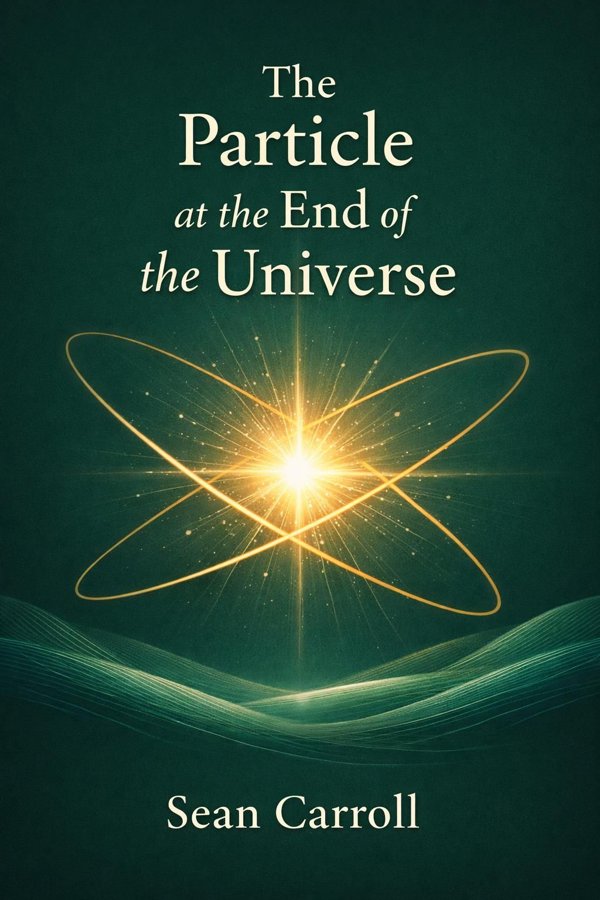
The Particle at the End of the Universe: How the Hunt for the Higgs Boson Leads Us to the Edge of a New World: Summary & Key Insights
by Sean Carroll
 10 min4 chaptersAudio available
What Is The Particle at the End of the Universe: How the Hunt for the Higgs Boson Leads Us to the Edge of a New World About?
The Particle at the End of the Universe: How the Hunt for the Higgs Boson Leads Us to the Edge of a New World by Sean Carroll is a popular_sci book spanning 4 pages. This book explores the discovery of the Higgs boson at CERN’s Large Hadron Collider and its profound implications for our understanding of the universe. Sean Carroll narrates the scientific journey, the people behind the experiments, and the significance of the Higgs field in shaping the cosmos.
This FizzRead summary covers all 4 key chapters of The Particle at the End of the Universe: How the Hunt for the Higgs Boson Leads Us to the Edge of a New World in approximately 10 minutes, distilling the most important ideas, arguments, and takeaways from Sean Carroll's work. Also available as an audio summary and Key Quotes Podcast.
The Particle at the End of the Universe: How the Hunt for the Higgs Boson Leads Us to the Edge of a New World
This book explores the discovery of the Higgs boson at CERN’s Large Hadron Collider and its profound implications for our understanding of the universe. Sean Carroll narrates the scientific journey, the people behind the experiments, and the significance of the Higgs field in shaping the cosmos.
Who Should Read The Particle at the End of the Universe: How the Hunt for the Higgs Boson Leads Us to the Edge of a New World?
This book is perfect for anyone interested in popular_sci and looking to gain actionable insights in a short read. Whether you're a student, professional, or lifelong learner, the key ideas from The Particle at the End of the Universe: How the Hunt for the Higgs Boson Leads Us to the Edge of a New World by Sean Carroll will help you think differently.
- ✓Readers who enjoy popular_sci and want practical takeaways
- ✓Professionals looking to apply new ideas to their work and life
- ✓Anyone who wants the core insights of The Particle at the End of the Universe: How the Hunt for the Higgs Boson Leads Us to the Edge of a New World in just 10 minutes
Want the full summary?
Get instant access to this book summary and 100K+ more with Fizz Moment.
Get Free SummaryAvailable on App Store • Free to download
Key Chapters
When we describe the universe through the lens of modern physics, we speak in terms of the Standard Model—a framework that elegantly catalogs all known fundamental particles and their interactions. It’s a remarkable creation of human thought, but for decades, it was incomplete. The equations behaved beautifully on paper until we tried to ask one simple question: why do particles have mass?
Electrons, quarks, W and Z bosons—each carries mass, and this property affects everything from atoms to stars. But if you wrote out the Standard Model equations without the Higgs mechanism, they implied that all particles should move at the speed of light, massless and ghostlike. The world we see would simply not exist.
The Higgs field solved this mystery through the phenomenon known as spontaneous symmetry breaking. Picture the universe as a smooth landscape of perfect symmetry—a calm field that, under certain conditions, chooses a direction and breaks that symmetry. This break gives mass to particles as they interact with the Higgs field, like swimmers moving through a dense medium. Some are slowed more than others; that resistance, that interaction, we interpret as mass.
In the book, I emphasize how this idea wasn’t born in isolation. It emerged in the fertile ground of the 1960s, when theorists like Peter Higgs, Robert Brout, François Englert, and others wrestled with the contradictions within quantum field theory. They realized that mass wasn’t something built into particles—it arose dynamically from a pervasive field filling all space. The genius of this insight is that it preserves the mathematical beauty of the Standard Model while explaining physical reality.
To grasp why this matters, imagine a universe without the Higgs field. Atomic nuclei would never form; chemistry would be impossible; stars and planets would vanish. The universe would be filled with pure energy, devoid of structure, meaning, and life. The Higgs field is therefore the quiet architect of existence, a hidden stage upon which every physical phenomenon plays out. Understanding it means understanding why ‘something’ takes shape from the raw potential of the cosmos.
Converting the elegant equations of the Higgs mechanism into tangible evidence required something unprecedented—a machine of extraordinary scale and precision. The Large Hadron Collider, built by CERN near Geneva, represents humanity’s most ambitious scientific instrument. Its tunnels span 17 miles, its magnets operate at temperatures colder than outer space, and its detectors sift through unimaginable torrents of data every second.
In this part of the book, I recount the breathtaking effort that went into building the LHC. The project mobilized thousands of engineers, physicists, and technicians across continents, bound by a singular purpose: to recreate, for the tiniest instant, the conditions just after the Big Bang. By smashing protons together at energies higher than any previous accelerator, the team could hope to coax Higgs bosons into fleeting existence.
I describe the engineering marvel in human terms—the long nights designing superconducting magnets, the challenge of cooling massive structures with liquid helium, the synchronization of global computing networks to store and analyze collision data. Each of these achievements reflects not only technical mastery but philosophical dedication to uncovering nature’s secrets.
Yet the LHC wasn’t merely a machine; it was a symbol of global cooperation. The Atlas and CMS detectors housed within it functioned as colossal eyes peering into microscopic realms. Teams across the world calibrated sensors, refined algorithms, and verified every anomaly with painstaking care. Rutherford’s early collisions had taken place in tabletop devices—here, we were orchestrating proton beams moving at 99.999999% the speed of light.
The purpose was beautifully simple: to test whether the Higgs boson, predicted half a century earlier, actually existed. But the journey proved that science at its highest level isn’t about one discovery—it’s about the process of collective belief, persistence, and wonder. It’s about building machines that turn imagination into measurable truth.
+ 2 more chapters — available in the FizzRead app
All Chapters in The Particle at the End of the Universe: How the Hunt for the Higgs Boson Leads Us to the Edge of a New World
About the Author
Sean Carroll is a theoretical physicist and research professor at the California Institute of Technology. He is known for his work in cosmology, field theory, and the philosophy of science, as well as for his popular science writing and public lectures.
Get This Summary in Your Preferred Format
Read or listen to the The Particle at the End of the Universe: How the Hunt for the Higgs Boson Leads Us to the Edge of a New World summary by Sean Carroll anytime, anywhere. FizzRead offers multiple formats so you can learn on your terms — all free.
Available formats: App · Audio · PDF · EPUB — All included free with FizzRead
Download The Particle at the End of the Universe: How the Hunt for the Higgs Boson Leads Us to the Edge of a New World PDF and EPUB Summary
Key Quotes from The Particle at the End of the Universe: How the Hunt for the Higgs Boson Leads Us to the Edge of a New World
“When we describe the universe through the lens of modern physics, we speak in terms of the Standard Model—a framework that elegantly catalogs all known fundamental particles and their interactions.”
“Converting the elegant equations of the Higgs mechanism into tangible evidence required something unprecedented—a machine of extraordinary scale and precision.”
Frequently Asked Questions about The Particle at the End of the Universe: How the Hunt for the Higgs Boson Leads Us to the Edge of a New World
The Particle at the End of the Universe: How the Hunt for the Higgs Boson Leads Us to the Edge of a New World by Sean Carroll is a popular_sci book that explores key ideas across 4 chapters. This book explores the discovery of the Higgs boson at CERN’s Large Hadron Collider and its profound implications for our understanding of the universe. Sean Carroll narrates the scientific journey, the people behind the experiments, and the significance of the Higgs field in shaping the cosmos.
More by Sean Carroll
You Might Also Like

Structures: Or Why Things Don"t Fall Down
J.E. Gordon
10 min
The Road to Wigan Pier
George Orwell
10 min
Bonk: The Curious Coupling of Science and Sex
Mary Roach
10 min
First Bite: How We Learn to Eat
Bee Wilson
10 min
In Pursuit Of The Unknown: 17 Equations That Changed The World
Ian Stewart
10 min
Napoleon's Buttons: 17 Molecules That Changed History
Penny Le Couteur and Jay Burreson
10 minBrowse by Category
Ready to read The Particle at the End of the Universe: How the Hunt for the Higgs Boson Leads Us to the Edge of a New World?
Get the full summary and 100K+ more books with Fizz Moment.