
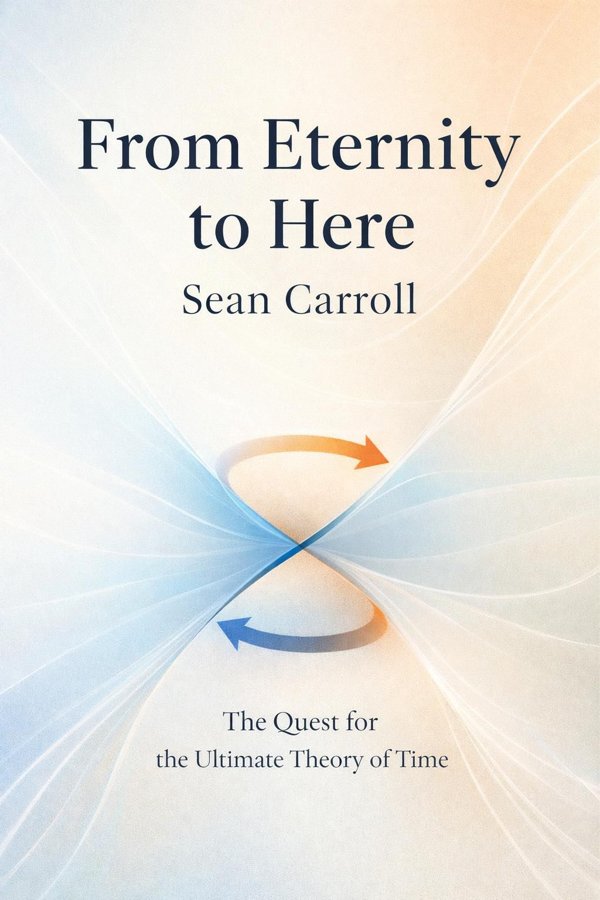
From Eternity to Here: The Quest for the Ultimate Theory of Time: Summary & Key Insights
by Sean Carroll
 10 min10 chaptersAudio available
Key Takeaways from From Eternity to Here: The Quest for the Ultimate Theory of Time
Time feels intimate, but physics treats it with startling impersonality.
The most familiar fact about time is not that it exists, but that it has a direction.
What if memory itself depends on entropy?
The deepest mystery is not that entropy increases now, but that it was ever low enough to increase in the first place.
You cannot solve the mystery of time by looking only at clocks on Earth.
What Is From Eternity to Here: The Quest for the Ultimate Theory of Time About?
From Eternity to Here: The Quest for the Ultimate Theory of Time by Sean Carroll is a popular_sci book spanning 10 pages. Why does time move forward when the laws of physics seem largely indifferent to direction? That deceptively simple question powers Sean Carroll’s ambitious and deeply rewarding exploration of one of science’s oldest mysteries. In From Eternity to Here, Carroll examines why we remember the past but not the future, why eggs break but never unbreak, and why the universe itself appears to have begun in an extraordinarily ordered state. His central claim is bold yet elegant: to understand time, we must understand entropy, cosmology, and the low-entropy origins of the universe. Written for curious general readers, the book blends accessible explanations with genuine scientific depth. Carroll moves from Einstein’s relativity to Boltzmann’s statistical mechanics, from black holes to inflationary cosmology, always returning to the same puzzle: how a time-symmetric set of physical laws gives rise to a world filled with irreversible processes. As a leading theoretical physicist and cosmologist, Carroll is especially well placed to guide readers through this terrain. The result is not just a book about clocks and calendars, but a sweeping inquiry into memory, causation, the universe’s beginning, and the ultimate fate of reality.
This FizzRead summary covers all 10 key chapters of From Eternity to Here: The Quest for the Ultimate Theory of Time in approximately 10 minutes, distilling the most important ideas, arguments, and takeaways from Sean Carroll's work. Also available as an audio summary and Key Quotes Podcast.
From Eternity to Here: The Quest for the Ultimate Theory of Time
Why does time move forward when the laws of physics seem largely indifferent to direction? That deceptively simple question powers Sean Carroll’s ambitious and deeply rewarding exploration of one of science’s oldest mysteries. In From Eternity to Here, Carroll examines why we remember the past but not the future, why eggs break but never unbreak, and why the universe itself appears to have begun in an extraordinarily ordered state. His central claim is bold yet elegant: to understand time, we must understand entropy, cosmology, and the low-entropy origins of the universe.
Written for curious general readers, the book blends accessible explanations with genuine scientific depth. Carroll moves from Einstein’s relativity to Boltzmann’s statistical mechanics, from black holes to inflationary cosmology, always returning to the same puzzle: how a time-symmetric set of physical laws gives rise to a world filled with irreversible processes. As a leading theoretical physicist and cosmologist, Carroll is especially well placed to guide readers through this terrain. The result is not just a book about clocks and calendars, but a sweeping inquiry into memory, causation, the universe’s beginning, and the ultimate fate of reality.
Who Should Read From Eternity to Here: The Quest for the Ultimate Theory of Time?
This book is perfect for anyone interested in popular_sci and looking to gain actionable insights in a short read. Whether you're a student, professional, or lifelong learner, the key ideas from From Eternity to Here: The Quest for the Ultimate Theory of Time by Sean Carroll will help you think differently.
- ✓Readers who enjoy popular_sci and want practical takeaways
- ✓Professionals looking to apply new ideas to their work and life
- ✓Anyone who wants the core insights of From Eternity to Here: The Quest for the Ultimate Theory of Time in just 10 minutes
Want the full summary?
Get instant access to this book summary and 100K+ more with Fizz Moment.
Get Free SummaryAvailable on App Store • Free to download
Key Chapters
Time feels intimate, but physics treats it with startling impersonality. In everyday life, time is what we run out of, waste, save, and remember. In physics, however, time is first a coordinate: a parameter that helps specify when events occur. That shift matters, because many of our deepest intuitions about flowing time do not appear in the fundamental equations.
Carroll begins by separating human experience from physical description. Newton imagined time as universal and absolute, the same for everyone everywhere. Einstein overturned that picture. In relativity, time depends on motion and gravity. Two observers can disagree about how much time passes between events, yet both can be correct within their own frames of reference. This does not mean time is unreal; it means time is woven into spacetime, a four-dimensional structure in which distance and duration are related.
Still, relativity does not explain why time seems to move from past to future. It explains how clocks behave, how simultaneity breaks down, and why time can dilate near light speed or massive objects. But it does not tell us why experience has a direction. That puzzle belongs to thermodynamics and cosmology.
A practical way to appreciate this distinction is to notice how often we confuse measuring time with explaining time. Your phone clock, an atomic clock, and your biological rhythms all track temporal order, but none tells you why causes precede effects or why memory points backward. Physics can describe time precisely without endorsing the feeling of flow.
Actionable takeaway: When thinking about time, separate three questions: how we measure it, how physics models it, and why experience gives it a direction.
The most familiar fact about time is not that it exists, but that it has a direction. We see this arrow everywhere: perfume disperses through a room, ice melts in warm water, and broken glass does not leap back onto the table. Carroll argues that this one-way character of experience is best understood through entropy, the measure of how many microscopic arrangements correspond to a macroscopic state.
The crucial insight is that the basic laws governing particles are, in most cases, reversible. If you filmed two billiard balls colliding and played the footage backward, the motion would still look physically plausible. Yet a film of a shattered glass reassembling instantly looks absurd. Why? Because there are vastly more disordered ways for the molecules to be arranged than ordered ones. Systems naturally evolve from less probable macrostates to more probable ones simply because there are more of them.
This is the Second Law of Thermodynamics: in a closed system, entropy tends to increase. Importantly, entropy is not merely “disorder” in a casual sense. It is about multiplicity, probability, and the enormous difference between special arrangements and generic ones. That is why time’s arrow is statistical rather than absolute. In principle, local decreases in entropy can happen, but for macroscopic systems they are fantastically unlikely.
You can see this in daily life. A tidy desk becomes messy without effort because there are many ways for objects to be scattered and very few ways for them to be neatly arranged. Order requires constraints and energy input. Disorder requires almost nothing.
Actionable takeaway: To understand why processes feel irreversible, ask not whether the laws forbid reversal, but whether reversal is overwhelmingly improbable.
What if memory itself depends on entropy? Carroll shows that the arrow of time is not just a feature of physics labs and cosmic models; it structures nearly every aspect of ordinary life. We remember the past because memory formation is a physical process that leaves records, and record-making increases entropy. We do not remember the future because future events have not yet produced those physical imprints.
This idea reaches far beyond psychology. Footprints in sand, fossils in rock, photographs in your phone, rings in a tree trunk, and scars on a body are all records of lower-entropy conditions evolving into higher-entropy ones. The past is knowable because it has left traces. The future, by contrast, contains possibilities rather than records. Our sense of causation follows the same asymmetry: causes come before effects because information about causes propagates forward through increasing entropy.
Aging offers another intuitive example. Bodies maintain local order only by consuming energy and exporting entropy into their surroundings. Over time, repair processes become less effective, damage accumulates, and the statistical tendency toward greater entropy wins out. Life is not an exception to thermodynamics; it is one of its most intricate expressions.
This also clarifies why we can make plans but not predictions with certainty. The future is open at the macroscopic level because multiple pathways remain compatible with current conditions, while the past is constrained by evidence already embedded in the world.
In practical terms, entropy gives you a framework for understanding why maintenance is hard. Homes, institutions, habits, and bodies all drift unless energy is continually invested. Stability is an achievement, not the default.
Actionable takeaway: Treat order as something that must be actively maintained, because irreversible change is built into the physical world we inhabit.
The deepest mystery is not that entropy increases now, but that it was ever low enough to increase in the first place. Carroll emphasizes that the Second Law only works as an explanation of time’s arrow if the universe started in an extraordinarily special condition: a state of remarkably low entropy. Without that beginning, there would be no reason for entropy to be rising today.
This idea is often called the Past Hypothesis. It is not a full theory so much as a statement that the early universe was highly ordered compared with what it could have been. At first glance, the early universe looks messy and hot, so why call it low entropy? Because when gravity is included, a smooth distribution of matter is actually highly ordered. Gravity prefers clumping: stars, galaxies, black holes. A nearly uniform early cosmos had enormous room to become more entropic as structures formed.
This is one of Carroll’s central contributions to public understanding. Many people assume the universe began as chaos and cooled into order. In thermodynamic terms, the opposite is closer to the truth. The beginning was special, and explaining that specialness is the real challenge.
The implication is profound. If physical laws are time-symmetric, then the asymmetry we experience may come not from the laws themselves but from boundary conditions, especially the universe’s initial state. That moves the discussion from local physics to cosmology.
In everyday reasoning, this principle matters because origins shape possibilities. A company, relationship, or habit with carefully chosen initial conditions can evolve in radically different ways than one that begins haphazardly.
Actionable takeaway: When facing a persistent pattern, look to starting conditions as much as governing rules; beginnings often determine the direction of change.
You cannot solve the mystery of time by looking only at clocks on Earth. Carroll argues that the arrow of time is ultimately a cosmological question. If the observable universe is part of a much larger reality, then local irreversibility may reflect a global history shaped by expansion, gravity, and the universe’s initial conditions.
Modern cosmology reveals a universe that has evolved dramatically. It began hot and dense, expanded, cooled, and formed increasingly complex structures. Gravity plays a special role here. In a gas floating in a box, uniformity tends toward equilibrium. But in a self-gravitating universe, uniformity is not equilibrium at all. Matter tends to clump into stars and galaxies, and eventually into black holes, which carry enormous entropy. That means cosmic history is a story of entropy increasing through structure formation.
Carroll uses this to bridge small-scale thermodynamics and large-scale astronomy. The arrow of time we see in kitchens and laboratories is part of the same broader trajectory that governs galaxy formation and stellar evolution. Cosmology is not a separate topic added on for grandeur; it is essential to explaining why any local arrow exists.
This perspective also reshapes existential questions. The universe is not a static backdrop for human life but an evolving physical system with a thermodynamic history. Our lives unfold inside a vast one-way process stretching from a special beginning toward a more entropic future.
A practical analogy is to think of local events as scenes within a longer movie. If you only watch one frame, you miss the story. Context provides direction.
Actionable takeaway: When a problem seems mysterious at the local level, widen the frame; larger systems often explain the patterns smaller ones cannot.
If relativity changes how time is measured, quantum mechanics changes what reality itself seems to allow. Carroll explores how quantum theory both preserves and complicates the arrow of time. At the level of the wave function, the fundamental equations are typically reversible, much like classical mechanics. Yet measurements appear asymmetric: possibilities become outcomes, and uncertainty seems to collapse into fact.
This tension feeds some of the most important debates in modern physics. Is wave-function collapse a real physical process, or merely an update in our knowledge? Carroll is sympathetic to interpretations, such as Everett’s many-worlds view, that avoid collapse altogether. In that picture, the universal wave function evolves smoothly and deterministically, while decoherence makes different branches effectively independent. The world appears classical because interference between alternatives becomes negligible.
Why does this matter for time? Because apparent irreversibility in quantum measurements may not be fundamental. Decoherence itself is entropic: as systems interact with environments, information spreads into inaccessible degrees of freedom. That creates the practical one-wayness we observe. Once again, the arrow emerges from statistical behavior and boundary conditions rather than from an explicit time-directed law.
This may sound abstract, but the implications are concrete. Technologies like quantum computing rely on controlling decoherence; the challenge is preserving coherent states against the relentless spread of entanglement with the environment. Everyday classical reality may be the result of quantum possibilities becoming thermodynamically entrenched.
Actionable takeaway: When confronting apparent one-way processes, consider whether the asymmetry is fundamental or whether it arises from information being dispersed beyond recovery.
Few objects make time feel stranger than black holes. They distort spacetime so severely that clocks near them run differently, and they seem to threaten one of physics’ most cherished principles: that information is not destroyed. Carroll uses black holes to show how questions about time intersect with gravity, entropy, and quantum theory at their sharpest edge.
Black holes are not merely cosmic vacuum cleaners; they are thermodynamic objects. Thanks to the work of Bekenstein and Hawking, physicists now understand that black holes possess entropy proportional to the area of their event horizons. They also emit Hawking radiation and can, over immense timescales, evaporate. This creates a puzzle: if a black hole forms from matter in a specific quantum state and then evaporates into seemingly featureless radiation, where does the information go?
The information puzzle matters because it probes whether time evolution is ultimately reversible. If information truly vanished, the future would not contain enough structure to reconstruct the past even in principle. That would imply a fundamental break with ordinary quantum mechanics. Carroll presents the puzzle as evidence that our current theories are incomplete, especially where gravity and quantum mechanics meet.
Black holes also represent extreme entropy. In the long run, they may dominate the thermodynamic bookkeeping of the cosmos before eventually evaporating. So they are central not only to exotic astrophysics but to the universe’s entropic future.
The broader lesson is practical as well as theoretical: edge cases expose hidden assumptions. Systems under extreme pressure reveal what your framework can and cannot explain.
Actionable takeaway: Pay special attention to anomalies and extreme cases; they often illuminate the deepest principles more clearly than ordinary situations do.
A finite universe with one special beginning leaves us with a hard question: why that beginning? Carroll considers whether a larger cosmological picture might make low-entropy beginnings less mysterious. One candidate is eternal inflation, the idea that inflationary expansion continues in parts of the cosmos, constantly generating pocket universes with different local conditions.
In such a framework, our observable universe could be one region within a much larger multiverse. That does not automatically solve the arrow-of-time problem, but it changes the setting. If new regions continually form, perhaps low-entropy beginnings are not unique miracles but recurring events within a broader spacetime. Carroll examines these possibilities carefully, without pretending that speculative cosmology is settled science.
He is especially interested in models where empty space, or de Sitter space, can fluctuate and give rise to new inflating patches. The goal is to find a naturalistic account in which entropy can increase overall while local low-entropy domains emerge. This would allow arrows of time to arise repeatedly rather than only once.
Yet such scenarios generate their own headaches, including the problem of Boltzmann brains: if random fluctuations can produce observers, then disembodied momentary minds might vastly outnumber ordinary evolved beings. Any good cosmology must explain why we are not such observers.
For readers, the value of this discussion is methodological. Science advances not only by answering questions but by refining which answers are acceptable. A theory must fit data, cohere mathematically, and make our existence unsurprising rather than absurdly atypical.
Actionable takeaway: When evaluating big explanations, ask not only whether they can account for the facts, but whether they do so without creating even stranger problems.
Time’s arrow is not only about origins; it is also about destiny. Carroll explores the long-term fate of the universe to show where increasing entropy leads. Stars burn out, galaxies drift apart, black holes eventually evaporate, and the cosmos moves toward a thin, cold, dilute state often described as heat death. This is not a dramatic apocalypse but a gradual exhaustion of free energy.
The key idea is that life, structure, and activity depend on energy differences. You can do work only when there are gradients to exploit: hot versus cold, dense versus diffuse, ordered versus disordered. As entropy rises, those differences diminish. The far future therefore contains fewer opportunities for complexity and organized processes. Time does not stop, but meaningful thermodynamic change becomes rarer.
This cosmic horizon gives our current era a special character. We live in a universe rich in usable energy, where stars shine, planets cycle heat, and complex systems can emerge. In a sense, we inhabit a transient window between an ordered past and a depleted future. That perspective can feel sobering, but Carroll presents it as a reason for wonder rather than despair.
On a human scale, the principle is familiar. Motivation, innovation, and biological life all depend on available gradients and constraints. Opportunity exists because conditions are not in equilibrium. Once everything is flat, nothing much happens.
Actionable takeaway: Value and use periods of disequilibrium well, because creativity, growth, and meaningful action are possible only when differences remain to be transformed.
The most honest conclusion of the book is that we do not yet possess the ultimate theory of time. Carroll offers powerful explanations, especially through entropy and cosmology, but he also highlights open questions that remain unresolved. That intellectual humility is one of the book’s strengths. It treats science not as a storehouse of finished answers but as a disciplined way of pushing mystery back.
The philosophical implications are substantial. If the flow of time is not fundamental, what becomes of becoming, free will, and personal identity? Carroll does not reduce these questions to equations, nor does he drift into mysticism. Instead, he suggests that many features of human life are emergent: real at our level, even if not built into the universe at its deepest layer in the way common sense imagines.
This is an important habit of thought. Reality may have levels, and explanations appropriate at one level need not appear explicitly at another. Temperature is real even though no individual molecule contains temperature. Likewise, the felt passage of time may be a robust feature of conscious agents embedded in an entropic universe, even if the fundamental laws do not contain a moving present.
For everyday life, this perspective can be liberating. It encourages comfort with complexity and with partial understanding. You can appreciate the reality of experience while recognizing that intuition is not always a guide to ontology.
Actionable takeaway: Hold two ideas together: your lived experience of time is meaningful, and the universe may underlie that experience in ways that are far stranger than common sense suggests.
All Chapters in From Eternity to Here: The Quest for the Ultimate Theory of Time
About the Author
Sean Carroll is an American theoretical physicist, cosmologist, and prominent science communicator. He has held research and teaching positions at leading institutions and is especially known for his work on cosmology, gravitation, quantum mechanics, and the foundations of physics. Beyond academic research, Carroll has built a wide readership through bestselling popular science books, public lectures, essays, and podcasts that explore both scientific ideas and their philosophical implications. His writing is admired for combining precision, clarity, and intellectual curiosity. In From Eternity to Here, Carroll draws on his expertise in cosmology and statistical physics to examine one of the most profound questions in science: why time appears to move forward. He is widely regarded as one of the most thoughtful contemporary interpreters of modern physics for general audiences.
Get This Summary in Your Preferred Format
Read or listen to the From Eternity to Here: The Quest for the Ultimate Theory of Time summary by Sean Carroll anytime, anywhere. FizzRead offers multiple formats so you can learn on your terms — all free.
Available formats: App · Audio · PDF · EPUB — All included free with FizzRead
Download From Eternity to Here: The Quest for the Ultimate Theory of Time PDF and EPUB Summary
Key Quotes from From Eternity to Here: The Quest for the Ultimate Theory of Time
“Time feels intimate, but physics treats it with startling impersonality.”
“The most familiar fact about time is not that it exists, but that it has a direction.”
“What if memory itself depends on entropy?”
“The deepest mystery is not that entropy increases now, but that it was ever low enough to increase in the first place.”
“You cannot solve the mystery of time by looking only at clocks on Earth.”
Frequently Asked Questions about From Eternity to Here: The Quest for the Ultimate Theory of Time
From Eternity to Here: The Quest for the Ultimate Theory of Time by Sean Carroll is a popular_sci book that explores key ideas across 10 chapters. Why does time move forward when the laws of physics seem largely indifferent to direction? That deceptively simple question powers Sean Carroll’s ambitious and deeply rewarding exploration of one of science’s oldest mysteries. In From Eternity to Here, Carroll examines why we remember the past but not the future, why eggs break but never unbreak, and why the universe itself appears to have begun in an extraordinarily ordered state. His central claim is bold yet elegant: to understand time, we must understand entropy, cosmology, and the low-entropy origins of the universe. Written for curious general readers, the book blends accessible explanations with genuine scientific depth. Carroll moves from Einstein’s relativity to Boltzmann’s statistical mechanics, from black holes to inflationary cosmology, always returning to the same puzzle: how a time-symmetric set of physical laws gives rise to a world filled with irreversible processes. As a leading theoretical physicist and cosmologist, Carroll is especially well placed to guide readers through this terrain. The result is not just a book about clocks and calendars, but a sweeping inquiry into memory, causation, the universe’s beginning, and the ultimate fate of reality.
More by Sean Carroll
The Particle at the End of the Universe: How the Hunt for the Higgs Boson Leads Us to the Edge of a New World
Sean Carroll
10 min
The Biggest Ideas in the Universe: Space, Time, and Motion
Sean Carroll
10 min
The Big Picture: On the Origins of Life, Meaning, and the Universe Itself
Sean Carroll
10 minYou Might Also Like
Structures: Or Why Things Don"t Fall Down
J.E. Gordon
10 min
The Road to Wigan Pier
George Orwell
10 min
Bonk: The Curious Coupling of Science and Sex
Mary Roach
10 min
First Bite: How We Learn to Eat
Bee Wilson
10 min
In Pursuit Of The Unknown: 17 Equations That Changed The World
Ian Stewart
10 min
Napoleon's Buttons: 17 Molecules That Changed History
Penny Le Couteur and Jay Burreson
10 minBrowse by Category
Ready to read From Eternity to Here: The Quest for the Ultimate Theory of Time?
Get the full summary and 100K+ more books with Fizz Moment.