
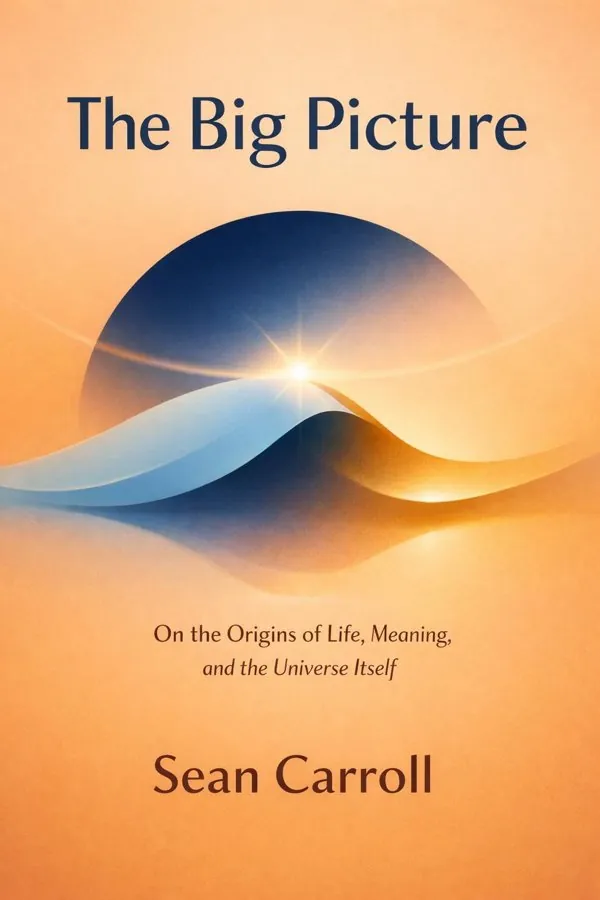
The Big Picture: On the Origins of Life, Meaning, and the Universe Itself: Summary & Key Insights
by Sean Carroll
 10 min9 chaptersAudio available
Key Takeaways from The Big Picture: On the Origins of Life, Meaning, and the Universe Itself
A universe without supernatural design does not have to be a universe without depth.
The most astonishing fact about the universe may be that it is intelligible at all.
Simple rules can generate astonishing richness.
Time feels like a river flowing from past to future, yet the deepest laws of physics are often nearly reversible.
The gap between nonliving matter and living organisms can feel enormous, but Carroll argues it is a gap of organization, not magic.
What Is The Big Picture: On the Origins of Life, Meaning, and the Universe Itself About?
The Big Picture: On the Origins of Life, Meaning, and the Universe Itself by Sean Carroll is a space_physics book spanning 8 pages. What kind of universe do we live in, and how can a world governed by impersonal physical laws still contain love, purpose, morality, and conscious experience? In The Big Picture, theoretical physicist Sean Carroll tackles these enormous questions with unusual clarity and ambition. He moves from the foundations of modern physics to the emergence of life, mind, and human values, arguing that reality is fully natural yet far from empty or bleak. His central idea, "poetic naturalism," holds that there is one physical world, but many valid ways of describing it—from particles and fields to stories about selves, choices, and meaning. This book matters because it speaks directly to a modern anxiety: if science explains more and more, does that leave less room for human significance? Carroll’s answer is no. Instead, scientific understanding can deepen wonder while giving us a more honest framework for living. Drawing on his expertise in cosmology, quantum mechanics, and the philosophy of science, Carroll offers a sweeping but grounded vision of existence—one that helps readers connect the vastness of the universe with the intimate realities of everyday life.
This FizzRead summary covers all 9 key chapters of The Big Picture: On the Origins of Life, Meaning, and the Universe Itself in approximately 10 minutes, distilling the most important ideas, arguments, and takeaways from Sean Carroll's work. Also available as an audio summary and Key Quotes Podcast.
The Big Picture: On the Origins of Life, Meaning, and the Universe Itself
What kind of universe do we live in, and how can a world governed by impersonal physical laws still contain love, purpose, morality, and conscious experience? In The Big Picture, theoretical physicist Sean Carroll tackles these enormous questions with unusual clarity and ambition. He moves from the foundations of modern physics to the emergence of life, mind, and human values, arguing that reality is fully natural yet far from empty or bleak. His central idea, "poetic naturalism," holds that there is one physical world, but many valid ways of describing it—from particles and fields to stories about selves, choices, and meaning.
This book matters because it speaks directly to a modern anxiety: if science explains more and more, does that leave less room for human significance? Carroll’s answer is no. Instead, scientific understanding can deepen wonder while giving us a more honest framework for living. Drawing on his expertise in cosmology, quantum mechanics, and the philosophy of science, Carroll offers a sweeping but grounded vision of existence—one that helps readers connect the vastness of the universe with the intimate realities of everyday life.
Who Should Read The Big Picture: On the Origins of Life, Meaning, and the Universe Itself?
This book is perfect for anyone interested in space_physics and looking to gain actionable insights in a short read. Whether you're a student, professional, or lifelong learner, the key ideas from The Big Picture: On the Origins of Life, Meaning, and the Universe Itself by Sean Carroll will help you think differently.
- ✓Readers who enjoy space_physics and want practical takeaways
- ✓Professionals looking to apply new ideas to their work and life
- ✓Anyone who wants the core insights of The Big Picture: On the Origins of Life, Meaning, and the Universe Itself in just 10 minutes
Want the full summary?
Get instant access to this book summary and 100K+ more with Fizz Moment.
Get Free SummaryAvailable on App Store • Free to download
Key Chapters
A universe without supernatural design does not have to be a universe without depth. Carroll’s central philosophical proposal, poetic naturalism, begins with a simple claim: there is only one world, the natural world, but there are many useful and legitimate ways of talking about it. At the most basic level, reality may consist of quantum fields and physical laws. But that does not mean higher-level concepts like beliefs, ecosystems, justice, or love are illusions. They are real descriptions at the scale where they do explanatory work.
This idea helps dissolve a false choice many people feel pressured to make. On one side is strict reductionism, where only fundamental physics is treated as truly real. On the other side is a vague humanism that resists scientific explanation. Carroll argues we need neither extreme. A poem is not invalid because it could, in principle, be described as patterns of ink molecules. Likewise, a moral decision is not meaningless because the brain obeys physical laws.
In practice, poetic naturalism encourages intellectual flexibility. A doctor can describe depression in terms of neurotransmitters, personal history, and social context without contradiction. A legal system can treat people as responsible agents even though they are made of atoms. A parent can see a child as both a biological organism and a source of love, hope, and obligation.
The deeper lesson is that truth comes in levels. Physics tells us what the world is made of; higher-level narratives tell us what matters within it. Actionable takeaway: when confronting a big question, ask which level of explanation is most useful rather than assuming only the most microscopic description counts.
The most astonishing fact about the universe may be that it is intelligible at all. Carroll begins with the foundations of modern physics because any serious account of life, consciousness, and meaning must start with the underlying structure of reality. Relativity tells us that space and time are woven together into spacetime. Quantum mechanics reveals that matter and energy are governed by probabilistic rules unlike ordinary common sense. Together, these theories describe a universe that is elegant, precise, and often strange.
Yet Carroll’s point is not merely that physics is powerful. It is that physical law appears sufficient to explain the behavior of the universe without appealing to hidden purposes or supernatural interventions. Stars form, galaxies evolve, planets emerge, and chemistry unfolds according to regular patterns. That regularity is what makes science possible and what allows complexity to accumulate over cosmic time.
This has practical implications for how we think. If the world is lawful, then understanding it requires curiosity, evidence, and revision rather than authority or wishful thinking. Everyday technologies already embody this worldview. GPS systems rely on relativity. Semiconductors depend on quantum principles. Medical imaging, electronics, and communication networks all work because the universe follows knowable rules.
Carroll is not saying physics answers every interesting question. He is saying all answers must be compatible with physics. Human life unfolds on top of this foundation, not apart from it. Appreciating that can make wonder more concrete rather than less. Actionable takeaway: cultivate respect for evidence-based explanations, and whenever possible ask what underlying mechanisms make a phenomenon possible instead of stopping at appearances.
Simple rules can generate astonishing richness. One of Carroll’s most important moves is showing how a universe governed by impersonal laws can still produce the layered complexity we see around us. From elementary particles came atoms; from atoms came molecules; from molecules came stars, planets, and eventually living cells. No external designer is required for complexity to arise when matter, energy, time, and the right environmental conditions interact.
Emergence is the key concept here. Emergent phenomena are not violations of physics; they are higher-level patterns that become meaningful when many parts interact. Wetness is not found in a single water molecule, but it emerges from many molecules together. Life similarly emerges from chemistry organized in self-sustaining, information-rich ways. Economic markets, ant colonies, and weather systems all display this same principle.
This matters because people often assume that if something is not fundamental, it is somehow less real. Carroll rejects that view. A hurricane is real even though it is made of air molecules. A cell is real even though it is made of chemicals. A mind can be real even if it arises from brain processes. Seeing reality this way allows us to honor complexity without mystifying it.
In everyday life, emergence can reshape how we solve problems. A productive workplace is not just a collection of employees; it is a system of interactions. Health is not just a list of organs; it is a coordinated process. Better results often come from improving relationships among parts, not obsessing over one component.
Actionable takeaway: when something seems mysterious, look for emergent patterns—how simple elements interacting over time create outcomes that cannot be understood by isolating the parts alone.
Time feels like a river flowing from past to future, yet the deepest laws of physics are often nearly reversible. Carroll uses entropy to explain why our experience of time has a direction. Entropy is roughly a measure of disorder or, more precisely, the number of microscopic arrangements compatible with a system’s visible state. The reason eggs scramble but never spontaneously unscramble, and why we remember the past rather than the future, is that the universe evolves from lower-entropy states to higher-entropy ones.
This insight is not only about thermodynamics. It is central to understanding memory, causation, aging, and cosmic history. The early universe appears to have begun in an extraordinarily low-entropy condition, and that special beginning makes the arrow of time possible. Without it, there would be no sustained increase in complexity, no stable records of the past, and no familiar sense of before and after.
Carroll’s discussion helps readers see that many features of ordinary life depend on this statistical trend. Refrigerators work by moving heat around because thermal behavior has direction. We plan for tomorrow because information is stored from yesterday. We grieve losses and celebrate growth because change accumulates irreversibly.
There is also a philosophical lesson here. The asymmetry we feel so deeply may not be written into every law individually; it may arise from the universe’s boundary conditions. That is a humbling reminder that common sense is not always fundamental truth.
Actionable takeaway: use the arrow of time wisely by recognizing irreversibility—invest in habits, relationships, and projects that benefit from compounding, because many choices cannot simply be reset once entropy has done its work.
The gap between nonliving matter and living organisms can feel enormous, but Carroll argues it is a gap of organization, not magic. Life does not require a special vital force beyond physics and chemistry. Instead, it emerges when matter forms systems capable of metabolism, replication, adaptation, and information storage. Biological evolution then takes over, allowing simple self-replicating structures to become the breathtaking diversity of life on Earth.
This view does not cheapen life. It makes it more remarkable. The same atoms forged in stars can, under the right conditions, become cells that maintain themselves, respond to environments, and pass on successful variations. Natural selection explains how complexity can accumulate without foresight. Eyes were not planned in advance; they emerged through countless small changes that improved survival and reproduction.
Carroll’s naturalistic account also clarifies why life elsewhere in the universe is scientifically plausible even if not yet confirmed. If life is a product of chemistry plus suitable environments, then planets with liquid water, energy sources, and complex molecules become natural places to search.
On a personal level, this perspective invites a more dynamic understanding of health and identity. Your body is not a fixed thing but a self-maintaining process. Nutrition, sleep, stress, exercise, and environment influence how that process unfolds. In education and innovation, evolution offers a model too: variation, feedback, and selection often beat rigid top-down planning.
Actionable takeaway: think of living systems as processes that require supportive conditions; whether caring for your body, a team, or a creative project, focus on maintaining environments where adaptation and renewal can happen.
Few questions feel more intimate than how subjective experience can exist in a material universe. Carroll approaches consciousness without mysticism, arguing that minds arise from physical processes in the brain. Thoughts, feelings, perceptions, and memories are not separate from neural activity; they are what certain organized patterns of neural activity are like when viewed at the right explanatory level.
This does not mean consciousness is easy to explain. It remains one of the most challenging areas in science and philosophy. But Carroll resists the temptation to treat difficulty as evidence for the supernatural. History shows that many once-mysterious phenomena, from life to lightning, became more understandable through patient inquiry. Consciousness deserves the same disciplined optimism.
An important part of his argument is that different vocabularies serve different purposes. Neuroscience may describe firing neurons and brain networks. Psychology may describe attention, emotion, or personality. Everyday life may describe hopes, fears, and intentions. These are not competing realities but layered descriptions of the same underlying processes.
This framework has practical value. It supports compassion for mental illness by grounding it in physical and psychological causes rather than moral failure. It encourages better conversations about education, trauma, addiction, and well-being. It also reminds us that cultivating a mind means shaping a brain through habits, practice, and environments.
Actionable takeaway: treat your mental life as both meaningful and embodied—take thoughts and emotions seriously, but also support them through sleep, movement, learning, relationships, and evidence-based care for the brain that makes them possible.
If the universe has no built-in purpose, then meaning is not discovered like a hidden planet; it is created through human life. Carroll argues that this is not a weakness but a liberation. In an undesigned cosmos, values do not descend from outside nature. They arise from conscious creatures who care, suffer, cooperate, imagine, and choose. Morality is therefore real in the human world even if it is not written into the equations of particle physics.
Carroll’s point is subtle. He is not claiming morality is arbitrary. Human beings share needs, vulnerabilities, and capacities for flourishing. From those facts emerge reasons to care about honesty, fairness, compassion, freedom, and harm reduction. Ethical systems are constructed, but they are constrained by the realities of human existence. Some norms help sentient beings live together better than others.
This view can make morality feel more urgent, not less. If no cosmic judge guarantees justice, then justice depends on what we build. If meaning is not handed to us, then our commitments matter more. Raising a child, keeping a promise, making art, fighting cruelty, and contributing to knowledge become sources of significance precisely because finite beings choose them.
In practical terms, this philosophy encourages active responsibility. Instead of waiting for certainty from beyond, we deliberate, empathize, and revise. A workplace code of conduct, a family tradition, or a civic institution can all be improved by asking how they affect real human flourishing.
Actionable takeaway: define your values explicitly and test them against their consequences for conscious beings; meaning grows when you commit to projects, relationships, and principles that make life better for others as well as yourself.
Many people assume that if the universe is governed by physical law, then free will must be an illusion. Carroll pushes back by showing that the debate often confuses levels of description. At the microscopic level, events may be deterministic or probabilistic depending on the theory. But the human concept of free will is not about escaping physics. It is about whether our actions flow from our reasons, desires, deliberations, and character rather than from coercion or compulsion.
In this sense, freedom is compatible with naturalism. A person deciding whether to apologize, change careers, or keep a promise is a real system processing information and projecting possible futures. The fact that this process is implemented in a physical brain does not make it unreal. Saying "I chose" can be a valid higher-level description, just as saying "the thermostat regulates temperature" is valid even though the device obeys electronics.
Carroll also explains why quantum randomness does not rescue a magical idea of freedom. Randomness is not control. If your decisions were partly random at the quantum level, that would not make them more authentically yours. What matters is whether choices emerge from the organized person you are.
This has consequences for ethics and law. We can hold people responsible while still recognizing degrees of capacity, impairment, and influence. It also improves self-understanding: changing behavior means changing the patterns that generate action—habits, incentives, beliefs, and environments.
Actionable takeaway: stop looking for freedom outside causation and instead strengthen the conditions that make actions genuinely yours—reflection, self-knowledge, emotional regulation, and environments that support better choices.
Knowledge without wisdom can feel sterile, while values without reality checks can become fantasy. One of Carroll’s most compelling achievements is showing that science and humanism are not enemies. Science tells us how the world works and disciplines our beliefs with evidence. Humanism addresses what we should care about, how we live together, and what makes a life worth living. A full worldview needs both.
Carroll’s poetic naturalism makes this partnership possible. Because there is one natural world described at multiple levels, there is no need to choose between being scientifically serious and existentially engaged. Physics does not tell you whom to love, but it does not forbid love. Neuroscience does not render ethics pointless, but it can inform how people actually behave. Cosmology can make us feel small, yet it can also make our brief conscious existence feel precious.
This integration is especially useful in a polarized age. Public debates about technology, climate, medicine, and education often fail because facts and values are treated separately. Better decisions require both. We need accurate models of reality and thoughtful discussion of goals. A policymaker, teacher, or parent ignores either side at their peril.
Carroll ultimately offers not just an explanation of the universe, but a way of inhabiting it. To live within poetic naturalism is to embrace curiosity, humility, compassion, and the courage to create meaning without guarantees.
Actionable takeaway: build a two-part decision habit—first ask, "What is true?" using evidence, then ask, "What matters?" using values, and refuse to let either question replace the other.
All Chapters in The Big Picture: On the Origins of Life, Meaning, and the Universe Itself
About the Author
Sean Carroll is a theoretical physicist and science communicator best known for making complex ideas in cosmology and fundamental physics accessible to broad audiences. He has worked on topics including general relativity, quantum mechanics, dark energy, and the foundations of the universe, and has held prominent academic appointments, including at the California Institute of Technology. Beyond research, Carroll is widely respected for exploring how scientific understanding intersects with philosophy, ethics, and everyday human life. He is the author of several acclaimed books and a popular public voice through lectures, essays, podcasts, and interviews. In The Big Picture, Carroll brings together his scientific expertise and philosophical range to offer a naturalistic worldview that connects the laws of physics with life, consciousness, meaning, and morality.
Get This Summary in Your Preferred Format
Read or listen to the The Big Picture: On the Origins of Life, Meaning, and the Universe Itself summary by Sean Carroll anytime, anywhere. FizzRead offers multiple formats so you can learn on your terms — all free.
Available formats: App · Audio · PDF · EPUB — All included free with FizzRead
Download The Big Picture: On the Origins of Life, Meaning, and the Universe Itself PDF and EPUB Summary
Key Quotes from The Big Picture: On the Origins of Life, Meaning, and the Universe Itself
“A universe without supernatural design does not have to be a universe without depth.”
“The most astonishing fact about the universe may be that it is intelligible at all.”
“Simple rules can generate astonishing richness.”
“Time feels like a river flowing from past to future, yet the deepest laws of physics are often nearly reversible.”
“The gap between nonliving matter and living organisms can feel enormous, but Carroll argues it is a gap of organization, not magic.”
Frequently Asked Questions about The Big Picture: On the Origins of Life, Meaning, and the Universe Itself
The Big Picture: On the Origins of Life, Meaning, and the Universe Itself by Sean Carroll is a space_physics book that explores key ideas across 9 chapters. What kind of universe do we live in, and how can a world governed by impersonal physical laws still contain love, purpose, morality, and conscious experience? In The Big Picture, theoretical physicist Sean Carroll tackles these enormous questions with unusual clarity and ambition. He moves from the foundations of modern physics to the emergence of life, mind, and human values, arguing that reality is fully natural yet far from empty or bleak. His central idea, "poetic naturalism," holds that there is one physical world, but many valid ways of describing it—from particles and fields to stories about selves, choices, and meaning. This book matters because it speaks directly to a modern anxiety: if science explains more and more, does that leave less room for human significance? Carroll’s answer is no. Instead, scientific understanding can deepen wonder while giving us a more honest framework for living. Drawing on his expertise in cosmology, quantum mechanics, and the philosophy of science, Carroll offers a sweeping but grounded vision of existence—one that helps readers connect the vastness of the universe with the intimate realities of everyday life.
More by Sean Carroll
The Particle at the End of the Universe: How the Hunt for the Higgs Boson Leads Us to the Edge of a New World
Sean Carroll
10 min
The Biggest Ideas in the Universe: Space, Time, and Motion
Sean Carroll
10 min
From Eternity to Here: The Quest for the Ultimate Theory of Time
Sean Carroll
10 minYou Might Also Like
The Means Of Prediction
Mark P. Silverman
10 min
AstroTech
Various Authors
10 min
Black Holes and Time Warps: Einstein’s Outrageous Legacy
Kip S. Thorne
10 min
Dark Matter and the Dinosaurs: The Astounding Interconnectedness of the Universe
Lisa Randall
10 min
Helgoland
Carlo Rovelli
10 min
Hyperspace: A Scientific Odyssey Through Parallel Universes, Time Warps, and the 10th Dimension
Michio Kaku
10 minBrowse by Category
Ready to read The Big Picture: On the Origins of Life, Meaning, and the Universe Itself?
Get the full summary and 100K+ more books with Fizz Moment.