
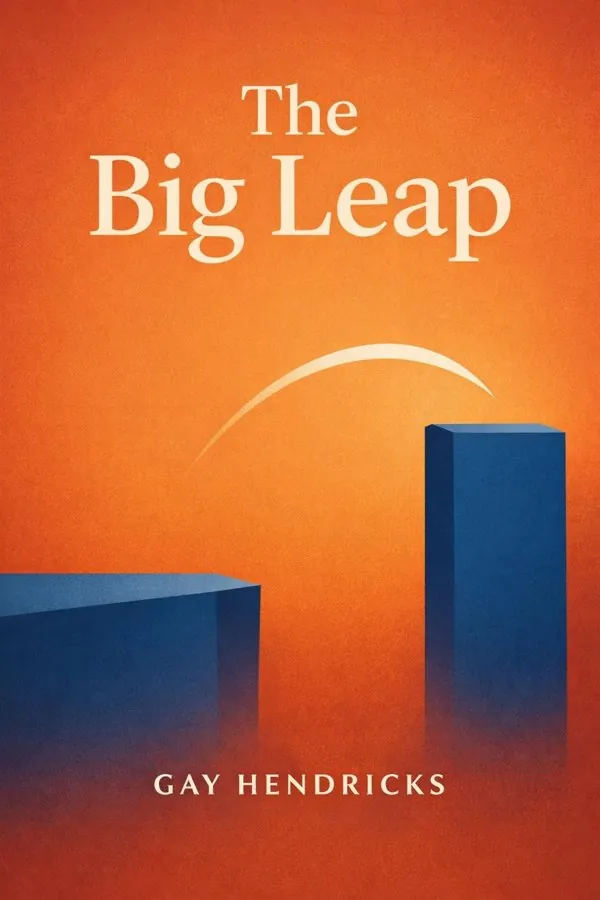
The Big Leap: Summary & Key Insights
 10 min9 chaptersAudio available
Key Takeaways from The Big Leap
One of the most unsettling truths about growth is that success does not always feel safe.
Many people think their biggest blocks are failure or fear of rejection, but Hendricks suggests something even more surprising: we often fear feeling too good.
Being busy is not the same as being aligned.
The most dangerous place to get stuck is not mediocrity; it is excellence.
Your Zone of Genius is not merely what you are good at; it is what you are uniquely built to do.
What Is The Big Leap About?
The Big Leap by Gay Hendricks is a self-help book published in 2009 spanning 5 pages. Why do people often fall apart just when life starts going well? In The Big Leap, psychologist and relationship expert Gay Hendricks argues that many of us unconsciously resist the very happiness, success, love, and creative freedom we say we want. He calls this pattern the “Upper Limit Problem”: a hidden internal threshold that triggers self-sabotage whenever we begin to exceed our familiar comfort zone. Instead of blaming bad luck or external obstacles, Hendricks invites readers to look inward and notice the subtle ways they cap their own potential. What makes this book so compelling is its mix of psychology, practical self-awareness, and deeply encouraging insight. Hendricks doesn’t just diagnose the problem; he offers a framework for moving beyond it, especially by identifying your “Zone of Genius,” the kind of work and way of being that expresses your unique gifts most fully. Drawing on decades of experience in personal development and relationship coaching, he presents a clear message: expanding your capacity for joy and abundance is not selfish or unrealistic—it is the next stage of growth. The Big Leap is a guide for anyone ready to stop shrinking and start living at their true level.
This FizzRead summary covers all 9 key chapters of The Big Leap in approximately 10 minutes, distilling the most important ideas, arguments, and takeaways from Gay Hendricks's work. Also available as an audio summary and Key Quotes Podcast.
The Big Leap
Why do people often fall apart just when life starts going well? In The Big Leap, psychologist and relationship expert Gay Hendricks argues that many of us unconsciously resist the very happiness, success, love, and creative freedom we say we want. He calls this pattern the “Upper Limit Problem”: a hidden internal threshold that triggers self-sabotage whenever we begin to exceed our familiar comfort zone. Instead of blaming bad luck or external obstacles, Hendricks invites readers to look inward and notice the subtle ways they cap their own potential.
What makes this book so compelling is its mix of psychology, practical self-awareness, and deeply encouraging insight. Hendricks doesn’t just diagnose the problem; he offers a framework for moving beyond it, especially by identifying your “Zone of Genius,” the kind of work and way of being that expresses your unique gifts most fully. Drawing on decades of experience in personal development and relationship coaching, he presents a clear message: expanding your capacity for joy and abundance is not selfish or unrealistic—it is the next stage of growth. The Big Leap is a guide for anyone ready to stop shrinking and start living at their true level.
Who Should Read The Big Leap?
This book is perfect for anyone interested in self-help and looking to gain actionable insights in a short read. Whether you're a student, professional, or lifelong learner, the key ideas from The Big Leap by Gay Hendricks will help you think differently.
- ✓Readers who enjoy self-help and want practical takeaways
- ✓Professionals looking to apply new ideas to their work and life
- ✓Anyone who wants the core insights of The Big Leap in just 10 minutes
Want the full summary?
Get instant access to this book summary and 100K+ more with Fizz Moment.
Get Free SummaryAvailable on App Store • Free to download
Key Chapters
One of the most unsettling truths about growth is that success does not always feel safe. Gay Hendricks argues that many people unconsciously sabotage themselves not because they lack talent, discipline, or opportunity, but because they have an internal limit on how much happiness, love, wealth, or recognition they can comfortably tolerate. He calls this the Upper Limit Problem. When life starts going unusually well, the mind often creates tension to restore familiar emotional balance. That tension may show up as picking a fight, making a careless mistake, getting anxious, obsessing over a small problem, or even feeling physically unwell.
The idea is simple but powerful: each person has a subconscious thermostat for how good life is allowed to get. If reality rises above that setting, old beliefs rush in to pull us back down. A professional might land a major client and then procrastinate on the next opportunity. A couple may enjoy deep closeness, only to argue over something trivial the next day. A creative person may finish excellent work and then immediately doubt its value.
Hendricks believes the first step is noticing the pattern without shame. Self-sabotage is not proof that you are broken; it is evidence that your nervous system is attached to old limits. Once you identify your upper-limit behaviors, you can interrupt them and choose expansion instead of contraction.
Actionable takeaway: For one week, notice what happens right after something good occurs. Write down any tension, conflict, worry, or withdrawal that follows. That pattern may reveal your personal Upper Limit Problem.
Many people think their biggest blocks are failure or fear of rejection, but Hendricks suggests something even more surprising: we often fear feeling too good. Underneath upper-limit behavior are hidden beliefs formed early in life, such as “I must not outshine others,” “I can’t be successful and lovable,” “If I am too happy, something bad will happen,” or “There is only so much luck to go around.” These beliefs create an emotional ceiling that can affect every part of life.
Hendricks identifies recurring false assumptions that drive self-imposed limits. Some people carry guilt about surpassing parents, siblings, or peers. Others believe they are fundamentally flawed and therefore cannot sustain abundance. Some are loyal to struggle because it feels familiar and morally safer than ease. As a result, they unconsciously create problems whenever life becomes too peaceful, prosperous, or intimate.
This insight matters because it shifts the conversation from tactics to identity. You can improve productivity, communication, or financial habits, but if your deeper belief says you do not deserve expansion, old patterns will keep reappearing. The goal is not to force yourself into success but to become conscious of the stories that make success feel dangerous.
In daily life, this could mean catching yourself when you minimize praise, deflect affection, spend impulsively after earning more, or create unnecessary drama when things are calm. These are not random behaviors; they are clues to a deeper emotional contract.
Actionable takeaway: Ask yourself, “What do I secretly fear would happen if I were truly happy, successful, and loved?” Write your answers honestly. Naming the hidden fear weakens its hold.
Being busy is not the same as being aligned. One of Hendricks’s most useful frameworks is the idea that people operate in four zones: the Zone of Incompetence, the Zone of Competence, the Zone of Excellence, and the Zone of Genius. Most frustration at work and in life comes from spending too much time in the wrong zone.
The Zone of Incompetence includes tasks you are simply bad at and that others can do better. The Zone of Competence includes things you can do adequately, but they do not energize you or distinguish you. The Zone of Excellence is more deceptive: it contains work you do very well and may even be praised or rewarded for. Many people build their careers there. Yet excellence can become a trap because it is comfortable, socially validated, and profitable enough to keep you from discovering your deepest calling.
The Zone of Genius is different. It is where your natural talent, deepest passion, creativity, and contribution intersect. In this zone, your work feels absorbing, meaningful, and alive. You are not merely effective; you are uniquely yourself. Hendricks argues that the biggest leap is not from failure to success, but from excellence to genius.
A manager may be excellent at operations but come alive when mentoring people. A writer may be competent at corporate content but feel electrified when teaching ideas. A founder may be strong in execution but truly gifted in vision and strategic storytelling.
Actionable takeaway: Make a list of your regular activities and label each one as incompetence, competence, excellence, or genius. Then choose one low-value task to delegate and one genius activity to expand this week.
The most dangerous place to get stuck is not mediocrity; it is excellence. Hendricks emphasizes that many high performers never make their big leap because they are heavily rewarded for what they are already good at. Their competence earns approval, money, and identity, so they rarely question whether that work is truly their best contribution. In this way, success itself can become an obstacle.
The Zone of Excellence is seductive because it looks admirable from the outside. You receive promotions, recognition, and trust. People depend on you. You may even feel proud of your reliability. But internally, there is often a quiet drain: your work feels effortful, repetitive, or slightly deadening. You are producing results, but not from your deepest source. Over time, this can create subtle resentment, fatigue, or a sense that life is passing by while you remain efficient but underexpressed.
Hendricks invites readers to consider a radical possibility: what if your greatest responsibility is not to keep proving your competence, but to fully inhabit your genius? That may require disappointing expectations, changing roles, charging differently for your work, or letting go of tasks others associate with your identity.
For example, a successful lawyer may realize her genius lies in negotiation and high-level problem solving, not endless administrative work. An entrepreneur may discover his genius is product vision, not managing every department. The shift often begins with subtraction before expansion.
Actionable takeaway: Identify one area where you are highly effective but secretly uninspired. Ask, “What is this preventing me from fully doing?” Then create a plan to reduce, redesign, or delegate that work.
Your Zone of Genius is not merely what you are good at; it is what you are uniquely built to do. Hendricks describes it as the activity or way of being that brings both deep satisfaction and maximum contribution. Time feels different there. You become more inventive, more energized, and often more valuable to others. Yet many people overlook their genius because it feels too natural. What comes easily to you may seem ordinary, when in fact it is your rarest gift.
A useful clue is joy. Genius often has the emotional signature of fascination, aliveness, and easeful intensity. Another clue is repeatability: the activity keeps drawing you back because it feels inherently right. Others may also notice it before you do, saying things like, “You make that look effortless,” or “You light up when you do this.”
Claiming genius requires courage because it often asks for a new level of self-permission. You may need to stop measuring your worth by busyness, stop saying yes to every obligation, or stop hiding behind roles that feel safe. Hendricks argues that living in your genius is not self-indulgent. It is the highest form of service because you contribute most powerfully when you function from your deepest strengths.
In practice, this might mean teaching instead of managing, designing instead of administering, or building relationships instead of processing tasks. The point is not to copy someone else’s path but to identify where your natural brilliance already appears.
Actionable takeaway: Write answers to three questions: What do I most love to do? What do I do best? What creates the greatest positive impact when I do it? Where those answers overlap, your genius is likely waiting.
Most people treat time as an external force acting upon them, but Hendricks proposes a more liberating idea: time pressure is often a mental construction tied to fear, avoidance, and divided attention. He calls the alternative “Einstein Time,” a state in which you take full responsibility for how you experience time rather than acting like its victim. Instead of saying, “I don’t have time,” you shift to, “I choose not to do that now,” or “I am creating exactly the amount of time I need.”
This change in language is not superficial. It restores agency. When you stop blaming time, you become more honest about your priorities and more present in your actions. Hendricks also suggests that feeling rushed often means part of your attention is trapped in the past or future. Creative flow becomes available when you inhabit the present fully.
Einstein Time is especially important for people stepping into their Zone of Genius. Genius cannot thrive in chronic fragmentation. If you are constantly multitasking, reacting, and apologizing for being behind, your best thinking stays inaccessible. By contrast, when you create spaciousness and undivided attention, insight accelerates.
A practical example: instead of packing every hour with obligations, a consultant may protect two uninterrupted morning hours for high-value creative work. A parent may stop saying “I’m too busy” and instead make clearer choices about what matters most. The result is often less guilt, better focus, and more meaningful output.
Actionable takeaway: Replace “I don’t have time” with “That is not my priority right now” for one week. Notice how this language shift clarifies your choices and reveals where your time is truly going.
When people hit an upper limit, they rarely announce it directly. More often, they generate secondary problems that distract them from expansion. Hendricks points to recurring patterns such as unnecessary worry, criticism, blame, arguments, and manufactured drama. These reactions may seem caused by external circumstances, but they often function as escape hatches from too much openness, intimacy, or success.
Consider how often a joyful moment is followed by unease: after receiving praise, you obsess about a minor flaw; after a loving conversation, you become irritable; after a financial win, you worry about losing everything. The content changes, but the structure stays the same. The mind seizes on something negative in order to return you to a familiar emotional baseline.
This is why self-awareness must include pattern recognition. Hendricks does not advise suppressing all negative feelings or pretending every problem is imaginary. Instead, he encourages readers to ask whether their distress is proportionate and whether it appeared right after an expansion. If so, the issue may be less about the event itself and more about your discomfort with feeling good.
This perspective can transform relationships. Rather than taking every flare-up at face value, couples can ask whether greater closeness has triggered an upper-limit response. Teams can notice whether tension rises after a breakthrough. Individuals can stop treating worry as wisdom when it is actually self-contraction.
Actionable takeaway: The next time you feel a sudden wave of worry or irritation after something positive, pause and ask, “Is this a real issue, or am I upper-limiting?” That question can interrupt the cycle before it gains momentum.
A central message of The Big Leap is that growth is not only about achieving more; it is about becoming able to receive more. Many people can create opportunities, but they struggle to tolerate the emotional intensity of greater abundance. Hendricks argues that the real work is increasing your capacity to feel good without collapsing back into guilt, fear, or self-protection.
This applies to money, love, recognition, and creative fulfillment. If you are uncomfortable receiving appreciation, you may dismiss compliments. If wealth feels morally suspicious, you may unconsciously undercharge or overspend. If deep love feels vulnerable, you may shut down after moments of closeness. In every case, the external result reflects an internal receiving limit.
Hendricks encourages a practice of consciously opening to positive energy. That means letting yourself feel success in the body instead of rushing past it or neutralizing it. It means tolerating ease instead of assuming tension is proof of seriousness. It also means recognizing that abundance is not a fixed pie. Someone else’s brilliance or prosperity does not diminish yours.
A practical application might be as simple as pausing when praise arrives and saying, “Thank you,” without deflecting. It might mean holding onto more of what you earn, staying present during a loving moment, or allowing yourself to enjoy a win before chasing the next goal.
Actionable takeaway: Each day, notice one positive experience you usually rush past. Spend 20 extra seconds feeling it fully—whether it is appreciation, calm, pleasure, or success. Train yourself to stay open to what is already good.
Transformation does not happen through insight alone; it requires a new level of commitment. Hendricks stresses that making the big leap means becoming radically honest about what you most want and what repeatedly pulls you away from it. This includes honoring your true desires, keeping clear agreements, and aligning your daily choices with your deepest values instead of your old fears.
Integrity, in this context, is not moral perfection. It is wholeness. It means not splitting yourself between the life you claim to want and the habits that maintain your upper limit. If you say you want meaningful work but continually fill your schedule with low-value obligations, there is an integrity gap. If you say you want intimacy but avoid honest conversations, the same principle applies.
Hendricks also emphasizes the power of conscious commitment statements. By clearly declaring what you are available for—more love, more creativity, more prosperity, more service—you begin reorganizing attention and behavior around a larger identity. Such commitments help you recognize when upper-limit patterns are trying to pull you back.
In practical terms, commitment may mean setting stronger boundaries, renegotiating roles, ending chronic overextension, or making time for the work that matters most. The point is not intensity for its own sake, but consistent alignment.
Actionable takeaway: Write a one-sentence commitment beginning with “I commit to…” and make it specific to your next level of expansion. Read it daily and notice which habits or fears immediately resist it. Those points of resistance show where your next growth work lies.
All Chapters in The Big Leap
About the Author
Gay Hendricks, Ph.D., is an American psychologist, educator, and bestselling author known for his work on personal growth, conscious relationships, and human potential. Over the course of his career, he has written more than 40 books, including The Big Leap, Conscious Loving, and The Genius Zone. Along with his wife, Dr. Kathlyn Hendricks, he co-founded the Hendricks Institute, an organization devoted to teaching conscious living and loving through seminars, training programs, and coaching. His work combines psychological insight with practical tools for emotional awareness, creativity, communication, and fulfillment. Hendricks is especially known for popularizing concepts such as the Upper Limit Problem and the Zone of Genius, which have influenced readers, leaders, entrepreneurs, and coaches seeking to expand their capacity for success and well-being.
Get This Summary in Your Preferred Format
Read or listen to the The Big Leap summary by Gay Hendricks anytime, anywhere. FizzRead offers multiple formats so you can learn on your terms — all free.
Available formats: App · Audio · PDF · EPUB — All included free with FizzRead
Download The Big Leap PDF and EPUB Summary
Key Quotes from The Big Leap
“One of the most unsettling truths about growth is that success does not always feel safe.”
“Many people think their biggest blocks are failure or fear of rejection, but Hendricks suggests something even more surprising: we often fear feeling too good.”
“Being busy is not the same as being aligned.”
“The most dangerous place to get stuck is not mediocrity; it is excellence.”
“Your Zone of Genius is not merely what you are good at; it is what you are uniquely built to do.”
Frequently Asked Questions about The Big Leap
The Big Leap by Gay Hendricks is a self-help book that explores key ideas across 9 chapters. Why do people often fall apart just when life starts going well? In The Big Leap, psychologist and relationship expert Gay Hendricks argues that many of us unconsciously resist the very happiness, success, love, and creative freedom we say we want. He calls this pattern the “Upper Limit Problem”: a hidden internal threshold that triggers self-sabotage whenever we begin to exceed our familiar comfort zone. Instead of blaming bad luck or external obstacles, Hendricks invites readers to look inward and notice the subtle ways they cap their own potential. What makes this book so compelling is its mix of psychology, practical self-awareness, and deeply encouraging insight. Hendricks doesn’t just diagnose the problem; he offers a framework for moving beyond it, especially by identifying your “Zone of Genius,” the kind of work and way of being that expresses your unique gifts most fully. Drawing on decades of experience in personal development and relationship coaching, he presents a clear message: expanding your capacity for joy and abundance is not selfish or unrealistic—it is the next stage of growth. The Big Leap is a guide for anyone ready to stop shrinking and start living at their true level.
More by Gay Hendricks
You Might Also Like


Featured In
Browse by Category
Ready to read The Big Leap?
Get the full summary and 100K+ more books with Fizz Moment.