
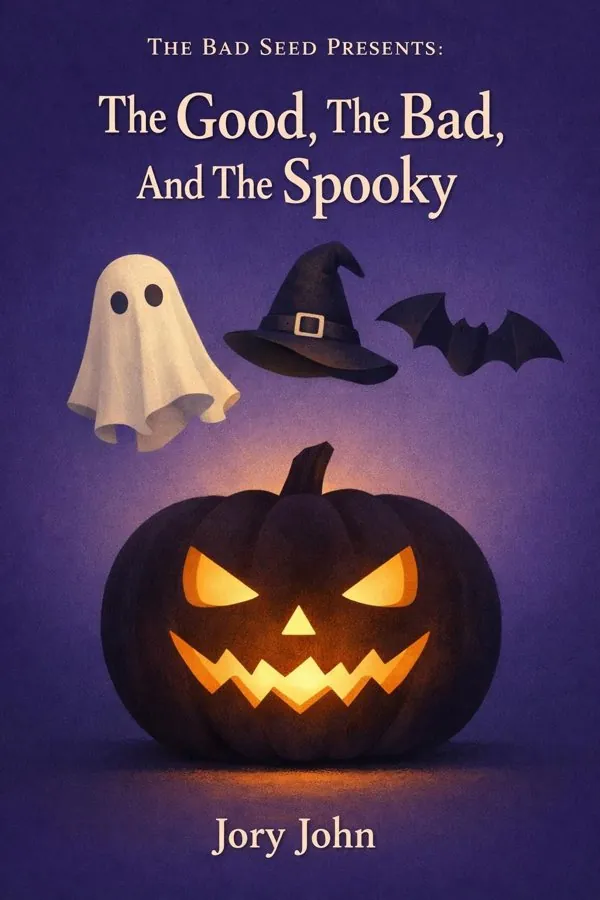
The Bad Seed Presents: The Good, The Bad, And The Spooky: Summary & Key Insights
by Jory John
 10 min8 chaptersAudio available
Key Takeaways from The Bad Seed Presents: The Good, The Bad, And The Spooky
Perfection often disguises itself as excitement.
Disappointment becomes sharper when expectations become rigid.
When things feel imperfect, quitting can feel like control.
Connection often rescues us from self-absorption.
Children often confuse a single experience with a verdict about who they are.
What Is The Bad Seed Presents: The Good, The Bad, And The Spooky About?
The Bad Seed Presents: The Good, The Bad, And The Spooky by Jory John is a parenting book spanning 3 pages. Halloween is supposed to be fun, but for anyone who has ever felt pressure to get everything just right, it can become surprisingly stressful. In The Bad Seed Presents: The Good, The Bad, And The Spooky, Jory John takes that familiar feeling and turns it into a witty, child-friendly story about costumes, expectations, disappointment, and rediscovering joy. The Bad Seed wants the perfect Halloween experience. He wants the best costume, the biggest reaction, and a night worthy of admiration. But as his plans wobble, he learns a lesson that extends far beyond trick-or-treating: celebrations matter less when we are performing for approval and more when we are present for connection. This picture book works especially well for parents because it gives children a playful way to talk about perfectionism, self-consciousness, and emotional flexibility. Jory John is especially skilled at pairing humor with emotional truth, and that is exactly why his books resonate so strongly with families. Known for creating memorable characters like The Bad Seed, The Good Egg, and The Cool Bean, he has a gift for helping children understand big feelings in accessible, entertaining ways. This Halloween story is light, funny, and surprisingly wise.
This FizzRead summary covers all 8 key chapters of The Bad Seed Presents: The Good, The Bad, And The Spooky in approximately 10 minutes, distilling the most important ideas, arguments, and takeaways from Jory John's work. Also available as an audio summary and Key Quotes Podcast.
The Bad Seed Presents: The Good, The Bad, And The Spooky
Halloween is supposed to be fun, but for anyone who has ever felt pressure to get everything just right, it can become surprisingly stressful. In The Bad Seed Presents: The Good, The Bad, And The Spooky, Jory John takes that familiar feeling and turns it into a witty, child-friendly story about costumes, expectations, disappointment, and rediscovering joy. The Bad Seed wants the perfect Halloween experience. He wants the best costume, the biggest reaction, and a night worthy of admiration. But as his plans wobble, he learns a lesson that extends far beyond trick-or-treating: celebrations matter less when we are performing for approval and more when we are present for connection.
This picture book works especially well for parents because it gives children a playful way to talk about perfectionism, self-consciousness, and emotional flexibility. Jory John is especially skilled at pairing humor with emotional truth, and that is exactly why his books resonate so strongly with families. Known for creating memorable characters like The Bad Seed, The Good Egg, and The Cool Bean, he has a gift for helping children understand big feelings in accessible, entertaining ways. This Halloween story is light, funny, and surprisingly wise.
Who Should Read The Bad Seed Presents: The Good, The Bad, And The Spooky?
This book is perfect for anyone interested in parenting and looking to gain actionable insights in a short read. Whether you're a student, professional, or lifelong learner, the key ideas from The Bad Seed Presents: The Good, The Bad, And The Spooky by Jory John will help you think differently.
- ✓Readers who enjoy parenting and want practical takeaways
- ✓Professionals looking to apply new ideas to their work and life
- ✓Anyone who wants the core insights of The Bad Seed Presents: The Good, The Bad, And The Spooky in just 10 minutes
Want the full summary?
Get instant access to this book summary and 100K+ more with Fizz Moment.
Get Free SummaryAvailable on App Store • Free to download
Key Chapters
Perfection often disguises itself as excitement. At first, the Bad Seed’s Halloween obsession seems harmless: he wants an amazing costume, a memorable entrance, and the kind of praise that makes everyone stop and stare. But beneath that enthusiasm is a deeper need to get everything exactly right. He is not simply looking forward to Halloween; he is attaching his sense of success to how impressive he appears. That shift matters. When children begin believing that enjoyment depends on being the best, even a playful event can start to feel like a test.
Jory John uses humor to show how quickly anticipation can become pressure. The Bad Seed imagines reactions, compares possibilities, and raises the standard higher and higher in his own mind. This is a pattern many children and parents will recognize. It happens before birthdays, school events, sports games, and even family vacations. The more we script the “perfect” outcome, the more fragile our enjoyment becomes.
For parents, this idea opens a useful conversation: Are we helping children enjoy experiences, or are we unintentionally teaching them to optimize every moment? A child choosing a costume might start with playful curiosity and end up overwhelmed by wanting it to be unique, funny, or admired. Adults do the same thing with party planning, holidays, and social media-worthy moments.
The book gently reminds readers that perfection is a poor host for celebration. Fun shrinks when performance takes over. Instead of asking, “What will impress people most?” children can be encouraged to ask, “What sounds fun to me?” That one shift lowers pressure and invites authenticity.
Actionable takeaway: When a child seems overly focused on getting something “just right,” help them name one simple goal for the event, such as having fun, being creative, or spending time with friends.
Disappointment becomes sharper when expectations become rigid. The Bad Seed does not merely hope Halloween will go well; he builds a mental picture of exactly how it should unfold. In his mind, the costume should be perfect, the reactions should be enthusiastic, and the whole evening should confirm that he nailed it. That is a powerful setup for frustration, because real life rarely follows a script.
This is one of the most useful emotional lessons hidden in the story. Children often struggle not simply because things go wrong, but because they had one fixed version of how things were supposed to go. If the costume tears, if a friend wears something similar, if the weather changes, or if the candy haul is smaller than expected, the gap between fantasy and reality can feel huge. The event itself may still be good, but unmet expectations can make it feel like failure.
Parents can use this book to show that expectation management is not about lowering joy; it is about creating room for resilience. Before a special event, children can be invited to imagine a few different possible outcomes instead of one ideal one. Maybe the costume will be amazing. Maybe it will be a little silly. Maybe something unexpected will happen and that will become the funniest part of the night.
Adults benefit from this reminder too. Family events become tense when parents overinvest in a flawless experience. Children are often more flexible than we think, unless they absorb our stress first.
The story suggests that delight often lives in what we did not plan. Once we loosen our grip on the perfect version, ordinary fun becomes visible again.
Actionable takeaway: Before any big event, ask your child to name one thing they hope for and one thing they can still enjoy even if the plan changes.
When things feel imperfect, quitting can feel like control. That is exactly what happens when the Bad Seed’s Halloween vision starts slipping away. Rather than sit with disappointment or adjust his expectations, he leans toward a dramatic conclusion: maybe he should skip Halloween entirely. It is a very childlike reaction, but also a very human one. When we cannot have the experience we imagined, abandoning it can feel safer than participating imperfectly.
This moment is important because it reveals how all-or-nothing thinking works. If the costume is not the best, then the whole night is ruined. If the plan changes, then none of it is worth doing. Children often fall into this pattern because strong emotions shrink perspective. But adults do it too. If a holiday meal is not going smoothly, if a trip is disrupted, or if a celebration feels less special than expected, we may mentally check out instead of adapting.
Jory John captures this reaction with comic exaggeration, which helps children recognize the feeling without shame. The Bad Seed’s impulse to quit is understandable. He is embarrassed, frustrated, and defensive. That emotional honesty matters. The book does not pretend flexibility is easy; it shows that disappointment is real before suggesting a healthier response.
For parents, this is a chance to teach that walking away is sometimes less about the event and more about protecting pride. A child who says, “I don’t even want to go,” may actually mean, “I’m upset that this won’t be how I imagined it.” Naming that distinction can reduce escalation.
The deeper lesson is that imperfect participation is better than total withdrawal. We do not need the ideal setup in order to enjoy ourselves.
Actionable takeaway: When your child wants to quit after a setback, validate the disappointment first, then offer a smaller next step instead of debating the whole event.
Connection often rescues us from self-absorption. The turning point in the story comes when Halloween stops being a solo performance and becomes a shared experience again. The Bad Seed’s earlier focus is inward: How do I look? What will others think? Is my costume the best? But joy returns when the spotlight moves away from self-evaluation and toward being with others. Suddenly, Halloween is not a competition to win. It is a celebration to join.
This is a powerful lesson for children because many social disappointments grow from comparison. A child may be having a perfectly good time until they notice someone with a fancier costume, bigger candy bag, or louder attention. The event becomes less about participation and more about ranking. The book gently corrects that mindset. Fun multiplies in company. Laughter, surprise, neighborhood traditions, and friendship matter more than individual perfection.
For families, this insight has practical value. Holidays and milestones are often richer when they include rituals of togetherness rather than performance. Walking with siblings, sharing candy afterward, laughing about awkward moments, or taking simple photos can matter more than achieving a polished result. Children remember how an event felt, not just how it looked.
The Bad Seed’s shift also suggests an emotional truth: self-consciousness narrows experience, but connection expands it. When children feel accepted, they can relax. When they relax, they can play. And play is where celebration truly lives.
This idea is especially helpful for parents raising anxious or perfectionistic children. The fastest way to lower pressure is often to emphasize companionship over outcome.
Actionable takeaway: Before a celebration, ask your child who they are excited to be with, not just what they are excited to wear or receive.
Children often confuse a single experience with a verdict about who they are. If Halloween does not go well, a child may feel uncool, uncreative, or left out. That is especially true for a character like the Bad Seed, whose identity already carries a label. He is used to being seen through a certain lens, and Halloween becomes another opportunity to either confirm or escape that role. His costume is not just a costume; it becomes tangled up with self-worth.
One of the subtle strengths of this story is how it separates identity from performance. A disappointing costume does not make the Bad Seed less interesting. An awkward moment does not define his value. A celebration that goes off-script does not erase his ability to belong. These are crucial messages for children, who are still building their sense of self and can be deeply affected by small social moments.
Parents can extend this lesson by watching how they talk after events. If a child says, “I looked silly,” adults can respond with language that distinguishes the moment from the person: “That costume part didn’t work out the way you hoped, but that doesn’t say anything bad about you.” This kind of framing helps children understand that experiences are temporary and identity is larger.
The story also models that growth does not require becoming flawless. The Bad Seed does not transform into a completely different character. He simply gains a healthier perspective. That is reassuring for children. They do not need to become someone else to have a better time.
Actionable takeaway: When your child has a rough social moment, help them describe what happened without turning it into a statement about who they are.
Children often learn best when they are laughing. Jory John understands that emotional lessons land more effectively when they are wrapped in humor rather than instruction. The Bad Seed’s dramatic thinking, oversized reactions, and self-serious determination are funny, but they are also emotionally recognizable. That balance allows children to see themselves in the character without feeling exposed or corrected.
Humor creates distance from embarrassment. A child who would resist a direct lecture about overreacting may happily discuss the Bad Seed’s exaggerated behavior. From there, parents can gently build insight: “Have you ever felt like that when something didn’t go your way?” Because the story invites amusement first, reflection feels safer.
This matters especially in parenting. Many of the behaviors adults want to address, such as perfectionism, frustration, inflexibility, and comparison, are emotionally charged. Direct confrontation can produce defensiveness. Shared laughter opens the door instead. It signals that mistakes and dramatic feelings are part of being human, not evidence of failure.
The book’s tone also models something useful: emotional honesty does not have to be heavy. Children can acknowledge disappointment and still move toward joy. They can feel silly, grumpy, or frustrated and still find their way back to connection.
In everyday life, families can use humor to reduce tension around minor setbacks. A costume mishap, a wrong turn, or a small holiday glitch does not need immediate fixing. Sometimes a funny comment or playful perspective restores emotional flexibility faster than problem-solving does.
Actionable takeaway: Use story characters to discuss tough feelings indirectly, and when possible, add lightness before offering advice or correction.
Some of the best memories come from what almost went wrong. The Bad Seed’s Halloween struggle highlights a truth adults often forget and children urgently need to learn: special occasions are rarely special because they are flawless. They are special because they are shared, anticipated, felt, and remembered. A crooked costume, an awkward moment, or a changed plan can become part of the story rather than a reason to dismiss it.
Children are growing up in a world saturated with polished images of holidays and events. They see coordinated costumes, picture-perfect decorations, and idealized celebrations. That can quietly teach them that a good experience should look impressive. Jory John pushes back against that idea in a way children can understand. Halloween still matters even when it is messy. Maybe it matters more.
For parents, this is a valuable corrective. Family celebrations often become stressful because adults absorb the burden of creating magic. But children usually need far less than we think. They need attention, warmth, a bit of anticipation, and permission to enjoy what is actually happening. The pressure to engineer a perfect memory can prevent us from living inside the memory as it unfolds.
The book encourages a healthier family culture around celebrations: one where mishaps are normalized, flexibility is admired, and joy is allowed to be simple. A homemade costume can be enough. A changed plan can still be fun. A less-than-perfect night can still become a beloved tradition.
Actionable takeaway: After a celebration, ask your child about the funniest or most surprising moment, not just the “best” part, to reinforce that imperfection belongs in good memories.
A better experience does not always require a bigger solution; sometimes it begins with a different perspective. The Bad Seed does not solve his Halloween dilemma by discovering the ultimate costume or controlling every detail. What changes is his mindset. He moves from obsession to participation, from comparison to connection, from rigid expectations to openness. The event itself may not transform dramatically, but his experience of it does.
This is one of the most useful lessons for children and parents alike. When a child is upset, adults often rush to fix the external problem. Sometimes that is necessary, but often the deeper issue is internal: a belief that things must go one way to be worthwhile. Teaching children to make small emotional shifts builds resilience that lasts beyond any one holiday.
Examples are everywhere. A child whose art project did not turn out as planned can still enjoy making it. A student who did not get the role they wanted can still participate in the performance. A family whose outing is rained out can still create a cozy alternative. Flexibility does not erase disappointment, but it prevents disappointment from taking over.
The Bad Seed’s experience shows that emotional recovery is not dramatic. It is often quiet. A child may soften, laugh, rejoin the group, or let go of one rigid idea. Those small moments are major developmental wins. They show the growing ability to adjust rather than collapse.
Parents can support this process by praising flexibility as much as achievement. Children need to hear that adapting well is its own kind of success.
Actionable takeaway: When your child rebounds after a disappointment, point it out specifically by saying, “You changed your plan and still found a way to enjoy it. That’s a big skill.”
All Chapters in The Bad Seed Presents: The Good, The Bad, And The Spooky
About the Author
Jory John is an American author celebrated for his humorous, emotionally intelligent children’s books. He is best known for creating bestselling titles such as The Bad Seed, The Good Egg, The Cool Bean, and other character-centered stories that help children explore feelings, relationships, and personal growth. His writing stands out for blending comedy with empathy, making complex emotional themes accessible to young readers without losing a sense of fun. John’s books are widely read in homes, classrooms, and libraries because they spark both laughter and meaningful conversation. Whether he is writing about insecurity, friendship, disappointment, or self-acceptance, he has a gift for turning everyday emotional struggles into memorable, approachable stories that children recognize in themselves.
Get This Summary in Your Preferred Format
Read or listen to the The Bad Seed Presents: The Good, The Bad, And The Spooky summary by Jory John anytime, anywhere. FizzRead offers multiple formats so you can learn on your terms — all free.
Available formats: App · Audio · PDF · EPUB — All included free with FizzRead
Download The Bad Seed Presents: The Good, The Bad, And The Spooky PDF and EPUB Summary
Key Quotes from The Bad Seed Presents: The Good, The Bad, And The Spooky
“Perfection often disguises itself as excitement.”
“Disappointment becomes sharper when expectations become rigid.”
“When things feel imperfect, quitting can feel like control.”
“Connection often rescues us from self-absorption.”
“Children often confuse a single experience with a verdict about who they are.”
Frequently Asked Questions about The Bad Seed Presents: The Good, The Bad, And The Spooky
The Bad Seed Presents: The Good, The Bad, And The Spooky by Jory John is a parenting book that explores key ideas across 8 chapters. Halloween is supposed to be fun, but for anyone who has ever felt pressure to get everything just right, it can become surprisingly stressful. In The Bad Seed Presents: The Good, The Bad, And The Spooky, Jory John takes that familiar feeling and turns it into a witty, child-friendly story about costumes, expectations, disappointment, and rediscovering joy. The Bad Seed wants the perfect Halloween experience. He wants the best costume, the biggest reaction, and a night worthy of admiration. But as his plans wobble, he learns a lesson that extends far beyond trick-or-treating: celebrations matter less when we are performing for approval and more when we are present for connection. This picture book works especially well for parents because it gives children a playful way to talk about perfectionism, self-consciousness, and emotional flexibility. Jory John is especially skilled at pairing humor with emotional truth, and that is exactly why his books resonate so strongly with families. Known for creating memorable characters like The Bad Seed, The Good Egg, and The Cool Bean, he has a gift for helping children understand big feelings in accessible, entertaining ways. This Halloween story is light, funny, and surprisingly wise.
More by Jory John
You Might Also Like
Never Enough
Jennifer Breheny Wallace
10 min
Bluey: Sleepytime
Joe Brumm
10 min
In My Heart: A Book of Feelings
Jo Witek
10 min
Love From The Crayons
Drew Daywalt, Oliver Jeffers
10 min
Pete The Cat: Big Easter Adventure
James Dean, Kimberly Dean
10 min
Smart Money Smart Kids: Raising the Next Generation to Win with Money
Dave Ramsey, Rachel Cruze
10 minBrowse by Category
Ready to read The Bad Seed Presents: The Good, The Bad, And The Spooky?
Get the full summary and 100K+ more books with Fizz Moment.