
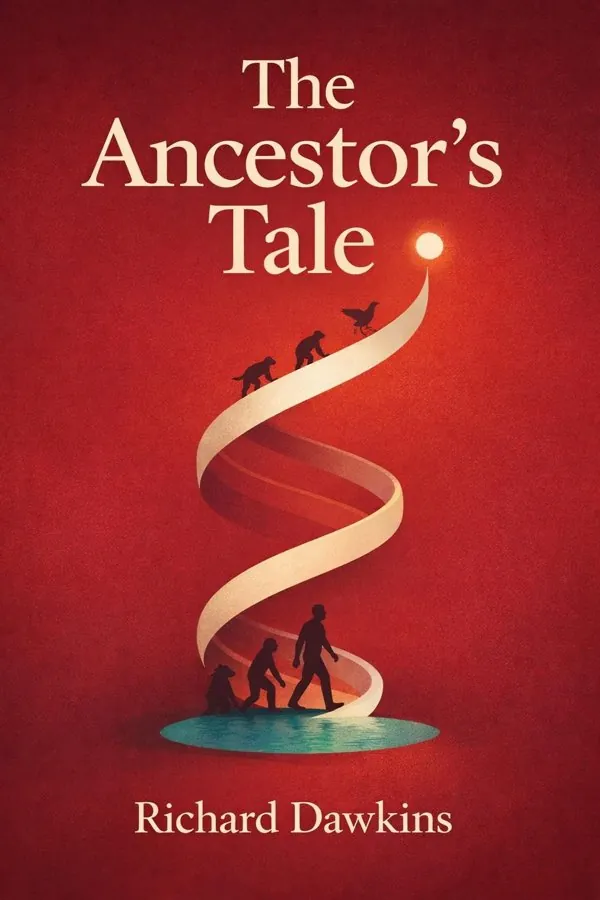
The Ancestor’s Tale: A Pilgrimage to the Dawn of Evolution: Summary & Key Insights
 10 min9 chaptersAudio available
Key Takeaways from The Ancestor’s Tale: A Pilgrimage to the Dawn of Evolution
The most unsettling idea in evolution is also the most liberating: humans are not the climax of life’s story.
Nothing punctures human exceptionalism faster than meeting our nearest living relatives.
Each branching point, or rendezvous, marks a common ancestor from which multiple lineages diverged.
By the time rodents and marsupials enter the procession, the story widens from primates to mammals as a whole.
One of Dawkins’s most powerful moves is to keep pushing the reader beyond the comfort zone of mammalian kinship.
What Is The Ancestor’s Tale: A Pilgrimage to the Dawn of Evolution About?
The Ancestor’s Tale: A Pilgrimage to the Dawn of Evolution by Richard Dawkins is a life_science book spanning 13 pages. The Ancestor’s Tale is Richard Dawkins’s grand tour of evolution told in reverse: instead of beginning with the first life and moving forward, he starts with modern humans and travels backward through time to the earliest common ancestors we share with every other living thing. Along the way, species “join” the pilgrimage at the point where our lineages converge, turning the history of life into a vivid, memorable procession rather than a dry sequence of facts. The result is both intellectually rigorous and emotionally expansive. It shows that humans are not the goal of evolution, but one twig on a vast, branching tree. What makes the book matter is its power to reshape perspective. Dawkins uses comparative anatomy, genetics, paleontology, and evolutionary logic to reveal the deep kinship connecting apes, mammals, reptiles, fish, plants, fungi, and microbes. He also dismantles common misunderstandings, especially the idea that evolution is a ladder of progress. As one of the world’s best-known evolutionary biologists and the author of The Selfish Gene, Dawkins brings authority, clarity, and narrative flair to a subject that defines how we understand life itself.
This FizzRead summary covers all 9 key chapters of The Ancestor’s Tale: A Pilgrimage to the Dawn of Evolution in approximately 10 minutes, distilling the most important ideas, arguments, and takeaways from Richard Dawkins's work. Also available as an audio summary and Key Quotes Podcast.
The Ancestor’s Tale: A Pilgrimage to the Dawn of Evolution
The Ancestor’s Tale is Richard Dawkins’s grand tour of evolution told in reverse: instead of beginning with the first life and moving forward, he starts with modern humans and travels backward through time to the earliest common ancestors we share with every other living thing. Along the way, species “join” the pilgrimage at the point where our lineages converge, turning the history of life into a vivid, memorable procession rather than a dry sequence of facts. The result is both intellectually rigorous and emotionally expansive. It shows that humans are not the goal of evolution, but one twig on a vast, branching tree.
What makes the book matter is its power to reshape perspective. Dawkins uses comparative anatomy, genetics, paleontology, and evolutionary logic to reveal the deep kinship connecting apes, mammals, reptiles, fish, plants, fungi, and microbes. He also dismantles common misunderstandings, especially the idea that evolution is a ladder of progress. As one of the world’s best-known evolutionary biologists and the author of The Selfish Gene, Dawkins brings authority, clarity, and narrative flair to a subject that defines how we understand life itself.
Who Should Read The Ancestor’s Tale: A Pilgrimage to the Dawn of Evolution?
This book is perfect for anyone interested in life_science and looking to gain actionable insights in a short read. Whether you're a student, professional, or lifelong learner, the key ideas from The Ancestor’s Tale: A Pilgrimage to the Dawn of Evolution by Richard Dawkins will help you think differently.
- ✓Readers who enjoy life_science and want practical takeaways
- ✓Professionals looking to apply new ideas to their work and life
- ✓Anyone who wants the core insights of The Ancestor’s Tale: A Pilgrimage to the Dawn of Evolution in just 10 minutes
Want the full summary?
Get instant access to this book summary and 100K+ more with Fizz Moment.
Get Free SummaryAvailable on App Store • Free to download
Key Chapters
The most unsettling idea in evolution is also the most liberating: humans are not the climax of life’s story. Dawkins begins with Homo sapiens precisely because we are tempted to imagine ourselves as the center of nature. We are the species that tells stories, builds civilizations, and studies its own origins. Yet the scientific picture strips away the comforting illusion that evolution was aiming at us. Natural selection has no foresight, no final goal, and no privileged endpoint. It produces adaptations that work well enough in specific environments, and humans are one such outcome.
This reversal matters because it changes how we interpret both our strengths and our limits. Our intelligence, language, and symbolic culture are extraordinary, but they are still evolved traits, not evidence of a separate creation. Our anatomy also carries the marks of contingency: a vulnerable spine adapted from four-legged ancestors, eyes with blind spots, and a reproductive system far from perfect engineering. Seen in this light, humanity becomes more interesting, not less. We are a historical product, assembled by cumulative change over immense stretches of time.
In practical terms, this perspective encourages humility in science, ethics, and environmental thinking. It reminds us that our needs do not automatically outrank the rest of life, and that understanding ourselves requires comparison with other species. It also helps explain human behavior as a biological inheritance shaped by ancestral conditions, while still leaving room for culture, reflection, and moral choice.
Actionable takeaway: when thinking about human nature, start with continuity rather than exception. Ask not “What makes us separate?” but “What traits do we share, and how did they evolve?”
Nothing punctures human exceptionalism faster than meeting our nearest living relatives. On Dawkins’s backward pilgrimage, chimpanzees and bonobos are the first fellow travelers to join us, because we share a remarkably recent common ancestor with them. The crucial lesson is that chimps did not descend from humans, and humans did not descend from chimps. Rather, both species are cousins growing from the same branching point. Evolution is not a ladder with one species “above” another; it is a tree with diverging lineages.
This distinction is more than a technicality. It helps explain why chimpanzees can look so familiar in expression, social behavior, and body design while still being profoundly different. We share a large proportion of our DNA, but small genetic changes, accumulated over time and filtered through selection, can produce major consequences in cognition, anatomy, and social organization. Bonobos, for instance, also illuminate how different social systems can evolve among close relatives. By comparing ourselves with chimps and bonobos, we can better understand aggression, cooperation, sexuality, alliance-building, and parental care.
The idea has practical applications in psychology, medicine, and conservation. Our kinship with primates helps researchers study inherited traits and diseases, but it also raises ethical questions about how we treat animals whose emotional and cognitive capacities overlap with ours. Conservation, too, becomes personal: protecting apes is not just preserving wildlife, but safeguarding close branches of our own extended family.
Actionable takeaway: whenever you hear that one species is “more evolved” than another, replace that language with “differently evolved.” It is a more accurate and more revealing way to think.
As gorillas, orangutans, and then Old World monkeys join the pilgrimage, Dawkins expands a simple but profound insight: relatedness is measured by shared ancestry, not superficial similarity alone. Each branching point, or rendezvous, marks a common ancestor from which multiple lineages diverged. By moving backward through these junctions, the book teaches readers to read the tree of life as a map of historical connection. Gorillas are not failed humans, monkeys are not primitive half-apes, and living species are not snapshots of our own past. All are modern survivors of ancient divergence.
This framework clarifies many common confusions. For example, if monkeys are still here, that does not challenge evolution; it confirms branching evolution. One lineage can give rise to many descendants, each adapting to different ecological niches. The same logic applies across the tree of life. Once you grasp this, the endless debates about “missing links” begin to fade, because the fossil record and living species are not expected to form a neat ladder. They reveal a bushy pattern of shared descent.
Dawkins also uses these rendezvous to highlight evidence from anatomy and genetics. Shared bone structures, grasping hands, forward-facing eyes, and molecular similarities all testify to common ancestry. These clues are like family resemblances spread across millions of years. In everyday life, this way of thinking can sharpen scientific literacy. It helps people interpret news about DNA, fossils, and species classification with greater accuracy.
Actionable takeaway: visualize evolution as a branching family tree. When learning about any species, ask where it sits on the tree and which ancestors it shares with others.
One of Dawkins’s most powerful moves is to keep pushing the reader beyond the comfort zone of mammalian kinship. It is easy to feel connected to apes and perhaps to dogs or whales. It is harder, and therefore more transformative, to recognize our kinship with reptiles, birds, amphibians, and fish. Yet the evolutionary evidence insists on exactly this. As the pilgrimage moves backward, the ancestors we share with these groups reveal that features we think of as uniquely ours are built upon far older vertebrate foundations.
Consider the skeleton: the same broad architecture reappears across vertebrates, though stretched, reduced, fused, or reshaped in different lineages. Limbs become wings, fins, hands, or running legs; jaws and ears are remodeled across deep time; embryos preserve clues to ancient developmental pathways. Birds and reptiles especially show how categories from everyday language can obscure real ancestry. Birds are not merely birdlike creatures standing apart from reptiles; they emerged from reptilian ancestry and carry that history in their bodies.
Fish and amphibians widen the frame even more. Our own limbs, lungs, and developmental patterns trace back to aquatic ancestors. The move from water to land was not a sudden leap but a series of transitional innovations. Understanding this deepens appreciation for evolution as cumulative modification, not magic transformation. In education, this perspective helps explain why comparative anatomy and developmental biology are so persuasive. In environmental policy, it fosters empathy for habitats that sustain lineages far older than humanity.
Actionable takeaway: use vertebrate similarities as evidence of history. The next time you see a bird wing, a lizard leg, or a fish fin, look for the family resemblance rather than just the difference.
Human bias tends to rank animals by how much they resemble us, but evolution does not share our preferences. When Dawkins reaches the invertebrates and later the microbial world, the book confronts a humbling truth: the vast majority of life is not like us at all, and yet it is every bit as central to life’s history. Insects, mollusks, worms, crustaceans, fungi, protists, and bacteria are not side characters in evolution. They are the main cast, both in diversity and in ecological significance.
Invertebrates demonstrate how many successful ways there are to be alive. Their body plans differ radically from vertebrate ones, revealing that evolution can explore very different structural solutions. Microbes push this lesson further. Much of the planet’s chemistry, nutrient cycling, and evolutionary innovation has been driven by microscopic life. Long before animals appeared, microbes had already shaped Earth’s atmosphere, metabolism, and ecological possibility. Even today, multicellular organisms depend on them profoundly, from digestion to decomposition to climate regulation.
This matters practically in medicine, agriculture, and public health. A microbial understanding changes how we think about antibiotics, immunity, soil health, and disease spread. It also challenges the idea that size or complexity equals importance. A species can be tiny and still alter the fate of ecosystems or civilizations. Dawkins’s reverse journey thus becomes a corrective to our anthropocentric instinct to notice only what feels familiar.
Actionable takeaway: broaden your sense of what matters in biology. Pay attention not only to large animals but also to the unseen organisms and overlooked groups that make complex life possible.
Perhaps the single most important conceptual contribution of The Ancestor’s Tale is its repeated demolition of ladder thinking. People instinctively imagine evolution as a climb from lower to higher forms, culminating in humans. Dawkins insists that this image is wrong in almost every way. Evolution has no summit, no predetermined direction, and no universal scale of advancement. There are only lineages adapting to circumstances, branching and diverging through time. Some become more complex in certain respects; others become simpler. Success means leaving descendants, not approaching an ideal.
The pilgrimage structure makes this easier to grasp because it reverses the usual narrative. By walking backward from humans to ancient common ancestors, readers see that every living species is equally modern. Amoebas, oak trees, octopuses, and humans have all been evolving for the same amount of time since their shared ancestors. None is “left behind.” This insight has consequences far beyond biology. It undermines cultural habits of ranking beings by imagined superiority and encourages more accurate language in education and communication.
It also sharpens critical thinking. Misleading phrases such as “higher life forms” or “more evolved” sneak teleology into scientific discussions. Once you notice them, you begin to see how often they distort public understanding. Dawkins’s corrective is not only factual but philosophical: history can produce complexity without aiming at it, and order can emerge without design.
Actionable takeaway: remove ladder metaphors from your vocabulary. Replace them with tree, branch, divergence, lineage, and common ancestry to think more clearly about evolution.
A recurring wonder in the book is the appearance of intricate adaptation without any guiding intelligence. Eyes, wings, echolocation, social cooperation, and biochemical pathways can seem so exquisitely fitted to their functions that design feels intuitive. Dawkins’s deeper point is that natural selection can build such complexity cumulatively, through countless small advantages preserved across generations. The elegance lies not in preplanned perfection but in the power of repeated filtering.
This explanation does not make life less marvelous; it makes it more intellectually satisfying. Features are often brilliant in one sense and makeshift in another because evolution works like a tinkerer, not an engineer starting fresh. The vertebrate eye, for example, is impressive, yet it also carries historical compromises. Human backs are capable but injury-prone. Such imperfections are exactly what we would expect from descent with modification. They are harder to explain under a model of flawless design.
The practical application is broad. Evolutionary thinking helps explain antibiotic resistance, pesticide resistance, viral change, and why selective breeding can transform species so dramatically. It also offers a mental model for cumulative improvement in human systems. Complex results often arise from iteration, selection, and retention rather than from one master plan. Businesses, technologies, and institutions frequently evolve this way too.
Dawkins does not ask readers for blind awe, but for disciplined wonder: the ability to see astonishing order and then ask what natural process produced it. That habit of explanation is one of science’s great gifts.
Actionable takeaway: when confronted by complexity, resist jumping to purpose or intention. First ask what stepwise processes could have generated the pattern over time.
The pilgrimage ends where all biological explanation eventually points: the origin of life itself. Dawkins is careful here. Evolution by natural selection explains how life diversifies after self-replicating systems arise, but it does not by itself solve the question of how the first such systems appeared. Instead of pretending certainty, he frames the origin of life as a frontier of scientific investigation. This honesty is part of the book’s strength. Science is not diminished by unanswered questions; it is defined by them.
The deeper message is that the existence of a hard question does not justify abandoning natural explanation. The early Earth offered chemistry, energy sources, and immense spans of time. Somewhere within those conditions, matter crossed a threshold into replication, heredity, and differential survival. We do not yet know every step, but we can investigate plausible pathways. The same scientific spirit that revealed common ancestry can also illuminate life’s beginnings, even if the picture remains incomplete.
This final movement gives the whole book a philosophical resonance. It invites awe without mystification, humility without surrender, and curiosity without dogma. From a practical perspective, it models an excellent intellectual attitude: separate what is well established from what is still uncertain, and remain willing to revise beliefs as evidence grows. That is useful far beyond biology, whether in policy, business, education, or personal decision-making.
Actionable takeaway: treat unanswered questions as invitations to learn, not excuses to stop thinking. Distinguish clearly between what science knows confidently and what it is still working to explain.
All Chapters in The Ancestor’s Tale: A Pilgrimage to the Dawn of Evolution
About the Author
Richard Dawkins is a British evolutionary biologist, author, and emeritus fellow of New College, Oxford. Born in 1941, he became one of the world’s most influential interpreters of Darwinian evolution through his ability to translate complex science into clear, compelling prose. His landmark book The Selfish Gene popularized the gene-centered view of evolution and introduced ideas such as the “meme” into public discourse. Over the years, Dawkins has written several major works on natural selection, adaptation, and scientific reasoning, including The Blind Watchmaker, Climbing Mount Improbable, and The Greatest Show on Earth. He is also widely known as a public intellectual and advocate for secularism and critical thinking. In The Ancestor’s Tale, he brings his signature clarity and ambition to the full sweep of life’s evolutionary history.
Get This Summary in Your Preferred Format
Read or listen to the The Ancestor’s Tale: A Pilgrimage to the Dawn of Evolution summary by Richard Dawkins anytime, anywhere. FizzRead offers multiple formats so you can learn on your terms — all free.
Available formats: App · Audio · PDF · EPUB — All included free with FizzRead
Download The Ancestor’s Tale: A Pilgrimage to the Dawn of Evolution PDF and EPUB Summary
Key Quotes from The Ancestor’s Tale: A Pilgrimage to the Dawn of Evolution
“The most unsettling idea in evolution is also the most liberating: humans are not the climax of life’s story.”
“Nothing punctures human exceptionalism faster than meeting our nearest living relatives.”
“As gorillas, orangutans, and then Old World monkeys join the pilgrimage, Dawkins expands a simple but profound insight: relatedness is measured by shared ancestry, not superficial similarity alone.”
“By the time rodents and marsupials enter the procession, the story widens from primates to mammals as a whole.”
“One of Dawkins’s most powerful moves is to keep pushing the reader beyond the comfort zone of mammalian kinship.”
Frequently Asked Questions about The Ancestor’s Tale: A Pilgrimage to the Dawn of Evolution
The Ancestor’s Tale: A Pilgrimage to the Dawn of Evolution by Richard Dawkins is a life_science book that explores key ideas across 9 chapters. The Ancestor’s Tale is Richard Dawkins’s grand tour of evolution told in reverse: instead of beginning with the first life and moving forward, he starts with modern humans and travels backward through time to the earliest common ancestors we share with every other living thing. Along the way, species “join” the pilgrimage at the point where our lineages converge, turning the history of life into a vivid, memorable procession rather than a dry sequence of facts. The result is both intellectually rigorous and emotionally expansive. It shows that humans are not the goal of evolution, but one twig on a vast, branching tree. What makes the book matter is its power to reshape perspective. Dawkins uses comparative anatomy, genetics, paleontology, and evolutionary logic to reveal the deep kinship connecting apes, mammals, reptiles, fish, plants, fungi, and microbes. He also dismantles common misunderstandings, especially the idea that evolution is a ladder of progress. As one of the world’s best-known evolutionary biologists and the author of The Selfish Gene, Dawkins brings authority, clarity, and narrative flair to a subject that defines how we understand life itself.
More by Richard Dawkins
You Might Also Like
The Selfish Gene
Richard Dawkins
10 min
Awakenings
Oliver Sacks
10 min
Parasite Rex: Inside the Bizarre World of Nature's Most Dangerous Creatures
Carl Zimmer
10 min
The Atlas of Life on Earth
Various
10 min
The Book of Humans: The Story of How We Became Us
Adam Rutherford
10 min
The Horse
Wendy Williams
10 minBrowse by Category
Ready to read The Ancestor’s Tale: A Pilgrimage to the Dawn of Evolution?
Get the full summary and 100K+ more books with Fizz Moment.