
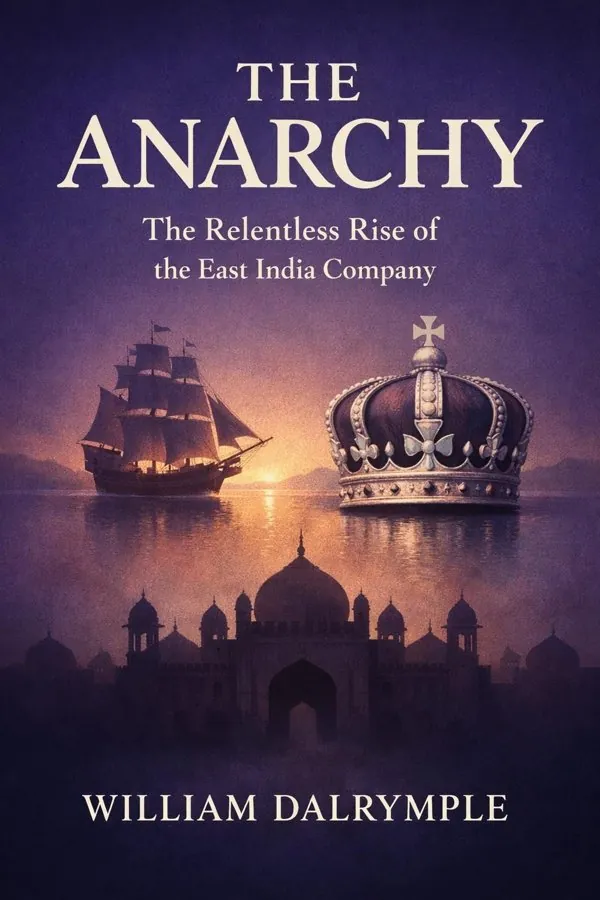
The Anarchy: The Relentless Rise of the East India Company: Summary & Key Insights
 10 min10 chaptersAudio available
Key Takeaways from The Anarchy: The Relentless Rise of the East India Company
One of the book’s most unsettling insights is that the East India Company did not begin as an empire-builder at all; it began as a business.
Empires often justify conquest by portraying the conquered as weak, chaotic, or backward.
The East India Company did not defeat a united India in a single march of conquest.
Some battles matter less for their military scale than for the political doors they open.
The most chilling truth in The Anarchy is that the East India Company governed not to serve a population, but to enrich shareholders.
What Is The Anarchy: The Relentless Rise of the East India Company About?
The Anarchy: The Relentless Rise of the East India Company by William Dalrymple is a world_history book spanning 11 pages. What happens when a profit-seeking corporation acquires an army, manipulates governments, and begins ruling millions of people? In The Anarchy, William Dalrymple answers that question through the astonishing and disturbing story of the East India Company. What began as a commercial venture founded by English merchants in 1600 gradually transformed into one of the most aggressive political forces in world history, exploiting the weakening of Mughal authority to conquer vast territories across India. Dalrymple shows that empire was not initially built by the British state, but by a private company driven by shareholders, speculation, and greed. This book matters because it reframes imperial history in a way that feels urgently contemporary. It is not only about battles and emperors, but also about corporate overreach, financial corruption, political lobbying, and the devastating human cost of unchecked private power. Dalrymple, one of the most respected historians of South Asia, combines archival depth with vivid storytelling to make this history feel immediate and relevant. The result is a gripping account of how commerce, violence, and ambition combined to reshape India and the modern world.
This FizzRead summary covers all 10 key chapters of The Anarchy: The Relentless Rise of the East India Company in approximately 10 minutes, distilling the most important ideas, arguments, and takeaways from William Dalrymple's work. Also available as an audio summary and Key Quotes Podcast.
The Anarchy: The Relentless Rise of the East India Company
What happens when a profit-seeking corporation acquires an army, manipulates governments, and begins ruling millions of people? In The Anarchy, William Dalrymple answers that question through the astonishing and disturbing story of the East India Company. What began as a commercial venture founded by English merchants in 1600 gradually transformed into one of the most aggressive political forces in world history, exploiting the weakening of Mughal authority to conquer vast territories across India. Dalrymple shows that empire was not initially built by the British state, but by a private company driven by shareholders, speculation, and greed.
This book matters because it reframes imperial history in a way that feels urgently contemporary. It is not only about battles and emperors, but also about corporate overreach, financial corruption, political lobbying, and the devastating human cost of unchecked private power. Dalrymple, one of the most respected historians of South Asia, combines archival depth with vivid storytelling to make this history feel immediate and relevant. The result is a gripping account of how commerce, violence, and ambition combined to reshape India and the modern world.
Who Should Read The Anarchy: The Relentless Rise of the East India Company?
This book is perfect for anyone interested in world_history and looking to gain actionable insights in a short read. Whether you're a student, professional, or lifelong learner, the key ideas from The Anarchy: The Relentless Rise of the East India Company by William Dalrymple will help you think differently.
- ✓Readers who enjoy world_history and want practical takeaways
- ✓Professionals looking to apply new ideas to their work and life
- ✓Anyone who wants the core insights of The Anarchy: The Relentless Rise of the East India Company in just 10 minutes
Want the full summary?
Get instant access to this book summary and 100K+ more with Fizz Moment.
Get Free SummaryAvailable on App Store • Free to download
Key Chapters
One of the book’s most unsettling insights is that the East India Company did not begin as an empire-builder at all; it began as a business. Chartered by Queen Elizabeth I, it entered Asian waters seeking spices, textiles, and trading privileges. Its early voyages were fragile, expensive, and dangerous, and the Company initially appeared far weaker than the mighty states with which it hoped to trade. In Mughal India, English merchants were supplicants, not masters. They negotiated for factory rights, courted local rulers, and relied on diplomacy simply to survive.
Yet Dalrymple shows how commercial organizations can evolve when profit opportunities collide with political instability. The Company learned to combine trade with coercion. It built fortified settlements, maintained armed guards, and slowly developed the military capacity to defend and then expand its interests. What began as protection for commerce turned into intervention in local disputes. Intervention became influence. Influence became rule.
This pattern matters far beyond early modern history. The Company’s story shows how institutions often outgrow their original mission. Businesses that claim to be solving practical problems can accumulate influence in finance, politics, and security. Modern readers can see echoes in multinational corporations that shape legislation, control supply chains, or exert pressure over governments.
A practical way to apply this idea is to ask of any powerful institution: what incentives drive it, and what happens when it gains tools beyond its original purpose? Mission creep is rarely announced; it happens gradually. The East India Company’s rise reminds us to watch not only what organizations say they are, but what powers they are quietly acquiring.
Actionable takeaway: whenever a commercial institution gains political, legal, or military influence, examine its incentives early—before profit-seeking hardens into domination.
Empires often justify conquest by portraying the conquered as weak, chaotic, or backward. Dalrymple powerfully rejects that myth. Before the East India Company rose to dominance, India under the Mughals was one of the world’s richest, most sophisticated civilizations. Its cities were larger than many in Europe, its artisans produced coveted textiles and luxury goods, and its administrative systems, court culture, architecture, and revenue networks reflected immense complexity. The Company did not create prosperity in India; it targeted prosperity that already existed.
Understanding this changes the moral and historical frame of the story. The British did not step into a vacuum. They inserted themselves into an advanced political and economic order, first as traders benefiting from Mughal stability and later as opportunists exploiting Mughal fragmentation. Figures such as Akbar, Jahangir, Shah Jahan, and Aurangzeb oversaw a realm whose wealth dazzled foreign visitors. European merchants came to India because India mattered enormously to the global economy.
This matters today because historical narratives still shape public memory. When people imagine colonialism as modernization brought from outside, they overlook what was displaced, drained, or destroyed. In practical terms, this insight encourages readers to question any story that treats intervention as inherently civilizing. Whether in history, business, or politics, external actors often succeed by appropriating systems built by others.
A useful application is intellectual humility. Before judging an institution, community, or country by the moment of its crisis, ask what strengths existed before that crisis. Decline can obscure prior excellence.
Actionable takeaway: whenever you encounter a story of conquest or takeover, first identify what value, sophistication, and stability already existed before outsiders claimed control.
The East India Company did not defeat a united India in a single march of conquest. It advanced through fragmentation. After Aurangzeb’s death, Mughal central authority weakened, and regional powers, court factions, military entrepreneurs, and ambitious governors competed for influence. This did not mean India suddenly became powerless; rather, it became politically fractured. The Company exploited that fragmentation with remarkable skill. It offered loans, military backing, treaties, and selective alliances, presenting itself as a useful partner while preparing to become a dominant one.
Dalrymple emphasizes that imperial rise often depends less on raw strength than on the ability to manipulate divisions within existing systems. The Company backed one claimant against another, turned local disputes into opportunities, and used diplomacy as aggressively as warfare. It succeeded not simply because its officers were brilliant, but because its rivals were divided and often underestimated the long-term consequences of relying on foreign corporate muscle.
This pattern appears in many contexts. In organizations, competitors rarely take over healthy, unified institutions. They gain ground when leadership fractures, when departments compete, or when short-term interests override shared purpose. In geopolitics, outside powers still exploit domestic polarization. In personal life, too, divided priorities make people vulnerable to manipulation.
The practical lesson is that internal disunity can invite external control. Strong systems do not need to be perfect, but they do need mechanisms for coordination, conflict resolution, and long-term thinking. If every faction seeks immediate advantage, the whole structure becomes easy to capture.
Actionable takeaway: protect any institution you value by addressing internal fractures early, because external actors often win by amplifying division rather than by overpowering unity.
Some battles matter less for their military scale than for the political doors they open. The Battle of Plassey in 1757 is one of those moments. On the surface, it was a relatively small confrontation in Bengal between the forces of Siraj ud-Daulah and the East India Company under Robert Clive. But Dalrymple shows that its real significance lay in intrigue, bribery, and betrayal. The Company secured victory not through overwhelming military genius alone, but by engineering defections among Bengali elites, especially Mir Jafar.
The consequences were enormous. Bengal was among the richest regions in the world, and control over its revenues transformed the Company from a merchant body into a territorial power with financial muscle. Plassey gave the Company something more valuable than trade concessions: access to state income. Once a private corporation could extract revenue from land and people, it could fund armies, buy influence, and expand further. In effect, Bengal became the engine of corporate empire.
Dalrymple’s treatment of Plassey also exposes how corruption can reshape history. Secret deals, private enrichment, and shareholder interests were not side effects; they were central mechanisms. In modern terms, the battle reads like a hostile takeover executed through financial manipulation and political capture.
Readers can apply this lesson by looking beyond headline events to the systems they unlock. Major turning points are often less about the visible drama and more about who gains control over cash flow, legitimacy, and institutional leverage.
Actionable takeaway: when assessing any political or corporate victory, ask not just who won the event, but who gained lasting control over money, decision-making, and future outcomes.
The most chilling truth in The Anarchy is that the East India Company governed not to serve a population, but to enrich shareholders. Once it acquired tax-collecting rights, especially in Bengal, the Company redirected wealth on an immense scale. Revenue was squeezed from peasants, local industries were subordinated to imperial demand, and fortunes were sent to Britain. Company servants amassed private riches through graft and coercion, while the institution itself treated Indian territories as assets to be monetized.
Dalrymple connects this extraction to human suffering. The Bengal Famine of 1770, in which millions died, was not simply a natural disaster. It unfolded within a system of ruthless revenue demands, commercial monopolies, and administrative indifference. A state-oriented government might, at least in theory, balance revenue collection with social stability. A corporation accountable primarily to profit behaves differently. That distinction sits at the heart of the book.
This idea has wide relevance. Extraction happens whenever institutions view people, land, labor, or data mainly as resources to be harvested. Whether in colonial rule, industrial labor systems, or digital economies, the warning remains: when accountability is weak and profit is supreme, human costs are often externalized.
A practical application is to examine incentives behind policies and business models. Who bears the risk? Who captures the reward? If an organization prospers while communities become more vulnerable, extraction is probably at work even if the language used is neutral or technical.
Actionable takeaway: evaluate powerful institutions by following the flow of value—if wealth consistently moves upward while hardship moves downward, you are likely looking at an extractive system.
History often separates war from negotiation, but Dalrymple shows that the East India Company treated them as complementary tools. Company expansion depended on a flexible mix of treaties, subsidies, intelligence networks, military intimidation, and selective warfare. It was as willing to sign an agreement as to break one when circumstances shifted. Diplomacy was not a peaceful alternative to coercion; it was often the softer face of coercion itself.
This is especially visible in the Company’s dealings with Indian rulers such as the nawabs of Bengal, the rulers of Awadh, Mysore under Haidar Ali and Tipu Sultan, and the Maratha confederacy. It cultivated allies, promised protection, and then converted dependency into subordination. Local elites sometimes cooperated for pragmatic reasons, hoping to secure advantage against rivals. Yet each concession widened the Company’s leverage.
The lesson is that power rarely operates through a single instrument. Strong actors combine pressure points. They use legal agreements, economic dependency, public narratives, and force in layered ways. This insight remains highly relevant in contemporary politics, business negotiations, and international relations. A contract signed under structural imbalance may be formally voluntary while functionally coercive.
To apply this idea, look at the full ecosystem of influence whenever a deal is presented as mutually beneficial. What hidden dependencies exist? Who has enforcement power? Who can afford to walk away? Understanding context helps distinguish real partnership from managed submission.
Actionable takeaway: never evaluate an agreement in isolation—examine the surrounding balance of power, because diplomacy under inequality often serves domination rather than cooperation.
A story of conquest can easily become a story of inevitability, but The Anarchy resists that simplification. Dalrymple highlights the many forms of resistance that challenged Company expansion. Indian rulers, soldiers, financiers, and local populations did not passively accept foreign corporate rule. From Siraj ud-Daulah to Tipu Sultan and the Marathas, there were repeated efforts to contain, defeat, or outmaneuver the Company. Even after territorial gains, resentment simmered among those burdened by annexation, taxation, and cultural intrusion.
This resistance matters because it restores agency to historical actors too often reduced to victims. The Company won many decisive victories, but its path was contested, unstable, and costly. The eventual uprising of 1857, though beyond the book’s main center of gravity, can be understood as the culmination of long-building anger toward Company practices. Corporate empire was powerful, but it was never universally accepted or morally legitimate.
There is also a broader lesson here: domination always generates pushback, even if that resistance is fragmented or ultimately defeated. In workplaces, politics, and civil society, unjust systems can appear stable right until accumulated grievances find expression. Failure to see resistance is often a failure of perspective, not proof of consent.
A practical use of this idea is to look for submerged opposition in any unequal system. Silence may reflect fear, exhaustion, or lack of coordination, not approval. Wise leaders pay attention to early warning signs instead of assuming compliance means legitimacy.
Actionable takeaway: do not mistake temporary control for lasting consent—where exploitation persists, resistance is often present, even before it becomes visible.
It is tempting to think the East India Company went wrong because of a few immoral individuals. Dalrymple argues something more disturbing: corruption was built into the structure. Company servants were poorly supervised, enriched by private trade, and encouraged by a culture that rewarded opportunism. In India, men like Robert Clive and Warren Hastings operated in an environment where public authority and private gain constantly overlapped. Fortunes were made through gifts, contracts, monopolies, and political manipulation.
In Britain, scandals erupted as returning Company men bought estates, influenced Parliament, and became symbols of sudden, suspect wealth. The Company’s political clout helped it resist reform even as evidence of abuse accumulated. This blurring of corporate and state power is one of the book’s most modern themes. The issue was not merely theft, but a governance model in which oversight lagged far behind the scale of power.
The lesson extends well beyond eighteenth-century India. Systems become corrupt when incentives normalize conflict of interest. If those making decisions can personally profit from weak rules, corruption stops being exceptional and becomes routine. Organizations then struggle not because they lack ethics policies, but because their basic reward structure undermines them.
A practical application is to pay close attention to institutional design. Are there independent checks? Transparent reporting? Clear separation between public duty and private benefit? Culture matters, but structure matters more when large sums and political influence are involved.
Actionable takeaway: when evaluating any institution, ask whether its incentives make integrity easy or expensive—because corruption flourishes where personal enrichment is quietly built into the system.
One of the central ironies of The Anarchy is that the East India Company became too powerful, too abusive, and too destabilizing for even Britain to ignore. As scandals multiplied and governance failures became impossible to disguise, Parliament gradually intervened. Regulatory acts, public inquiries, and political battles reflected a growing recognition that a private corporation controlling armies, territories, and tax systems posed grave dangers. The transition to Crown rule after the uprising of 1857 marked the formal end of Company sovereignty.
But Dalrymple does not present this as a clean moral correction. The British state inherited and continued imperial domination, even if it imposed more direct oversight. Still, the shift matters because it reveals a recurring historical pattern: societies often allow private power to grow until crisis forces belated regulation. By then, the damage is already deep.
This insight has contemporary bite. Financial institutions, technology platforms, defense contractors, and multinational firms can acquire quasi-governmental influence before laws adapt. Public authorities frequently hesitate to regulate actors they depend on or profit from. The result is a cycle of permissiveness, scandal, and reactive reform.
The practical lesson is that accountability should not wait for catastrophe. Oversight is most effective before concentrated power becomes entrenched. Once institutions control infrastructure, security, or mass livelihoods, reform becomes politically and economically difficult.
Actionable takeaway: support early, clear oversight of powerful private actors, because regulation imposed only after abuse becomes visible usually arrives after immense human and institutional costs.
The East India Company is gone, but its legacy endures in political borders, economic inequalities, legal systems, and historical memory. Dalrymple makes clear that the Company’s rise was not a strange episode sealed in the past. It helped transfer wealth from India to Britain, altered patterns of governance, weakened old elites, and laid foundations for the British Raj. It also left behind deeper habits of extraction and administrative centralization that continued under colonial rule and influenced the modern state.
Just as important is the book’s warning about corporate power in the present. The Company was an early multinational with shareholders, lobbying networks, military capacity, and global reach. Its history challenges the comforting belief that private enterprise is naturally restrained by markets or that commerce is inherently civilizing. Under the right conditions, a corporation can become sovereign in all but name.
For modern readers, this legacy offers both a historical and civic lesson. It urges us to connect colonial history to today’s debates about supply chains, monopolies, resource extraction, and the responsibilities of global firms. It also encourages a more honest reckoning with how wealth and power were accumulated.
The best application is comparative thinking. When we encounter institutions that dominate communication, labor, logistics, finance, or security, we should ask not only what services they provide, but what forms of dependency they create and what limits constrain them.
Actionable takeaway: read imperial history as a guide to the present—then use it to question concentrated corporate power before it acquires social authority that democratic systems struggle to contain.
All Chapters in The Anarchy: The Relentless Rise of the East India Company
About the Author
William Dalrymple is a British historian, writer, and broadcaster widely recognized for his work on the history of India, the Mughal world, and the British Empire in South Asia. He is known for blending meticulous archival research with highly readable narrative storytelling, making complex historical subjects accessible to a broad audience. Among his best-known books are The Last Mughal, White Mughals, Return of a King, and City of Djinns, many of which have won major literary and historical awards. Dalrymple has spent decades studying the political and cultural entanglements between Britain and India, and he is also a prominent public intellectual on imperial history. In The Anarchy, he brings that expertise to one of the most consequential and cautionary stories in global history.
Get This Summary in Your Preferred Format
Read or listen to the The Anarchy: The Relentless Rise of the East India Company summary by William Dalrymple anytime, anywhere. FizzRead offers multiple formats so you can learn on your terms — all free.
Available formats: App · Audio · PDF · EPUB — All included free with FizzRead
Download The Anarchy: The Relentless Rise of the East India Company PDF and EPUB Summary
Key Quotes from The Anarchy: The Relentless Rise of the East India Company
“One of the book’s most unsettling insights is that the East India Company did not begin as an empire-builder at all; it began as a business.”
“Empires often justify conquest by portraying the conquered as weak, chaotic, or backward.”
“The East India Company did not defeat a united India in a single march of conquest.”
“Some battles matter less for their military scale than for the political doors they open.”
“The most chilling truth in The Anarchy is that the East India Company governed not to serve a population, but to enrich shareholders.”
Frequently Asked Questions about The Anarchy: The Relentless Rise of the East India Company
The Anarchy: The Relentless Rise of the East India Company by William Dalrymple is a world_history book that explores key ideas across 10 chapters. What happens when a profit-seeking corporation acquires an army, manipulates governments, and begins ruling millions of people? In The Anarchy, William Dalrymple answers that question through the astonishing and disturbing story of the East India Company. What began as a commercial venture founded by English merchants in 1600 gradually transformed into one of the most aggressive political forces in world history, exploiting the weakening of Mughal authority to conquer vast territories across India. Dalrymple shows that empire was not initially built by the British state, but by a private company driven by shareholders, speculation, and greed. This book matters because it reframes imperial history in a way that feels urgently contemporary. It is not only about battles and emperors, but also about corporate overreach, financial corruption, political lobbying, and the devastating human cost of unchecked private power. Dalrymple, one of the most respected historians of South Asia, combines archival depth with vivid storytelling to make this history feel immediate and relevant. The result is a gripping account of how commerce, violence, and ambition combined to reshape India and the modern world.
More by William Dalrymple

You Might Also Like
The Age of Capital
Eric Hobsbawm
10 min
The Gulag Archipelago
Aleksandr Solzhenitsyn
10 min
Jerusalem: The Biography
Simon Sebag Montefiore
10 min
The Anglo-Saxons
James Campbell
10 min
The Boer War
Thomas Pakenham
10 min
The Industrial Revolutionaries: The Making of the Modern World 1776–1914
Gavin Weightman
10 minBrowse by Category
Ready to read The Anarchy: The Relentless Rise of the East India Company?
Get the full summary and 100K+ more books with Fizz Moment.