
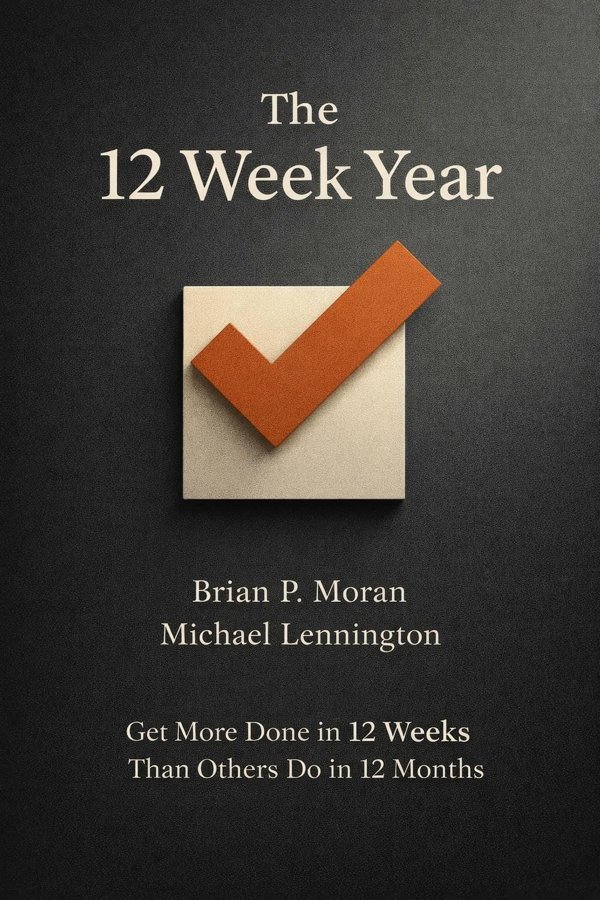
The 12 Week Year: Summary & Key Insights
by Brian Moran
 10 min9 chaptersAudio available
Key Takeaways from The 12 Week Year
A year is long enough to make almost any goal feel comfortably distant.
People rarely sustain difficult habits for goals they do not deeply care about.
Most productivity problems are not caused by laziness; they are caused by dilution.
Ambition without a plan is usually just optimism in disguise.
Many people resist accountability because they associate it with blame, pressure, or external control.
What Is The 12 Week Year About?
The 12 Week Year by Brian Moran is a productivity book published in 2013 spanning 5 pages. The 12 Week Year is a practical productivity classic that argues most people do not fail because they lack talent or ambition—they fail because they operate inside a time system that encourages delay. Brian Moran and Michael Lennington challenge the familiar rhythm of annual planning and replace it with a far tighter execution cycle: 12 weeks. Their central idea is simple but powerful. When a year feels long, people postpone important work, overestimate what they can do later, and lose focus. But when the horizon shrinks to 12 weeks, priorities sharpen, urgency rises, and execution improves. What makes this book matter is that it does not stop at motivation. It offers a full operating system for turning vision into results through clear goals, weekly planning, scorekeeping, and accountability. Moran writes from deep experience as a performance consultant helping leaders and organizations improve execution, and that practical background gives the book its credibility. This is not theory for its own sake. It is a repeatable method for anyone who wants to accomplish more in less time, whether in business, health, sales, leadership, or personal growth.
This FizzRead summary covers all 9 key chapters of The 12 Week Year in approximately 10 minutes, distilling the most important ideas, arguments, and takeaways from Brian Moran's work. Also available as an audio summary and Key Quotes Podcast.
The 12 Week Year
The 12 Week Year is a practical productivity classic that argues most people do not fail because they lack talent or ambition—they fail because they operate inside a time system that encourages delay. Brian Moran and Michael Lennington challenge the familiar rhythm of annual planning and replace it with a far tighter execution cycle: 12 weeks. Their central idea is simple but powerful. When a year feels long, people postpone important work, overestimate what they can do later, and lose focus. But when the horizon shrinks to 12 weeks, priorities sharpen, urgency rises, and execution improves.
What makes this book matter is that it does not stop at motivation. It offers a full operating system for turning vision into results through clear goals, weekly planning, scorekeeping, and accountability. Moran writes from deep experience as a performance consultant helping leaders and organizations improve execution, and that practical background gives the book its credibility. This is not theory for its own sake. It is a repeatable method for anyone who wants to accomplish more in less time, whether in business, health, sales, leadership, or personal growth.
Who Should Read The 12 Week Year?
This book is perfect for anyone interested in productivity and looking to gain actionable insights in a short read. Whether you're a student, professional, or lifelong learner, the key ideas from The 12 Week Year by Brian Moran will help you think differently.
- ✓Readers who enjoy productivity and want practical takeaways
- ✓Professionals looking to apply new ideas to their work and life
- ✓Anyone who wants the core insights of The 12 Week Year in just 10 minutes
Want the full summary?
Get instant access to this book summary and 100K+ more with Fizz Moment.
Get Free SummaryAvailable on App Store • Free to download
Key Chapters
A year is long enough to make almost any goal feel comfortably distant. That distance is the hidden reason so many well-intentioned plans collapse. In traditional annual thinking, people assume there will always be time later to catch up. January feels full of promise, spring seems early, summer gets busy, and by autumn the pressure finally appears—often too late. Moran argues that the annual cycle encourages procrastination, weak urgency, and uneven execution.
The 12 Week Year replaces the annual horizon with a 12-week performance period. This creates a shorter runway and a more immediate deadline, forcing people to focus on what matters now rather than on vague intentions for someday. The point is not to cram a year of work into three months. The point is to think and act with greater precision. A shorter cycle makes trade-offs clearer, reduces the number of goals you can pretend to pursue, and reveals whether your daily behavior actually supports your ambitions.
Imagine a sales manager who sets an annual revenue target. For months, underperformance can hide behind the belief that the team will make it up later. In a 12-week cycle, however, the numbers expose reality much sooner, allowing course correction while there is still time. The same applies to fitness, writing, studying, or launching a product.
The deeper insight is that execution improves when time feels real. A shorter cycle compresses feedback, increases engagement, and creates momentum through repeated finishes. Actionable takeaway: stop planning your most important goals on a vague yearly timeline and choose one to three meaningful outcomes to pursue over the next 12 weeks.
People rarely sustain difficult habits for goals they do not deeply care about. That is why Moran insists that execution starts with vision, not tactics. Vision is more than a mission statement or motivational phrase. It is a vivid picture of the life and results you want, connected to values that matter enough to carry you through inconvenience, boredom, and setbacks.
In the book, vision operates at multiple levels. There is a long-term vision for your life, a medium-term picture for the next few years, and then the short-term vision expressed through your current 12-week goals. This layered structure matters because short-term effort becomes easier when linked to a larger purpose. Waking up early to exercise feels different when it is tied to being energetic for your children. Prospecting feels less tedious when it supports your goal of building financial freedom or leading a high-performing team.
Without vision, accountability feels oppressive and planning feels mechanical. With vision, those same tools become supportive. A clear vision also helps you choose what not to do. Many people are overwhelmed not because they have too little ambition, but because they try to pursue too many disconnected things at once. Vision creates a filter.
Consider someone who wants career advancement, better health, and stronger relationships. A compelling vision clarifies which goals belong in this 12-week cycle and which should wait. Instead of scattering effort, they commit to three outcomes that genuinely move life forward.
Actionable takeaway: write a short description of the life and results you want three years from now, then identify how your next 12-week goals directly support that vision.
Most productivity problems are not caused by laziness; they are caused by dilution. People spread their energy across too many goals, projects, meetings, and obligations, then wonder why progress feels slow. One of the most powerful ideas in The 12 Week Year is that effectiveness increases when you narrow your focus. You do not need more commitments. You need better commitments.
Moran recommends selecting a small number of high-impact goals for each 12-week cycle. These should be measurable, meaningful, and realistically achievable within the period. The key is that they are not merely activity goals such as “work harder” or “be more organized.” They are outcome goals, supported by specific lead actions. For example, a consultant may choose to sign five new clients, improve sleep to seven hours a night, and complete a professional certification module.
This discipline feels uncomfortable at first because saying yes to one priority means saying no to many others. But that is exactly the point. Strategic focus creates the concentration required for results. In business, a team that identifies one key quarterly initiative often outperforms another team juggling six. In personal life, someone focused on finishing a thesis will progress faster than someone simultaneously trying to learn a language, train for a marathon, renovate a house, and start a side hustle.
Fewer priorities also make planning easier. Once your goals are clear, you can identify the critical actions that drive them and eliminate busywork that creates motion without progress.
Actionable takeaway: choose no more than three major 12-week goals and ask of every task on your calendar, “Does this directly support one of those goals?” If not, reduce, delegate, or delay it.
Ambition without a plan is usually just optimism in disguise. Moran emphasizes that clear goals alone are not enough; you must translate them into weekly actions. The 12 Week Year planning process is intentionally simple. You define your 12-week goals, identify the tactics needed to achieve them, and then build those tactics into weekly execution. The value of planning is not in producing a beautiful document. It is in creating clarity about what must happen next.
A strong 12-week plan includes measurable outcomes and the lead actions that influence them. For instance, if your goal is to generate more business, your plan might specify outreach calls, follow-up meetings, proposal deadlines, and referral requests. If your goal is health-related, your tactics may include meal preparation, gym sessions, a bedtime routine, and daily steps. The plan makes success concrete.
The weekly plan is where execution becomes real. Rather than reacting to email, urgency, or mood, you proactively schedule actions tied to your goals. This prevents important work from being crowded out by less important demands. It also reduces decision fatigue. When you already know the critical tasks for the week, you spend less energy asking what to do and more energy doing it.
Planning should be flexible but not casual. Life will disrupt the week, but having a plan allows you to adjust deliberately rather than drift. Think of it as your default path back to what matters.
Actionable takeaway: at the start of each week, write down the specific actions that move your 12-week goals forward and place them on your calendar before less important obligations fill the space.
Many people resist accountability because they associate it with blame, pressure, or external control. Moran reframes it as personal ownership. True accountability is not about someone catching you fail; it is about choosing to live in alignment with your commitments. In this sense, accountability is empowering because it returns control to your behavior rather than to your excuses.
The book distinguishes between intentions and commitments. We all intend to do many things, but commitments show up in action. Accountability asks a simple question: did you do what you said you would do? This is uncomfortable because it removes the emotional comfort of rationalization. Yet it is also liberating because progress becomes measurable and improvable.
A useful example is weekly review. If you planned to exercise four times, write two proposals, and hold three prospecting calls, accountability means honestly checking whether those actions happened. If they did not, the goal is not to shame yourself. The goal is to understand the gap. Did you overcommit? Did you avoid difficult work? Did you fail to protect time? That insight helps improve the next week.
Accountability can be strengthened through peers, teams, or coaches. A weekly meeting where each person reports execution creates healthy pressure and support. But even without a formal system, self-accountability can be built through scorekeeping and reflection.
The broader lesson is that high performance depends less on inspiration than on honoring commitments repeatedly over time. Actionable takeaway: at the end of every week, review your planned actions, score your execution honestly, and identify one behavior you must improve next week.
Change often feels exciting at the beginning and discouraging in the middle. That pattern is so common that Moran treats it as predictable rather than personal. Whenever you adopt a new system, habit, or standard, you typically pass through an emotional cycle. First comes optimism: the plan looks clear, motivation is high, and improvement feels inevitable. Then comes informed pessimism: reality intrudes, obstacles appear, and the effort seems harder than expected. If you persist, you eventually reach informed optimism and, finally, success and fulfillment.
This framework matters because many people quit in the second stage. They misinterpret difficulty as a sign that the method is broken or that they are not capable. In truth, friction is often evidence that meaningful change is underway. A new sales routine, writing habit, or fitness plan initially collides with old patterns, competing demands, and internal resistance.
Recognizing the emotional cycle helps you respond more intelligently. Instead of panicking when enthusiasm fades, you can prepare for the dip. For example, if you know week three of a new routine tends to feel messy, you can simplify your plan, seek support, and recommit to basic actions rather than abandoning the effort entirely.
This idea also explains why willpower alone is unreliable. Emotions fluctuate. Systems, scoreboards, and scheduled routines carry you through when feelings do not. In that sense, discipline is less about toughness than about structure.
Actionable takeaway: when your motivation drops during a 12-week cycle, do not rewrite your goals in a moment of frustration; assume you are in the normal discomfort phase of change and focus on completing the next planned action.
If you do not measure execution, you are left with stories instead of facts. Moran argues that measurement is one of the most underused tools in personal and professional performance. People often believe they are working hard, but without tracking results and key actions, they cannot know whether that effort is effective. Measurement makes progress visible, exposes gaps early, and creates the urgency needed for course correction.
The 12 Week Year introduces scorekeeping as a central discipline. You track both outcomes and execution. Outcomes tell you what happened—revenue earned, pounds lost, chapters written. Execution tells you whether you completed the lead actions most likely to drive those results—calls made, workouts finished, pages drafted. This distinction is crucial because outcomes can lag. Good execution today often produces results later.
Weekly scoring is especially powerful. Moran suggests that if you complete around 85 percent of your planned actions, you are operating at a high level. That benchmark gives people a concrete way to assess performance. A team might discover that although motivation seems high, execution is only at 55 percent. That fact changes the conversation from vague frustration to specific improvement.
Measurement also helps sustain momentum. A visible scoreboard can turn progress into a game, making consistency more rewarding. Whether you use a spreadsheet, notebook, or app, the act of tracking reinforces attention.
Actionable takeaway: create a simple weekly scoreboard with your 12-week goals, the lead actions tied to them, and your completion rate, then review it every week to see what is actually driving results.
Most weeks are not lost in dramatic failures. They are lost in drift. Meetings expand, inboxes multiply, urgent requests appear, and by Friday you realize your important work was postponed again. Moran presents the weekly review as one of the most practical habits in the entire system because it interrupts drift and restores intentionality.
A weekly review is a scheduled appointment with your goals. You examine the past week’s execution, assess your score, identify lessons, and build the next week around priority actions. This rhythm creates a closed loop between planning and performance. Instead of setting goals once and hoping for the best, you repeatedly reconnect your daily activities to your 12-week commitments.
The review also has psychological benefits. It reduces the guilt that comes from vague underperformance because it turns reflection into problem-solving. If prospecting did not happen, you ask why. Was the task undefined? Was the time block too late in the day? Did low-value work crowd it out? This level of review transforms missed actions into data.
In practice, a manager might spend 20 minutes every Friday checking metrics, reviewing calendar use, and scheduling next week’s critical actions. A student could use Sunday evening to evaluate study sessions and plan assignments before the week becomes reactive. The exact format matters less than the consistency.
What makes the weekly review so effective is that it compresses learning. Instead of waiting until the end of a quarter or year to discover what failed, you improve every seven days.
Actionable takeaway: reserve a recurring 20- to 30-minute weekly review on your calendar and treat it as non-negotiable time to score, learn, and plan.
Everyone gets the same number of hours, but not everyone uses them with equal intention. Moran argues that productivity is not primarily about getting more done; it is about spending time in ways that produce the most meaningful results. In the 12 Week Year system, time becomes strategic. Rather than letting the day be dictated by interruptions and habit, you assign time according to your priorities.
The book highlights structured time blocks as a way to protect execution. This can include strategic blocks for deep work on important goals, buffer blocks for routine tasks and communication, and breakout time to recover and renew. The idea is simple: if your most important work does not have a place on the calendar, less important work will take its place.
For example, an entrepreneur might schedule a two-hour strategic block every morning for product development, a midday buffer block for email and calls, and an afternoon client block for meetings. A writer might protect the first 90 minutes of the day for drafting before opening messages. These patterns reduce fragmentation and ensure progress on meaningful work even during busy periods.
Intentional time use also reveals trade-offs. Saying yes to every request feels generous, but it often means saying no to your own goals. The discipline of time-blocking forces you to confront that reality. It can feel restrictive at first, yet many people find it freeing because it replaces constant decision-making with designed focus.
Actionable takeaway: identify one recurring block of uninterrupted time each week for your highest-value work and defend it as seriously as you would defend an important meeting with someone else.
All Chapters in The 12 Week Year
About the Author
Brian P. Moran is a business strategist, speaker, and execution expert known for helping individuals and organizations improve performance through better planning and accountability. Over the course of his career, he has worked with leaders, sales teams, and companies seeking stronger execution and more consistent results. Moran is best known as the co-author of The 12 Week Year, a widely read productivity book that challenges traditional annual planning and introduces a shorter, more focused framework for achieving goals. His work draws on years of consulting experience in performance management, leadership, and strategic implementation. Rather than relying on abstract motivation, Moran emphasizes practical systems that connect vision to daily action, making his ideas especially useful for professionals who want measurable progress.
Get This Summary in Your Preferred Format
Read or listen to the The 12 Week Year summary by Brian Moran anytime, anywhere. FizzRead offers multiple formats so you can learn on your terms — all free.
Available formats: App · Audio · PDF · EPUB — All included free with FizzRead
Download The 12 Week Year PDF and EPUB Summary
Key Quotes from The 12 Week Year
“A year is long enough to make almost any goal feel comfortably distant.”
“People rarely sustain difficult habits for goals they do not deeply care about.”
“Most productivity problems are not caused by laziness; they are caused by dilution.”
“Ambition without a plan is usually just optimism in disguise.”
“Many people resist accountability because they associate it with blame, pressure, or external control.”
Frequently Asked Questions about The 12 Week Year
The 12 Week Year by Brian Moran is a productivity book that explores key ideas across 9 chapters. The 12 Week Year is a practical productivity classic that argues most people do not fail because they lack talent or ambition—they fail because they operate inside a time system that encourages delay. Brian Moran and Michael Lennington challenge the familiar rhythm of annual planning and replace it with a far tighter execution cycle: 12 weeks. Their central idea is simple but powerful. When a year feels long, people postpone important work, overestimate what they can do later, and lose focus. But when the horizon shrinks to 12 weeks, priorities sharpen, urgency rises, and execution improves. What makes this book matter is that it does not stop at motivation. It offers a full operating system for turning vision into results through clear goals, weekly planning, scorekeeping, and accountability. Moran writes from deep experience as a performance consultant helping leaders and organizations improve execution, and that practical background gives the book its credibility. This is not theory for its own sake. It is a repeatable method for anyone who wants to accomplish more in less time, whether in business, health, sales, leadership, or personal growth.
You Might Also Like



Featured In
Browse by Category
Ready to read The 12 Week Year?
Get the full summary and 100K+ more books with Fizz Moment.