
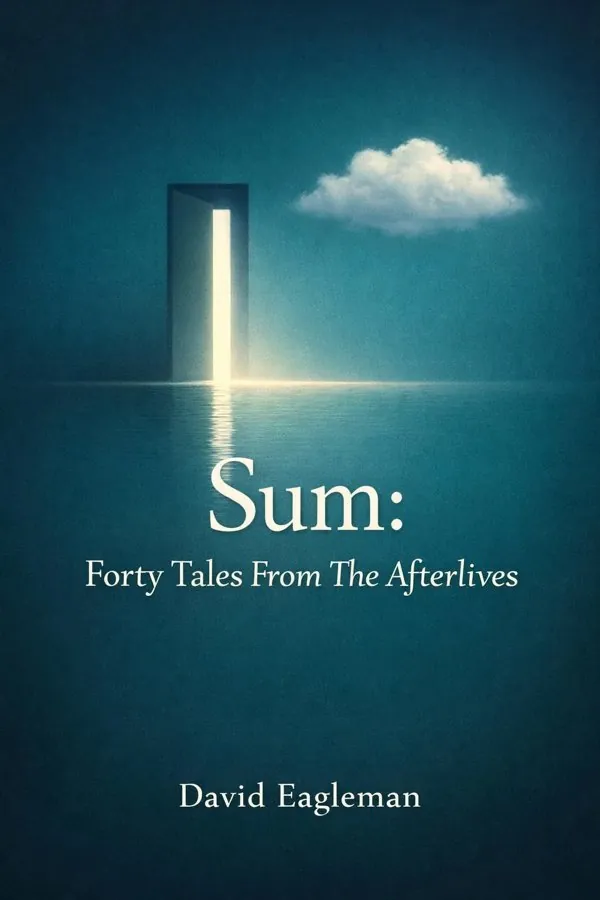
Sum: Forty Tales From The Afterlives: Summary & Key Insights
 10 min9 chaptersAudio available
Key Takeaways from Sum: Forty Tales From The Afterlives
A life does not feel the same when its moments are reorganized.
A world without unfairness may also be a world without distinction.
You do not know yourself in isolation; you know yourself through the minds that remember you.
Reality may be less objective than we think, and more dependent on the frame through which we experience it.
What if gods die when belief dies?
What Is Sum: Forty Tales From The Afterlives About?
Sum: Forty Tales From The Afterlives by David Eagleman is a popular_sci book spanning 13 pages. What if the afterlife were not a single destination, but a series of brilliant mental experiments revealing what it means to be human? In Sum: Forty Tales From The Afterlives, neuroscientist and writer David Eagleman offers forty short, imaginative visions of life after death. Each tale invents a different postmortem reality: one in which life is replayed by categories rather than chronology, another in which equality erases individuality, another in which all your unrealized possibilities must be confronted. These stories are not religious doctrine or conventional science fiction. They are philosophical miniatures that use the idea of the afterlife to investigate memory, identity, time, desire, regret, and meaning. The book matters because it turns a universal mystery into a mirror. By imagining what happens after death, Eagleman pushes us to examine what we value before death. His authority comes not from theology but from a rare combination of scientific rigor and literary imagination. As a neuroscientist who studies the brain and consciousness, Eagleman understands how fragile and strange our inner lives already are. Sum transforms that understanding into elegant, unsettling stories that expand the reader’s sense of what a life is and what it could mean.
This FizzRead summary covers all 9 key chapters of Sum: Forty Tales From The Afterlives in approximately 10 minutes, distilling the most important ideas, arguments, and takeaways from David Eagleman's work. Also available as an audio summary and Key Quotes Podcast.
Sum: Forty Tales From The Afterlives
What if the afterlife were not a single destination, but a series of brilliant mental experiments revealing what it means to be human? In Sum: Forty Tales From The Afterlives, neuroscientist and writer David Eagleman offers forty short, imaginative visions of life after death. Each tale invents a different postmortem reality: one in which life is replayed by categories rather than chronology, another in which equality erases individuality, another in which all your unrealized possibilities must be confronted. These stories are not religious doctrine or conventional science fiction. They are philosophical miniatures that use the idea of the afterlife to investigate memory, identity, time, desire, regret, and meaning.
The book matters because it turns a universal mystery into a mirror. By imagining what happens after death, Eagleman pushes us to examine what we value before death. His authority comes not from theology but from a rare combination of scientific rigor and literary imagination. As a neuroscientist who studies the brain and consciousness, Eagleman understands how fragile and strange our inner lives already are. Sum transforms that understanding into elegant, unsettling stories that expand the reader’s sense of what a life is and what it could mean.
Who Should Read Sum: Forty Tales From The Afterlives?
This book is perfect for anyone interested in popular_sci and looking to gain actionable insights in a short read. Whether you're a student, professional, or lifelong learner, the key ideas from Sum: Forty Tales From The Afterlives by David Eagleman will help you think differently.
- ✓Readers who enjoy popular_sci and want practical takeaways
- ✓Professionals looking to apply new ideas to their work and life
- ✓Anyone who wants the core insights of Sum: Forty Tales From The Afterlives in just 10 minutes
Want the full summary?
Get instant access to this book summary and 100K+ more with Fizz Moment.
Get Free SummaryAvailable on App Store • Free to download
Key Chapters
A life does not feel the same when its moments are reorganized. In the opening tale, “Sum,” Eagleman imagines an afterlife in which you relive your entire existence, but not in chronological order. Instead, every similar activity is grouped together: all your hours of sleeping, every moment spent driving, every conversation, every time you brushed your teeth, every second of pain, boredom, delight, or waiting. The thought experiment is simple, but its impact is profound. Events that seemed minor when scattered across a lifetime become overwhelming when concentrated. Activities you barely noticed suddenly occupy years. Pleasures you thought defined your life may turn out to have been brief islands surrounded by oceans of routine.
This tale changes how we think about time. We often assume that life’s meaning comes from dramatic milestones: graduation, marriage, success, travel, loss. Eagleman suggests that the real structure of life is built from repetition. Our days are mostly habits, not highlights. That means the quality of our routine is not a side issue; it is the substance of existence. If your daily commute is miserable, if your conversations are shallow, if your work drains rather than engages you, then a large part of your life is shaped by experiences you are treating as background noise.
Practically, this idea invites an audit of repetitive time. Imagine grouping your life by categories today: all your scrolling, all your worrying, all your laughter, all your moments of focused work, all your meals with people you love. What would you want more of? What would embarrass you by its sheer volume? This is a powerful exercise for redesigning habits.
Actionable takeaway: For one week, track your recurring activities and ask not, “What did I accomplish?” but “What kind of moments am I mass-producing?”
A world without unfairness may also be a world without distinction. In “Egalitaire,” Eagleman imagines an afterlife where everyone is equalized. Beauty, intelligence, talent, status, and memory are adjusted to a common midpoint. No one is too exceptional, no one too lacking. At first, this seems comforting. Resentment dissolves. Envy loses its fuel. Nobody towers over anyone else. Yet the deeper implication is disturbing: if every sharp edge of individuality is smoothed away, what remains of personality, excellence, aspiration, or delight in difference?
The tale explores a tension that runs through both ethics and politics. Human beings rightly seek fairness, dignity, and relief from arbitrary inequality. But we also admire uniqueness. We want justice without flattening, inclusion without sameness, and community without the disappearance of individual gifts. Eagleman’s imagined afterlife exposes how difficult that balance is. Equality is not merely a numerical adjustment; it changes the emotional and creative ecology of a society. If no one can shine, no one can be inspired by brilliance. If no one can fail, triumph loses meaning.
The practical application is relevant to families, schools, and workplaces. A healthy environment is not one where everyone is made identical, but one where each person receives equal respect and opportunity while still being free to be singular. In parenting, this means not forcing children into one mold. In leadership, it means building systems that reduce unfair barriers without punishing excellence. In friendships, it means valuing people not because they conform but because they contribute something irreplaceable.
Actionable takeaway: Examine one area of your life where you confuse fairness with sameness, and redesign it so that dignity is shared while individuality is protected.
Reality may be less objective than we think, and more dependent on the frame through which we experience it. Tales like “Quantum,” “Reversal,” and “Subjunctive” explore versions of existence in which multiple selves branch across possibilities, time runs backward, or unrealized alternatives remain vividly present. These scenarios are fantastical, but they expose something true about consciousness: we live not only in what happened, but in how the mind organizes possibility, sequence, and causation.
Eagleman uses afterlives to dramatize the hidden architecture of perception. In everyday life, we feel anchored in a stable timeline: the past is fixed, the present is immediate, the future is open. Yet psychologically, this is far messier. Regret lets us inhabit roads not taken. Anxiety lets future outcomes intrude into the present. Memory rewrites the past each time it is recalled. Identity itself depends on which version of your life story you emphasize. The afterlives in these tales magnify that instability until it becomes visible.
This has practical consequences. If your suffering comes partly from mental framing, then changing the frame can change the experience without denying reality. Someone who loses a job can see it only as collapse or also as a branching point. A parent can see years of caregiving as repetitive sacrifice or as the deepest expression of love. A failure can be interpreted as proof of inadequacy or as data for a better next move. The facts may remain the same; the conscious world built around them does not.
Actionable takeaway: When stuck in regret or fear, write down three alternative framings of the same event and notice how your emotional reality shifts with each one.
What if gods die when belief dies? In tales such as “Graveyard of the Gods” and “Blueprints,” Eagleman explores the possibility that divinity is less a fixed cosmic fact than a moving expression of human imagination, need, and interpretation. Forgotten gods accumulate like cultural fossils. Creators turn out to be engineers, committees, or beings just as confused as we are. The effect is not merely skeptical. It is revelatory. These stories show how humans project structure onto mystery and how every explanation, even a sacred one, may bear the fingerprint of the mind that invented it.
Eagleman is not simply mocking religion. He is investigating why people create narratives of order in the face of death and uncertainty. Gods, afterlives, cosmic plans, and moral architectures may arise because the human mind struggles to tolerate randomness. We want agency behind events, intention behind suffering, justice beyond the grave. The tales suggest that theologies can be understood as imaginative solutions to existential pressure.
In practical terms, this idea encourages intellectual humility. It asks us to hold our beliefs firmly enough to live by them, but lightly enough to recognize that they may be partial. This applies to religion, politics, identity, and even personal narratives. We all build blueprints to explain our lives. The danger comes when we mistake our map for the territory. A more mature stance is to remain curious about why a belief comforts, guides, or organizes us.
Actionable takeaway: Identify one belief you hold with confidence and ask two questions: “What need does this belief serve?” and “What would I notice if the opposite were partly true?”
Even eternity can become an institution. In “Perpetuity,” “Search,” and related tales, Eagleman imagines afterlives governed by systems, procedures, waiting, administration, and endless quests. The absurdity is comic, but the insight cuts deep: human beings do not escape structures simply by changing realms. Wherever there are rules, scarcity, organization, and expectations, there is friction between the individual and the system.
These stories satirize the modern experience of being processed by bureaucracies: paperwork, delays, invisible gatekeepers, arbitrary standards, and forms that seem to have become more important than the lives they regulate. Eagleman’s afterlife offices and searches feel familiar because earthly existence already contains mini-versions of them. We spend enormous portions of life navigating healthcare systems, educational systems, legal systems, workplace hierarchies, tax systems, and digital platforms whose logic we did not choose.
The philosophical point is that systems are not neutral containers. They shape identity, emotion, and possibility. If a process is inefficient, you begin to feel insignificant. If recognition depends on forms rather than substance, you may start performing for the system instead of living authentically. This is one reason people often feel exhausted by institutions even when those institutions are meant to help.
The practical lesson is to become a more conscious designer and navigator of systems. In organizations, simplify wherever possible. In personal life, reduce unnecessary procedural complexity. In dealing with institutions, document clearly, ask better questions, and understand the incentives of the structure you are entering. Often the frustration is not personal; it is systemic.
Actionable takeaway: Pick one recurring system that drains you and map its steps. Remove one unnecessary layer, automate one repetitive task, or learn one rule that gives you more leverage.
Human beings like to imagine themselves as the point of the story. Eagleman repeatedly destabilizes that assumption. In tales like “Descent of Species” and “The Unnatural,” the human perspective is displaced: perhaps we envy simpler forms of existence, perhaps we are experiments created by others, perhaps our intelligence is not the final achievement but an awkward byproduct. These afterlives challenge anthropocentrism, the comforting belief that the universe was made with us in mind.
This is where Eagleman’s scientific sensibility becomes especially powerful. Neuroscience and evolutionary biology already teach that the human mind is contingent, adapted, and limited. We are not outside nature observing it from a special throne; we are one peculiar outcome within it. By translating that insight into imaginative fictions, Eagleman makes humility visceral. If another species, another intelligence, or another cosmic frame judged human life, many of our status games and certainties would look ridiculous.
The practical value of this perspective is liberation. When you stop assuming that your preferences define reality, you become more open to learning, more tolerant of difference, and less defensive about uncertainty. It can also make everyday concerns shrink to proper size. Not every slight is monumental. Not every plan deserves cosmic seriousness. Humility is not self-erasure; it is scale awareness.
This idea applies to ecology too. If humans are not the sole measure of value, then other forms of life deserve more than instrumental use. A forest is not merely raw material. An animal is not merely a resource. A planet is not merely a stage set for human ambition.
Actionable takeaway: Practice one act of perspective-shifting this week: spend time in nature, study a nonhuman intelligence, or ask how your biggest worry looks from a wider biological or cosmic frame.
More options do not always produce more freedom. In “Subjunctive,” “Search,” and several other tales, Eagleman explores the torment of alternatives: all the lives you might have lived, all the answers you might keep pursuing, all the versions of yourself that continue in unrealized branches. The fantasy of unlimited possibility often sounds exhilarating, but Eagleman reveals its hidden burden. If every path remains available or visible, closure becomes difficult. Satisfaction depends not only on opportunity, but on commitment and limitation.
This insight speaks directly to contemporary life. We live in an age of endless choice: careers, identities, partners, media, lifestyles, locations, and opinions. Yet abundance frequently produces anxiety rather than peace. When every option remains mentally open, each decision can feel like a renunciation of dozens of better lives. The imagined afterlives in Sum turn that feeling into metaphysical drama. They show that regret is often the shadow cast by possibility.
The lesson is not to avoid options but to recognize that meaning requires pruning. A life becomes coherent when you close some doors and inhabit others fully. Someone who spends years comparing every possible job may never build mastery in one. Someone who constantly imagines alternative relationships may fail to deepen the relationship they have. Someone who keeps rewriting the past cannot live in the present.
Practically, this means learning to choose without demanding certainty. It means accepting that every meaningful path includes sacrifice. It means replacing the question “What is the perfect option?” with “What am I willing to commit to and cultivate?” Peace comes less from maximizing than from inhabiting.
Actionable takeaway: Make one pending decision using a “good enough to commit” standard, then stop reopening it for a defined period of time.
The deepest achievement of Sum is that its afterlives return us to life. Across stories of replayed routines, leveled identities, dead gods, backward time, cosmic experiments, and infinite alternatives, Eagleman builds a cumulative argument: mortality is not merely a problem to solve but a condition that gives shape to experience. We care because time is limited. We choose because we cannot have every life. We love because loss is possible. We seek meaning because existence is unstable and finite.
This is why the book resonates beyond its clever premises. The afterlives are not escapes from death so much as instruments for examining life from strange angles. By the end, the reader senses that no perfect postmortem design exists. Every imagined eternity introduces new distortions, frustrations, or paradoxes. Immortality can become monotonous. Equality can become flattening. Infinite branching can become paralyzing. Bureaucratic order can become dehumanizing. In that sense, earthly life, with all its limitations, may be better tuned for significance than we realize.
The practical application is ethical as much as philosophical. If finitude is what makes moments matter, then attention becomes a moral act. To be present with another person, to notice beauty, to tell the truth, to create something, to forgive, to risk vulnerability—these become urgent precisely because they cannot be repeated forever. A finite life asks us not to control everything, but to inhabit what is here with more consciousness.
Actionable takeaway: At the end of each day, name one finite moment you do not want to overlook, and let that awareness guide one better choice tomorrow.
All Chapters in Sum: Forty Tales From The Afterlives
About the Author
David Eagleman is an American neuroscientist, author, and science communicator known for exploring how the brain constructs human experience. His research has focused on topics such as time perception, sensory substitution, plasticity, and consciousness, and he has built a reputation for translating complex scientific ideas into vivid, accessible language. Alongside his academic work, Eagleman has written bestselling nonfiction and literary works that bridge science and philosophy. What makes him distinctive is his ability to combine empirical curiosity with imaginative storytelling. In Sum: Forty Tales From The Afterlives, that combination is especially clear: he brings a neuroscientist’s fascination with the mind to enduring human questions about death, identity, memory, and meaning. His work consistently invites readers to rethink what it means to perceive, choose, and exist.
Get This Summary in Your Preferred Format
Read or listen to the Sum: Forty Tales From The Afterlives summary by David Eagleman anytime, anywhere. FizzRead offers multiple formats so you can learn on your terms — all free.
Available formats: App · Audio · PDF · EPUB — All included free with FizzRead
Download Sum: Forty Tales From The Afterlives PDF and EPUB Summary
Key Quotes from Sum: Forty Tales From The Afterlives
“A life does not feel the same when its moments are reorganized.”
“A world without unfairness may also be a world without distinction.”
“You do not know yourself in isolation; you know yourself through the minds that remember you.”
“Reality may be less objective than we think, and more dependent on the frame through which we experience it.”
“Even eternity can become an institution.”
Frequently Asked Questions about Sum: Forty Tales From The Afterlives
Sum: Forty Tales From The Afterlives by David Eagleman is a popular_sci book that explores key ideas across 9 chapters. What if the afterlife were not a single destination, but a series of brilliant mental experiments revealing what it means to be human? In Sum: Forty Tales From The Afterlives, neuroscientist and writer David Eagleman offers forty short, imaginative visions of life after death. Each tale invents a different postmortem reality: one in which life is replayed by categories rather than chronology, another in which equality erases individuality, another in which all your unrealized possibilities must be confronted. These stories are not religious doctrine or conventional science fiction. They are philosophical miniatures that use the idea of the afterlife to investigate memory, identity, time, desire, regret, and meaning. The book matters because it turns a universal mystery into a mirror. By imagining what happens after death, Eagleman pushes us to examine what we value before death. His authority comes not from theology but from a rare combination of scientific rigor and literary imagination. As a neuroscientist who studies the brain and consciousness, Eagleman understands how fragile and strange our inner lives already are. Sum transforms that understanding into elegant, unsettling stories that expand the reader’s sense of what a life is and what it could mean.
More by David Eagleman
Incognito: The Secret Lives of the Brain
David Eagleman
10 min
Livewired: The Inside Story of the Ever-Changing Brain
David Eagleman
10 min
The Brain: The Story of You
David Eagleman
10 min
The Runaway Species: How Human Creativity Remakes the World
David Eagleman, Anthony Brandt
10 minYou Might Also Like
Structures: Or Why Things Don"t Fall Down
J.E. Gordon
10 min
The Road to Wigan Pier
George Orwell
10 min
Bonk: The Curious Coupling of Science and Sex
Mary Roach
10 min
First Bite: How We Learn to Eat
Bee Wilson
10 min
In Pursuit Of The Unknown: 17 Equations That Changed The World
Ian Stewart
10 min
Napoleon's Buttons: 17 Molecules That Changed History
Penny Le Couteur and Jay Burreson
10 minBrowse by Category
Ready to read Sum: Forty Tales From The Afterlives?
Get the full summary and 100K+ more books with Fizz Moment.