
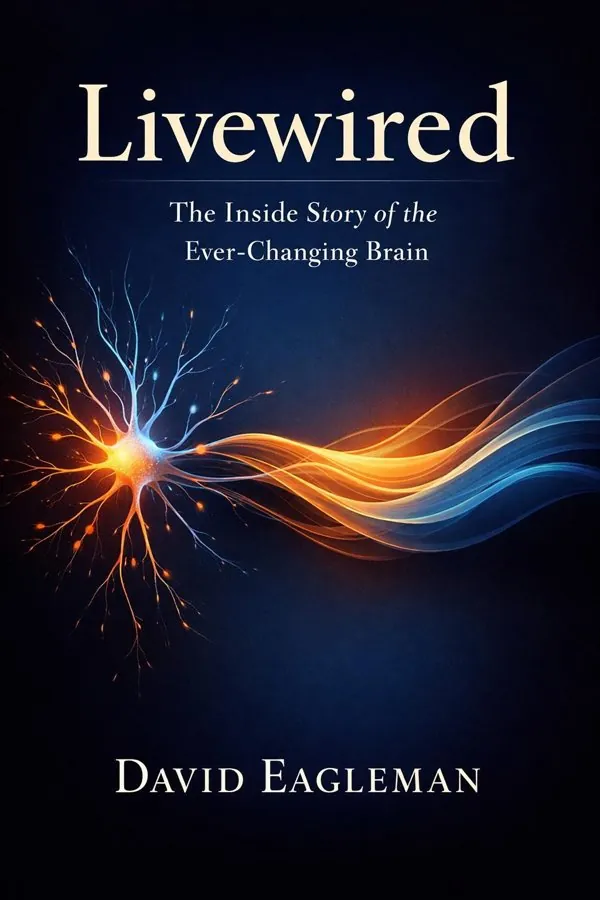
Livewired: The Inside Story of the Ever-Changing Brain: Summary & Key Insights
 10 min6 chaptersAudio available
What Is Livewired: The Inside Story of the Ever-Changing Brain About?
Livewired: The Inside Story of the Ever-Changing Brain by David Eagleman is a neuroscience book spanning 6 pages. Livewired es una exploración de cómo el cerebro humano se adapta y cambia constantemente. David Eagleman, neurocientífico, describe la plasticidad cerebral y cómo las conexiones neuronales se reorganizan en respuesta a la experiencia, el aprendizaje y el entorno. El libro combina investigaciones científicas con ejemplos accesibles para mostrar cómo la mente se reinventa continuamente.
This FizzRead summary covers all 6 key chapters of Livewired: The Inside Story of the Ever-Changing Brain in approximately 10 minutes, distilling the most important ideas, arguments, and takeaways from David Eagleman's work. Also available as an audio summary and Key Quotes Podcast.
Livewired: The Inside Story of the Ever-Changing Brain
Livewired es una exploración de cómo el cerebro humano se adapta y cambia constantemente. David Eagleman, neurocientífico, describe la plasticidad cerebral y cómo las conexiones neuronales se reorganizan en respuesta a la experiencia, el aprendizaje y el entorno. El libro combina investigaciones científicas con ejemplos accesibles para mostrar cómo la mente se reinventa continuamente.
Who Should Read Livewired: The Inside Story of the Ever-Changing Brain?
This book is perfect for anyone interested in neuroscience and looking to gain actionable insights in a short read. Whether you're a student, professional, or lifelong learner, the key ideas from Livewired: The Inside Story of the Ever-Changing Brain by David Eagleman will help you think differently.
- ✓Readers who enjoy neuroscience and want practical takeaways
- ✓Professionals looking to apply new ideas to their work and life
- ✓Anyone who wants the core insights of Livewired: The Inside Story of the Ever-Changing Brain in just 10 minutes
Want the full summary?
Get instant access to this book summary and 100K+ more with Fizz Moment.
Get Free SummaryAvailable on App Store • Free to download
Key Chapters
The central argument of *Livewired* is that the human brain is not hardwired—it’s *livewired*. Every thought, every experience, every movement of attention changes its circuitry. Unlike computers, where electrons flow through predetermined paths, our neurons continually remodel their connections. This process is not random; it is guided by experience. When you learn a skill or adapt to an environment, the brain’s architecture reorganizes to optimize performance.
I illustrate this through both scientific insights and real-world analogies. Consider a musician mastering a new instrument. The neural pathways associated with auditory and motor coordination rapidly strengthen as the musician practices. Axons and dendrites grow new branches; synaptic efficiencies shift. In this way, practice becomes physiology. The musician’s skill is not simply stored—it’s built into neural structure.
This principle extends to every form of adaptation. A blind person’s visual cortex can be repurposed to process tactile or auditory information. A person who loses a limb continues to feel sensations in the missing part because the brain’s map of the body reorganizes itself to compensate. What matters is not the input, but the brain’s ability to interpret and adapt. It learns to read the world through whatever channels are available.
Understanding the brain as dynamic changes the way we approach learning, rehabilitation, and technology. Traditional views of brain cells dying with age are giving way to a new vision: one of continuous remodeling. Even in adulthood, neural circuits keep responding to new challenges, reshaping themselves to accommodate growth. The implication is empowering—learning is not confined to youth, nor is change limited by your biology. This livewired brain is your most powerful instrument of transformation.
One of the most fascinating demonstrations of livewiring is sensory substitution—the process by which the brain learns to translate one type of sensory data into another. If a person loses their vision, for example, the brain can use touch or sound as alternative channels for constructing the same spatial awareness it once gained through sight. Devices have been created that translate camera input into tactile or auditory signals, enabling blind individuals to 'see' through their tongues or ears.
When I present this research, I emphasize the profound versatility encoded in neural networks. The brain doesn’t care where information comes from—it only cares about patterns, correlations, and meaning. As soon as new input streams arrive, neurons begin building fresh models of the world, finding ways to extract usable structure. This is not pre-programmed; it’s adaptive learning happening spontaneously.
What these experiments demonstrate is that the brain is fundamentally a prediction engine, constantly trying to minimize error between its expectations and sensory feedback. Sensory substitution is thus a testament to the brain’s willingness to revise itself. It reminds us that our perceptual experience is not a rigid translation of external data—it’s a bespoke construction arising from the plastic activity of billions of neurons striving to make sense of input.
Such flexibility gives us hope for restoration and enhancement. Whether it’s prosthetics that feed neural signals or interfaces that help paralyzed individuals interact with machines, sensory substitution shows how rapidly the brain adopts new technologies as extensions of itself. This livewiring means that what we call natural perception is merely one set of solutions among infinite possible mappings. The boundaries of the human experience can be stretched far beyond what evolution pre-installed.
+ 4 more chapters — available in the FizzRead app
All Chapters in Livewired: The Inside Story of the Ever-Changing Brain
About the Author
David Eagleman es un neurocientífico estadounidense, profesor en la Universidad de Stanford y autor de varios libros de divulgación científica. Su trabajo se centra en la plasticidad cerebral, la percepción sensorial y la conciencia. Es conocido por su capacidad para comunicar conceptos complejos de la neurociencia al público general.
Get This Summary in Your Preferred Format
Read or listen to the Livewired: The Inside Story of the Ever-Changing Brain summary by David Eagleman anytime, anywhere. FizzRead offers multiple formats so you can learn on your terms — all free.
Available formats: App · Audio · PDF · EPUB — All included free with FizzRead
Download Livewired: The Inside Story of the Ever-Changing Brain PDF and EPUB Summary
Key Quotes from Livewired: The Inside Story of the Ever-Changing Brain
“The central argument of *Livewired* is that the human brain is not hardwired—it’s *livewired*.”
“One of the most fascinating demonstrations of livewiring is sensory substitution—the process by which the brain learns to translate one type of sensory data into another.”
Frequently Asked Questions about Livewired: The Inside Story of the Ever-Changing Brain
Livewired: The Inside Story of the Ever-Changing Brain by David Eagleman is a neuroscience book that explores key ideas across 6 chapters. Livewired es una exploración de cómo el cerebro humano se adapta y cambia constantemente. David Eagleman, neurocientífico, describe la plasticidad cerebral y cómo las conexiones neuronales se reorganizan en respuesta a la experiencia, el aprendizaje y el entorno. El libro combina investigaciones científicas con ejemplos accesibles para mostrar cómo la mente se reinventa continuamente.
More by David Eagleman

Incognito: The Secret Lives of the Brain
David Eagleman
10 min
Sum: Forty Tales From The Afterlives
David Eagleman
10 min
The Brain: The Story of You
David Eagleman
10 min
The Runaway Species: How Human Creativity Remakes the World
David Eagleman, Anthony Brandt
10 minYou Might Also Like
Anxious
Joseph LeDoux
10 min
Hallucinations
Oliver Sacks
10 min
The Biological Mind: How Brain, Body, and Environment Collaborate to Make Us Who We Are
Alan Jasanoff
10 min
The Feeling of Life Itself: Why Consciousness Is Widespread but Can't Be Computed
Christof Koch
10 min
The No-Nonsense Meditation Book
Steven Laureys
10 min
A General Theory of Love
Thomas Lewis, Fari Amini, Richard Lannon
10 minBrowse by Category
Ready to read Livewired: The Inside Story of the Ever-Changing Brain?
Get the full summary and 100K+ more books with Fizz Moment.