
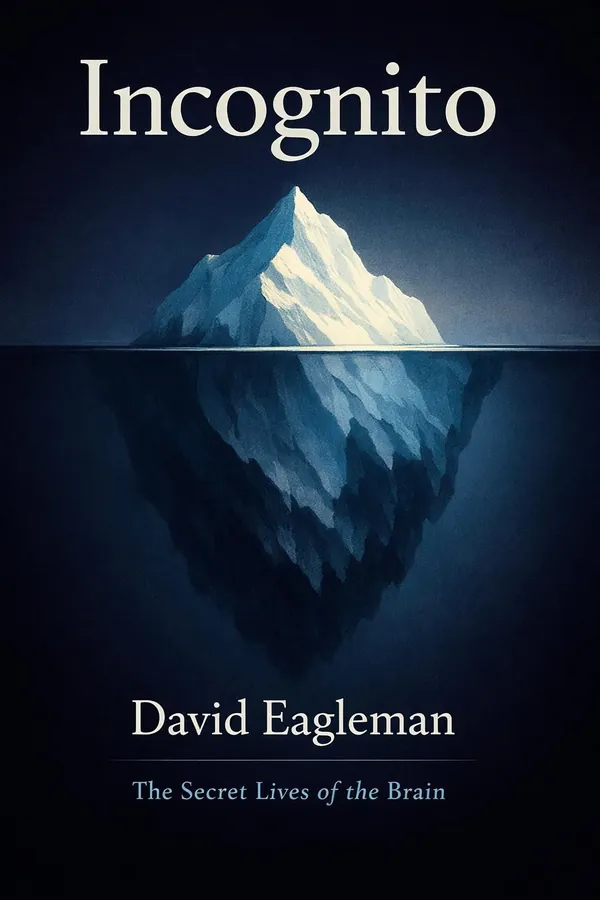
Incognito: The Secret Lives of the Brain: Summary & Key Insights
 10 min6 chaptersAudio available
What Is Incognito: The Secret Lives of the Brain About?
Incognito: The Secret Lives of the Brain by David Eagleman is a neuroscience book spanning 6 pages. In this thought-provoking work, neuroscientist David Eagleman explores the vast hidden world of the unconscious brain. He guides readers through the intricate mechanisms of perception, decision-making, and behavior that occur beyond our conscious awareness. Using illuminating examples from neuroscience and everyday life, Eagleman reveals how much of what we experience and believe to be conscious thought actually originates beneath the surface of awareness.
This FizzRead summary covers all 6 key chapters of Incognito: The Secret Lives of the Brain in approximately 10 minutes, distilling the most important ideas, arguments, and takeaways from David Eagleman's work. Also available as an audio summary and Key Quotes Podcast.
Incognito: The Secret Lives of the Brain
In this thought-provoking work, neuroscientist David Eagleman explores the vast hidden world of the unconscious brain. He guides readers through the intricate mechanisms of perception, decision-making, and behavior that occur beyond our conscious awareness. Using illuminating examples from neuroscience and everyday life, Eagleman reveals how much of what we experience and believe to be conscious thought actually originates beneath the surface of awareness.
Who Should Read Incognito: The Secret Lives of the Brain?
This book is perfect for anyone interested in neuroscience and looking to gain actionable insights in a short read. Whether you're a student, professional, or lifelong learner, the key ideas from Incognito: The Secret Lives of the Brain by David Eagleman will help you think differently.
- ✓Readers who enjoy neuroscience and want practical takeaways
- ✓Professionals looking to apply new ideas to their work and life
- ✓Anyone who wants the core insights of Incognito: The Secret Lives of the Brain in just 10 minutes
Want the full summary?
Get instant access to this book summary and 100K+ more with Fizz Moment.
Get Free SummaryAvailable on App Store • Free to download
Key Chapters
Consciousness likes to believe it’s in charge. But consider the evidence: experiments using brain scans and electrophysiology have consistently shown that neural activity predicting a decision occurs hundreds of milliseconds before we become aware of making it. In other words, by the time you think you’ve chosen to move your hand, your brain has already begun initiating the movement.
This discovery, first revealed in classic studies by Benjamin Libet and confirmed by modern imaging, shakes the foundations of free will. I remember the resistance these findings inspired — after all, what could be more disorienting than discovering that the ‘I’ who chooses is merely a latecomer to the process? But the deeper truth is less nihilistic and more liberating: consciousness is only one actor in a much larger ensemble, a figurehead on the ship rather than the wind that moves it.
Most of our daily behavior runs on autopilot. From driving a familiar route to responding emotionally to an insult, unconscious processes shape our reactions long before conscious thought can intervene. Yet rather than despair, this invites humility. Understanding the illusion of control softens our judgments — both of ourselves and others. We are not the full authors of our impulses; we are caretakers navigating forces we barely comprehend.
Still, consciousness plays a crucial role. It can reprogram the unconscious over time, much as gentle steering can redirect a great ship. Through reflection, habit, and deliberate training, the brain’s automatic systems can be rewired. What this means is that we are both the products of our biology and the shapers of it — participants in a conversation between conscious intention and unconscious power. Recognizing that dynamic allows us to live with greater perspective, replacing illusion with wonder.
+ 4 more chapters — available in the FizzRead app
All Chapters in Incognito: The Secret Lives of the Brain
About the Author
David Eagleman is an American neuroscientist and author, known for his research on time perception, synesthesia, and brain plasticity. He is also a professor at Stanford University and the creator of several popular science books and television series that make neuroscience accessible to general audiences.
Get This Summary in Your Preferred Format
Read or listen to the Incognito: The Secret Lives of the Brain summary by David Eagleman anytime, anywhere. FizzRead offers multiple formats so you can learn on your terms — all free.
Available formats: App · Audio · PDF · EPUB — All included free with FizzRead
Download Incognito: The Secret Lives of the Brain PDF and EPUB Summary
Key Quotes from Incognito: The Secret Lives of the Brain
“To grasp how little conscious control we actually exert, we must first understand how much the brain does behind the scenes.”
“Consciousness likes to believe it’s in charge.”
Frequently Asked Questions about Incognito: The Secret Lives of the Brain
Incognito: The Secret Lives of the Brain by David Eagleman is a neuroscience book that explores key ideas across 6 chapters. In this thought-provoking work, neuroscientist David Eagleman explores the vast hidden world of the unconscious brain. He guides readers through the intricate mechanisms of perception, decision-making, and behavior that occur beyond our conscious awareness. Using illuminating examples from neuroscience and everyday life, Eagleman reveals how much of what we experience and believe to be conscious thought actually originates beneath the surface of awareness.
More by David Eagleman
Livewired: The Inside Story of the Ever-Changing Brain
David Eagleman
10 min
Sum: Forty Tales From The Afterlives
David Eagleman
10 min
The Brain: The Story of You
David Eagleman
10 min
The Runaway Species: How Human Creativity Remakes the World
David Eagleman, Anthony Brandt
10 minYou Might Also Like
Anxious
Joseph LeDoux
10 min
Hallucinations
Oliver Sacks
10 min
The Biological Mind: How Brain, Body, and Environment Collaborate to Make Us Who We Are
Alan Jasanoff
10 min
The Feeling of Life Itself: Why Consciousness Is Widespread but Can't Be Computed
Christof Koch
10 min
The No-Nonsense Meditation Book
Steven Laureys
10 min
A General Theory of Love
Thomas Lewis, Fari Amini, Richard Lannon
10 minBrowse by Category
Ready to read Incognito: The Secret Lives of the Brain?
Get the full summary and 100K+ more books with Fizz Moment.