
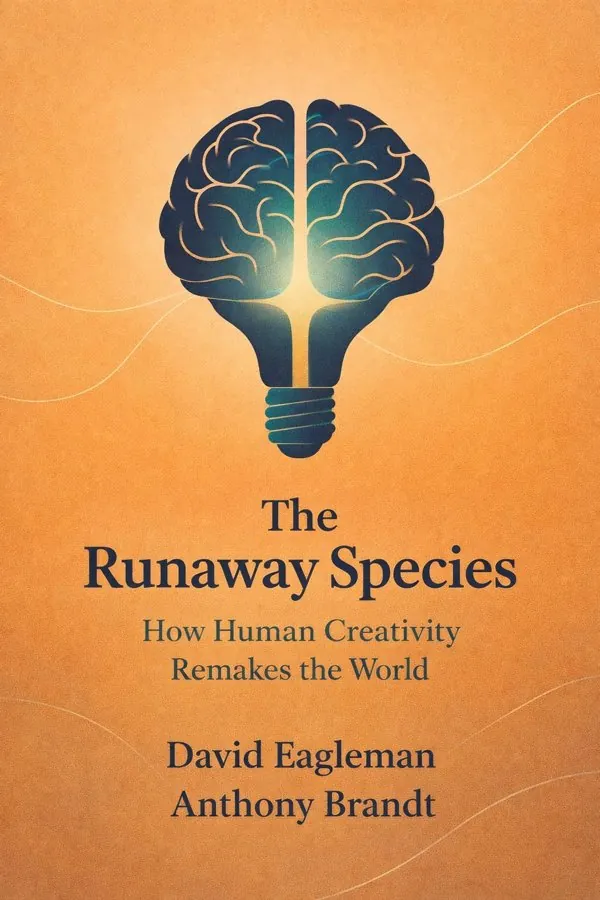
The Runaway Species: How Human Creativity Remakes the World: Summary & Key Insights
by David Eagleman, Anthony Brandt
 10 min9 chaptersAudio available
Key Takeaways from The Runaway Species: How Human Creativity Remakes the World
The most original ideas rarely appear out of nowhere.
Many breakthroughs begin not by rejecting tradition, but by stretching it.
Sometimes progress does not come from refinement but from rupture.
Some of the most powerful creative leaps happen when separate domains collide.
Creativity can feel mysterious from the inside, but the book shows that it emerges from ordinary brain processes doing extraordinary work together.
What Is The Runaway Species: How Human Creativity Remakes the World About?
The Runaway Species: How Human Creativity Remakes the World by David Eagleman, Anthony Brandt is a neuroscience book spanning 12 pages. Human beings are not content merely to survive in the world as it is. We redesign it. We turn stone into sculpture, sound into symphony, symbols into mathematics, and raw materials into technologies that alter how entire civilizations live. In The Runaway Species, neuroscientist David Eagleman and composer Anthony Brandt argue that creativity is not a rare talent possessed by a gifted few, but a core feature of the human mind. Our species is “runaway” because we continually transform our environment through imagination, experimentation, and invention. What makes this book especially valuable is its unusual partnership of disciplines. Eagleman brings deep expertise in brain science, perception, and cognition, while Brandt contributes the perspective of a working artist and composer. Together, they show that creativity can be studied, understood, and cultivated. Drawing on examples from music, architecture, language, science, education, and technology, they reveal the mental tools behind innovation: bending, breaking, and blending existing ideas into something new. The result is an accessible, illuminating exploration of why humans create and how that creativity has become our defining evolutionary advantage.
This FizzRead summary covers all 9 key chapters of The Runaway Species: How Human Creativity Remakes the World in approximately 10 minutes, distilling the most important ideas, arguments, and takeaways from David Eagleman, Anthony Brandt's work. Also available as an audio summary and Key Quotes Podcast.
The Runaway Species: How Human Creativity Remakes the World
Human beings are not content merely to survive in the world as it is. We redesign it. We turn stone into sculpture, sound into symphony, symbols into mathematics, and raw materials into technologies that alter how entire civilizations live. In The Runaway Species, neuroscientist David Eagleman and composer Anthony Brandt argue that creativity is not a rare talent possessed by a gifted few, but a core feature of the human mind. Our species is “runaway” because we continually transform our environment through imagination, experimentation, and invention.
What makes this book especially valuable is its unusual partnership of disciplines. Eagleman brings deep expertise in brain science, perception, and cognition, while Brandt contributes the perspective of a working artist and composer. Together, they show that creativity can be studied, understood, and cultivated. Drawing on examples from music, architecture, language, science, education, and technology, they reveal the mental tools behind innovation: bending, breaking, and blending existing ideas into something new. The result is an accessible, illuminating exploration of why humans create and how that creativity has become our defining evolutionary advantage.
Who Should Read The Runaway Species: How Human Creativity Remakes the World?
This book is perfect for anyone interested in neuroscience and looking to gain actionable insights in a short read. Whether you're a student, professional, or lifelong learner, the key ideas from The Runaway Species: How Human Creativity Remakes the World by David Eagleman, Anthony Brandt will help you think differently.
- ✓Readers who enjoy neuroscience and want practical takeaways
- ✓Professionals looking to apply new ideas to their work and life
- ✓Anyone who wants the core insights of The Runaway Species: How Human Creativity Remakes the World in just 10 minutes
Want the full summary?
Get instant access to this book summary and 100K+ more with Fizz Moment.
Get Free SummaryAvailable on App Store • Free to download
Key Chapters
The most original ideas rarely appear out of nowhere. One of the book’s central claims is that the human brain is fundamentally a remix system: it takes existing materials, memories, patterns, and experiences and recombines them into new forms. Creativity is not magic and not ex nihilo invention. Instead, it is the result of a brain built to compare, edit, distort, and rearrange what it already knows.
Eagleman and Brandt explain that the cortex does more than record reality. It interprets, simplifies, predicts, and fills gaps. This means we do not experience the world as a passive camera would. We actively construct it. That same constructive capacity makes creativity possible. A novelist combines observed behavior with remembered conversations and imagined scenarios. An engineer adapts principles from nature to solve a mechanical problem. A chef fuses familiar ingredients into an unfamiliar flavor profile.
This view demystifies innovation. If all creativity involves recombination, then everyone has access to its raw materials. The difference lies not in whether you can create, but in how broadly you gather experiences and how flexibly you connect them. Exposure to multiple fields, cultures, and problems increases the number of possible combinations your mind can make.
In practical terms, this means creativity improves when you feed your brain diverse inputs. Read outside your specialty. Study how other industries solve problems. Keep notes on surprising connections. Instead of waiting for a brilliant idea to strike, build the conditions for recombination. Actionable takeaway: widen your inputs intentionally each week, then ask, “What can I combine here that has not been combined before?”
Many breakthroughs begin not by rejecting tradition, but by stretching it. The authors call this process bending: taking a familiar structure, rule, tool, or convention and transforming it without destroying its identity. Bending matters because creativity often works best when it starts with something recognizable and then pushes it in an unexpected direction.
You can see bending everywhere. A musician takes a classical melody and reinterprets it through jazz rhythm. An architect preserves the basic function of a building but reimagines its form and materials. A business keeps a proven model yet changes delivery, audience, or experience. The result is innovation that feels both new and understandable. It surprises us, but it does not alienate us.
Constraints play a major role here. Far from suppressing imagination, boundaries often sharpen it. When you cannot abandon the entire system, you are forced to explore subtler, more inventive transformations. Poets innovate within meter. product designers refine objects that still must fit the hand. Filmmakers create suspense not by inventing an entirely new medium, but by bending timing, framing, and expectation.
This idea is useful for anyone who struggles with blank-page syndrome. You do not need to invent from scratch. Start with an existing template and ask how it can be stretched. What if the usual sequence were reversed? What if the tone changed? What if the scale, context, or audience shifted?
Actionable takeaway: choose one familiar process, product, or habit in your work and deliberately alter one element at a time—form, timing, style, or audience—to discover a fresh version without losing coherence.
Sometimes progress does not come from refinement but from rupture. Breaking, in the authors’ framework, means challenging or discarding inherited assumptions so completely that a new system becomes possible. If bending stretches convention, breaking snaps it. This is riskier, but it can produce revolutions rather than variations.
Human history is full of examples. Modern art broke from strict realism, freeing painters to prioritize emotion, abstraction, and perspective. Scientific revolutions often begin when someone questions a foundational model that everyone else treats as fixed. Entrepreneurs break accepted categories when they redefine what a service, product, or platform even is. Language itself evolves through breakage, as grammar shifts and once-rigid forms become fluid.
Breaking is difficult because people are attached to familiar structures. Existing systems feel natural even when they are arbitrary. The mind prefers what it has practiced. That is why radical creativity often faces resistance at first. A new idea may look wrong simply because it does not fit an old frame.
Yet the book makes clear that breaking is not chaos for its own sake. Useful breakage creates a better possibility. It exposes the assumptions hiding inside a convention and asks whether they still deserve obedience. In education, for example, breaking may mean abandoning one-size-fits-all teaching in favor of interdisciplinary, project-based learning. In personal work, it may mean realizing that a problem persists because you are using the wrong category altogether.
Actionable takeaway: when you feel trapped, list the “rules” governing your problem and ask which are truly essential. Then experiment by removing one major assumption to see whether an entirely different solution emerges.
Some of the most powerful creative leaps happen when separate domains collide. The authors call this blending: merging elements from different categories, disciplines, or traditions to produce something neither could generate alone. Blending is a major engine of innovation because the brain thrives on analogy and cross-mapping. It notices structural similarities between unlike things and uses one domain to transform another.
Consider how smartphones blend communication, computing, photography, navigation, and entertainment into a single object. Consider bio-inspired engineering, where observations from birds, insects, or plants influence machines and materials. In the arts, genre fusion can create entirely new forms, from hip-hop sampling to multimedia performance that unites sound, image, movement, and code.
Blending works because knowledge is not stored in sealed boxes. The mind searches for transferable patterns. A surgeon may learn precision from sculpture. A manager may borrow principles from theater to improve team coordination. A teacher may use game design to increase student engagement. The more varied your experiences, the richer your blending opportunities become.
Still, blending is more than mixing ingredients randomly. Productive blending depends on recognizing meaningful relationships. You need enough understanding of each domain to preserve what makes it powerful, then combine them in a way that generates new function or insight. Superficial mashups can feel gimmicky; deep blends feel inevitable in hindsight.
Actionable takeaway: pick two areas you know reasonably well but usually keep separate. Identify one principle from each, then design a small project, presentation, or experiment that uses both together. Creativity grows when you force useful collisions.
Creativity can feel mysterious from the inside, but the book shows that it emerges from ordinary brain processes doing extraordinary work together. Perception, memory, prediction, association, emotion, and motor control all contribute to innovation. The same brain that helps you recognize patterns in the world also helps you alter them.
A key insight is that the brain is not a passive receiver of information. It is a prediction machine that constantly models what is likely to happen next. This predictive architecture supports creativity because imagining alternatives is closely related to anticipating outcomes. When you mentally simulate a new design, melody, sentence, or strategy, you are using neural systems that evolved to rehearse possibilities before acting.
Memory also matters in a dynamic way. We often think of memory as storage, but memory is reconstructive. Every act of recall involves rebuilding the past, not replaying it exactly. That flexibility gives creativity its raw material. Ideas can be revisited, reshaped, and connected to new contexts. Emotion, too, plays a role by signaling relevance and motivating persistence. We return to ideas that feel unresolved, meaningful, or exciting.
This neuroscience perspective matters because it reframes creativity as trainable. If innovation depends on pattern recognition, associative range, and mental simulation, then practices that enrich those functions should improve creative output. Reflection, incubation, sketching, improvisation, and interdisciplinary learning all make sense in light of how the brain works.
Actionable takeaway: support your brain’s creative systems by alternating focused work with downtime, capturing emerging ideas quickly, and revisiting them later. Creativity often appears when prediction, memory, and association are given room to interact.
No creator works alone, and no idea appears in a vacuum. One of the book’s broader contributions is showing that human creativity is cumulative: each generation inherits tools, symbols, stories, techniques, and problems from the last, then modifies them. Culture is not just a backdrop for invention; it is the medium that makes large-scale creativity possible.
This helps explain why innovation often clusters in particular times and places. Creative bursts emerge where people have access to shared resources, diverse influences, and mechanisms for exchanging ideas. Renaissance workshops, scientific communities, music scenes, and technology hubs all demonstrate that invention is partly social. Individuals matter, but networks matter too.
Historical examples reveal how creative forms evolve through countless small changes. Musical notation enabled more complex compositions and collaboration across distance. Writing systems preserved thought long enough for others to challenge and expand it. Tools and technologies extend what the brain can do, allowing culture itself to become an external memory system.
This cumulative process also means that borrowing is not a flaw in creativity; it is often the point. Every tradition grows through adaptation. The real question is not whether creators draw from the past, but how deeply they transform what they inherit. In teams and organizations, this has practical implications: the freer ideas move, the more likely they are to combine productively.
Actionable takeaway: build environments where ideas circulate. Share drafts early, study predecessors without imitation, and create routines for collaborative exchange. Creativity becomes more powerful when you treat it as participation in an ongoing cultural conversation rather than a solitary performance.
It is tempting to think creativity requires complete freedom. The book argues the opposite: constraints are often what make creativity possible. Limits focus attention, force choices, and prevent us from drifting into vague possibility. When options are infinite, action can stall. When conditions are defined, invention becomes a problem worth solving.
Artists have long understood this. A sonnet’s strict structure inspires unusual linguistic precision. Black-and-white photography turns the absence of color into a strength of contrast and composition. In product design, budget, materials, and user needs push creators toward elegant solutions. In science, unanswered questions and methodological limits sharpen the search for better explanations.
The authors connect this to the way humans evolved. We are creative partly because we are constrained creatures. We cannot fly unaided, so we invent aircraft. We cannot survive every environment naturally, so we redesign environments themselves. Human ingenuity often begins where biology leaves off. Necessity is not merely the mother of invention; limitation is its architecture.
For individuals, this insight is liberating. You do not need ideal conditions to create. In fact, waiting for unlimited time, money, or freedom may reduce urgency and inventiveness. Better to ask: what can I do brilliantly with what I have? A startup can use limited resources to innovate around simplicity. A teacher can transform a sparse classroom through imaginative methods. A writer can use a narrow theme to produce depth.
Actionable takeaway: set deliberate constraints on your next project—time limit, word count, budget cap, or tool restriction. Then treat those boundaries as design prompts rather than obstacles.
If creativity is a fundamental human capacity, education should nurture it deliberately rather than treating it as a side effect. The book challenges systems of schooling that reward memorization, compliance, and one correct answer at the expense of experimentation and original thought. In a world that changes quickly, the ability to adapt, reframe, and invent may matter more than the ability to repeat information.
This does not mean facts are unimportant. Knowledge is the raw material of creativity. But knowledge becomes powerful when students learn how to manipulate it: how to ask better questions, connect ideas across subjects, test alternatives, and tolerate uncertainty. A student who understands history, science, language, and design as separate silos may perform well on exams yet struggle to innovate. A student taught to blend, bend, and break concepts can use knowledge dynamically.
Practical applications are clear. Project-based learning encourages students to solve real problems with multiple possible solutions. Arts education trains attention, pattern recognition, and expressive flexibility. Interdisciplinary assignments mirror the way creativity actually works in life. Even assessment can evolve by valuing process, iteration, and insight alongside correctness.
The authors’ message is especially relevant for parents, teachers, and leaders. Creative confidence is often fragile. When institutions punish risk and celebrate only polished outcomes, people learn to hide originality. But when experimentation is normalized, more minds participate.
Actionable takeaway: whether you teach, manage, or parent, reward thoughtful attempts, not just successful results. Ask people to explain how they arrived at an idea and what they would try next. Creativity strengthens when process becomes visible and valued.
The image of the lone genius is compelling, but the book points toward a larger truth: much of human creativity is collective. Ideas travel through groups, tools, institutions, and technologies. What any one person can imagine depends partly on what a community has already built and what collaboration makes possible. Human creativity is runaway not just because individuals innovate, but because society compounds and accelerates those innovations.
Technology reveals this clearly. New tools do not simply solve old problems; they change what kinds of creativity are possible. Recording technology reshaped music. Digital software altered filmmaking, design, and publishing. Artificial intelligence, biotechnology, and networked systems are now expanding the scale and speed of experimentation. Each invention becomes a platform for further invention.
At the same time, creativity remains tied to survival and adaptation. Humans dominate environments not through physical specialization, but through flexible redesign. We build clothing for climates our bodies cannot handle, systems for communication beyond natural distance, and institutions for coordinating large groups. Our species survives by externalizing intelligence into culture and tools.
This makes the future of creativity both exciting and ethically significant. As our powers increase, so does our responsibility. The same capacities that produce art and medicine can also produce manipulation, inequality, and destruction. Understanding creativity, then, is not merely about generating more ideas. It is about directing human inventiveness wisely.
Actionable takeaway: develop creativity with a systems mindset. When evaluating a new idea, ask not only “Is it novel?” but also “What does it enable, who does it affect, and how might others build on it?”
All Chapters in The Runaway Species: How Human Creativity Remakes the World
About the Authors
David Eagleman is an American neuroscientist, bestselling author, and science communicator known for his work on brain plasticity, perception, time, and consciousness. He has taught at Stanford University and built a reputation for translating complex neuroscience into accessible, engaging ideas for general readers. Anthony Brandt is an acclaimed composer, educator, and professor of music at Rice University, where he has written extensively about musical creativity and interdisciplinary thinking. His work often explores how artistic innovation emerges from form, experimentation, and cognitive flexibility. Together, Eagleman and Brandt bring a rare combination of scientific depth and artistic practice to The Runaway Species. Their collaboration gives the book both intellectual authority and creative credibility, making it a distinctive study of how human imagination operates.
Get This Summary in Your Preferred Format
Read or listen to the The Runaway Species: How Human Creativity Remakes the World summary by David Eagleman, Anthony Brandt anytime, anywhere. FizzRead offers multiple formats so you can learn on your terms — all free.
Available formats: App · Audio · PDF · EPUB — All included free with FizzRead
Download The Runaway Species: How Human Creativity Remakes the World PDF and EPUB Summary
Key Quotes from The Runaway Species: How Human Creativity Remakes the World
“The most original ideas rarely appear out of nowhere.”
“Many breakthroughs begin not by rejecting tradition, but by stretching it.”
“Sometimes progress does not come from refinement but from rupture.”
“Some of the most powerful creative leaps happen when separate domains collide.”
“Creativity can feel mysterious from the inside, but the book shows that it emerges from ordinary brain processes doing extraordinary work together.”
Frequently Asked Questions about The Runaway Species: How Human Creativity Remakes the World
The Runaway Species: How Human Creativity Remakes the World by David Eagleman, Anthony Brandt is a neuroscience book that explores key ideas across 9 chapters. Human beings are not content merely to survive in the world as it is. We redesign it. We turn stone into sculpture, sound into symphony, symbols into mathematics, and raw materials into technologies that alter how entire civilizations live. In The Runaway Species, neuroscientist David Eagleman and composer Anthony Brandt argue that creativity is not a rare talent possessed by a gifted few, but a core feature of the human mind. Our species is “runaway” because we continually transform our environment through imagination, experimentation, and invention. What makes this book especially valuable is its unusual partnership of disciplines. Eagleman brings deep expertise in brain science, perception, and cognition, while Brandt contributes the perspective of a working artist and composer. Together, they show that creativity can be studied, understood, and cultivated. Drawing on examples from music, architecture, language, science, education, and technology, they reveal the mental tools behind innovation: bending, breaking, and blending existing ideas into something new. The result is an accessible, illuminating exploration of why humans create and how that creativity has become our defining evolutionary advantage.
You Might Also Like
Anxious
Joseph LeDoux
10 min
Hallucinations
Oliver Sacks
10 min
The Biological Mind: How Brain, Body, and Environment Collaborate to Make Us Who We Are
Alan Jasanoff
10 min
The Feeling of Life Itself: Why Consciousness Is Widespread but Can't Be Computed
Christof Koch
10 min
The No-Nonsense Meditation Book
Steven Laureys
10 min
A General Theory of Love
Thomas Lewis, Fari Amini, Richard Lannon
10 minBrowse by Category
Ready to read The Runaway Species: How Human Creativity Remakes the World?
Get the full summary and 100K+ more books with Fizz Moment.