
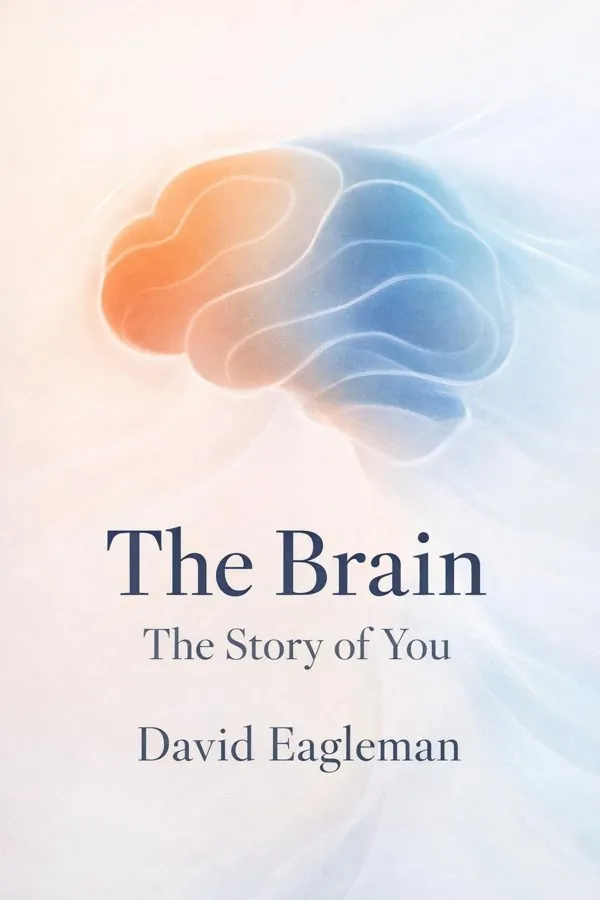
The Brain: The Story of You: Summary & Key Insights
 10 min7 chaptersAudio available
What Is The Brain: The Story of You About?
The Brain: The Story of You by David Eagleman is a neuroscience book spanning 7 pages. In this accessible exploration of neuroscience, David Eagleman takes readers on a journey through the inner workings of the human brain, revealing how billions of neurons create our perceptions, emotions, and sense of self. The book blends scientific insight with engaging storytelling to explain how the brain constructs reality, makes decisions, and adapts to change.
This FizzRead summary covers all 7 key chapters of The Brain: The Story of You in approximately 10 minutes, distilling the most important ideas, arguments, and takeaways from David Eagleman's work. Also available as an audio summary and Key Quotes Podcast.
The Brain: The Story of You
In this accessible exploration of neuroscience, David Eagleman takes readers on a journey through the inner workings of the human brain, revealing how billions of neurons create our perceptions, emotions, and sense of self. The book blends scientific insight with engaging storytelling to explain how the brain constructs reality, makes decisions, and adapts to change.
Who Should Read The Brain: The Story of You?
This book is perfect for anyone interested in neuroscience and looking to gain actionable insights in a short read. Whether you're a student, professional, or lifelong learner, the key ideas from The Brain: The Story of You by David Eagleman will help you think differently.
- ✓Readers who enjoy neuroscience and want practical takeaways
- ✓Professionals looking to apply new ideas to their work and life
- ✓Anyone who wants the core insights of The Brain: The Story of You in just 10 minutes
Want the full summary?
Get instant access to this book summary and 100K+ more with Fizz Moment.
Get Free SummaryAvailable on App Store • Free to download
Key Chapters
One of the greatest revelations in neuroscience is that the brain is not static. It is not a fixed map etched at birth, but a vast wilderness of connecting pathways that continuously shape and reshape themselves. Plasticity—the brain’s ability to rewire—is more than just a neurological curiosity; it is the foundation of our ability to adapt, recover, and learn.
Think about what happens when you master a new skill, such as playing a guitar chord or learning a new language. What you are really doing is training your neurons to communicate in more efficient and specialized ways. Synaptic connections grow stronger with use and fade when neglected—a biological manifestation of the adage ‘practice makes perfect.’ But the implications reach far deeper than personal mastery. Plasticity also governs how we recover from injury, how early experiences sculpt our temperament, and how trauma or deprivation can leave its marks in the architecture of the adult brain.
In my laboratories and others across the world, we have found that this rewiring is happening all the time, at every age. Each experience you live literally re-sculpts the physical wiring of your brain. The brain is a dynamic, self-tuning system, constantly calibrating itself in response to its environment. It is not a cleanly designed machine but a living work-in-progress that learns and forgets, adapts and rewires. Understanding this dynamism is crucial, because it frees us from believing that our brains—and therefore our identities—are fixed. We are organisms of change, molded by our interactions, continuously shaping who we will become.
Every moment you think you are perceiving the world ‘as it is,’ your brain is in fact constructing a version of reality. Your eyes absorb light, your ears take in pressure waves, and your skin responds to molecular vibrations—but none of these signals carry inherent meaning. The brain is the artist that weaves these signals into a coherent picture of the world.
To illustrate this, consider optical illusions. When you are fooled by them, what fails is not your eyesight—it’s your brain’s interpretation. The same happens every second you are awake: your brain makes predictions based on prior experiences and fills in the gaps with expectations. You live in a reality that is shaped more by internal models than by external data. We call this predictive coding, a process where the brain is always balancing what it expects to perceive with what it actually senses.
This principle extends far beyond vision. Our sense of temperature, sound, color, even time—all of them are subjective reconstructions. For instance, two people listening to the same piece of music may feel entirely different emotions, because each brings to that experience a different neural history. In this sense, there is no universal reality—only personalized versions of it.
Living with this realization changes the way we navigate the world. It encourages humility, because it reminds us that our perceptions are not infallible representations of truth. They are stories written by the electrical language of our brain, shaped by evolution to help us survive, not to show us objective reality.
+ 5 more chapters — available in the FizzRead app
All Chapters in The Brain: The Story of You
About the Author
David Eagleman is an American neuroscientist, author, and science communicator known for his research on time perception, synesthesia, and brain plasticity. He is a professor at Stanford University and the founder of several neuroscience-related ventures. Eagleman is also recognized for his popular science books and television series that make complex brain science accessible to the public.
Get This Summary in Your Preferred Format
Read or listen to the The Brain: The Story of You summary by David Eagleman anytime, anywhere. FizzRead offers multiple formats so you can learn on your terms — all free.
Available formats: App · Audio · PDF · EPUB — All included free with FizzRead
Download The Brain: The Story of You PDF and EPUB Summary
Key Quotes from The Brain: The Story of You
“One of the greatest revelations in neuroscience is that the brain is not static.”
“Every moment you think you are perceiving the world ‘as it is,’ your brain is in fact constructing a version of reality.”
Frequently Asked Questions about The Brain: The Story of You
The Brain: The Story of You by David Eagleman is a neuroscience book that explores key ideas across 7 chapters. In this accessible exploration of neuroscience, David Eagleman takes readers on a journey through the inner workings of the human brain, revealing how billions of neurons create our perceptions, emotions, and sense of self. The book blends scientific insight with engaging storytelling to explain how the brain constructs reality, makes decisions, and adapts to change.
More by David Eagleman

Incognito: The Secret Lives of the Brain
David Eagleman
10 min
Livewired: The Inside Story of the Ever-Changing Brain
David Eagleman
10 min
Sum: Forty Tales From The Afterlives
David Eagleman
10 min
The Runaway Species: How Human Creativity Remakes the World
David Eagleman, Anthony Brandt
10 minYou Might Also Like
Anxious
Joseph LeDoux
10 min
Hallucinations
Oliver Sacks
10 min
The Biological Mind: How Brain, Body, and Environment Collaborate to Make Us Who We Are
Alan Jasanoff
10 min
The Feeling of Life Itself: Why Consciousness Is Widespread but Can't Be Computed
Christof Koch
10 min
The No-Nonsense Meditation Book
Steven Laureys
10 min
A General Theory of Love
Thomas Lewis, Fari Amini, Richard Lannon
10 minBrowse by Category
Ready to read The Brain: The Story of You?
Get the full summary and 100K+ more books with Fizz Moment.