
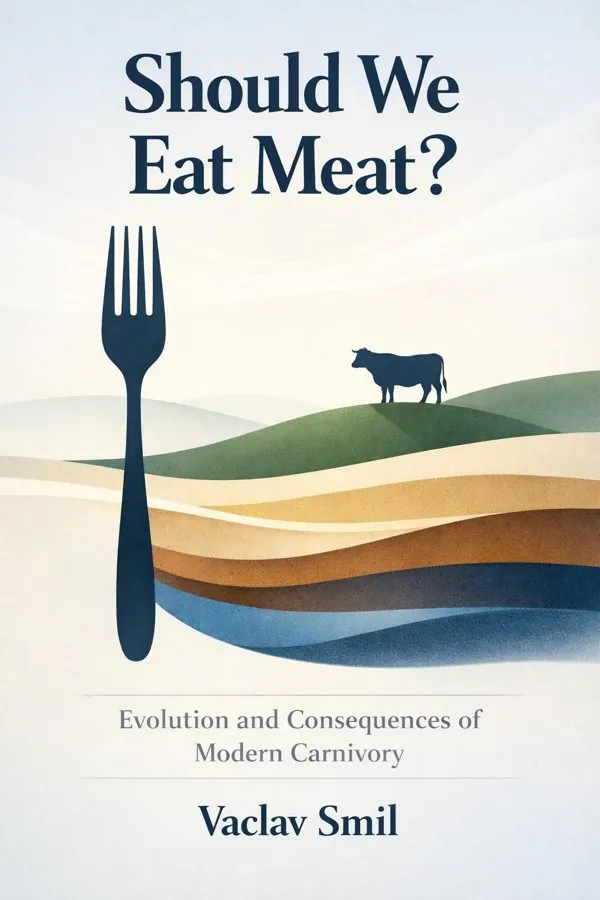
Should We Eat Meat?: Evolution and Consequences of Modern Carnivory: Summary & Key Insights
by Vaclav Smil
 10 min9 chaptersAudio available
Key Takeaways from Should We Eat Meat?: Evolution and Consequences of Modern Carnivory
A useful way to rethink meat is to stop seeing it first as a modern preference and start seeing it as an ancient survival strategy.
Food does more than feed; it signals status, identity, and belonging.
The real revolution in meat was not that humans learned to eat it, but that modern systems learned to produce it cheaply, quickly, and continuously.
One of the strongest reasons meat persists in human diets is that it delivers real nutritional benefits.
Not all meat has the same ecological footprint, and that distinction is one of Smil’s most important contributions.
What Is Should We Eat Meat?: Evolution and Consequences of Modern Carnivory About?
Should We Eat Meat?: Evolution and Consequences of Modern Carnivory by Vaclav Smil is a environment book spanning 9 pages. Should We Eat Meat?: Evolution and Consequences of Modern Carnivory is a wide-ranging examination of one of the most emotionally charged and materially important questions in modern life: why humans eat meat, how that habit developed, and what it now costs the planet. Rather than arguing from ideology, Vaclav Smil approaches the subject with the tools that define his work—history, biology, economics, energy analysis, and environmental science. He traces meat from its role in human evolution to its transformation into an industrial commodity consumed on a global scale, showing how a once-limited and valuable food became a daily expectation for billions. What makes this book especially valuable is its refusal to simplify. Smil does not present meat as either a moral evil or a nutritional necessity beyond question. Instead, he shows that the issue is shaped by trade-offs involving land use, greenhouse gases, cultural traditions, income growth, public health, and animal welfare. The result is a rigorous, evidence-based guide to understanding modern carnivory. For readers trying to make sense of sustainability, food systems, or their own dietary choices, this book offers rare clarity.
This FizzRead summary covers all 9 key chapters of Should We Eat Meat?: Evolution and Consequences of Modern Carnivory in approximately 10 minutes, distilling the most important ideas, arguments, and takeaways from Vaclav Smil's work. Also available as an audio summary and Key Quotes Podcast.
Should We Eat Meat?: Evolution and Consequences of Modern Carnivory
Should We Eat Meat?: Evolution and Consequences of Modern Carnivory is a wide-ranging examination of one of the most emotionally charged and materially important questions in modern life: why humans eat meat, how that habit developed, and what it now costs the planet. Rather than arguing from ideology, Vaclav Smil approaches the subject with the tools that define his work—history, biology, economics, energy analysis, and environmental science. He traces meat from its role in human evolution to its transformation into an industrial commodity consumed on a global scale, showing how a once-limited and valuable food became a daily expectation for billions.
What makes this book especially valuable is its refusal to simplify. Smil does not present meat as either a moral evil or a nutritional necessity beyond question. Instead, he shows that the issue is shaped by trade-offs involving land use, greenhouse gases, cultural traditions, income growth, public health, and animal welfare. The result is a rigorous, evidence-based guide to understanding modern carnivory. For readers trying to make sense of sustainability, food systems, or their own dietary choices, this book offers rare clarity.
Who Should Read Should We Eat Meat?: Evolution and Consequences of Modern Carnivory?
This book is perfect for anyone interested in environment and looking to gain actionable insights in a short read. Whether you're a student, professional, or lifelong learner, the key ideas from Should We Eat Meat?: Evolution and Consequences of Modern Carnivory by Vaclav Smil will help you think differently.
- ✓Readers who enjoy environment and want practical takeaways
- ✓Professionals looking to apply new ideas to their work and life
- ✓Anyone who wants the core insights of Should We Eat Meat?: Evolution and Consequences of Modern Carnivory in just 10 minutes
Want the full summary?
Get instant access to this book summary and 100K+ more with Fizz Moment.
Get Free SummaryAvailable on App Store • Free to download
Key Chapters
A useful way to rethink meat is to stop seeing it first as a modern preference and start seeing it as an ancient survival strategy. Smil explains that for most of human history, meat was neither abundant nor routine. Early humans pursued it because it delivered dense nutrition—particularly protein, fat, and micronutrients—in environments where plant foods could be seasonal, scattered, or unreliable. Hunting and scavenging likely contributed to human development not because meat was eaten constantly, but because it was highly valuable when available.
This evolutionary perspective matters because it corrects a common misunderstanding. Modern societies often treat heavy meat consumption as natural simply because humans have long eaten animals. Smil shows that this leap is unjustified. The fact that meat helped support human survival in prehistoric settings does not mean that industrial-scale, daily meat consumption is biologically necessary or historically normal. Evolution explains our capacity to eat meat, not the wisdom of eating it in ever-growing quantities.
The distinction has practical implications. People often defend current dietary habits by appealing to “what humans were meant to eat,” but such arguments ignore differences in activity levels, food availability, and life expectancy. A hunter-gatherer chasing scarce game in a harsh landscape lived under radically different constraints than a supermarket shopper choosing among burgers, sausages, lentils, tofu, and fish.
The actionable takeaway is simple: when evaluating your own diet, do not confuse evolutionary possibility with modern necessity. Ask not only whether humans can thrive with meat, but how much meat makes sense under today’s nutritional, environmental, and ethical conditions.
The real revolution in meat was not that humans learned to eat it, but that modern systems learned to produce it cheaply, quickly, and continuously. Smil examines how industrial agriculture transformed meat from an occasional food into a mass-market staple. Mechanized farming, synthetic fertilizers, concentrated feed crops, breeding technologies, refrigeration, global transport, and vertically integrated supply chains made it possible to raise and deliver enormous volumes of pork, poultry, and beef at prices many consumers could afford.
This achievement increased access, but it also changed expectations. What was once scarce became normalized. Consumers in wealthy and middle-income countries began to expect meat at nearly every meal, and rising incomes in developing economies accelerated similar demand. Poultry especially became a triumph of industrial efficiency: birds grow faster, convert feed more effectively, and require less time than larger livestock. Efficiency, however, does not erase consequences. Scale magnifies everything—resource use, waste, disease risk, labor pressures, and ethical concerns.
A practical example is the supermarket chicken breast: inexpensive, standardized, and widely available. Behind that convenience lies a system of grain inputs, controlled housing, energy-intensive processing, cold storage, transport logistics, and tightly optimized biology. Industrial meat production is not just farming; it is a vast technological network.
Smil’s broader insight is that abundance can conceal complexity. Low shelf prices often hide environmental costs, antibiotic dependence, water pollution, and the fragility of highly concentrated production systems. This does not mean all industrial methods are identical or equally harmful, but it does mean consumers should resist judging food only by immediate price.
The actionable takeaway is to see meat as a system, not a simple product. When choosing what to eat, consider production method, frequency, and hidden costs—not just affordability and convenience.
One of the strongest reasons meat persists in human diets is that it delivers real nutritional benefits. Smil acknowledges this clearly. Meat provides complete protein, bioavailable iron, vitamin B12, zinc, and other nutrients that can be difficult to obtain in some diets, especially where food diversity is limited. For children in undernourished populations, pregnant women, and communities with restricted food access, modest amounts of animal-source foods can play a meaningful role in improving nutritional status.
But Smil also rejects the idea that these benefits justify unlimited intake. In affluent societies, the problem is often not too little meat but too much of the wrong kinds—especially highly processed meats and excessive portions of red meat. Health outcomes depend on quantity, context, and substitution. A diet that includes small amounts of high-quality animal products alongside vegetables, legumes, whole grains, and fruits differs profoundly from one built around processed meats, refined starches, and calorie surplus.
This balanced view is especially useful in public debate, where people often swing between extremes: “meat is essential” or “meat is poison.” Smil’s analysis suggests that neither slogan is serious enough. Nutrition is situational. A low-income child facing stunting and micronutrient deficiencies has different needs from a sedentary adult already consuming excess calories and saturated fat.
In practice, this means dietary decisions should be guided by personal health needs, local food availability, and overall eating patterns. Someone might reduce processed meat, shift from large beef portions to smaller servings of poultry or fish, or use eggs and dairy strategically while increasing legumes and nuts.
The actionable takeaway: evaluate meat as part of your whole diet, not in isolation. Focus on adequacy, moderation, and dietary quality rather than ideological labels.
Not all meat has the same ecological footprint, and that distinction is one of Smil’s most important contributions. He shows that meat production imposes significant environmental burdens through land conversion, water use, feed cultivation, manure management, biodiversity loss, and greenhouse gas emissions. Yet these impacts vary sharply by species, production system, and location. Beef from cattle, especially in systems linked to deforestation or methane-intensive operations, generally imposes a much heavier burden than chicken or pork. Ruminants are biologically less efficient at converting feed into edible protein and produce methane as part of digestion.
This matters because public conversation often treats “meat” as a single category. Smil pushes readers toward comparative thinking. If a society shifts some consumption from beef to poultry, emissions and land requirements may decline even if meat eating does not disappear. Likewise, reducing food waste, improving feed efficiency, or managing manure better can also lower environmental damage. These are not perfect solutions, but they illustrate that impact depends on structure, not just moral intention.
Examples from everyday life make this concrete. Replacing several weekly beef meals with beans, eggs, or chicken can meaningfully lower a household’s food footprint. For institutions such as schools, hospitals, and workplaces, menu design offers even greater leverage because small per-meal changes scale across thousands of diners.
Smil’s caution, however, is that efficiency gains alone may not be enough if total demand keeps rising. Better production can be overwhelmed by sheer volume.
The actionable takeaway: think in gradients, not absolutes. If eliminating meat is unrealistic for you, start by reducing the most resource-intensive kinds and cutting waste across the meals you already eat.
As societies grow wealthier, diets usually change—and meat is often one of the first symbols of arrival. Smil examines the strong historical relationship between rising incomes, urbanization, and increased consumption of animal products. For families moving beyond subsistence, meat often represents progress, convenience, and a break from scarcity. Refrigeration, modern retail, restaurant culture, and global trade further reinforce this transition.
This trend creates a difficult policy challenge. Environmental advocates may call for lower meat consumption, but for many populations in emerging economies, eating more meat is experienced not as excess but as newly attained dignity. A recommendation that seems reasonable in a rich country may sound elitist in a poorer one. Smil’s analysis is valuable precisely because it does not ignore this tension. Sustainability is not only a technical issue; it is also a question of fairness and development.
Consider two households: one in a wealthy city consuming large portions of beef several times a week, and another in a lower-income region adding eggs, milk, or occasional chicken after years of dietary monotony. Treating these situations as morally equivalent obscures essential differences. Policy must distinguish between overconsumption and nutritional improvement.
This insight also affects business and governance. Food companies planning for long-term demand, and governments concerned about imports, feed supplies, or emissions, must reckon with the fact that demand growth is tied to aspirations as much as appetite. Cultural and economic forces can be stronger than public messaging.
The actionable takeaway: discuss meat with attention to inequality. Support reductions where consumption is excessive, while recognizing that modest increases in animal-source foods may still have legitimate roles in some populations.
The question “should we eat meat?” cannot be answered by taste alone because eating animals raises moral issues that go beyond nutrition and environment. Smil reviews the ethical landscape without turning the book into a philosophical manifesto. He considers animal suffering, the conditions of industrial confinement, the treatment of sentient creatures as production units, and the broader human responsibility involved in killing animals for food when alternatives increasingly exist.
What makes his treatment useful is its sobriety. He neither dismisses ethical concerns as sentimental nor assumes that all meat eating is equally immoral. Instead, he helps readers see that ethics enters at multiple levels: whether animals should be eaten at all, whether some forms of husbandry are more acceptable than others, and whether convenience can justify systems that prioritize output over welfare.
Practical examples reveal these distinctions. A consumer may object less to extensive grazing systems than to highly concentrated confinement operations, even if both end in slaughter. Another may continue eating meat but refuse products from producers with poor welfare standards. Others may decide that the existence of adequate alternatives makes abstention the most coherent response.
Smil’s broader point is that modern consumers cannot pretend ignorance. Industrial supply chains create distance, but they do not erase responsibility. Once we know how animals are bred, housed, transported, and killed, ethical neutrality becomes harder to maintain.
The actionable takeaway: make your meat choices morally explicit. Whether you reduce, replace, or selectively source animal products, do so according to principles you can clearly articulate rather than habits you have never examined.
A central lesson of Smil’s book is that efficiency improvements, though important, are unlikely to solve the meat problem on their own. Better feed conversion, improved genetics, smarter manure handling, and lower-emission production methods all help. But if global demand continues rising rapidly, the gains can be offset by larger total volumes of animals raised and slaughtered. This is the classic trap of scale: systems become more efficient while overall impact still expands.
Smil therefore pushes readers toward a more uncomfortable conclusion. In many affluent societies, sustainability will require some degree of absolute reduction in meat consumption, especially of resource-intensive meats. This is not the same as universal vegetarianism, nor does it mean every region should follow the same pathway. It means that the arithmetic of land, water, feed, and emissions imposes limits that efficiency alone cannot repeal.
Practical change can look less dramatic than people fear. A household might move from daily meat to a few times per week. A company cafeteria might make plant-based meals the default while keeping meat options available. Governments could update dietary guidelines, procurement policies, and agricultural incentives to favor lower-impact protein sources without imposing outright bans.
Smil’s contribution here is not utopian. He understands that demand habits are sticky and politics are difficult. Yet he insists that realistic sustainability begins with acknowledging physical constraints.
The actionable takeaway: do not wait for technology to remove all trade-offs. Treat reduced meat frequency and smaller portions as concrete sustainability tools available right now.
There is no single replacement for meat, and Smil’s analysis suggests the future of protein will likely be plural rather than revolutionary. Plant-based foods, improved legumes, eggs, dairy, aquaculture, cultured meat, insects, and more efficient livestock systems may all play roles depending on region, price, consumer acceptance, and nutritional needs. The search for alternatives matters because the current model of expanding meat consumption faces ecological and ethical constraints. Yet Smil remains cautious about hype. New technologies do not automatically become mass solutions.
This skepticism is useful. Public debate often swings from pessimism to technological salvation. One year cultured meat is supposed to end animal farming; the next, plant-based burgers are framed as the complete answer. Smil encourages a more grounded view: alternatives must be judged by scalability, cost, consumer adoption, processing requirements, nutrient profile, and total environmental performance. A novel food can sound promising in principle yet fail in infrastructure, affordability, or cultural appeal.
For everyday readers, the most practical future-oriented lesson is experimentation. The transition away from heavy meat dependence may happen less through dramatic conversion than through diversified habits: legumes replacing minced beef in some dishes, mushroom-based meals becoming routine, better seafood choices, or blended products reducing animal inputs while preserving familiar textures.
Institutions can accelerate this shift by normalizing variety rather than forcing stark all-or-nothing choices. When alternatives are tasty, accessible, and socially ordinary, they become easier to adopt.
The actionable takeaway: build a broader protein portfolio. Instead of asking what single food should replace meat, start incorporating several alternatives that fit your budget, culture, and taste.
All Chapters in Should We Eat Meat?: Evolution and Consequences of Modern Carnivory
About the Author
Vaclav Smil is a Czech-Canadian scientist, policy analyst, and writer renowned for his interdisciplinary work on energy, environment, food production, technological change, and global development. He is Distinguished Professor Emeritus at the University of Manitoba and the author of numerous influential books that combine historical depth with quantitative analysis. Smil is widely respected for examining large civilizational systems—how societies produce food, use energy, shape landscapes, and respond to material limits. His writing is known for its rigor, skepticism toward simplistic narratives, and refusal to offer easy ideological conclusions. In Should We Eat Meat?, he brings those strengths to one of the most contested issues in modern life, showing how dietary habits intersect with ecology, economics, public health, and ethics.
Get This Summary in Your Preferred Format
Read or listen to the Should We Eat Meat?: Evolution and Consequences of Modern Carnivory summary by Vaclav Smil anytime, anywhere. FizzRead offers multiple formats so you can learn on your terms — all free.
Available formats: App · Audio · PDF · EPUB — All included free with FizzRead
Download Should We Eat Meat?: Evolution and Consequences of Modern Carnivory PDF and EPUB Summary
Key Quotes from Should We Eat Meat?: Evolution and Consequences of Modern Carnivory
“A useful way to rethink meat is to stop seeing it first as a modern preference and start seeing it as an ancient survival strategy.”
“Food does more than feed; it signals status, identity, and belonging.”
“The real revolution in meat was not that humans learned to eat it, but that modern systems learned to produce it cheaply, quickly, and continuously.”
“One of the strongest reasons meat persists in human diets is that it delivers real nutritional benefits.”
“Not all meat has the same ecological footprint, and that distinction is one of Smil’s most important contributions.”
Frequently Asked Questions about Should We Eat Meat?: Evolution and Consequences of Modern Carnivory
Should We Eat Meat?: Evolution and Consequences of Modern Carnivory by Vaclav Smil is a environment book that explores key ideas across 9 chapters. Should We Eat Meat?: Evolution and Consequences of Modern Carnivory is a wide-ranging examination of one of the most emotionally charged and materially important questions in modern life: why humans eat meat, how that habit developed, and what it now costs the planet. Rather than arguing from ideology, Vaclav Smil approaches the subject with the tools that define his work—history, biology, economics, energy analysis, and environmental science. He traces meat from its role in human evolution to its transformation into an industrial commodity consumed on a global scale, showing how a once-limited and valuable food became a daily expectation for billions. What makes this book especially valuable is its refusal to simplify. Smil does not present meat as either a moral evil or a nutritional necessity beyond question. Instead, he shows that the issue is shaped by trade-offs involving land use, greenhouse gases, cultural traditions, income growth, public health, and animal welfare. The result is a rigorous, evidence-based guide to understanding modern carnivory. For readers trying to make sense of sustainability, food systems, or their own dietary choices, this book offers rare clarity.
More by Vaclav Smil
Grand Transitions: How the Modern World Was Made
Vaclav Smil
10 min
How the World Really Works: The Science Behind How We Got Here and Where We're Going
Vaclav Smil
10 min
Making the Modern World: Materials and Dematerialization
Vaclav Smil
10 min
Invention and Innovation
Vaclav Smil
10 minYou Might Also Like

A Life on Our Planet: My Witness Statement and a Vision for the Future
David Attenborough
10 min
A Sky Full Of Birds
Matt Merritt
10 min
Carbon Zero: Imagining Cities That Can Save the Planet
Alex Steffen
10 min
Eaarth: Making a Life on a Tough New Planet
Bill McKibben
10 min
The Social Contract and Environmental Governance
Various Editors
10 min
The Wild Places
Robert Macfarlane
10 minBrowse by Category
Ready to read Should We Eat Meat?: Evolution and Consequences of Modern Carnivory?
Get the full summary and 100K+ more books with Fizz Moment.