
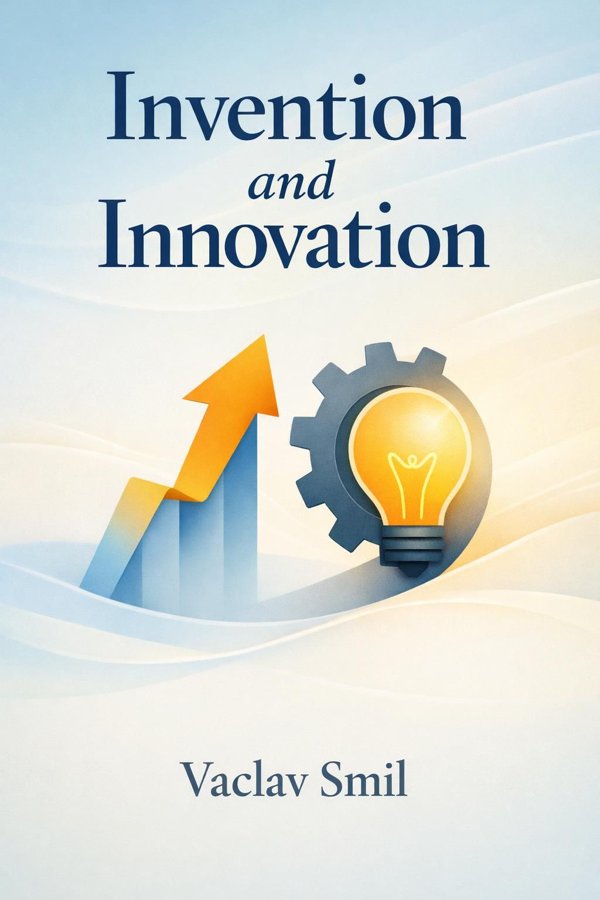
Invention and Innovation: Summary & Key Insights
by Vaclav Smil
 10 min12 chaptersAudio available
What Is Invention and Innovation About?
Invention and Innovation by Vaclav Smil is a popular_sci book spanning 12 pages. This book explores the complex processes behind technological invention and innovation, examining how new ideas emerge, evolve, and transform societies. Vaclav Smil analyzes historical examples and the interplay between science, engineering, and economics to explain why some innovations succeed while others fail.
This FizzRead summary covers all 12 key chapters of Invention and Innovation in approximately 10 minutes, distilling the most important ideas, arguments, and takeaways from Vaclav Smil's work. Also available as an audio summary and Key Quotes Podcast.
Invention and Innovation
This book explores the complex processes behind technological invention and innovation, examining how new ideas emerge, evolve, and transform societies. Vaclav Smil analyzes historical examples and the interplay between science, engineering, and economics to explain why some innovations succeed while others fail.
Who Should Read Invention and Innovation?
This book is perfect for anyone interested in popular_sci and looking to gain actionable insights in a short read. Whether you're a student, professional, or lifelong learner, the key ideas from Invention and Innovation by Vaclav Smil will help you think differently.
- ✓Readers who enjoy popular_sci and want practical takeaways
- ✓Professionals looking to apply new ideas to their work and life
- ✓Anyone who wants the core insights of Invention and Innovation in just 10 minutes
Want the full summary?
Get instant access to this book summary and 100K+ more with Fizz Moment.
Get Free SummaryAvailable on App Store • Free to download
Key Chapters
Every age thinks it is the most innovative in history, yet our capacity to imagine the future depends on understanding how technological creativity evolved. In the earliest stages of human culture, invention meant pure survival. The shaping of stone tools or the use of fire were cognitive leaps, showing how Homo sapiens could translate imagination into sustained function. But invention isn’t simply naming a novelty; it’s creating something reproducible. It took centuries before these scattered insights became organized craft traditions.
The ancient world produced some of the most important foundational mechanisms: water wheels, levers, screws, pulleys, and gears. These small mechanical triumphs set the stage for the Industrial Revolution’s massive systemization of power. Mechanical clocks in medieval Europe, for example, marked one of humanity’s most intricate harmonies between precision mechanics, metallurgy, and social need (time discipline). The printing press was another paradigmatic invention, transforming information distribution, literacy, and later, scientific collaboration.
The modern era of invention began with the late-eighteenth and nineteenth centuries — an era defined by the engineering of energy. James Watt’s improvements to the steam engine encapsulate what invention became: not an isolated bright idea, but the synthesis of materials science, thermodynamics, and enterprise. By the twentieth century, invention extended far beyond mechanical engineering into chemistry, physics, and biology — laying the groundwork for electricity, petroleum refining, and eventually the semiconductor and the gene.
In this historical sweep, invention appears less as a linear chronology and more as a mosaic of human problem-solving under constraint. I have always argued that innovation feeds on previous energy transitions. The ability to smelt, forge, and machine at higher efficiencies expanded what inventors could conceive. This long view reminds us that invention is cumulative — it grows out of the physical and intellectual capital accumulated over generations.
Invention is not a sudden spark; it is an iterative dance between curiosity, persistence, and failure. My studies across disciplines consistently show that major inventions rarely arise from a single epiphany. They emerge from long cycles of experimentation, trial and error, and adaptation of existing knowledge. The image of the lone genius in a garage or attic obscures what makes invention durable — the accumulation of experience, craft, and feedback.
Central to invention is the material world. One cannot invent what one cannot build. A society’s capacity to produce fine instruments, manipulate matter at small scales, and understand natural processes shapes its inventive potential. The early metallurgists who refined bronze and iron were inventors as surely as modern electrical engineers; their experimentation was empirical, not theoretical, yet extraordinarily effective.
Creativity in invention also requires cultural permission to challenge convention. Societies that encourage learning through apprenticeship, scientific inquiry, and open exchange tend to accumulate more inventive momentum. But invention is unpredictable — there is no metrics-driven formula that guarantees a breakthrough. What matters more is a long attention span and iterative refinement. In modern laboratories, most new ideas fail, and yet these failures are the essential compost of innovation.
Reflecting on contemporary claims of hyper-innovation, I emphasize that the basic human process of inventing has not changed much. What’s different now is scale and tools: we have computation, global communication, and automated design. But the fundamental logic — incremental refinement guided by deep understanding — remains invariant. The myth of overnight invention simply neglects the centuries of invisible groundwork that made each leap possible.
+ 10 more chapters — available in the FizzRead app
All Chapters in Invention and Innovation
About the Author
Vaclav Smil is a Czech-Canadian scientist and author known for his interdisciplinary research on energy, environment, technology, and history. He has written extensively on the development of modern civilization and the role of innovation in shaping human progress.
Get This Summary in Your Preferred Format
Read or listen to the Invention and Innovation summary by Vaclav Smil anytime, anywhere. FizzRead offers multiple formats so you can learn on your terms — all free.
Available formats: App · Audio · PDF · EPUB — All included free with FizzRead
Download Invention and Innovation PDF and EPUB Summary
Key Quotes from Invention and Innovation
“Every age thinks it is the most innovative in history, yet our capacity to imagine the future depends on understanding how technological creativity evolved.”
“Invention is not a sudden spark; it is an iterative dance between curiosity, persistence, and failure.”
Frequently Asked Questions about Invention and Innovation
Invention and Innovation by Vaclav Smil is a popular_sci book that explores key ideas across 12 chapters. This book explores the complex processes behind technological invention and innovation, examining how new ideas emerge, evolve, and transform societies. Vaclav Smil analyzes historical examples and the interplay between science, engineering, and economics to explain why some innovations succeed while others fail.
More by Vaclav Smil

Grand Transitions: How the Modern World Was Made
Vaclav Smil
10 min
How the World Really Works: The Science Behind How We Got Here and Where We're Going
Vaclav Smil
10 min
Making the Modern World: Materials and Dematerialization
Vaclav Smil
10 min
Should We Eat Meat?: Evolution and Consequences of Modern Carnivory
Vaclav Smil
10 minYou Might Also Like

Structures: Or Why Things Don"t Fall Down
J.E. Gordon
10 min
The Road to Wigan Pier
George Orwell
10 min
Bonk: The Curious Coupling of Science and Sex
Mary Roach
10 min
First Bite: How We Learn to Eat
Bee Wilson
10 min
In Pursuit Of The Unknown: 17 Equations That Changed The World
Ian Stewart
10 min
Napoleon's Buttons: 17 Molecules That Changed History
Penny Le Couteur and Jay Burreson
10 minBrowse by Category
Ready to read Invention and Innovation?
Get the full summary and 100K+ more books with Fizz Moment.