
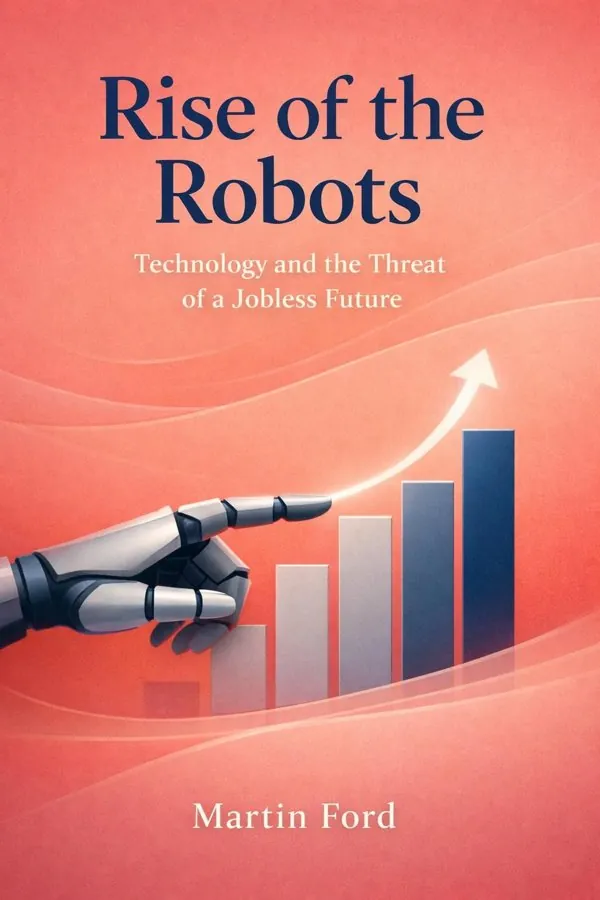
Rise of the Robots: Technology and the Threat of a Jobless Future: Summary & Key Insights
by Martin Ford
 10 min10 chaptersAudio available
Key Takeaways from Rise of the Robots: Technology and the Threat of a Jobless Future
One of the most comforting assumptions about technology is also one of the most dangerous: that every wave of automation destroys some jobs but inevitably creates better ones.
The real disruption begins when machines stop being tools and start becoming competitors.
Factories provide an early and revealing picture of what automation does to employment.
For decades, education was sold as protection against automation.
A healthy economy is often assumed to be one in which productivity growth benefits everyone.
What Is Rise of the Robots: Technology and the Threat of a Jobless Future About?
Rise of the Robots: Technology and the Threat of a Jobless Future by Martin Ford is a future_trends book spanning 10 pages. Martin Ford’s Rise of the Robots is a sharp, urgent examination of how artificial intelligence, robotics, and software automation are reshaping the modern economy. The book argues that the current wave of technological change is fundamentally different from earlier industrial revolutions because machines are no longer replacing only routine physical labor; they are increasingly performing cognitive, analytical, and even creative tasks once thought uniquely human. As a result, Ford warns that entire sectors of employment—from factory work and retail to law, finance, medicine, and transportation—face disruption on a historic scale. What makes the book especially important is its focus not just on technology itself, but on the broader economic consequences: stagnant wages, declining labor demand, rising inequality, and the risk that consumer purchasing power may erode in a highly automated society. Ford writes with the clarity of a futurist and the practicality of an entrepreneur, combining economic history, business insight, and technological analysis. This is not a science-fiction warning, but a grounded exploration of a future already taking shape—and a compelling call to rethink work, education, and public policy before the disruption becomes irreversible.
This FizzRead summary covers all 10 key chapters of Rise of the Robots: Technology and the Threat of a Jobless Future in approximately 10 minutes, distilling the most important ideas, arguments, and takeaways from Martin Ford's work. Also available as an audio summary and Key Quotes Podcast.
Rise of the Robots: Technology and the Threat of a Jobless Future
Martin Ford’s Rise of the Robots is a sharp, urgent examination of how artificial intelligence, robotics, and software automation are reshaping the modern economy. The book argues that the current wave of technological change is fundamentally different from earlier industrial revolutions because machines are no longer replacing only routine physical labor; they are increasingly performing cognitive, analytical, and even creative tasks once thought uniquely human. As a result, Ford warns that entire sectors of employment—from factory work and retail to law, finance, medicine, and transportation—face disruption on a historic scale.
What makes the book especially important is its focus not just on technology itself, but on the broader economic consequences: stagnant wages, declining labor demand, rising inequality, and the risk that consumer purchasing power may erode in a highly automated society. Ford writes with the clarity of a futurist and the practicality of an entrepreneur, combining economic history, business insight, and technological analysis. This is not a science-fiction warning, but a grounded exploration of a future already taking shape—and a compelling call to rethink work, education, and public policy before the disruption becomes irreversible.
Who Should Read Rise of the Robots: Technology and the Threat of a Jobless Future?
This book is perfect for anyone interested in future_trends and looking to gain actionable insights in a short read. Whether you're a student, professional, or lifelong learner, the key ideas from Rise of the Robots: Technology and the Threat of a Jobless Future by Martin Ford will help you think differently.
- ✓Readers who enjoy future_trends and want practical takeaways
- ✓Professionals looking to apply new ideas to their work and life
- ✓Anyone who wants the core insights of Rise of the Robots: Technology and the Threat of a Jobless Future in just 10 minutes
Want the full summary?
Get instant access to this book summary and 100K+ more with Fizz Moment.
Get Free SummaryAvailable on App Store • Free to download
Key Chapters
One of the most comforting assumptions about technology is also one of the most dangerous: that every wave of automation destroys some jobs but inevitably creates better ones. Martin Ford challenges this belief by revisiting earlier industrial revolutions and asking whether history truly offers reassurance for the age of artificial intelligence. In the past, mechanization displaced workers, but new industries absorbed them. Farm laborers moved into factories; factory workers later moved into service roles. Productivity gains expanded markets, lowered prices, and generated fresh demand for human labor.
Ford argues that today’s situation may be fundamentally different. Earlier machines mainly replaced muscle, while modern systems increasingly replace pattern recognition, decision-making, language processing, and other forms of cognition. If machines can perform both routine manual work and a growing range of mental tasks, the usual path from displaced labor to reemployment becomes narrower. A worker replaced in retail, transport, or clerical work may find that adjacent occupations are also being automated.
Ford’s insight is not that history is irrelevant, but that historical analogies can mislead when the underlying technology changes category. For example, software can scale globally at near-zero cost, replacing millions of workers far faster than physical machinery ever could. A single algorithm can affect entire industries simultaneously.
The practical implication is clear: societies cannot assume labor markets will automatically heal themselves. Policymakers, educators, and businesses must question old narratives and examine whether new job creation is keeping pace with technological substitution. Actionable takeaway: stop using past industrial revolutions as a guarantee of future employment, and start evaluating automation by asking which human roles remain economically defensible in the next decade.
The real disruption begins when machines stop being tools and start becoming competitors. Ford explains that advances in artificial intelligence, machine learning, sensors, and robotics have moved automation beyond rigid, preprogrammed routines. Today’s systems improve through data, adapt to changing conditions, and perform tasks that once required judgment, perception, or experience. This is what makes the current wave of automation so economically powerful.
In earlier eras, a machine might help a worker become more productive. Now, in many contexts, the machine becomes the worker. Algorithms can review legal documents, detect fraud, recommend medical diagnoses, optimize logistics, answer customer questions, and even generate written or visual content. Robots equipped with computer vision can navigate warehouses, sort goods, and collaborate with fewer human supervisors. Self-driving technologies threaten transportation jobs not because they are perfect, but because they may become good enough at lower cost.
Ford emphasizes that business adoption follows incentives, not sentiment. If software can do a task faster, cheaper, and at scale, firms will deploy it. The key issue is not whether machines can replicate all of human intelligence, but whether they can perform enough economically valuable tasks to reduce demand for human workers.
For individuals, this means the safest work is not simply “knowledge work,” but work that combines human trust, social nuance, unpredictable environments, and genuine accountability. For organizations, it means understanding which functions are vulnerable to software substitution versus those best augmented by technology. Actionable takeaway: assess your work not by how skilled it feels, but by whether its core tasks can be standardized, digitized, or learned from large amounts of data.
Factories provide an early and revealing picture of what automation does to employment. Ford shows that manufacturing has long been the testing ground for labor-saving technology, from assembly-line machines to industrial robots. The result has been a powerful lesson: output can rise even as human employment falls. In other words, an industry can appear healthy in terms of productivity, profitability, and production while creating far fewer jobs than before.
This matters because many people still imagine industrial revival as a solution to economic decline. Ford pushes back on that hope. Even if manufacturing returns to a country, it often comes back in highly automated form. Modern plants rely on robotics, computerized machining, sensor networks, and software-driven quality control. They need engineers, technicians, and managers—but not the vast middle layer of workers that once formed the backbone of the middle class.
Examples are visible worldwide. Automobile plants use robotic arms for welding and painting. Warehousing systems integrate conveyor networks, autonomous mobile robots, and algorithmic inventory management. Food processing, packaging, and electronics assembly increasingly depend on machines that can operate continuously with precision and minimal downtime.
Ford’s larger point is that manufacturing previews what could happen elsewhere. Once a sector becomes measurable, repetitive, and technologically tractable, labor reduction follows. This does not mean factories disappear; it means jobs disappear faster than production does.
For communities and policymakers, the takeaway is sobering: bringing industries home is not the same as bringing employment back. Economic development strategies must focus not only on attracting production, but also on creating resilient local ecosystems around education, entrepreneurship, and human-centered services. Actionable takeaway: evaluate industries by job intensity, not just by output or investment headlines.
For decades, education was sold as protection against automation. Ford argues that this promise is weakening because software is increasingly capable of performing white-collar tasks once reserved for trained professionals. The old division between vulnerable blue-collar work and secure knowledge work is breaking down. That shift is one of the book’s most unsettling insights.
Many administrative and professional roles consist of structured information processing: reviewing documents, applying rules, identifying anomalies, generating reports, and making predictions from historical data. Those are precisely the domains in which algorithms excel. In law, software can scan contracts and case files. In journalism, automated systems produce earnings reports and sports summaries. In medicine, AI can assist in image recognition and diagnostic support. In finance, algorithms trade, assess risk, and detect irregularities. In customer service, chatbots and voice systems increasingly handle inquiries once managed by large support teams.
Ford does not claim every professional will be replaced. Instead, he shows how automation can hollow out occupations by removing routine components, reducing entry-level opportunities, and concentrating value among a smaller number of top performers. A radiologist may still exist, but fewer may be needed. A law firm may still hire associates, but software can reduce the volume of junior analytical work that once trained future partners.
This has practical consequences for career planning. Degrees alone are not a shield if the underlying tasks are predictable and data-rich. Human advantages remain strongest where work involves persuasion, empathy, ethics, leadership, relationship-building, and adaptation to messy real-world contexts.
Actionable takeaway: don’t judge career security by status or credentials; break your role into tasks and identify which parts create uniquely human value that software cannot easily commoditize.
A healthy economy is often assumed to be one in which productivity growth benefits everyone. Ford questions that assumption by highlighting a growing decoupling between productivity and employment. Companies can produce more with fewer workers, and markets can reward that efficiency, yet ordinary households may see stagnant wages, insecure work, and declining bargaining power. This is one of the central economic tensions in the book.
Traditionally, productivity gains helped raise living standards because workers remained essential to production and shared in the gains through higher wages and broader employment. But in an economy increasingly driven by software and capital-intensive automation, profits can accumulate to owners, investors, and a small number of highly skilled workers while labor’s share shrinks. A digital platform can serve millions of customers with a surprisingly small workforce. A highly automated firm can scale rapidly without creating corresponding job growth.
Ford shows why this matters beyond fairness. Workers are also consumers. If automation reduces income across large parts of the population, then demand weakens. Businesses may become excellent at producing goods and services, but if too many people lack purchasing power, the economy becomes unstable. In this sense, technological unemployment is not only a labor-market issue; it is a macroeconomic threat.
The practical application is broad. Investors may celebrate lean business models, but governments must ask whether national prosperity can survive if too many citizens are excluded from meaningful income. Business leaders should also recognize that consumer markets depend on widespread earning power.
Actionable takeaway: when evaluating economic progress, look beyond GDP and productivity statistics to measures of wage growth, labor participation, and household purchasing power.
Technology does not affect everyone equally, and Ford argues that automation can intensify inequality across workers, firms, and regions. At the individual level, high-skill workers who design, manage, or complement advanced systems may gain outsized rewards, while those performing routine tasks are displaced or pushed into lower-paid service roles. At the corporate level, digital businesses often produce winner-take-most outcomes, where scale, data, and network effects allow a handful of firms to dominate. At the geographic level, innovation clusters attract capital and talent, while other communities lose employers and economic resilience.
Ford’s concern is not merely moral; it is structural. Extreme inequality weakens social cohesion, distorts politics, and undermines the broad consumer base that market economies depend on. A society in which productivity gains accrue primarily to shareholders and elite professionals may become both economically fragile and politically volatile. The promise that everyone will benefit indirectly from innovation begins to ring hollow when wages stagnate, stable jobs disappear, and wealth concentrates.
Examples are easy to imagine. An AI-enabled company may replace thousands of support staff while enriching executives and investors. A rural logistics hub may become heavily automated, leaving fewer local opportunities. A college-educated worker may still earn well, but those without elite credentials may cycle between gig work, unstable scheduling, and declining benefits.
Ford’s analysis encourages readers to see inequality not as a side effect of technological progress, but as one of its defining policy challenges. Tax systems, ownership structures, bargaining institutions, and social insurance all shape whether innovation lifts societies or fractures them.
Actionable takeaway: treat inequality as a key metric of technological success, and support policies and business models that distribute gains more broadly rather than assuming market forces will do it automatically.
When jobs disappear, the default public response is often simple: workers need new skills. Ford argues that this view is too narrow and sometimes dangerously misleading. Retraining can help individuals adapt, but it cannot solve a systemic problem if automation reduces demand across many occupations at once. Teaching people new skills matters only if there are enough new roles that genuinely require humans.
Ford challenges the comforting idea that workers displaced by technology can smoothly move up the skill ladder. Not everyone can become a software engineer, data scientist, or robotics specialist, and even these fields can be affected by future automation. More importantly, if technology keeps advancing, jobs created today may themselves become vulnerable tomorrow. Education remains valuable, but its power to guarantee security is often overstated.
This does not mean learning is futile. Rather, Ford suggests we need a more realistic understanding of what education can and cannot do. Training works best when tied to areas of durable human advantage: interpersonal care, skilled trades in unpredictable environments, leadership, complex collaboration, and roles requiring judgment under uncertainty. Even then, labor demand may not be sufficient to absorb everyone displaced elsewhere.
A practical example is healthcare. Some jobs in patient care may grow because human presence matters, yet diagnostic and administrative functions may still be automated. Similarly, coding boot camps can help some workers, but they are not a universal escape hatch for millions.
Ford’s broader message is that labor-market disruption cannot be individualized. It is a social and economic challenge requiring policy support, income security, and new ways of distributing opportunity. Actionable takeaway: invest in learning, but reject the myth that retraining by itself can offset economy-wide reductions in labor demand.
If automation changes the role of labor in the economy, then policy cannot remain tied to assumptions from the industrial age. Ford argues that incremental fixes will not be enough. Societies may need to redesign how income is distributed, how markets are stabilized, and how citizens maintain economic security in a future where paid work is less central. This is where the book becomes most provocative.
Ford explores responses such as strengthening the social safety net, rethinking taxation, and seriously considering a universal basic income. His reasoning is practical: if machines perform more of the work, then the link between employment and survival becomes increasingly fragile. A basic income could preserve consumer demand, reduce insecurity, and give people room to pursue caregiving, education, entrepreneurship, or creative work even when traditional jobs are scarce.
He also points to the need for policies that prevent excessive concentration of wealth and power. That may include tax reforms, support for public goods, investment in health and education, and systems that ensure technological gains benefit society broadly rather than a narrow elite. The aim is not to halt innovation, but to align it with social stability.
Critics may object that these ideas are expensive or unrealistic. Ford’s counterpoint is that refusing to adapt may be even more costly if unemployment, inequality, and weak demand become chronic. The old model—let markets innovate and labor markets adjust—may not work when machines substitute for people across large segments of the economy.
Actionable takeaway: treat automation as a policy challenge requiring structural reform, and evaluate solutions by whether they preserve both human dignity and the purchasing power that modern economies depend on.
Ford’s long-term outlook is serious, but not fatalistic. The future is not predetermined by technology alone. Machines do not impose a social order; people, institutions, and political choices do. This final idea is crucial because it shifts the conversation from passive prediction to active design. Automation may continue advancing rapidly, but whether it leads to abundance or exclusion depends on how societies respond.
Ford imagines a future in which intelligent machines can produce extraordinary wealth with minimal human labor. In principle, that could free people from drudgery and enable better lives. In practice, however, such abundance could coexist with poverty and insecurity if ownership and income remain concentrated. The same technological progress that could support leisure, creativity, and public well-being could also produce mass displacement and social division.
This makes the debate deeply ethical as well as economic. What is the purpose of productivity if most people do not benefit? How should people find meaning in a world with less work? What institutions are needed when labor is no longer the primary route to survival or social inclusion? Ford does not claim to answer every question, but he insists they can no longer be ignored.
For readers, the practical lesson is to think beyond narrow job forecasts. The real issue is what kind of civilization automation will support. Businesses can choose whether to deploy technology purely to cut labor or also to create human-centered value. Citizens can demand policies that distribute gains more fairly. Educators can prepare people for adaptability, not just credentials.
Actionable takeaway: engage with automation as a civic issue, not merely a workplace trend, and help shape a future where technological progress expands human possibility rather than shrinking it.
All Chapters in Rise of the Robots: Technology and the Threat of a Jobless Future
About the Author
Martin Ford is an American futurist, author, and former software entrepreneur best known for analyzing how automation and artificial intelligence affect jobs, inequality, and the broader economy. With a background in computer engineering and business, he brings both technical literacy and economic insight to his writing. Ford gained wide recognition with Rise of the Robots, a book that helped push concerns about technological unemployment into mainstream debate. He later expanded his exploration of AI through works such as Architects of Intelligence, which draws on conversations with leading researchers and innovators. A frequent speaker and commentator, Ford is known for making complex technological trends understandable while focusing on their real-world consequences for workers, institutions, and society.
Get This Summary in Your Preferred Format
Read or listen to the Rise of the Robots: Technology and the Threat of a Jobless Future summary by Martin Ford anytime, anywhere. FizzRead offers multiple formats so you can learn on your terms — all free.
Available formats: App · Audio · PDF · EPUB — All included free with FizzRead
Download Rise of the Robots: Technology and the Threat of a Jobless Future PDF and EPUB Summary
Key Quotes from Rise of the Robots: Technology and the Threat of a Jobless Future
“One of the most comforting assumptions about technology is also one of the most dangerous: that every wave of automation destroys some jobs but inevitably creates better ones.”
“The real disruption begins when machines stop being tools and start becoming competitors.”
“Factories provide an early and revealing picture of what automation does to employment.”
“For decades, education was sold as protection against automation.”
“A healthy economy is often assumed to be one in which productivity growth benefits everyone.”
Frequently Asked Questions about Rise of the Robots: Technology and the Threat of a Jobless Future
Rise of the Robots: Technology and the Threat of a Jobless Future by Martin Ford is a future_trends book that explores key ideas across 10 chapters. Martin Ford’s Rise of the Robots is a sharp, urgent examination of how artificial intelligence, robotics, and software automation are reshaping the modern economy. The book argues that the current wave of technological change is fundamentally different from earlier industrial revolutions because machines are no longer replacing only routine physical labor; they are increasingly performing cognitive, analytical, and even creative tasks once thought uniquely human. As a result, Ford warns that entire sectors of employment—from factory work and retail to law, finance, medicine, and transportation—face disruption on a historic scale. What makes the book especially important is its focus not just on technology itself, but on the broader economic consequences: stagnant wages, declining labor demand, rising inequality, and the risk that consumer purchasing power may erode in a highly automated society. Ford writes with the clarity of a futurist and the practicality of an entrepreneur, combining economic history, business insight, and technological analysis. This is not a science-fiction warning, but a grounded exploration of a future already taking shape—and a compelling call to rethink work, education, and public policy before the disruption becomes irreversible.
More by Martin Ford


You Might Also Like
Futureproof: 9 Rules for Humans in the Age of Automation
Kevin Roose
10 min
The Third Wave
Alvin Toffler
10 min
2030: How Today's Biggest Trends Will Collide and Reshape the Future of Everything
Mauro F. Guillén
10 min
A Very Human Future: Enriching Humanity in a Digitized World
Rohit Talwar, Steve Wells, Alexandra Whittington
10 min
AI 2041: Ten Visions for Our Future
Kai-Fu Lee, Chen Qiufan
10 min
Abundance: The Future Is Better Than You Think
Peter H. Diamandis, Steven Kotler
10 minBrowse by Category
Ready to read Rise of the Robots: Technology and the Threat of a Jobless Future?
Get the full summary and 100K+ more books with Fizz Moment.