
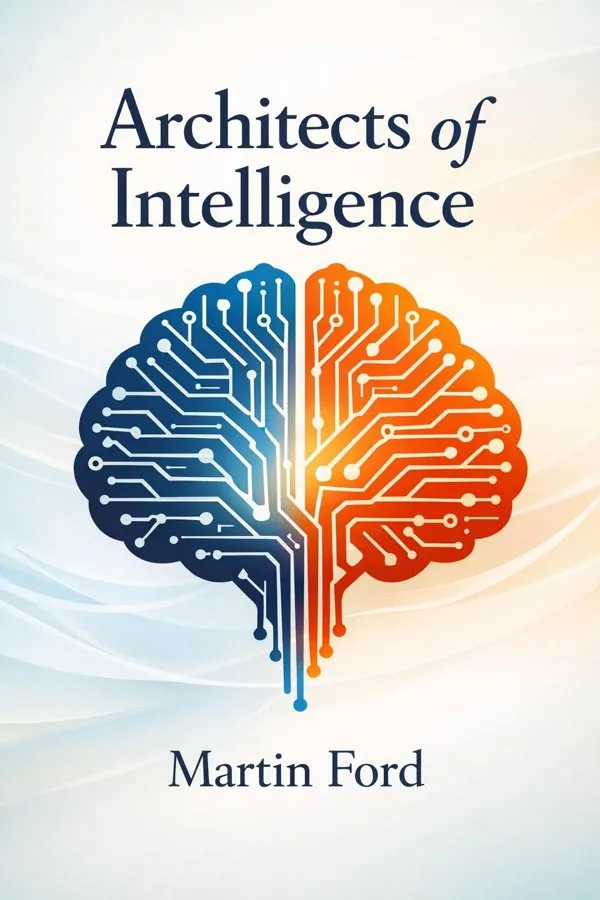
Architects of Intelligence: The Truth About AI from the People Building It: Summary & Key Insights
by Martin Ford
 10 min5 chaptersAudio available
What Is Architects of Intelligence: The Truth About AI from the People Building It About?
Architects of Intelligence: The Truth About AI from the People Building It by Martin Ford is a ai_ml book spanning 5 pages. Architects of Intelligence es una colección de entrevistas en profundidad con veintitrés líderes en inteligencia artificial, incluyendo investigadores y empresarios. El autor, Martin Ford, explora el estado actual de la IA, sus posibles avances futuros y las implicaciones sociales y económicas de su desarrollo. El libro ofrece una visión panorámica de cómo los expertos ven el futuro de la tecnología y su impacto en la humanidad.
This FizzRead summary covers all 5 key chapters of Architects of Intelligence: The Truth About AI from the People Building It in approximately 10 minutes, distilling the most important ideas, arguments, and takeaways from Martin Ford's work. Also available as an audio summary and Key Quotes Podcast.
Architects of Intelligence: The Truth About AI from the People Building It
Architects of Intelligence es una colección de entrevistas en profundidad con veintitrés líderes en inteligencia artificial, incluyendo investigadores y empresarios. El autor, Martin Ford, explora el estado actual de la IA, sus posibles avances futuros y las implicaciones sociales y económicas de su desarrollo. El libro ofrece una visión panorámica de cómo los expertos ven el futuro de la tecnología y su impacto en la humanidad.
Who Should Read Architects of Intelligence: The Truth About AI from the People Building It?
This book is perfect for anyone interested in ai_ml and looking to gain actionable insights in a short read. Whether you're a student, professional, or lifelong learner, the key ideas from Architects of Intelligence: The Truth About AI from the People Building It by Martin Ford will help you think differently.
- ✓Readers who enjoy ai_ml and want practical takeaways
- ✓Professionals looking to apply new ideas to their work and life
- ✓Anyone who wants the core insights of Architects of Intelligence: The Truth About AI from the People Building It in just 10 minutes
Want the full summary?
Get instant access to this book summary and 100K+ more with Fizz Moment.
Get Free SummaryAvailable on App Store • Free to download
Key Chapters
Artificial intelligence today stands at a pivotal threshold. Through my interviews with pioneers, it became clear that AI has advanced not through one single breakthrough but through decades of cumulative effort—machine learning algorithms refining themselves, data expanding in scale, and computing power growing exponentially. When experts such as Andrew Ng and Demis Hassabis discuss their work, they often describe AI as analogous to electricity—a transformative, general-purpose technology that will be woven into everything.
Machine learning, particularly deep learning, underpins this transformation. Neural networks now mimic certain structures of biological cognition, allowing systems to identify patterns within massive datasets. Tasks once thought impossible—natural language understanding, image recognition, complex strategic gameplay—are now achievable with remarkable precision. Yet every expert underscores that today’s AI is still narrow: it excels in specialized domains but lacks the flexible, general reasoning that defines human intelligence.
This distinction—between narrow and general intelligence—is critical. Demis Hassabis at DeepMind sees the quest for general AI as comparable to understanding the human brain itself, an effort merging neuroscience and computer science. Yoshua Bengio, meanwhile, emphasizes the importance of embedding social and emotional intelligence into AI if it’s ever to truly align with human values. Through these discussions, a picture emerges of a discipline simultaneously confident in progress and humbled by the complexity of cognition.
The overview also touches upon hybrid models, reinforcement learning, and the growing interplay between AI and neuroscience. When AlphaGo challenged human champions, it didn’t merely demonstrate computational might—it revealed how learning algorithms could achieve creativity through self-play and exploration. For many thinkers in the book, this was symbolic of an era where AI begins to reveal something about ourselves: the patterns in how we learn, pursue goals, and adapt. AI has become not just a tool but a mirror reflecting human ambition and limitation.
As I frame this chapter, I want readers to see that AI is not magic—nor mythology—but engineering combined with experimentation. Understanding this foundation allows us to discuss its implications with greater clarity and less fear. The experts remind us that intelligence, whether artificial or biological, thrives on feedback and iteration. In that sense, our own engagement with AI—how we choose to deploy and regulate it—will be the feedback loop determining its evolution.
If one question dominated my conversations, it was: what will AI do to jobs? Nearly every expert acknowledges that automation will reshape the labor landscape on a scale rivaling the Industrial Revolution. Machines don’t just replace manual labor—they extend into cognitive domains, handling analysis, design adjustments, and even creative ideation. Andrew Ng often points out that AI is best seen as the new electricity: any industry not integrating it risks obsolescence.
But beneath this enthusiasm lies deep concern. How does society manage the transition? I recall discussions with Rodney Brooks and Kai-Fu Lee about the dual nature of productivity gains. AI can amplify output—yet the benefits may concentrate among those who own technology and data. The recurring theme is inequality. Automation tends to reward capital over labor, algorithms over artisans. Unless actively balanced through policy and innovation, this could lead to widespread displacement and tension.
Experts shared varying solutions. Some emphasize education and lifelong learning, others universal basic income or new models of social safety nets. Fei-Fei Li insists that we must design AI for augmentation rather than replacement—tools that empower teachers, doctors, creatives, not eliminate them. In industries such as medicine, AI can ease diagnostic workloads, allowing professionals to focus on empathy and complex care. In contrast, routine clerical or transport roles face rapid automation.
Throughout this chapter I stress a crucial mindset shift. The future of work may not lie in competing with machines but collaborating with them—finding human niches where empathy, ethics, and contextual reasoning remain irreplaceable. As AI handles data-driven precision, humans can emphasize compassion, adaptability, and imagination. But this transition will demand intentional restructuring of education and economic incentives, not passive optimism.
The experts agree that work will change—but human worth need not diminish. Understanding AI’s economic trajectory enables proactive adaptation rather than fear. The next era could be one where productivity and creativity coexist, provided we build frameworks that align technological efficiency with human flourishing.
+ 3 more chapters — available in the FizzRead app
All Chapters in Architects of Intelligence: The Truth About AI from the People Building It
About the Author
Martin Ford es un autor y futurista estadounidense conocido por sus obras sobre el impacto de la automatización y la inteligencia artificial en la economía y la sociedad. Es también el autor de 'Rise of the Robots', ganador del Financial Times and McKinsey Business Book of the Year Award.
Get This Summary in Your Preferred Format
Read or listen to the Architects of Intelligence: The Truth About AI from the People Building It summary by Martin Ford anytime, anywhere. FizzRead offers multiple formats so you can learn on your terms — all free.
Available formats: App · Audio · PDF · EPUB — All included free with FizzRead
Download Architects of Intelligence: The Truth About AI from the People Building It PDF and EPUB Summary
Key Quotes from Architects of Intelligence: The Truth About AI from the People Building It
“Artificial intelligence today stands at a pivotal threshold.”
“If one question dominated my conversations, it was: what will AI do to jobs?”
Frequently Asked Questions about Architects of Intelligence: The Truth About AI from the People Building It
Architects of Intelligence: The Truth About AI from the People Building It by Martin Ford is a ai_ml book that explores key ideas across 5 chapters. Architects of Intelligence es una colección de entrevistas en profundidad con veintitrés líderes en inteligencia artificial, incluyendo investigadores y empresarios. El autor, Martin Ford, explora el estado actual de la IA, sus posibles avances futuros y las implicaciones sociales y económicas de su desarrollo. El libro ofrece una visión panorámica de cómo los expertos ven el futuro de la tecnología y su impacto en la humanidad.
More by Martin Ford
You Might Also Like
Life 3.0
Max Tegmark
10 min
Superintelligence
Nick Bostrom
10 min
TensorFlow in Action
Thushan Ganegedara
10 min
AI Made Simple: A Beginner’s Guide to Generative AI, ChatGPT, and the Future of Work
Rajeev Kapur
10 min
AI Snake Oil
Arvind Narayanan, Sayash Kapoor
10 min
AI Superpowers: China, Silicon Valley, and the New World Order
Kai-Fu Lee
10 minBrowse by Category
Ready to read Architects of Intelligence: The Truth About AI from the People Building It?
Get the full summary and 100K+ more books with Fizz Moment.