
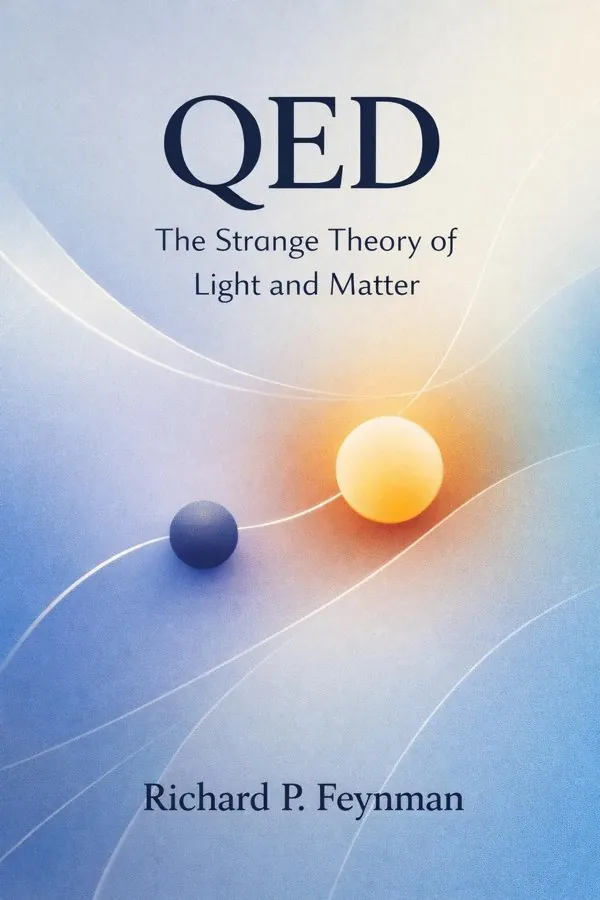
QED: The Strange Theory of Light and Matter: Summary & Key Insights
 10 min10 chaptersAudio available
Key Takeaways from QED: The Strange Theory of Light and Matter
One of the book’s first shocks is that light does not behave the way common sense says it should.
The quantum world does not merely say that outcomes are uncertain; it says uncertainty is calculated in a very specific and surprising way.
A mirror looks simple, but Feynman reveals that reflection is one of the great quantum miracles hiding in plain sight.
Perhaps the strangest idea in the book is that a photon does not travel from point A to point B along one single, definite route.
If photons unsettle our intuitions, electrons do no less.
What Is QED: The Strange Theory of Light and Matter About?
QED: The Strange Theory of Light and Matter by Richard P. Feynman is a popular_sci book spanning 10 pages. Richard P. Feynman’s QED: The Strange Theory of Light and Matter is a rare kind of science book: one that explains an extraordinarily difficult theory without flattening its mystery. Based on four public lectures, the book introduces quantum electrodynamics, the branch of physics that describes how light and matter interact. From reflections in a mirror to the behavior of electrons and photons, Feynman shows that the everyday world is built on rules that are deeply counterintuitive yet stunningly precise. What makes this book so important is not only the subject but the method. Rather than drowning readers in advanced mathematics, Feynman uses simple diagrams, vivid analogies, and a playful tone to reveal how modern physics actually thinks. He does not pretend quantum theory is intuitive; instead, he helps readers accept its strangeness and follow its logic. Feynman was uniquely qualified for this task. A Nobel Prize-winning physicist and one of the chief architects of quantum electrodynamics, he helped build the theory he is explaining. The result is an accessible, witty, and profound guide to one of the most successful scientific theories ever created.
This FizzRead summary covers all 10 key chapters of QED: The Strange Theory of Light and Matter in approximately 10 minutes, distilling the most important ideas, arguments, and takeaways from Richard P. Feynman's work. Also available as an audio summary and Key Quotes Podcast.
QED: The Strange Theory of Light and Matter
Richard P. Feynman’s QED: The Strange Theory of Light and Matter is a rare kind of science book: one that explains an extraordinarily difficult theory without flattening its mystery. Based on four public lectures, the book introduces quantum electrodynamics, the branch of physics that describes how light and matter interact. From reflections in a mirror to the behavior of electrons and photons, Feynman shows that the everyday world is built on rules that are deeply counterintuitive yet stunningly precise.
What makes this book so important is not only the subject but the method. Rather than drowning readers in advanced mathematics, Feynman uses simple diagrams, vivid analogies, and a playful tone to reveal how modern physics actually thinks. He does not pretend quantum theory is intuitive; instead, he helps readers accept its strangeness and follow its logic.
Feynman was uniquely qualified for this task. A Nobel Prize-winning physicist and one of the chief architects of quantum electrodynamics, he helped build the theory he is explaining. The result is an accessible, witty, and profound guide to one of the most successful scientific theories ever created.
Who Should Read QED: The Strange Theory of Light and Matter?
This book is perfect for anyone interested in popular_sci and looking to gain actionable insights in a short read. Whether you're a student, professional, or lifelong learner, the key ideas from QED: The Strange Theory of Light and Matter by Richard P. Feynman will help you think differently.
- ✓Readers who enjoy popular_sci and want practical takeaways
- ✓Professionals looking to apply new ideas to their work and life
- ✓Anyone who wants the core insights of QED: The Strange Theory of Light and Matter in just 10 minutes
Want the full summary?
Get instant access to this book summary and 100K+ more with Fizz Moment.
Get Free SummaryAvailable on App Store • Free to download
Key Chapters
One of the book’s first shocks is that light does not behave the way common sense says it should. For centuries, people argued over whether light was a wave or a stream of particles. Quantum electrodynamics begins by accepting a deeply unsettling answer: in many important situations, light acts as if it comes in packets called photons, and these photons do not behave like tiny billiard balls either.
Feynman uses simple experiments to show why the older picture of smooth, continuous light is incomplete. When light is made extremely dim, detectors do not register a faint smear. They click in distinct events, as though individual units of light are arriving one by one. That means we cannot think of light as merely a spread-out ripple. Something granular is happening.
This particle-like behavior helps explain practical technologies. Solar panels depend on light delivering energy in discrete amounts. Digital camera sensors detect individual photon events. Laser systems, fiber optics, and medical imaging all rely on understanding light at the quantum level, not just as a classical wave.
Yet Feynman is careful: calling light a particle is useful, but it can also mislead if taken too literally. A photon is not a little bead flying along a neat visible track. It is part of a quantum process governed by probabilities and amplitudes. The old categories of “wave” and “particle” survive only as rough guides.
Actionable takeaway: when learning quantum physics, resist forcing new phenomena into familiar categories. Start by asking what experiments show, not what everyday intuition prefers.
The quantum world does not merely say that outcomes are uncertain; it says uncertainty is calculated in a very specific and surprising way. Feynman introduces one of the book’s central tools: probability amplitudes, represented visually as arrows. Instead of adding ordinary probabilities directly, physicists first add these arrows and only then square the result to get the actual probability.
This small change transforms everything. In ordinary reasoning, if there are two possible ways something can happen, you might expect the total probability to be the sum of the two chances. In QED, the alternatives contribute amplitudes that can reinforce or cancel each other depending on their direction. That is why quantum events can show interference, where adding more possibilities can sometimes reduce the likelihood of an outcome.
A familiar example is light reflecting from glass. Part of the light can reflect from the front surface, and part can enter the glass and reflect from the back. These different possibilities contribute arrows. Depending on thickness and timing, the arrows can combine to brighten or dim the reflected light. This principle also underlies interferometers, anti-reflective coatings, and many precision optical devices.
Feynman’s arrows are not a childish simplification. They capture the logic of complex numbers in quantum mechanics without requiring advanced algebra. More importantly, they teach readers how quantum theory differs from everyday statistics. The universe is not choosing among prewritten outcomes in a crude lottery. It is combining possibilities before facts become definite.
Actionable takeaway: when a quantum effect seems absurd, ask whether you are mistakenly thinking in ordinary probabilities. In quantum mechanics, the path to the answer matters as much as the answer itself.
A mirror looks simple, but Feynman reveals that reflection is one of the great quantum miracles hiding in plain sight. Classical physics says light reflects according to neat geometric laws: angle in, angle out. QED asks a deeper question: why should that happen at all when individual photons arrive one at a time?
Feynman explains that a photon reaching a surface has several possible fates. It may reflect, transmit, or take part in more complicated interactions depending on the material. Reflection is not caused by a tiny classical bounce. Instead, it emerges from the combined amplitudes of many quantum possibilities. When those amplitudes are added correctly, the behavior we call reflection appears with remarkable regularity.
This view also clarifies why different materials reflect differently. A polished metal, a pane of glass, and a soap bubble are not merely different “surfaces”; they are different quantum environments with different opportunities for photons to interact with electrons. That is why coatings can reduce glare, why some windows tint or reflect heat, and why iridescent films shimmer with color. These are not exceptions to the theory but expressions of it.
Understanding reflection as a quantum process matters beyond physics classrooms. Engineers designing lenses, screens, telescopes, and optical sensors need to predict how light behaves at boundaries. Modern communications and imaging systems depend on careful control of those interactions.
Actionable takeaway: treat everyday optical effects as clues, not background scenery. When you notice glare, color shifts, or mirror-like surfaces, ask what hidden quantum interactions are making them possible.
Perhaps the strangest idea in the book is that a photon does not travel from point A to point B along one single, definite route. According to Feynman, to calculate what happens, you must consider every possible path the photon could take. The final outcome comes from adding an amplitude for each path.
At first this sounds like madness. Surely a photon must choose one trajectory. But quantum experiments repeatedly support the opposite view. The paths near the classical route tend to reinforce each other because their arrows point in similar directions. Far-off paths usually cancel one another out. That is why, in everyday situations, light appears to travel in straight lines even though the underlying calculation includes wildly indirect possibilities.
This framework explains the principle of least time in optics and connects quantum mechanics to familiar behavior. A lifeguard running and swimming to save someone, for example, intuitively chooses the path that minimizes total time. In optics, the classical “best” path emerges because neighboring paths add constructively while others cancel. The straight line or efficient route is not imposed from above; it emerges from quantum bookkeeping.
Applications of this idea appear in path integral methods, semiconductor physics, and even conceptual tools used in modern quantum computing. More broadly, it teaches a profound lesson about science: the deepest explanations often look nothing like surface appearances.
Actionable takeaway: when a system seems to follow a simple rule, consider that the rule may be an emergent result of many hidden possibilities, not a basic commandment of nature.
If photons unsettle our intuitions, electrons do no less. Feynman shows that matter particles are governed by the same amplitude-based logic as light. Electrons are not tiny hard marbles orbiting in neat classical paths. They, too, are quantum objects whose behavior must be described through probabilities, interference, and interactions.
This matters because QED is not just a theory of light in isolation. It is a theory of how light and charged matter influence one another. Electrons absorb photons, emit photons, scatter them, and exchange them in ways that produce forces and observable effects. The visible properties of atoms, metals, circuits, and chemistry all depend on these interactions.
Practical examples are everywhere. Electronics works because electrons move through materials in quantized ways. Spectroscopy identifies substances because electrons absorb and emit light at characteristic energies. LEDs, fluorescent lamps, and atomic clocks all depend on controlled electron-photon processes. What seems like “matter” on one side and “light” on the other is, at a deeper level, an ongoing conversation between quantum actors.
Feynman also helps readers avoid a common mistake: imagining electrons as following little hidden tracks that we simply do not know. The theory does not say the track exists but is unknown. It says that track-like thinking is often the wrong language from the start.
Actionable takeaway: whenever you encounter a material property such as color, conductivity, or transparency, ask how electrons are interacting with light. That question often leads to the real explanation.
A great scientific theory becomes elegant when immense complexity can be traced back to a few simple rules. Feynman emphasizes that QED rests on three basic processes: a photon can be emitted or absorbed by an electron, an electron can move from one place to another, and a photon can move from one place to another. From these simple ingredients, the bewildering variety of electromagnetic phenomena can be constructed.
This is one of the book’s most beautiful lessons. Instead of memorizing countless disconnected facts about mirrors, atoms, sparks, currents, and radiation, QED invites us to see them as combinations of a small number of elementary events. The world’s apparent diversity is built from repeated patterns.
Think of language. A vast literature can arise from a finite alphabet and a limited set of grammatical rules. In the same way, lasers, radio signals, x-rays, chemical bonds, and screen displays all emerge from repeated combinations of a few quantum interactions. This perspective is invaluable for anyone trying to understand physics structurally rather than as trivia.
The approach also models a broader intellectual habit: seek the generating rules beneath the surface variety. In software, complex programs come from simple operations composed well. In biology, diverse organisms arise from a common genetic code. In physics, the elegance lies in compression.
Actionable takeaway: when a subject feels overwhelming, look for its elementary operations. Mastering a few core processes often gives more power than memorizing a hundred separate results.
Human understanding often depends on pictures, and one of Feynman’s great contributions was to invent a way of drawing quantum interactions that helps physicists think. Feynman diagrams are not literal snapshots of reality. They are bookkeeping tools that represent particle interactions in a clear, structured way. Lines stand for particles such as electrons and photons, while vertices mark events where they interact.
Their brilliance is practical. Without diagrams, the calculation of quantum processes can become overwhelmingly abstract. With them, physicists can break complicated interactions into understandable pieces. A scattering event, an emission process, or a correction to a particle’s behavior can all be visualized as combinations of lines and interaction points.
Feynman is careful not to oversell them. A diagram is not a photograph of what “really happens in time” inside the quantum world. It is a compact representation of terms in a calculation. Still, that representation changed physics because it made powerful mathematics more intuitive and manageable.
The influence of this way of thinking extends beyond particle physics. Diagrams and visual abstractions help people reason in chemistry, network science, systems engineering, and computer programming. A good representation does not replace thought; it makes thought possible.
For general readers, Feynman diagrams provide a valuable philosophical lesson. Science often advances not just by discovering new facts but by inventing better languages for organizing them.
Actionable takeaway: when faced with a complex idea, create or find a visual structure that captures the relationships. The right diagram can turn confusion into insight.
One of the most unsettling features of QED is that some straightforward calculations initially produce nonsense: infinities. If taken literally, the theory seems to predict impossible results. Rather than abandoning the theory, physicists developed a procedure called renormalization, which reorganizes calculations so that measurable quantities come out finite and astonishingly accurate.
Feynman does not hide the discomfort. He admits that renormalization once felt like a suspicious trick even to those using it. But he also shows why science ultimately judges theories by the reliability of their predictions. When QED is handled through renormalization, it delivers answers that match experiment to extraordinary precision, including the magnetic behavior of the electron and subtle shifts in atomic energy levels.
This is a crucial insight about real science. Great theories are not always aesthetically clean at every stage of calculation. Sometimes progress involves using imperfect but effective methods while continuing to debate their deeper meaning. Physics advances through a combination of rigor, humility, and pragmatic testing.
There are practical echoes of this mindset in many fields. Economists adjust idealized models to fit real measurements. Engineers calibrate systems to account for hidden variables. Data scientists regularize models to prevent mathematical blowups. The underlying lesson is not “anything goes,” but rather that disciplined correction can rescue a powerful framework.
Actionable takeaway: do not reject a useful model just because its first form is messy. Ask whether it can be systematically corrected to produce reliable, testable results.
Quantum electrodynamics earns trust not because it sounds reasonable but because it works with breathtaking precision. Feynman repeatedly emphasizes that the theory’s weirdness must be judged against its results. QED predicts experimental outcomes more accurately than almost any other theory in science.
This matters because human beings often confuse familiarity with truth. A theory may feel intuitive and still be wrong. Another may sound absurd and yet survive every serious test. QED belongs firmly in the second category. Its predictions for quantities such as the anomalous magnetic moment of the electron are so precise that agreement extends to many decimal places. That level of success is not philosophical decoration; it is the strongest argument a physical theory can have.
The practical consequences are enormous. Technologies based on quantum electrodynamics include semiconductors, lasers, advanced sensors, medical imaging devices, and communications systems. The modern world depends on physical theories that are not merely approximately correct but exquisitely dependable.
Feynman’s broader point is epistemological. Science does not demand that nature conform to our imagination. It demands that our theories conform to observation. The more deeply a theory is tested and the more accurately it predicts, the more seriously we must take it, even if it overturns common sense.
Actionable takeaway: when evaluating ideas, especially scientific ones, privilege predictive accuracy over intuition. A strange idea supported by strong evidence deserves more respect than a comfortable idea supported by none.
A mark of intellectual honesty is knowing where a theory stops, and Feynman is unusually clear about QED’s limits. Quantum electrodynamics is extraordinarily successful in describing electromagnetic interactions between light and charged particles. But it does not explain every force, every particle, or every question in physics.
This distinction is important because popular science can sometimes imply that a powerful theory is a final theory. Feynman resists that temptation. QED does not cover gravity in a quantum-consistent way. It is not the complete theory of nuclear forces. It does not resolve every philosophical puzzle about measurement or reality. It is one part of a larger scientific picture, albeit one of the most polished parts.
Understanding limits makes the theory more impressive, not less. A model that states clearly what it can and cannot do is more trustworthy than one that overclaims. In practical life, the same principle applies. A map of a city is useful because it leaves out mountains and weather patterns. A good model is selective by design.
For readers, this final lesson provides a healthy way to engage with science. You do not need certainty about everything to possess real knowledge about something. Scientific progress often comes in domains of extraordinary mastery surrounded by open questions.
Actionable takeaway: admire precision without demanding totality. The most reliable frameworks are often those that define their scope clearly and leave room for further discovery.
All Chapters in QED: The Strange Theory of Light and Matter
About the Author
Richard Phillips Feynman (1918–1988) was an American theoretical physicist widely regarded as one of the most brilliant scientific minds of the twentieth century. He made foundational contributions to quantum electrodynamics, particle physics, and quantum mechanics, and shared the 1965 Nobel Prize in Physics with Julian Schwinger and Sin-Itiro Tomonaga for work on QED. Feynman taught at Cornell University and later at the California Institute of Technology, where he became legendary for his originality, wit, and teaching skill. Beyond research, he was a gifted communicator who brought complex physics to general audiences through lectures and books. His enduring appeal comes from a rare combination of intellectual rigor, playful curiosity, and a deep commitment to understanding how nature really works.
Get This Summary in Your Preferred Format
Read or listen to the QED: The Strange Theory of Light and Matter summary by Richard P. Feynman anytime, anywhere. FizzRead offers multiple formats so you can learn on your terms — all free.
Available formats: App · Audio · PDF · EPUB — All included free with FizzRead
Download QED: The Strange Theory of Light and Matter PDF and EPUB Summary
Key Quotes from QED: The Strange Theory of Light and Matter
“One of the book’s first shocks is that light does not behave the way common sense says it should.”
“The quantum world does not merely say that outcomes are uncertain; it says uncertainty is calculated in a very specific and surprising way.”
“A mirror looks simple, but Feynman reveals that reflection is one of the great quantum miracles hiding in plain sight.”
“Perhaps the strangest idea in the book is that a photon does not travel from point A to point B along one single, definite route.”
“If photons unsettle our intuitions, electrons do no less.”
Frequently Asked Questions about QED: The Strange Theory of Light and Matter
QED: The Strange Theory of Light and Matter by Richard P. Feynman is a popular_sci book that explores key ideas across 10 chapters. Richard P. Feynman’s QED: The Strange Theory of Light and Matter is a rare kind of science book: one that explains an extraordinarily difficult theory without flattening its mystery. Based on four public lectures, the book introduces quantum electrodynamics, the branch of physics that describes how light and matter interact. From reflections in a mirror to the behavior of electrons and photons, Feynman shows that the everyday world is built on rules that are deeply counterintuitive yet stunningly precise. What makes this book so important is not only the subject but the method. Rather than drowning readers in advanced mathematics, Feynman uses simple diagrams, vivid analogies, and a playful tone to reveal how modern physics actually thinks. He does not pretend quantum theory is intuitive; instead, he helps readers accept its strangeness and follow its logic. Feynman was uniquely qualified for this task. A Nobel Prize-winning physicist and one of the chief architects of quantum electrodynamics, he helped build the theory he is explaining. The result is an accessible, witty, and profound guide to one of the most successful scientific theories ever created.
More by Richard P. Feynman

Surely You're Joking, Mr. Feynman!
Richard P. Feynman
10 min
The Feynman Lectures on Physics
Richard P. Feynman
10 min
The Character of Physical Law
Richard P. Feynman
10 min
Surely You’re Joking, Mr. Feynman!: Adventures of a Curious Character
Richard P. Feynman
10 minYou Might Also Like

Structures: Or Why Things Don"t Fall Down
J.E. Gordon
10 min
The Road to Wigan Pier
George Orwell
10 min
Bonk: The Curious Coupling of Science and Sex
Mary Roach
10 min
First Bite: How We Learn to Eat
Bee Wilson
10 min
In Pursuit Of The Unknown: 17 Equations That Changed The World
Ian Stewart
10 min
Napoleon's Buttons: 17 Molecules That Changed History
Penny Le Couteur and Jay Burreson
10 minBrowse by Category
Ready to read QED: The Strange Theory of Light and Matter?
Get the full summary and 100K+ more books with Fizz Moment.