
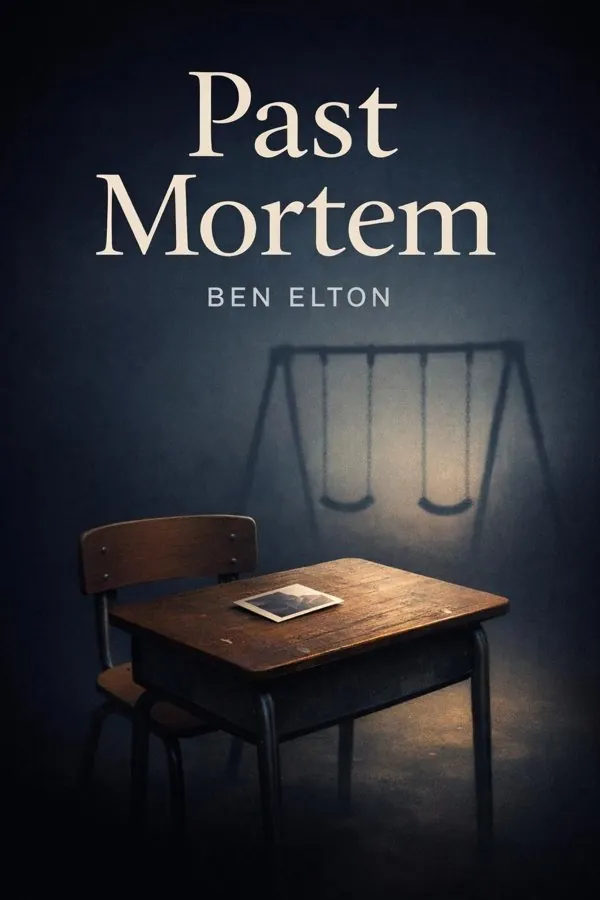
Past Mortem: Summary & Key Insights
by Ben Elton
 10 min8 chaptersAudio available
Key Takeaways from Past Mortem
A murder investigation is never only about the dead; it is also about the living stories they leave behind.
Technology does not erase the past; it archives it, beautifies it, and makes it searchable.
We do not remember love as it was; we remember it as we need it to have been.
The moment an investigator starts seeing a case through the lens of personal history, justice becomes harder to keep clean.
Forgetting is often less permanent than it feels; many experiences are not gone, merely dormant.
What Is Past Mortem About?
Past Mortem by Ben Elton is a mystery book spanning 5 pages. Past Mortem is Ben Elton’s darkly intelligent mystery about murder, memory, and the long afterlife of cruelty. At its center is Detective Inspector Edward Newson, a weary but capable investigator drawn into a string of gruesome killings that appear to be linked to the victims’ school years. What begins as a baffling police case quickly turns into something more unsettling: a reckoning with the buried humiliations, jealousies, and emotional wounds that people carry from adolescence into adult life. As Newson follows the trail, he is forced to revisit his own past, including a lost romance and the uncomfortable realization that nostalgia often hides as much as it reveals. The novel matters because it uses the machinery of crime fiction to ask deeper questions about bullying, class, masculinity, social performance, and revenge in the digital age. Elton, celebrated for his satirical wit in television, theater, and fiction, brings both comic sharpness and psychological insight to the story. The result is a mystery that entertains while exposing how the past can remain dangerously unfinished.
This FizzRead summary covers all 8 key chapters of Past Mortem in approximately 10 minutes, distilling the most important ideas, arguments, and takeaways from Ben Elton's work. Also available as an audio summary and Key Quotes Podcast.
Past Mortem
Past Mortem is Ben Elton’s darkly intelligent mystery about murder, memory, and the long afterlife of cruelty. At its center is Detective Inspector Edward Newson, a weary but capable investigator drawn into a string of gruesome killings that appear to be linked to the victims’ school years. What begins as a baffling police case quickly turns into something more unsettling: a reckoning with the buried humiliations, jealousies, and emotional wounds that people carry from adolescence into adult life. As Newson follows the trail, he is forced to revisit his own past, including a lost romance and the uncomfortable realization that nostalgia often hides as much as it reveals. The novel matters because it uses the machinery of crime fiction to ask deeper questions about bullying, class, masculinity, social performance, and revenge in the digital age. Elton, celebrated for his satirical wit in television, theater, and fiction, brings both comic sharpness and psychological insight to the story. The result is a mystery that entertains while exposing how the past can remain dangerously unfinished.
Who Should Read Past Mortem?
This book is perfect for anyone interested in mystery and looking to gain actionable insights in a short read. Whether you're a student, professional, or lifelong learner, the key ideas from Past Mortem by Ben Elton will help you think differently.
- ✓Readers who enjoy mystery and want practical takeaways
- ✓Professionals looking to apply new ideas to their work and life
- ✓Anyone who wants the core insights of Past Mortem in just 10 minutes
Want the full summary?
Get instant access to this book summary and 100K+ more with Fizz Moment.
Get Free SummaryAvailable on App Store • Free to download
Key Chapters
A murder investigation is never only about the dead; it is also about the living stories they leave behind. In Past Mortem, Ben Elton opens with a series of brutal killings that initially look sensational and bizarre, but Detective Inspector Edward Newson quickly senses that the violence is not random. The victims are being targeted in ways that point backward, toward school ties, old hierarchies, and long-preserved grudges. This is what gives the novel its charge: the crimes are not simply acts of present rage, but messages written in the language of adolescence.
Newson is an especially effective guide because he is no glamorous super-detective. He is tired, intelligent, skeptical, and frustrated by modern police bureaucracy. That grounded perspective lets Elton show how real investigations are shaped by paperwork, pressure, and instinct in equal measure. As clues accumulate, the detective must ask a difficult question: what if the most important motive is not money, lust, or immediate conflict, but humiliation stored for decades?
The novel’s opening also reminds readers that people often underestimate the emotional seriousness of youth. Adults dismiss school experiences as things everyone simply gets over. Elton argues the opposite. A cruel nickname, social exclusion, or public humiliation can become a private mythology that lasts a lifetime. In practical terms, this idea applies far beyond crime fiction. Workplaces, families, and communities often operate with old scripts people never consciously revisit.
The actionable takeaway is simple but powerful: when trying to understand present conflict, do not look only at recent events. Ask what older wound may still be shaping behavior beneath the surface.
Technology does not erase the past; it archives it, beautifies it, and makes it searchable. One of Past Mortem’s smartest ideas is its use of digital reconnection as both a plot device and a social warning. A website designed to help former classmates reunite becomes, in Elton’s hands, a kind of emotional trapdoor. What promises comfort and nostalgia instead exposes regret, resentment, vanity, and fear. The digital world acts as a mirror, but not a neutral one. It reflects people as they wish to be seen while also preserving the social dynamics they thought they had outgrown.
This matters because the novel understands how memory changes when technology gets involved. Before online networks, school memories faded unevenly. People lost touch, reinvented themselves, and let old identities blur. Now, names, photos, and group histories can be revived in seconds. That can be joyful, but it can also reopen injuries. A former bully may view a reunion site as harmless fun, while someone they tormented may see the same page as a gallery of unresolved pain.
Elton uses this dynamic to sharpen the mystery. The killer is not just avenging the past in private; the murders are connected to a culture in which the past is constantly being resurfaced and repackaged. In modern life, we see similar patterns whenever social media revives old affiliations, rivalries, or embarrassments. A single tagged photo or reunion thread can trigger strong reactions that seem disproportionate until we remember the history beneath them.
The actionable takeaway: treat digital nostalgia with caution. Reconnecting can be meaningful, but before reopening old circles, consider what histories those platforms may also be reviving for others.
We do not remember love as it was; we remember it as we need it to have been. A crucial emotional layer in Past Mortem is Edward Newson’s reconnection with a woman from his past, a development that turns the investigation inward. As he revisits old feelings, Elton explores a familiar but dangerous habit: using memory to rewrite unfinished emotional stories. What seemed romantic in youth may have involved cowardice, misunderstanding, or idealization. The return of a long-lost love does not simply revive desire; it reactivates guilt, regret, and the temptation to imagine an alternate life.
This subplot matters because it keeps the novel from becoming only a procedural. The murders force Newson to examine not just other people’s school experiences, but his own moral history. Was he kinder than he remembers? More passive? More self-serving? Elton suggests that nostalgia often acts as self-defense. We edit ourselves into our memories as decent bystanders, tragic romantics, or misunderstood youths, when the truth is usually less flattering and more complicated.
Readers can recognize this pattern in ordinary life. Many people revisit old relationships through social media, reunions, or chance encounters and immediately begin narrating what might have been. But memory is selective. It tends to preserve emotional intensity while blurring context. The result can be obsession disguised as tenderness.
Elton’s insight is that unresolved feelings make people vulnerable—not only to poor decisions, but to false narratives about who they were. The actionable takeaway is to question sentimental certainty. When revisiting the past, ask not only what you lost, but what you may be misremembering in order to make that loss feel meaningful.
The moment an investigator starts seeing a case through the lens of personal history, justice becomes harder to keep clean. In Past Mortem, the inquiry steadily tightens around Newson’s own past, and the shift changes the emotional temperature of the story. What began as professional duty becomes entangled with self-recognition, old loyalties, and private anxieties. Elton uses this turn to examine a classic moral problem: can anyone remain objective when a case starts exposing their own unresolved life?
This is where the novel deepens beyond a conventional whodunit. The killer’s logic, however warped, emerges from a moral universe built on accumulated grievance. The police, meanwhile, are expected to represent impartial order. But Newson is still a human being with memories, shame, and desire. As the lines blur, the story asks whether formal justice is enough when emotional injuries have gone unacknowledged for years.
In everyday life, the same principle appears whenever people try to resolve conflict while secretly pursuing vindication. A manager handling a dispute may actually be settling an old score. A family mediator may be protecting their own self-image. A person seeking "closure" may really want punishment. Elton shows that once the personal and the principled become confused, judgment starts to warp.
The brilliance of the novel is that it never excuses revenge, but it does force readers to confront how often institutions fail to notice suffering until it becomes extreme. The actionable takeaway: if you are involved in any conflict where your own history is activated, pause and separate facts from feelings. Accountability matters most when emotion tempts you to call vengeance fairness.
Forgetting is often less permanent than it feels; many experiences are not gone, merely dormant. The aftermath of Past Mortem leaves readers with an unsettling truth: childhood and adolescence do not end neatly. They survive inside adult identities, relationships, and insecurities, sometimes for decades. Elton’s title points toward this idea with bitter elegance. The past is not dead matter. It remains active, waiting for the right trigger to become visible again.
What makes this especially effective is that the novel does not treat memory as sentimental treasure. Instead, memory is unstable and morally charged. Different characters remember the same social world differently. For one person, school was playful roughness; for another, it was daily terror. For one person, a romance was formative; for another, it was incidental. This unevenness is central to Elton’s point. The damage of the past often persists because those who caused it did not experience it as damage at all.
This insight has broad practical value. In workplaces, friendships, and families, people often speak as though time itself heals. But time alone can just as easily preserve silence. Unnamed hurts harden into worldview. Unexamined privilege becomes blindness. Untested nostalgia becomes denial. The novel asks readers to recognize that maturity is not simply getting older; it is being willing to revisit earlier versions of yourself honestly.
The actionable takeaway is to stop assuming old events have lost their power just because they are old. If a pattern keeps repeating in your relationships or self-image, look back with honesty. What waits in the past often explains what feels confusing in the present.
Humor does not weaken dark material; in skilled hands, it makes the darkness harder to avoid. Ben Elton is famous for satire, and in Past Mortem he uses wit not as relief from the mystery but as a tool for sharpening it. The novel skewers police bureaucracy, middle-class vanity, school nostalgia, and the absurd performances people maintain in adult life. This comic edge makes the murders more disturbing because it reminds us how ordinary the surrounding world is. The violence does not erupt in a gothic fantasy; it breaks through a recognizable culture of self-importance, embarrassment, and social posing.
Satire also helps Elton expose hypocrisy. Adults who dismiss childhood cruelty as harmless often become the same adults obsessively curating their old identities online. Institutions that speak the language of care are shown to be clumsy, hierarchical, and image-conscious. Even the desire to reconnect with the past can be comic in its vanity: people want remembrance, but on flattering terms.
This blend of comedy and menace has practical resonance. In real life, difficult truths are often easiest to see when framed through irony. A joke about office culture can reveal exploitation more clearly than a formal memo. A satirical look at reunion culture can expose insecurity, status anxiety, and unresolved rivalry better than a nostalgic speech ever could.
Elton’s achievement lies in refusing tonal simplicity. He allows readers to laugh, then makes them question what exactly they were laughing at. The actionable takeaway: do not dismiss humor as superficial. If a sharp joke makes you uncomfortable, treat that discomfort as information. Satire often identifies the truth that polite language tries to hide.
Most people believe they have outgrown their teenage selves, yet a single reunion or remembered insult can prove otherwise. Throughout Past Mortem, Elton shows that identity is not a stable essence but a performance shaped by context. Characters who seem successful, respectable, or emotionally settled in adulthood become fragile when confronted with the social codes of school. Old roles reappear with startling speed: bully, outsider, beauty, clown, romantic, loser. The murders gain much of their force from this recognition that beneath adult polish, many people remain anxious performers.
This is one of the novel’s most contemporary insights. Modern life encourages reinvention. Careers, cities, relationships, and online profiles all let people present improved versions of themselves. But the school years often form the template against which those later selves are measured. Someone who was humiliated young may pursue status compulsively. Someone once admired may chase youth long after it has passed. Someone who fit in effortlessly may never examine the casual cruelty that came with belonging.
Elton does not suggest that change is impossible. Rather, he argues that change requires awareness. If people do not understand the roles that shaped them, they risk performing those roles forever in disguised form. This applies beyond the novel. Team dynamics at work, friendship groups, and romantic relationships often recreate adolescent scripts because they feel emotionally familiar.
The actionable takeaway is to notice when you become a former version of yourself around certain people or settings. Ask what role you slip into automatically and whether it still serves the life you want to lead.
All Chapters in Past Mortem
About the Author
Ben Elton is a British author, playwright, comedian, and screenwriter celebrated for his sharp wit and socially observant storytelling. He first became widely known through television, co-writing landmark British comedies including Blackadder and The Young Ones, where his fast-paced, satirical style helped define a generation of comedy. He later built a successful career as a novelist, writing books that blend suspense, humor, and commentary on politics, media, technology, and modern life. Elton’s fiction often takes popular genres and uses them to explore uncomfortable truths about society and human behavior. In Past Mortem, he brings that signature combination of intelligence and entertainment to the crime novel, using murder, memory, and old school hierarchies to examine how the past continues to shape adult lives.
Get This Summary in Your Preferred Format
Read or listen to the Past Mortem summary by Ben Elton anytime, anywhere. FizzRead offers multiple formats so you can learn on your terms — all free.
Available formats: App · Audio · PDF · EPUB — All included free with FizzRead
Download Past Mortem PDF and EPUB Summary
Key Quotes from Past Mortem
“A murder investigation is never only about the dead; it is also about the living stories they leave behind.”
“Technology does not erase the past; it archives it, beautifies it, and makes it searchable.”
“We do not remember love as it was; we remember it as we need it to have been.”
“The moment an investigator starts seeing a case through the lens of personal history, justice becomes harder to keep clean.”
“Forgetting is often less permanent than it feels; many experiences are not gone, merely dormant.”
Frequently Asked Questions about Past Mortem
Past Mortem by Ben Elton is a mystery book that explores key ideas across 8 chapters. Past Mortem is Ben Elton’s darkly intelligent mystery about murder, memory, and the long afterlife of cruelty. At its center is Detective Inspector Edward Newson, a weary but capable investigator drawn into a string of gruesome killings that appear to be linked to the victims’ school years. What begins as a baffling police case quickly turns into something more unsettling: a reckoning with the buried humiliations, jealousies, and emotional wounds that people carry from adolescence into adult life. As Newson follows the trail, he is forced to revisit his own past, including a lost romance and the uncomfortable realization that nostalgia often hides as much as it reveals. The novel matters because it uses the machinery of crime fiction to ask deeper questions about bullying, class, masculinity, social performance, and revenge in the digital age. Elton, celebrated for his satirical wit in television, theater, and fiction, brings both comic sharpness and psychological insight to the story. The result is a mystery that entertains while exposing how the past can remain dangerously unfinished.
More by Ben Elton




You Might Also Like




Browse by Category
Ready to read Past Mortem?
Get the full summary and 100K+ more books with Fizz Moment.