
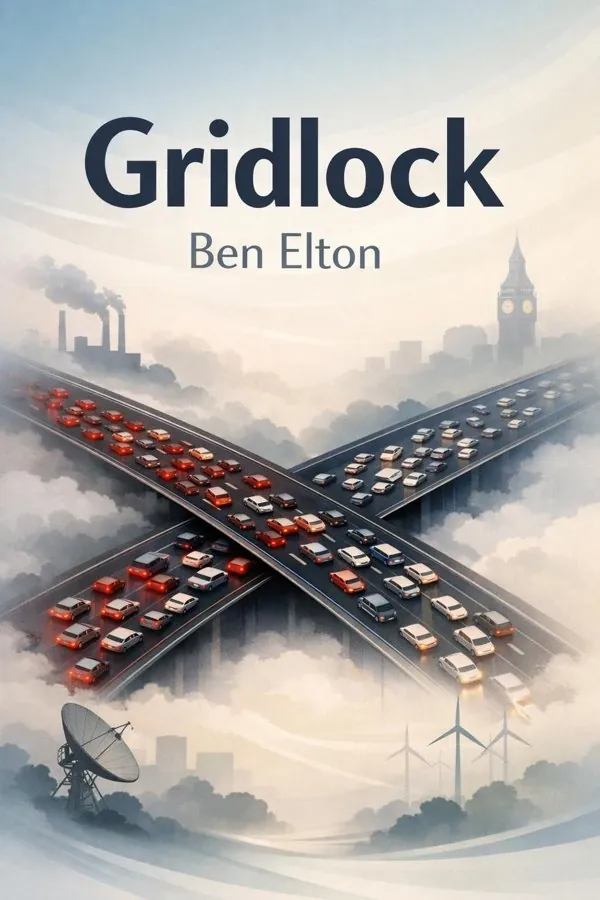
Gridlock: Summary & Key Insights
by Ben Elton
 10 min8 chaptersAudio available
Key Takeaways from Gridlock
A traffic jam is never just a traffic jam; it is a visible symptom of a civilization organized around denial.
A society reveals itself most clearly through the people it rewards, ignores, and ridicules.
The most threatening ideas are often not the wildest ones, but the ones that expose how unnecessary the crisis really is.
Citizens lose trust not only when governments fail, but when governments pretend failure is success.
Even in a paralyzed society, human beings keep searching for intimacy, loyalty, and connection.
What Is Gridlock About?
Gridlock by Ben Elton is a bestsellers book spanning 7 pages. What happens when a society becomes so dependent on convenience, consumption, and political spin that it can no longer physically move? In Gridlock, Ben Elton turns that question into a savage, hilarious, and unsettling satire. Set in a near-future Britain overwhelmed by traffic congestion, the novel imagines a country in which roads are permanently jammed, public patience has worn thin, and the systems meant to serve citizens now trap them instead. But the book is not really just about cars. It is about environmental neglect, government failure, media sensationalism, and the dangerous habit of postponing obvious solutions until crisis becomes normal. Elton uses an ensemble cast of activists, politicians, media figures, and ordinary citizens to reveal how private interests and public incompetence combine to create paralysis. His comic style keeps the story lively, but beneath the jokes lies a serious warning about modern life: when short-term politics replaces long-term thinking, everyone pays the price. As a novelist, playwright, and satirist famous for exposing social absurdities, Elton brings both wit and authority to this critique. Gridlock remains striking because its exaggerated future often feels uncomfortably close to the present.
This FizzRead summary covers all 8 key chapters of Gridlock in approximately 10 minutes, distilling the most important ideas, arguments, and takeaways from Ben Elton's work. Also available as an audio summary and Key Quotes Podcast.
Gridlock
What happens when a society becomes so dependent on convenience, consumption, and political spin that it can no longer physically move? In Gridlock, Ben Elton turns that question into a savage, hilarious, and unsettling satire. Set in a near-future Britain overwhelmed by traffic congestion, the novel imagines a country in which roads are permanently jammed, public patience has worn thin, and the systems meant to serve citizens now trap them instead. But the book is not really just about cars. It is about environmental neglect, government failure, media sensationalism, and the dangerous habit of postponing obvious solutions until crisis becomes normal.
Elton uses an ensemble cast of activists, politicians, media figures, and ordinary citizens to reveal how private interests and public incompetence combine to create paralysis. His comic style keeps the story lively, but beneath the jokes lies a serious warning about modern life: when short-term politics replaces long-term thinking, everyone pays the price. As a novelist, playwright, and satirist famous for exposing social absurdities, Elton brings both wit and authority to this critique. Gridlock remains striking because its exaggerated future often feels uncomfortably close to the present.
Who Should Read Gridlock?
This book is perfect for anyone interested in bestsellers and looking to gain actionable insights in a short read. Whether you're a student, professional, or lifelong learner, the key ideas from Gridlock by Ben Elton will help you think differently.
- ✓Readers who enjoy bestsellers and want practical takeaways
- ✓Professionals looking to apply new ideas to their work and life
- ✓Anyone who wants the core insights of Gridlock in just 10 minutes
Want the full summary?
Get instant access to this book summary and 100K+ more with Fizz Moment.
Get Free SummaryAvailable on App Store • Free to download
Key Chapters
A traffic jam is never just a traffic jam; it is a visible symptom of a civilization organized around denial. Gridlock opens in a Britain where congestion is no longer an inconvenience but a governing condition of life. Roads are clogged, schedules are meaningless, tempers fray, and movement itself becomes a luxury. Elton uses this exaggerated scenario to show what happens when a society builds its economy, culture, and daily routines around the private car without asking what the long-term cost will be.
The brilliance of the setup is that traffic becomes both literal and symbolic. People cannot get to work, hospitals, schools, or home on time, but they are also emotionally and politically stuck. Government promises more roads, more adjustments, more technical fixes, yet the basic problem remains untouched. The system keeps expanding the very habits that caused the breakdown. In that sense, congestion represents a broader modern paralysis: institutions keep doing what is familiar, even when familiar solutions are making everything worse.
You can see the same logic in many real-world settings. A company keeps adding meetings to solve inefficiency and becomes less productive. A city answers overcrowding with more parking rather than better transport. Individuals buy tools to save time and end up busier than before. Elton’s satire works because it exposes this pattern of self-defeating problem-solving.
The novel asks readers to notice where “normal” has become absurd. When frustration is constant, people stop questioning the system that creates it. Actionable takeaway: identify one area of life where repeated small inefficiencies have become accepted as unavoidable, and ask whether the structure itself—not your coping strategy—needs to change.
A society reveals itself most clearly through the people it rewards, ignores, and ridicules. Rather than following a single heroic protagonist, Gridlock unfolds through an ensemble of eccentric and sharply drawn characters. Environmental activists, cynical politicians, compromised officials, media operators, and ordinary citizens all occupy the same jammed world, but they interpret it in radically different ways. This allows Elton to portray traffic not simply as an engineering issue but as a cultural battleground.
The activists embody urgency. They may be chaotic, idealistic, and sometimes difficult, but they are among the few characters willing to confront root causes. Politicians, by contrast, are often preoccupied with appearances, polling, and self-preservation. Bureaucrats become trapped in process. Media figures search for drama more than truth. Everyday commuters, meanwhile, alternate between anger, helplessness, and resignation. Each group illustrates a familiar social role: the people who warn, the people who delay, the people who profit, and the people who endure.
This variety matters because social problems are rarely caused by villains alone. They persist because many different actors contribute in smaller ways. One person defends the status quo, another monetizes outrage, another gives up, and another hopes someone else will fix it. Elton’s characters are exaggerated for comic effect, but their interactions mirror real institutions where incentives often matter more than ideals.
For readers, the practical value lies in self-recognition. In any broken system, are you acting as an alarm bell, a silent bystander, a spinner of narratives, or a reluctant participant? Actionable takeaway: when facing a shared problem at work, in your community, or in politics, map the different roles people are playing and decide consciously which role you want to occupy.
The most threatening ideas are often not the wildest ones, but the ones that expose how unnecessary the crisis really is. One of Gridlock’s core themes is the suppression of meaningful change. Elton shows how environmental activism and reform movements are not simply opposed by direct force; they are more often neutralized through ridicule, delay, fragmentation, and strategic misrepresentation. The result is a society where reform becomes theatrically discussed but practically impossible.
In the novel, activists are easy targets. They can be painted as naive, extreme, anti-progress, or out of touch with ordinary people. Yet Elton suggests that this caricature is politically useful. If reformers can be mocked rather than answered, then institutions never have to address the substance of their critique. This is a tactic visible far beyond environmental politics. Whistleblowers are called disloyal, reformers are called unrealistic, and critics are dismissed as attention seekers. The debate shifts from whether they are right to whether they are respectable.
Another mechanism of suppression is exhaustion. People with genuine solutions are dragged into endless procedural fights, media storms, and internal conflicts until momentum disappears. The system does not always defeat opposition by strength; sometimes it simply outlasts it. That insight gives the novel much of its bitter force.
For modern readers, this theme remains highly practical. Good ideas often fail because they are not protected from distortion. If you care about change, whether in public policy or organizational culture, it is not enough to have evidence. You also need strategy, clarity, and resilience against bad-faith attacks. Actionable takeaway: if you are advocating for reform, define your core message in one sentence and repeat it relentlessly so it cannot be easily reframed by opponents.
Citizens lose trust not only when governments fail, but when governments pretend failure is success. In Gridlock, public institutions are depicted as deeply compromised by short-term thinking, political theater, and an inability to confront consequences honestly. Elton’s politicians are not simply incompetent individuals; they are products of a system that rewards image management over public service and immediate optics over long-term planning.
Traffic congestion is the perfect issue for this critique because it cannot be solved through slogans. It requires coordinated planning, public investment, and the courage to inconvenience powerful interests. Yet the leaders in the novel gravitate toward gestures rather than solutions. They announce, deflect, rename, commission, and spin. In doing so, they deepen the public’s cynicism. Citizens begin to assume that every statement is manipulative, every reform partial, and every crisis exploitable.
This erosion of faith has wider consequences. When people stop believing institutions can act competently or honestly, collective action becomes harder. Even sensible proposals are treated with suspicion. The social contract weakens because no one expects leadership to involve sacrifice, truth, or accountability. That is one reason Elton’s satire feels more serious than merely comic: the real damage is not just logistical chaos but democratic decay.
Readers can apply this insight by becoming more attentive to the difference between structural action and symbolic action. A city that announces a transport initiative may still be avoiding meaningful investment. A company that launches a task force may be sidestepping deeper reform. Actionable takeaway: when evaluating leaders, ask three questions—what problem are they naming, what trade-offs are they admitting, and what measurable changes are they willing to be judged on?
Even in a paralyzed society, human beings keep searching for intimacy, loyalty, and connection. Amid the satire and political fury of Gridlock, Elton includes relationships that reveal another dimension of life in crisis: people do not stop needing love simply because institutions are failing. In fact, breakdown often intensifies the desire for companionship, understanding, and solidarity.
The personal strands of the novel matter because they prevent the book from becoming a purely abstract social critique. Characters are not just ideological positions. They are lonely, flawed, passionate, insecure, and sometimes unexpectedly tender. Their bonds form under pressure, and that pressure exposes what is authentic. In a world dominated by noise, delay, and manipulation, genuine affection becomes a form of resistance. To care for another person seriously is to reject the numbness that dysfunctional systems can produce.
Elton also suggests that private relationships are shaped by public conditions. Stress, distance, and frustration spill into emotional life. Delays become arguments. Fear becomes withdrawal. Yet crisis can also clarify values. People discover whom they trust, what they are willing to risk, and whether their commitments survive inconvenience. This is true beyond fiction. Financial strain, political turmoil, overwork, and unstable systems test relationships in similar ways.
The novel therefore offers a practical reminder: large-scale problems are lived at small scale. Social breakdown is felt in marriages, friendships, parenting, and everyday courtesy. If we want healthier public life, we must also protect the human ties that make endurance possible. Actionable takeaway: when external pressures are high, communicate one concern and one appreciation clearly to someone close to you, so stress does not silently become distance.
A crisis becomes far more dangerous when the people describing it benefit from confusion. Gridlock is especially sharp in its treatment of the media. Elton portrays a culture in which attention, scandal, and emotional manipulation often matter more than public understanding. Instead of clarifying complex issues, media actors amplify spectacle, personalize conflict, and reward the most inflammatory interpretation available.
This matters because traffic, pollution, and policy are complicated subjects. They require context, patience, and evidence. But complexity rarely competes well with outrage. The novel shows how public discourse is shaped when cameras and headlines chase drama rather than truth. Activists become caricatures, politicians become performers, and citizens are fed a sequence of emotional cues instead of informed analysis. A serious structural problem is converted into entertainment.
Elton’s satire now feels prophetic. In modern media ecosystems, whether broadcast, tabloid, or digital, attention often flows toward what is fastest, loudest, and most divisive. A nuanced transport policy proposal may attract little interest; a personality clash or viral controversy dominates the cycle. The public ends up overinformed about theater and underinformed about reality.
For readers, the lesson is not to reject media entirely but to consume it more critically. Ask who benefits from the framing of a story. Notice whether a report explains systems or just spotlights personalities. Distinguish between visibility and importance. Manufactured outrage narrows thinking, because it keeps people reacting rather than reasoning.
Actionable takeaway: when a public controversy erupts, pause before adopting the dominant narrative. Read beyond headlines, look for primary facts, and ask what substantive issue might be hiding beneath the emotional packaging.
Revealing the truth does not automatically fix the system that hid it. As Gridlock moves toward exposure and aftermath, Elton resists the comforting fantasy that once corruption is uncovered, justice neatly follows. Instead, he shows that disclosure can be messy, partial, and politically contested. The truth matters, but systems built on convenience, denial, and self-interest are rarely transformed in a single moment of revelation.
This gives the novel a mature edge. Many satires end by humiliating the powerful and restoring moral order. Elton is more skeptical. Exposure creates openings, not guarantees. Some figures are discredited, some narratives collapse, and some consequences become unavoidable. Yet habits, incentives, and institutions remain. Public memory is short. Opportunists adapt. Reform, if it comes, arrives unevenly.
That realism is deeply useful. In workplaces, politics, and civic life, people often believe that identifying wrongdoing is the hard part. In practice, the harder task is converting awareness into durable change. A report may expose waste, but budgets stay the same. A scandal may reveal misconduct, but culture remains intact. A crisis may awaken public attention, but routine soon returns.
Elton does not suggest that exposure is futile. On the contrary, truth-telling is necessary. But he insists it is only one stage in a longer struggle between reality and convenience. Lasting change requires follow-through, institutions capable of reform, and citizens unwilling to be distracted the moment the headline fades.
Actionable takeaway: when a problem is finally acknowledged, do not stop at celebrating exposure. Ask what policy, structural, or behavioral changes must happen next—and who will be responsible for making sure they do.
People often accept criticism more readily when they are laughing, and that is one reason satire can be morally serious. Gridlock is funny, exaggerated, and absurd, but its humor is not decorative. Elton uses comedy as a method of diagnosis. By pushing familiar habits to ridiculous extremes, he reveals what is already irrational in ordinary life. The joke lands because the underlying behavior is recognizable.
This is one of the book’s major achievements. A straightforward policy novel about transport congestion and political corruption might feel heavy or preachy. Satire allows Elton to make the same points with greater energy and wider reach. Readers enjoy the absurdity, then slowly realize they are laughing at patterns they participate in themselves: consumer dependence, governmental evasiveness, media simplification, and the normalization of inconvenience.
Satire also disrupts complacency. When a system becomes too familiar, people stop seeing its contradictions. Humor restores vision by estranging the ordinary. A commuter trapped for hours in traffic may think, “That’s just life.” A satirical novelist says, “No, this is insane, and your acceptance of it is part of the problem.” In that sense, comedy becomes a form of civic attention.
This insight has practical value beyond literature. In communication, teaching, leadership, or activism, people often remember criticism better when it is vivid, pointed, and emotionally engaging. Humor can lower defenses and make hard truths discussable. Used well, it does not weaken the message; it sharpens it.
Actionable takeaway: when trying to challenge an unhealthy norm, consider whether wit, contrast, or carefully framed irony might help others see the absurdity they have stopped noticing.
All Chapters in Gridlock
About the Author
Ben Elton is a British novelist, playwright, comedian, and screenwriter celebrated for his sharp wit and socially engaged satire. He rose to prominence through stand-up comedy and television, becoming a key creative force behind landmark British series such as Blackadder and The Young Ones. Alongside his work for stage and screen, Elton has written numerous bestselling novels that tackle politics, media, technology, war, celebrity, and environmental decline with humor and urgency. His fiction is known for combining accessible storytelling with pointed critique, often turning everyday modern anxieties into dark comedy. This blend of entertainment and argument has made him one of Britain’s most recognizable satirical voices. In Gridlock, Elton applies that signature style to transport chaos, government failure, and the absurdities of contemporary life.
Get This Summary in Your Preferred Format
Read or listen to the Gridlock summary by Ben Elton anytime, anywhere. FizzRead offers multiple formats so you can learn on your terms — all free.
Available formats: App · Audio · PDF · EPUB — All included free with FizzRead
Download Gridlock PDF and EPUB Summary
Key Quotes from Gridlock
“A traffic jam is never just a traffic jam; it is a visible symptom of a civilization organized around denial.”
“A society reveals itself most clearly through the people it rewards, ignores, and ridicules.”
“The most threatening ideas are often not the wildest ones, but the ones that expose how unnecessary the crisis really is.”
“Citizens lose trust not only when governments fail, but when governments pretend failure is success.”
“Even in a paralyzed society, human beings keep searching for intimacy, loyalty, and connection.”
Frequently Asked Questions about Gridlock
Gridlock by Ben Elton is a bestsellers book that explores key ideas across 8 chapters. What happens when a society becomes so dependent on convenience, consumption, and political spin that it can no longer physically move? In Gridlock, Ben Elton turns that question into a savage, hilarious, and unsettling satire. Set in a near-future Britain overwhelmed by traffic congestion, the novel imagines a country in which roads are permanently jammed, public patience has worn thin, and the systems meant to serve citizens now trap them instead. But the book is not really just about cars. It is about environmental neglect, government failure, media sensationalism, and the dangerous habit of postponing obvious solutions until crisis becomes normal. Elton uses an ensemble cast of activists, politicians, media figures, and ordinary citizens to reveal how private interests and public incompetence combine to create paralysis. His comic style keeps the story lively, but beneath the jokes lies a serious warning about modern life: when short-term politics replaces long-term thinking, everyone pays the price. As a novelist, playwright, and satirist famous for exposing social absurdities, Elton brings both wit and authority to this critique. Gridlock remains striking because its exaggerated future often feels uncomfortably close to the present.
More by Ben Elton


You Might Also Like
The Godfather
Mario Puzo
10 min
The Handmaid's Tale
Margaret Atwood
10 min
The Hunger Games
Suzanne Collins
10 min
The Nightingale
Kristin Hannah
10 min
The Seven Husbands of Evelyn Hugo
Taylor Jenkins Reid
10 min
Backwater Justice
Fern Michaels
10 minBrowse by Category
Ready to read Gridlock?
Get the full summary and 100K+ more books with Fizz Moment.