
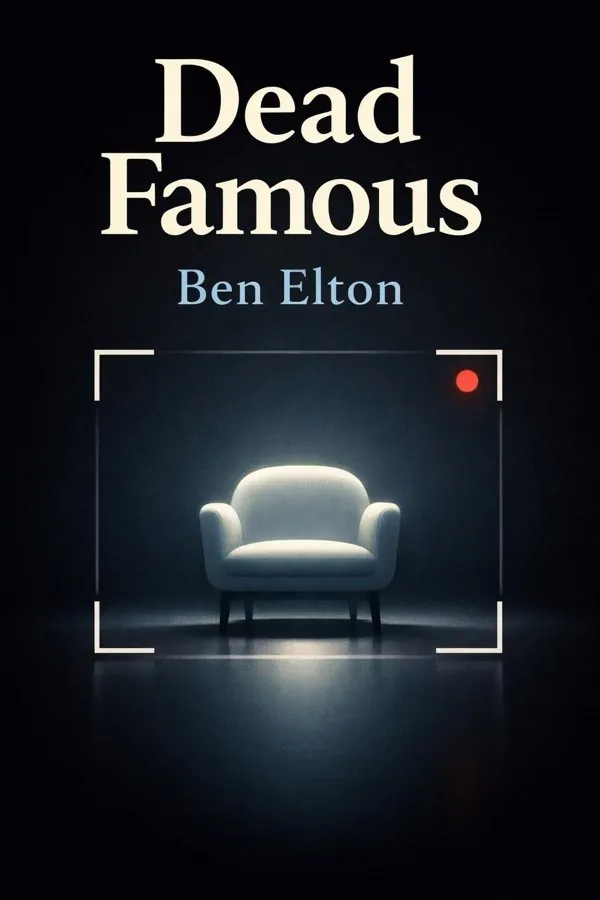
Dead Famous: Summary & Key Insights
by Ben Elton
 10 min8 chaptersAudio available
Key Takeaways from Dead Famous
A society reveals itself most clearly through what it chooses to watch for fun.
The most unsettling crimes are not the brutal ones, but the ones that seem impossible.
People rarely enter systems of fame understanding the price they will pay for attention.
When entertainment becomes the dominant lens for public life, truth starts competing with what is most watchable.
One of Elton’s sharpest insights is that ordinary people can become actors the moment they are told they are being watched.
What Is Dead Famous About?
Dead Famous by Ben Elton is a mystery book spanning 4 pages. Dead Famous is Ben Elton’s razor-sharp blend of murder mystery, media satire, and social commentary, set inside the sealed world of a reality television phenomenon called House Arrest. Ten contestants enter the house hoping for celebrity, validation, or reinvention. They are watched constantly by cameras, manipulated by producers, and judged by millions. Then the impossible happens: one of them is murdered in a place that is supposedly under total surveillance. With no clear evidence and no straightforward truth, the novel becomes both a whodunit and a dissection of a culture addicted to exposure. What makes the book matter is not just its clever premise, but its unnerving relevance. Elton explores how entertainment transforms private life into public spectacle, how audiences confuse observation with understanding, and how fame can become both aspiration and punishment. Long before social media normalized self-broadcasting, Dead Famous understood the emotional, ethical, and commercial machinery behind performative living. Elton’s authority comes from decades of satirical writing across television, theater, and fiction, where he has consistently exposed the absurdities of modern life with wit, speed, and bite. This novel is funny, unsettling, and surprisingly prophetic.
This FizzRead summary covers all 8 key chapters of Dead Famous in approximately 10 minutes, distilling the most important ideas, arguments, and takeaways from Ben Elton's work. Also available as an audio summary and Key Quotes Podcast.
Dead Famous
Dead Famous is Ben Elton’s razor-sharp blend of murder mystery, media satire, and social commentary, set inside the sealed world of a reality television phenomenon called House Arrest. Ten contestants enter the house hoping for celebrity, validation, or reinvention. They are watched constantly by cameras, manipulated by producers, and judged by millions. Then the impossible happens: one of them is murdered in a place that is supposedly under total surveillance. With no clear evidence and no straightforward truth, the novel becomes both a whodunit and a dissection of a culture addicted to exposure.
What makes the book matter is not just its clever premise, but its unnerving relevance. Elton explores how entertainment transforms private life into public spectacle, how audiences confuse observation with understanding, and how fame can become both aspiration and punishment. Long before social media normalized self-broadcasting, Dead Famous understood the emotional, ethical, and commercial machinery behind performative living. Elton’s authority comes from decades of satirical writing across television, theater, and fiction, where he has consistently exposed the absurdities of modern life with wit, speed, and bite. This novel is funny, unsettling, and surprisingly prophetic.
Who Should Read Dead Famous?
This book is perfect for anyone interested in mystery and looking to gain actionable insights in a short read. Whether you're a student, professional, or lifelong learner, the key ideas from Dead Famous by Ben Elton will help you think differently.
- ✓Readers who enjoy mystery and want practical takeaways
- ✓Professionals looking to apply new ideas to their work and life
- ✓Anyone who wants the core insights of Dead Famous in just 10 minutes
Want the full summary?
Get instant access to this book summary and 100K+ more with Fizz Moment.
Get Free SummaryAvailable on App Store • Free to download
Key Chapters
A society reveals itself most clearly through what it chooses to watch for fun. In Dead Famous, House Arrest is more than a hit television program; it is a miniature model of a fame-driven culture. A group of ordinary yet highly self-conscious contestants agrees to live together in a closed environment, surrendering privacy in exchange for visibility. They arrive carrying ambition, insecurity, vanity, and emotional hunger, and the show turns those impulses into marketable entertainment.
Elton uses the setting to show how reality television manufactures a strange paradox: contestants are told to “be themselves,” yet every aspect of the format pressures them to perform. The cameras are always on, the producers shape narratives behind the scenes, and the audience consumes conflict as if it were truth. House Arrest is sold as an experiment in authenticity, but in practice it rewards exaggeration, strategic emotion, and interpersonal drama.
This idea applies far beyond television. In workplaces, online platforms, and even social circles, people increasingly curate versions of themselves for approval. The pressure to be visible can distort behavior, turning ordinary interactions into calculated acts. Someone may share opinions online not to communicate, but to attract attention. A colleague may frame every decision as personal branding. The same logic that powers House Arrest appears wherever image becomes currency.
Elton’s genius lies in making this critique entertaining rather than preachy. He invites readers to laugh at the absurdity while recognizing their own complicity as consumers of spectacle. The house is artificial, but the emotional stakes are real. The contestants are ridiculous, but they are also vulnerable participants in a system larger than themselves.
Actionable takeaway: pay attention to where performance is shaping your choices. Ask yourself whether you are acting from genuine conviction or from a desire to be seen, approved of, or remembered.
The most unsettling crimes are not the brutal ones, but the ones that seem impossible. Dead Famous turns its central mystery into a brilliant satirical engine by placing a murder inside a house filled with cameras. In theory, such a setting should make violence easy to explain. Every room is monitored, every contestant observed, every action archived. Yet when a contestant dies, certainty collapses. Evidence is partial, interpretation becomes unstable, and the promise of total visibility proves false.
This is one of the novel’s smartest points: surveillance does not automatically create truth. Cameras record angles, not motives. Viewers see behavior, not inner life. Editors shape narrative through selection. Police, producers, journalists, and audiences all examine the same material yet arrive at conflicting conclusions. The murder becomes both a criminal investigation and a philosophical challenge. If everything is visible, why is so little understood?
In practical terms, this insight matters in modern life because people often assume that more data equals more clarity. But emails, screenshots, video clips, and public posts can still mislead when separated from context. A short recording may confirm an event but conceal the chain of causes behind it. A workplace dispute caught in fragments can produce false certainty. A public scandal can seem obvious until additional context changes everything.
Elton uses the murder not just to create suspense, but to puncture a cultural fantasy. The audience of House Arrest believes they know the contestants because they have watched them constantly. The crime exposes how shallow that confidence really is. Familiarity through exposure is not the same as understanding.
Actionable takeaway: when confronted with dramatic evidence, resist immediate conclusions. Ask what is missing, who selected the material, and what context might change the meaning of what appears obvious.
People rarely enter systems of fame understanding the price they will pay for attention. In Dead Famous, the contestants believe House Arrest offers opportunity: recognition, public affection, maybe a future career. What they receive instead is a psychologically intense environment in which every insecurity can be exploited. The producers shape tensions, audiences reward extremes, and participants begin to fear irrelevance as much as humiliation.
Elton captures the emotional mechanics of reality fame with remarkable sharpness. The contestants are not simply vain; they are trapped in a feedback loop. Being watched changes behavior, and the hope of continued attention deepens that change. Even conflict becomes useful because visibility, not dignity, is the true currency. This creates a manipulative ecosystem where everyone is incentivized to push boundaries. Producers need drama. Viewers crave novelty. Contestants need screen time. The result is exploitation disguised as entertainment.
This idea extends to today’s influencer culture and personal branding economy. Many people now participate in scaled-down versions of the same bargain. They trade privacy for engagement, emotional openness for audience loyalty, and outrage for relevance. A person may overshare personal pain online because vulnerability performs well. A creator may intensify conflict because calm honesty attracts less attention than public feuds. What looks like free self-expression may actually be shaped by invisible incentives.
Elton also shows that manipulation works best when participants feel they have chosen it. The contestants volunteer, which allows the system to appear fair. Yet consent under ambition, insecurity, and unequal power is not simple. They may choose entry, but they do not control what happens once the machine starts feeding on them.
Actionable takeaway: examine the incentives behind any attention-driven system you join. Before seeking visibility, decide what you are unwilling to trade away, especially your privacy, emotional balance, and self-respect.
When entertainment becomes the dominant lens for public life, truth starts competing with what is most watchable. Dead Famous shows how spectacle distorts judgment. The murder inside House Arrest is not treated only as a tragedy or a legal problem; it becomes content. The public consumes it with fascination, the media amplify it, and the line between investigation and show business becomes dangerously thin.
Elton’s satire suggests that in a spectacle culture, events are not merely reported but packaged. A mystery must have heroes, villains, twists, and emotional hooks. Complex people are flattened into roles the audience can easily process. The result is not outright lying so much as structured simplification. Facts are selected and framed according to narrative appeal, and those narratives can become more powerful than reality itself.
This dynamic is common in contemporary media. Public controversies are often filtered through emotionally satisfying storylines long before all the evidence is available. Social media intensifies the process by rewarding certainty, outrage, and immediate reaction. A nuanced explanation rarely travels as fast as a dramatic accusation. In workplaces, communities, and politics, people can become trapped inside narratives built around them rather than around the truth.
The novel asks readers to recognize their own role in sustaining this environment. Spectacle exists because there is demand for it. Audiences may criticize sensational media while eagerly consuming it. That tension is central to Elton’s social critique: the machine is not maintained only by cynical producers but also by willing viewers.
The deeper lesson is moral as well as intellectual. Once someone’s suffering becomes a public drama, empathy can weaken. We stop asking what is true and start asking what is compelling. That shift damages both justice and human dignity.
Actionable takeaway: consume dramatic news and entertainment with disciplined skepticism. Slow down, seek primary facts where possible, and remember that a gripping narrative is not the same thing as an accurate one.
One of Elton’s sharpest insights is that ordinary people can become actors the moment they are told they are being watched. The contestants in Dead Famous are not celebrities when they enter House Arrest. They are recognizable social types: insecure, ambitious, flirtatious, self-righteous, needy, controlling, idealistic. Yet the gaze of the camera transforms those traits into performances. They begin editing themselves in real time, shaping language, posture, alliances, even moral positions for an imagined audience.
This is what makes the novel so prescient. It understands that visibility changes identity. We do not simply reveal ourselves under observation; we become newly self-conscious and adaptive. The contestants are constantly asking, implicitly or explicitly, how they are coming across. A minor disagreement becomes a strategic opportunity. A vulnerable confession becomes both emotional release and image construction. Authenticity is never absent, but it is entangled with self-presentation.
Readers can recognize the same process in daily life. Social media profiles, professional networking, dating apps, and even group chats encourage people to stage themselves. Someone may present as constantly productive, perpetually witty, or morally impeccable because those personas generate approval. Over time, the performance can harden into habit, making it harder to know what one truly thinks or feels without an audience.
Elton does not suggest that performance is always dishonest. All social life involves some degree of impression management. The problem arises when the gap between lived reality and public persona becomes too wide. Then a person may feel alienated from their own life, pursuing responses rather than meaning.
Dead Famous uses its reality-show setting to magnify this pressure, but the underlying psychological truth is universal. Being watched can make us less spontaneous, less honest, and more divided against ourselves.
Actionable takeaway: create spaces in your life where no audience is present. Journal privately, spend time offline, and notice who you are when you are not trying to manage anyone’s impression of you.
Entertainment industries often present themselves as merely responding to public demand, but Dead Famous insists that viewers bear responsibility too. House Arrest exists because millions choose to watch strangers eat, flirt, argue, confess, and unravel. The audience may condemn the vulgarity of the show even while sustaining it with attention. Elton’s satire is especially effective here because it does not let readers occupy a morally superior position. If the system is grotesque, the spectators are part of the mechanism.
The novel explores how audiences become emotionally invested in edited versions of real people. They form loyalties, make judgments, and experience intimacy without reciprocity or depth. This creates a false sense of knowledge: viewers feel entitled to opinions about contestants’ character because they have consumed a curated flow of scenes. The murder intensifies this tendency. Public fascination grows not despite the tragedy, but partly because tragedy heightens the show’s emotional charge.
This pattern remains familiar. People now monitor online personalities, comment on strangers’ relationships, and participate in pile-ons with little awareness of the human costs involved. Attention can be both affectionate and predatory. Viewers may claim to care deeply about a public figure while rewarding the very conditions that erode that person’s mental health. The line between interest and consumption becomes blurred.
Elton’s point is not that audiences should stop being curious, but that curiosity without ethics becomes exploitation. Every click, view, repost, and comment contributes to a system that shapes incentives. What gets attention gets repeated. If humiliation sells, humiliation will be produced.
The book therefore asks a difficult question: what kind of spectator are you? Do you seek understanding, or just stimulation? Do you reward honesty, or drama? The answer matters more than most consumers admit.
Actionable takeaway: become intentional about what you watch and share. Refuse to reward media that dehumanizes people, and notice when your curiosity crosses into consumption of someone else’s distress.
Sometimes laughter is the fastest route to discomfort, and discomfort is the beginning of insight. Dead Famous works not only as a mystery but as a satire, and that choice is essential to its power. Elton exaggerates, sharpens, and exposes the absurdities of reality television culture until readers can no longer pretend its contradictions are harmless. The comedy keeps the novel lively, but the humor has teeth. It entertains while forcing moral recognition.
Satire is especially effective when a culture has normalized something questionable. By the time Elton wrote Dead Famous, reality television was becoming accepted as ordinary fun. Rather than lecture readers abstractly about voyeurism, commodification, and media manipulation, he dramatizes those forces inside a gripping plot. The result is that readers laugh at what they have also been taught to tolerate. That laughter carries an edge of self-recognition.
This has broader practical value. Satire can help people examine institutions they have stopped seeing clearly, whether those institutions are workplaces, political systems, schools, or digital platforms. A satirical lens reveals the gap between official language and actual behavior. A company that speaks about well-being while rewarding burnout, for instance, becomes easier to understand once its contradictions are seen as absurd rather than inevitable.
Elton’s use of satire also prevents the novel from becoming simplistic. He does not present a neat sermon with pure victims and pure villains. Instead, he creates a world of compromised motives, selfishness, aspiration, loneliness, and commerce. Humor allows him to hold all of that complexity together while maintaining momentum.
For readers, this is a reminder that comedy is not an escape from serious thought. It can be one of the most precise forms of social analysis. When something feels ridiculous, that feeling may signal a hidden truth.
Actionable takeaway: when humor exposes a social pattern, do not dismiss it as “just a joke.” Ask what contradiction the joke reveals and what behavior you might need to reconsider because of it.
Dead Famous is clever because it modernizes a classic detective structure without losing the pleasures of the genre. At its core, the novel is a locked-room mystery: a murder occurs in a confined environment with a limited set of suspects and apparently impossible circumstances. But instead of a country manor or isolated train carriage, Elton uses a reality TV house. This update does more than refresh the formula; it turns the investigation into a commentary on modern observation, narrative control, and public voyeurism.
Traditional mysteries depend on hidden information. Dead Famous complicates that by placing the crime in an environment where almost everything should be visible. The puzzle then shifts. The question is not merely who had access, but how visibility itself can mislead. Recorded footage, public perception, editorial framing, and participant performance all become part of the mystery architecture. Elton thereby fuses genre entertainment with cultural critique.
This makes the novel especially satisfying for readers who enjoy books that do two things at once. It delivers suspense, suspects, motives, and revelations, but it also asks how stories are constructed around crimes. In real life, criminal cases are often mediated through news reports, documentaries, and online speculation, each shaping public understanding. Dead Famous anticipated this by showing that every investigation now unfolds in an ecosystem of spectatorship.
The practical lesson here concerns how form influences meaning. The same event can be understood differently depending on whether it is treated as evidence, drama, scandal, or content. Elton’s brilliance lies in making the structure of the novel itself part of the argument. The murder mystery does not merely contain the satire; it becomes the satire.
Actionable takeaway: notice how the format of a story shapes your response to it. Whether in books, news, or social media, ask how presentation influences what you feel certain about and what questions you forget to ask.
All Chapters in Dead Famous
About the Author
Ben Elton is a British author, comedian, playwright, screenwriter, and director celebrated for his fast-paced wit and sharp satirical voice. He first gained major attention through television comedy, helping shape influential British series such as Blackadder and The Young Ones. Over the years, he has built a successful parallel career as a novelist, often using popular genres like thriller, mystery, and dystopian fiction to examine cultural trends, political hypocrisy, and social absurdity. His work is known for combining entertainment with critique, making serious ideas accessible through humor and strong storytelling. In novels such as Dead Famous, Elton shows a particular talent for exposing the hidden logic of modern life, especially where media, celebrity, and public morality collide. His writing remains energetic, provocative, and consistently relevant.
Get This Summary in Your Preferred Format
Read or listen to the Dead Famous summary by Ben Elton anytime, anywhere. FizzRead offers multiple formats so you can learn on your terms — all free.
Available formats: App · Audio · PDF · EPUB — All included free with FizzRead
Download Dead Famous PDF and EPUB Summary
Key Quotes from Dead Famous
“A society reveals itself most clearly through what it chooses to watch for fun.”
“The most unsettling crimes are not the brutal ones, but the ones that seem impossible.”
“People rarely enter systems of fame understanding the price they will pay for attention.”
“When entertainment becomes the dominant lens for public life, truth starts competing with what is most watchable.”
“One of Elton’s sharpest insights is that ordinary people can become actors the moment they are told they are being watched.”
Frequently Asked Questions about Dead Famous
Dead Famous by Ben Elton is a mystery book that explores key ideas across 8 chapters. Dead Famous is Ben Elton’s razor-sharp blend of murder mystery, media satire, and social commentary, set inside the sealed world of a reality television phenomenon called House Arrest. Ten contestants enter the house hoping for celebrity, validation, or reinvention. They are watched constantly by cameras, manipulated by producers, and judged by millions. Then the impossible happens: one of them is murdered in a place that is supposedly under total surveillance. With no clear evidence and no straightforward truth, the novel becomes both a whodunit and a dissection of a culture addicted to exposure. What makes the book matter is not just its clever premise, but its unnerving relevance. Elton explores how entertainment transforms private life into public spectacle, how audiences confuse observation with understanding, and how fame can become both aspiration and punishment. Long before social media normalized self-broadcasting, Dead Famous understood the emotional, ethical, and commercial machinery behind performative living. Elton’s authority comes from decades of satirical writing across television, theater, and fiction, where he has consistently exposed the absurdities of modern life with wit, speed, and bite. This novel is funny, unsettling, and surprisingly prophetic.
More by Ben Elton



You Might Also Like




Browse by Category
Ready to read Dead Famous?
Get the full summary and 100K+ more books with Fizz Moment.