
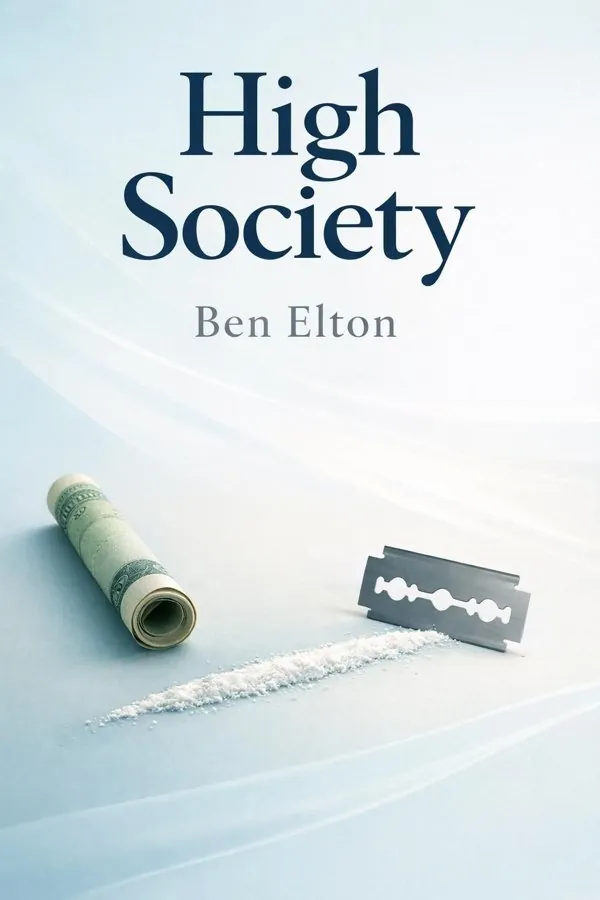
High Society: Summary & Key Insights
by Ben Elton
 10 min9 chaptersAudio available
Key Takeaways from High Society
The most dangerous lies in public life are often the ones people tell themselves first.
Policy debates become morally convenient when the people most harmed by them remain abstract.
Fame does not erase consequences, but it often delays them long enough for destruction to deepen.
A moral panic is most powerful when it allows everyone involved to feel righteous without becoming more truthful.
The truth about a society often emerges not from one dramatic event, but from the way different people live under the same rules.
What Is High Society About?
High Society by Ben Elton is a bestsellers book spanning 5 pages. What happens when a society condemns drugs in public while quietly celebrating intoxication in private? In High Society, Ben Elton turns that contradiction into a fierce, darkly comic, and surprisingly humane novel about modern Britain. Through overlapping lives that include an ambitious politician, a vulnerable young addict, media operators, police, celebrities, and middle-class users, Elton exposes a culture that draws arbitrary moral lines between acceptable and unacceptable forms of escape. Alcohol is normalized, status protects vice, and punishment falls hardest on the powerless. That tension gives the book both its satire and its emotional force. High Society matters because it is not merely a novel about drugs; it is a novel about class, hypocrisy, public image, and the gap between law and lived reality. Elton writes with the authority of a seasoned satirist who has spent decades dissecting British institutions, politics, and moral posturing. Known for his razor-sharp social commentary in fiction, television, and stand-up, he brings wit, outrage, and compassion to a subject often flattened by slogans. The result is a story that entertains while forcing readers to ask whether the war on drugs is really about public health, or about power, image, and selective judgment.
This FizzRead summary covers all 9 key chapters of High Society in approximately 10 minutes, distilling the most important ideas, arguments, and takeaways from Ben Elton's work. Also available as an audio summary and Key Quotes Podcast.
High Society
What happens when a society condemns drugs in public while quietly celebrating intoxication in private? In High Society, Ben Elton turns that contradiction into a fierce, darkly comic, and surprisingly humane novel about modern Britain. Through overlapping lives that include an ambitious politician, a vulnerable young addict, media operators, police, celebrities, and middle-class users, Elton exposes a culture that draws arbitrary moral lines between acceptable and unacceptable forms of escape. Alcohol is normalized, status protects vice, and punishment falls hardest on the powerless. That tension gives the book both its satire and its emotional force.
High Society matters because it is not merely a novel about drugs; it is a novel about class, hypocrisy, public image, and the gap between law and lived reality. Elton writes with the authority of a seasoned satirist who has spent decades dissecting British institutions, politics, and moral posturing. Known for his razor-sharp social commentary in fiction, television, and stand-up, he brings wit, outrage, and compassion to a subject often flattened by slogans. The result is a story that entertains while forcing readers to ask whether the war on drugs is really about public health, or about power, image, and selective judgment.
Who Should Read High Society?
This book is perfect for anyone interested in bestsellers and looking to gain actionable insights in a short read. Whether you're a student, professional, or lifelong learner, the key ideas from High Society by Ben Elton will help you think differently.
- ✓Readers who enjoy bestsellers and want practical takeaways
- ✓Professionals looking to apply new ideas to their work and life
- ✓Anyone who wants the core insights of High Society in just 10 minutes
Want the full summary?
Get instant access to this book summary and 100K+ more with Fizz Moment.
Get Free SummaryAvailable on App Store • Free to download
Key Chapters
The most dangerous lies in public life are often the ones people tell themselves first. Peter Paget stands at the center of High Society as a politician who believes he can reform a broken system while still surviving inside it. He is intelligent, articulate, and morally serious enough to recognize that Britain’s drug policy is incoherent. Yet he is also ambitious enough to understand that truth, in politics, is rarely rewarded when it threatens a party line, a tabloid narrative, or a ministerial career.
Through Peter, Ben Elton explores how institutions absorb and neutralize conscience. Peter is not a cartoon villain. That is precisely the point. He is the sort of man readers may want to trust: thoughtful, moderate, respectable. But his struggle shows that hypocrisy in politics is not always born from evil intent. It often grows out of compromise, fear, and the calculation that small deceptions are necessary for larger influence. The tragedy is that each compromise pushes real reform further away.
Elton uses Peter to ask a sharp question: if policymakers privately know the system is unjust, why does it endure? The answer lies in incentives. Politicians are rewarded for sounding tough, not for being honest about complexity. A policy can fail for decades and still survive if admitting failure is more dangerous than continuing it.
This dynamic extends far beyond drug legislation. Any reader who has watched leaders avoid obvious truths on housing, healthcare, climate, or inequality will recognize the pattern. Institutions do not merely contain hypocrisy; they can depend on it.
The actionable takeaway is simple but demanding: judge public figures less by their rhetoric and more by the risks they are willing to take for what they claim to believe.
Policy debates become morally convenient when the people most harmed by them remain abstract. Jessie’s story gives High Society its emotional gravity by turning statistics and slogans into lived experience. She is not written as a glamorous rebel or a moral failure. Instead, she represents vulnerability, circumstance, and the terrible speed with which a young life can become trapped in systems that punish damage more readily than they repair it.
Elton is especially effective in showing that drug harm is rarely caused by substances alone. It is shaped by poverty, unstable relationships, fear, shame, and the absence of meaningful support. Jessie’s experience reveals how the criminalization of addiction often intensifies the very problems it claims to solve. Stigma isolates her. Fear of authority drives secrecy. The language of moral condemnation makes recovery harder because it turns a health crisis into a social identity.
Her storyline also challenges the selective empathy of respectable society. Middle-class recreational users may be treated as wayward or amusing. A vulnerable young woman at the sharp end of dependency is treated as disposable. The gap is not accidental. It reflects how class and social power determine whether harmful behavior is interpreted as a mistake, a disease, or a crime.
In practical terms, Jessie’s story encourages readers to rethink how they talk about addiction in everyday life. Language matters. The difference between asking “What is wrong with her?” and “What happened to her?” is enormous. One frames a person as blameworthy; the other leaves room for context, compassion, and intervention.
The actionable takeaway: whenever you encounter discussions of addiction, resist moral simplifications and ask what forms of support, dignity, and structural help would actually reduce harm.
Fame does not erase consequences, but it often delays them long enough for destruction to deepen. Tommy Hanson embodies Elton’s critique of celebrity culture: a world that monetizes recklessness, rewards self-indulgence, and then feigns shock when the human being at its center begins to collapse. Tommy is not simply an individual with a drug problem. He is also a product of an industry that thrives on access, appetite, and image.
Elton avoids making Tommy a straightforward cautionary tale. Instead, he shows how celebrity creates a distorted moral environment. Enablers surround public figures because careers, headlines, and profits depend on continued performance. In that ecosystem, boundaries disappear. Bad behavior becomes branding. Addiction can be hidden behind phrases like “pressure,” “living hard,” or “rock-and-roll lifestyle,” as though glamour somehow neutralizes harm.
What makes Tommy’s story compelling is that his excess is publicly visible but privately misunderstood. People consume the spectacle while remaining indifferent to the person. The tabloids, fans, and professional hangers-on all participate in a cycle where collapse is both condemned and exploited. Elton’s satire lands because it reflects a broader social habit: we glamorize self-destruction when it arrives with status, beauty, or entertainment value.
This idea applies beyond celebrity culture. In many workplaces and social circles, dysfunction is tolerated when attached to high performance, charisma, or wealth. Society often excuses the privileged until the damage becomes impossible to ignore.
The actionable takeaway: be skeptical of any culture that treats destructive behavior as charming because it comes wrapped in success, talent, or glamour. Admiration should never require denial.
A moral panic is most powerful when it allows everyone involved to feel righteous without becoming more truthful. In High Society, the media does not merely report the drug debate; it shapes and distorts it. Elton shows how tabloids, broadcasters, and commentators reduce a deeply complex issue into emotionally useful narratives: predators and victims, crackdowns and crackups, scandals and redemption arcs. Such stories are easier to sell than nuance, and more politically useful than evidence.
The media’s role in the novel reveals a troubling exchange. Politicians need headlines that make them look firm. Newspapers need outrage that keeps readers engaged. Audiences enjoy certainty because it is less demanding than ambiguity. Together, these forces create an information environment where symbolic action outruns practical reform. The result is a public conversation obsessed with visible vice rather than real solutions.
Elton is especially sharp on selective framing. A drug scandal involving a celebrity may become national drama, while the slow social damage caused by alcohol abuse, underfunded treatment, or punitive policy receives far less sustained attention. This is not because one issue matters more. It is because one offers a cleaner story. Media logic privileges shock, personality, and conflict over systemic understanding.
Readers can apply this insight to contemporary news consumption. Whenever a social problem is presented through one sensational case, it is worth asking what broader context is missing. Which harms are being exaggerated? Which are being ignored? Who benefits from the framing?
The actionable takeaway: consume moral outrage carefully. Before accepting a media narrative, look for what it excludes, whose interests it serves, and whether it clarifies a problem or merely dramatizes it.
Legality is often mistaken for morality, even when history shows the two have little stable relationship. One of Elton’s boldest arguments in High Society is that society’s drug hierarchy is less rational than it pretends. Alcohol, despite its deep links to violence, illness, addiction, and family breakdown, remains culturally celebrated. Other drugs, some less socially destructive in certain contexts, are treated as uniquely immoral. Elton is not arguing that drugs are harmless. He is exposing how inconsistent the moral framework has become.
This matters because legal categories shape public perception. When a substance is legal, many assume it is fundamentally acceptable if used “responsibly.” When a substance is illegal, users are often imagined as reckless, deviant, or criminal. Yet the book repeatedly shows that actual harm does not align neatly with those labels. The respectable binge drinker, the discreet middle-class cocaine user, and the visibly addicted young person all occupy different places in the social imagination, regardless of comparable damage.
Elton’s satire forces readers to confront an uncomfortable possibility: societies do not always prohibit what is most harmful. They often normalize what is historically embedded, economically profitable, and culturally convenient. Once that is recognized, the debate shifts. The question is no longer simply “Is this substance legal?” but “What harms does it cause, who bears them, and what policy would most reduce them?”
This perspective can be applied in everyday discussions about addiction, public health, and law. It encourages evidence over habit and honesty over inherited assumptions.
The actionable takeaway: whenever legality is invoked as proof of moral legitimacy, pause and ask whether the law reflects actual harm, or merely tradition, politics, and social comfort.
When a society cannot solve a problem, it often becomes louder about condemning it. High Society argues that the war on drugs frequently substitutes punishment for understanding and symbolism for effectiveness. Elton shows how criminal justice mechanisms can create an illusion of control while failing to reduce addiction, violence, or social damage. Arrests, raids, and tough rhetoric may satisfy public demands for action, but they rarely address why people use drugs, how dependency develops, or what conditions make recovery possible.
The novel does not deny personal responsibility. Rather, it questions whether punishment is the most effective primary response to a problem rooted in pain, demand, profit, and inequality. Once drug use is framed mainly as a crime, other approaches become politically harder to defend. Treatment looks soft. Harm reduction appears controversial. Honest public education gets drowned out by grandstanding. The people who suffer most are often those already least able to absorb punishment.
Elton’s point has broad relevance. In many policy areas, leaders prefer visible penalties to slower, less theatrical forms of prevention. It is easier to be seen punishing failure than investing patiently in the conditions that reduce it.
For readers, this key idea offers a useful framework: if a policy has been aggressively enforced for years but the underlying problem remains widespread, the right question is not whether enforcement has been severe enough. It may be whether the model itself is flawed.
The actionable takeaway: evaluate policies by outcomes rather than emotional satisfaction. If a response feels tough but produces little measurable improvement, support approaches grounded in prevention, treatment, and harm reduction.
Not all vice is socially expensive; much depends on who can afford privacy. A recurring insight in High Society is that class determines how behavior is interpreted, hidden, and punished. Wealthy or well-connected people often have access to private spaces, legal assistance, social protection, and reputational cushioning. Poorer people encounter surveillance, stigma, and harsher consequences. The same underlying appetite for relief, pleasure, or numbness may exist across classes, but its risks are distributed unequally.
Elton uses this imbalance to dismantle comforting myths about deviance. Drug use is often portrayed as a problem imported from the margins into respectable life. High Society flips that assumption. Respectable life is already saturated with sanctioned forms of intoxication and unsanctioned forms of indulgence. What differs is visibility. Middle-class and elite users are better able to preserve the appearance of control. Their errors are individualized. The struggles of the poor are generalized into social threat.
This also affects shame. A person with status can frame excess as stress, experimentation, or youthful error. A vulnerable person may be branded for life. Elton suggests that public morality is not evenly applied because social judgment is inseparable from power.
This idea can help readers think more clearly about inequality in everyday settings. Whether the issue is addiction, debt, mental health, or family instability, consequences often intensify where support is weakest.
The actionable takeaway: when assessing behavior labeled irresponsible or self-destructive, ask how class changes the available choices, the visibility of failure, and the severity of punishment.
Sometimes laughter is the fastest route to honesty. Ben Elton does not approach the drug debate through detached policy analysis alone; he uses satire to expose absurdity, vanity, and selective outrage. In High Society, humor is not decorative. It is diagnostic. By making hypocrisy look ridiculous, Elton strips it of the dignity institutions often borrow from official language, ceremony, and certainty.
This matters because social contradictions can become normalized when discussed too solemnly. A politician defending incoherent policy may sound persuasive in a formal speech. A tabloid campaign may appear principled when wrapped in moral urgency. Satire punctures those performances. It reveals where rhetoric is inflated, where values are inconsistent, and where public outrage masks private complicity.
Elton’s satirical method is especially effective because it does not flatten everyone into villains. Instead, it reveals the comic dimensions of systems built on denial. Readers laugh not because suffering is trivial, but because the structures governing it are often irrational. That tension gives the novel its distinctive power: it can be entertaining and infuriating at the same time.
The broader application is significant. Humor can be a serious civic tool when it challenges deference, exposes cant, and invites people to see familiar narratives differently. Used well, it encourages critical distance rather than cynicism.
The actionable takeaway: when confronting moralized public debates, pay attention to satire and sharp humor. They often reveal inconsistencies that official arguments are designed to hide.
All Chapters in High Society
About the Author
Ben Elton is a British novelist, playwright, comedian, and screenwriter renowned for his sharp satire and incisive social commentary. He rose to prominence in the 1980s through stand-up comedy and his writing work on landmark television comedies such as Blackadder and The Young Ones. Over the years, he has built a bestselling fiction career with novels that blend humor, political critique, and fast-paced storytelling, often taking aim at hypocrisy in modern public life. His work spans stage, television, and prose, including plays and musicals as well as satirical and thriller-like novels. Elton’s distinctive voice combines wit, outrage, and accessibility, making complex social issues vivid for a broad audience. In High Society, he brings those talents to a fierce, darkly comic examination of drugs, class, media, and moral contradiction.
Get This Summary in Your Preferred Format
Read or listen to the High Society summary by Ben Elton anytime, anywhere. FizzRead offers multiple formats so you can learn on your terms — all free.
Available formats: App · Audio · PDF · EPUB — All included free with FizzRead
Download High Society PDF and EPUB Summary
Key Quotes from High Society
“The most dangerous lies in public life are often the ones people tell themselves first.”
“Policy debates become morally convenient when the people most harmed by them remain abstract.”
“Fame does not erase consequences, but it often delays them long enough for destruction to deepen.”
“A moral panic is most powerful when it allows everyone involved to feel righteous without becoming more truthful.”
“The truth about a society often emerges not from one dramatic event, but from the way different people live under the same rules.”
Frequently Asked Questions about High Society
High Society by Ben Elton is a bestsellers book that explores key ideas across 9 chapters. What happens when a society condemns drugs in public while quietly celebrating intoxication in private? In High Society, Ben Elton turns that contradiction into a fierce, darkly comic, and surprisingly humane novel about modern Britain. Through overlapping lives that include an ambitious politician, a vulnerable young addict, media operators, police, celebrities, and middle-class users, Elton exposes a culture that draws arbitrary moral lines between acceptable and unacceptable forms of escape. Alcohol is normalized, status protects vice, and punishment falls hardest on the powerless. That tension gives the book both its satire and its emotional force. High Society matters because it is not merely a novel about drugs; it is a novel about class, hypocrisy, public image, and the gap between law and lived reality. Elton writes with the authority of a seasoned satirist who has spent decades dissecting British institutions, politics, and moral posturing. Known for his razor-sharp social commentary in fiction, television, and stand-up, he brings wit, outrage, and compassion to a subject often flattened by slogans. The result is a story that entertains while forcing readers to ask whether the war on drugs is really about public health, or about power, image, and selective judgment.
More by Ben Elton

You Might Also Like
The Godfather
Mario Puzo
10 min
The Handmaid's Tale
Margaret Atwood
10 min
The Hunger Games
Suzanne Collins
10 min
The Nightingale
Kristin Hannah
10 min
The Seven Husbands of Evelyn Hugo
Taylor Jenkins Reid
10 min
Backwater Justice
Fern Michaels
10 minBrowse by Category
Ready to read High Society?
Get the full summary and 100K+ more books with Fizz Moment.