
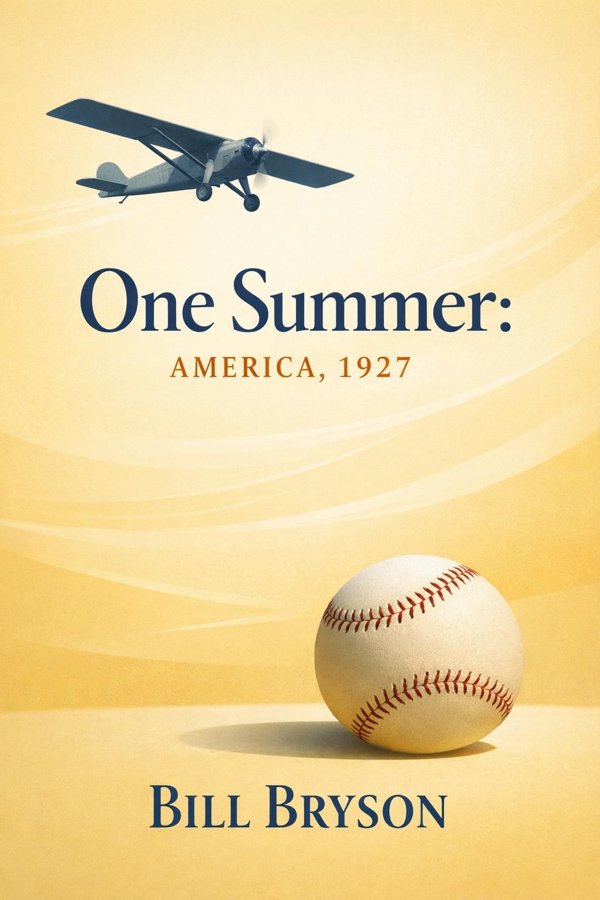
One Summer: America, 1927: Summary & Key Insights
by Bill Bryson
 10 min10 chaptersAudio available
Key Takeaways from One Summer: America, 1927
Sometimes a single achievement does more than break a record; it changes what a nation believes is possible.
A nation often reveals itself by the kind of heroes it cheers.
Disasters do not create inequality; they reveal it.
A country becomes culturally unified when millions of people begin reacting to the same stories at the same time.
Political success often depends less on ideas alone than on timing, visibility, and the appearance of competence.
What Is One Summer: America, 1927 About?
One Summer: America, 1927 by Bill Bryson is a world_history book spanning 11 pages. What if a single season could explain the rise of modern America? In One Summer: America, 1927, Bill Bryson argues that the summer of 1927 was one of those rare historical moments when politics, celebrity, technology, crime, sport, and media all collided to reveal a nation remaking itself in real time. Through a dazzling cast of figures including Charles Lindbergh, Babe Ruth, Al Capone, Herbert Hoover, and Louis B. Mayer, Bryson shows how America became louder, faster, more connected, and more self-aware than ever before. The book is not merely a chronicle of memorable events. It is a portrait of a country intoxicated by progress yet shadowed by inequality, corruption, racial tension, and spectacle-driven public life. Bryson’s gift lies in making history feel immediate: he combines meticulous research with lively storytelling, sharp wit, and a keen eye for surprising detail. Known for turning complex subjects into highly readable narratives, Bryson is especially well suited to this task. The result is a vivid, entertaining, and insightful account of a pivotal summer that helps explain the culture, ambitions, and contradictions of twentieth-century America.
This FizzRead summary covers all 10 key chapters of One Summer: America, 1927 in approximately 10 minutes, distilling the most important ideas, arguments, and takeaways from Bill Bryson's work. Also available as an audio summary and Key Quotes Podcast.
One Summer: America, 1927
What if a single season could explain the rise of modern America? In One Summer: America, 1927, Bill Bryson argues that the summer of 1927 was one of those rare historical moments when politics, celebrity, technology, crime, sport, and media all collided to reveal a nation remaking itself in real time. Through a dazzling cast of figures including Charles Lindbergh, Babe Ruth, Al Capone, Herbert Hoover, and Louis B. Mayer, Bryson shows how America became louder, faster, more connected, and more self-aware than ever before.
The book is not merely a chronicle of memorable events. It is a portrait of a country intoxicated by progress yet shadowed by inequality, corruption, racial tension, and spectacle-driven public life. Bryson’s gift lies in making history feel immediate: he combines meticulous research with lively storytelling, sharp wit, and a keen eye for surprising detail. Known for turning complex subjects into highly readable narratives, Bryson is especially well suited to this task. The result is a vivid, entertaining, and insightful account of a pivotal summer that helps explain the culture, ambitions, and contradictions of twentieth-century America.
Who Should Read One Summer: America, 1927?
This book is perfect for anyone interested in world_history and looking to gain actionable insights in a short read. Whether you're a student, professional, or lifelong learner, the key ideas from One Summer: America, 1927 by Bill Bryson will help you think differently.
- ✓Readers who enjoy world_history and want practical takeaways
- ✓Professionals looking to apply new ideas to their work and life
- ✓Anyone who wants the core insights of One Summer: America, 1927 in just 10 minutes
Want the full summary?
Get instant access to this book summary and 100K+ more with Fizz Moment.
Get Free SummaryAvailable on App Store • Free to download
Key Chapters
Sometimes a single achievement does more than break a record; it changes what a nation believes is possible. Charles Lindbergh’s 1927 solo flight across the Atlantic was one of those moments. At just twenty-five, flying the Spirit of St. Louis from New York to Paris, Lindbergh transformed aviation from a risky curiosity into a symbol of daring modernity. His flight captivated the public not only because it was technically astonishing, but because it seemed to prove that nerve, discipline, and engineering could shrink the world.
Bryson shows that Lindbergh’s success also marked a turning point in mass celebrity. Newspapers, radio, and newsreels amplified every detail of his journey and turned a shy airmail pilot into a global icon almost overnight. The public did not merely admire him; it consumed him. Ticker-tape parades, speaking tours, endorsements, and relentless reporting created a model of modern fame that has become familiar today: achievement fused with media saturation.
The episode also reveals a broader national mood. America wanted heroes who embodied progress, self-reliance, and technical mastery. Lindbergh gave the country a story that felt clean, triumphant, and forward-looking. Yet Bryson also hints at the danger of hero worship: public adoration can flatten a complex person into a national symbol.
In practical terms, Lindbergh’s story reminds us that breakthroughs matter most when they are communicated well. Innovation needs narrative to shape public imagination. The actionable takeaway is simple: if you want people to care about an achievement, connect the feat to a larger human story about courage, possibility, and change.
A nation often reveals itself by the kind of heroes it cheers. In the summer of 1927, Babe Ruth was not just a baseball player chasing home runs; he was the embodiment of American abundance, confidence, and spectacle. Playing for the New York Yankees, Ruth smashed records and drew crowds with a style that was larger than life. He was flawed, excessive, funny, and irresistible, and Bryson uses him to show how sports were becoming central to American identity.
Ruth’s appeal rested partly on performance and partly on personality. He turned athletic success into public theater. Fans followed statistics, gossip, rivalries, and dramatic storylines with a devotion that resembled modern celebrity culture. Alongside Lou Gehrig and the Yankees’ legendary lineup, Ruth helped make baseball more than a game. It became a national ritual broadcast through newspapers and radio, consumed by urban and rural Americans alike.
Bryson places Ruth within the wider culture of the Roaring Twenties, a decade of consumer appetite, bold public personalities, and shared spectacles. In Ruth, Americans saw a permission structure for excess: big swings, big appetites, big ambition. Yet this celebration of abundance also masked instability. The era’s exuberance would not last forever.
For readers today, Ruth’s story is a useful reminder that entertainment can unify a country while also commercializing its values. Modern sports, influencer culture, and fandom work in much the same way. The actionable takeaway: pay attention to the public figures a culture elevates, because they often reflect what that society most desires, excuses, and rewards.
Disasters do not create inequality; they reveal it. The Mississippi Flood of 1927 was one of the worst natural catastrophes in American history, submerging vast regions, displacing hundreds of thousands of people, and exposing deep failures in infrastructure, governance, and social justice. Bryson treats the flood as far more than a weather event. It was a national test that showed who was protected, who was sacrificed, and how power operated under pressure.
The flood devastated communities across several states, but Black residents often suffered the most brutal treatment. Many were forced into labor, denied freedom of movement, or left with little aid while officials prioritized property and political optics. The crisis thus laid bare the racial hierarchies built into Southern society. At the same time, the flood elevated public figures like Herbert Hoover, whose relief efforts helped build his national reputation and paved the way for his presidential rise.
Bryson’s account makes clear that modern states are judged not by their rhetoric but by the systems they build before crisis strikes. Levees, communications networks, emergency coordination, and fair distribution of aid matter enormously. The flood also showed the growing importance of national media in shaping public response. People far from the disaster could now witness suffering and demand action.
The lesson remains highly relevant. Whether facing floods, pandemics, or infrastructure collapse, societies need preparation, transparency, and an ethic of equal protection. The actionable takeaway is to evaluate any institution by how it serves the vulnerable during emergencies, not by how confidently it speaks when times are good.
A country becomes culturally unified when millions of people begin reacting to the same stories at the same time. In 1927, radio, newspapers, magazines, and newsreels were doing exactly that for the United States. Bryson shows how mass media transformed isolated regional experiences into a shared national consciousness. Americans in distant towns could follow Lindbergh’s flight, Ruth’s home runs, political scandals, criminal trials, and boxing matches almost simultaneously. The nation was learning to feel together.
This shift changed more than information flow; it altered power itself. Public opinion became faster, more emotional, and more easily mobilized. Editors, broadcasters, publishers, and studio executives gained enormous influence in deciding what mattered. Sensation often outperformed nuance. Heroes could be manufactured, villains amplified, and events turned into serialized drama. The media did not merely report America in 1927; it helped create the America people believed they lived in.
Bryson’s portrait feels strikingly contemporary. Today’s digital platforms accelerate the same dynamics with greater speed and fragmentation. Virality, outrage, and image management have roots in the media patterns of the 1920s. The tools have changed, but the basic mechanism remains: attention shapes reality.
A practical application is to become a more conscious consumer of public narratives. Ask who benefits from a story, what has been simplified, and which voices are missing. Media can educate and connect, but it can also distort and manipulate. The actionable takeaway is to treat every widely shared story as both information and construction, and to build the habit of reading beyond the headline.
Political success often depends less on ideas alone than on timing, visibility, and the appearance of competence. Bryson’s account of 1927 highlights a political culture that was increasingly tied to business interests, public relations, and media performance. President Calvin Coolidge represented restraint and quiet authority, while figures such as Herbert Hoover used crisis management and organizational skill to build national standing. Politics was becoming modern: less local, more image-driven, and more entangled with mass communication.
The era projected confidence. The economy looked strong, consumer culture was expanding, and many leaders believed prosperity could continue indefinitely. Yet beneath that optimism lay fragility. Bryson points to the complacency of elites, the limits of governmental imagination, and the tendency to confuse temporary success with permanent stability. The summer of 1927, for all its energy, sat close to the edge of the Great Depression, though few could see it clearly.
This political landscape also reflected unequal access to influence. Business leaders, newspaper proprietors, and powerful urban machines shaped outcomes in ways that diluted democratic ideals. Meanwhile, many social tensions, especially around race, immigration, and labor, were managed through avoidance rather than honest reform.
For modern readers, the relevance is immediate. Political branding, crisis optics, and confidence theater still dominate public life. Competence matters, but so does the narrative attached to competence. The actionable takeaway: judge leaders by long-term institutional thinking and fairness under pressure, not simply by calm rhetoric, popularity, or their ability to manage headlines.
Justice becomes most revealing when a society is afraid. The Sacco and Vanzetti case, culminating in 1927 with the execution of two Italian immigrants convicted of murder, exposed the fierce anxieties of an America unsettled by immigration, radical politics, and cultural change. Bryson presents the case not merely as a legal controversy but as a moral x-ray of the nation. Were Sacco and Vanzetti executed because they were guilty, or because they were foreign, anarchist, and convenient targets for public fear? The enduring power of the case lies in that unresolved question.
The trial and its aftermath drew international attention. Intellectuals, labor activists, and ordinary citizens protested what they saw as a deeply biased proceeding. To many observers, the case showed how prejudice can masquerade as law. At a time when the country was celebrating technological triumphs and modern confidence, it was also revealing profound insecurity about who counted as truly American.
Bryson uses this episode to highlight a recurring national pattern: moments of rapid change often produce scapegoating. Immigrants, dissidents, and minorities become symbols onto which broader fears are projected. The legal process then risks becoming a stage for cultural reassurance rather than impartial truth.
The modern application is sobering. Whenever public fear rises, due process and civil liberties come under strain. That makes procedural fairness more, not less, important. The actionable takeaway is to pay close attention when courts, media, and politicians converge around a hated group, because that is often when justice is most vulnerable to distortion.
New technologies matter most when they change not only what people consume, but how they imagine themselves. The arrival of talking pictures in 1927, especially with The Jazz Singer, marked such a shift. Silent film had already become a powerful cultural force, but synchronized sound made cinema feel more immediate, intimate, and commercially potent. Bryson uses this moment to show Hollywood becoming an even stronger engine of national mythmaking.
Sound transformed the film industry from top to bottom. Actors with the wrong voices lost careers, studios rushed to adapt equipment and production methods, and audiences experienced a new kind of realism. Movies could now carry dialogue, songs, accents, and emotional nuance in ways silent film never could. The change also intensified cinema’s influence on language, fashion, behavior, and aspiration. Hollywood was no longer simply producing entertainment; it was shaping the texture of everyday American life.
Bryson also notes the irony that technological progress often creates winners and losers simultaneously. The talkie revolution generated excitement and profit, but it also displaced workers and artistic traditions. That pattern is familiar in every era of innovation, from industrial automation to artificial intelligence.
Readers can apply this lesson by looking beyond the novelty of new tools to the systems they transform. Ask who gains access, who is excluded, and what habits are being rewired. The actionable takeaway is to approach technological change with both curiosity and scrutiny: embrace its possibilities, but always examine the human costs hidden behind the spectacle.
When law collides too sharply with everyday behavior, it can produce the opposite of moral order. Prohibition was intended to discipline American life by banning alcohol, but by 1927 it had helped expand organized crime, public hypocrisy, and contempt for law itself. Bryson uses figures like Al Capone and the booming illicit liquor trade to show how a reform movement can backfire when it ignores incentives, culture, and enforcement realities.
The contradiction was glaring. Politicians spoke the language of virtue while citizens drank in speakeasies, police accepted bribes, and criminal networks grew rich supplying what millions still wanted. Prohibition did not eliminate alcohol; it changed who profited from it and weakened respect for legal authority. Organized crime became more sophisticated, more violent, and more embedded in urban life. At the same time, the glamorous aura surrounding illegal nightlife made defiance feel modern and stylish.
Bryson presents Prohibition as part of a broader American tension between moral idealism and practical governance. The nation often wants to legislate virtue, but complex social behavior rarely yields to blunt prohibition. Similar dynamics appear whenever policymakers underestimate adaptation, black markets, or the gap between official norms and lived reality.
The practical lesson is useful far beyond alcohol policy. Effective rules must align with human behavior, social incentives, and credible enforcement. The actionable takeaway: when evaluating any policy, ask not only whether its goals are admirable, but whether its design accounts for how people will actually respond under real-world conditions.
Modernity is exhilarating precisely because it carries hidden costs. One of Bryson’s central achievements is showing 1927 as a year when technological and industrial progress made America feel unstoppable. Automobiles expanded mobility, aviation promised to conquer distance, consumer goods multiplied, electrical infrastructure spread, and industrial systems increased production and convenience. The country was speeding up, and many citizens experienced that acceleration as liberation.
Yet Bryson resists a simple celebration of progress. Every gain introduced new pressures: crowded cities, environmental strain, labor dislocation, rising inequality, and a social tempo that rewarded novelty over reflection. Industrial success made life more efficient, but it also made it more impersonal. Standardization created abundance while weakening older local rhythms. The very systems that connected the nation also increased its dependence on fragile networks of finance, transport, and energy.
This duality is what makes Bryson’s history so persuasive. He presents progress not as a clean upward arc, but as a bargain. America in 1927 embraced machines, speed, and scale because they delivered visible benefits. But that embrace also normalized a culture of perpetual expansion, one that would later expose the country to severe shocks.
For readers today, the parallel with digital life, logistics networks, and automation is obvious. Efficiency can improve life while also deepening fragility and fatigue. The actionable takeaway is to assess innovation by asking two questions at once: what new freedom does this create, and what new dependency does it quietly demand in return?
History often turns not when laws change, but when everyday habits do. Bryson portrays the summer of 1927 as a moment when American culture was quietly reorganizing itself around new patterns of leisure, consumption, identity, and spectacle. Women’s public roles were changing after suffrage, urban nightlife was reshaping social norms, consumer advertising was teaching people to desire more, and a younger generation increasingly defined freedom through style, entertainment, and personal choice.
At the same time, these cultural shifts sparked backlash. Traditionalists worried about loosening morals, new gender expectations, immigration, and the erosion of older certainties. The Dempsey–Tunney rematch, like Ruth’s season and Lindbergh’s flight, became more than an event: it was a giant national performance through which Americans negotiated class, masculinity, competition, and fame. Sports, film, and media did not simply distract people from change; they gave change its emotional form.
Bryson’s insight is that modern America was not built only in factories, courtrooms, and political offices. It was built in ballparks, movie theaters, radios, advertisements, and living rooms. Culture was becoming both more commercial and more national. That shift still defines public life today, where identity and belonging are often shaped as much by media consumption as by geography or tradition.
The practical value of this idea is that cultural change should never be dismissed as superficial. Habits, tastes, and symbols often prepare the ground for political and economic transformation. The actionable takeaway: if you want to understand where a society is headed, study what it watches, buys, celebrates, and fears in ordinary life.
All Chapters in One Summer: America, 1927
About the Author
Bill Bryson is a British-American author celebrated for making complex subjects engaging, witty, and accessible. Born in the United States and long associated with Britain, he has written acclaimed books on travel, science, memoir, language, and history. His best-known works include A Short History of Nearly Everything, Notes from a Small Island, At Home, The Body, and The Life and Times of the Thunderbolt Kid. Bryson’s writing is distinguished by deep research, sharp observation, and an ability to turn factual material into vivid storytelling. Whether he is explaining the history of the home, the wonders of the human body, or a pivotal year in American life, he combines curiosity and clarity in a way that appeals to both casual readers and serious learners. He remains one of the most widely admired popular nonfiction writers of his generation.
Get This Summary in Your Preferred Format
Read or listen to the One Summer: America, 1927 summary by Bill Bryson anytime, anywhere. FizzRead offers multiple formats so you can learn on your terms — all free.
Available formats: App · Audio · PDF · EPUB — All included free with FizzRead
Download One Summer: America, 1927 PDF and EPUB Summary
Key Quotes from One Summer: America, 1927
“Sometimes a single achievement does more than break a record; it changes what a nation believes is possible.”
“A nation often reveals itself by the kind of heroes it cheers.”
“Disasters do not create inequality; they reveal it.”
“A country becomes culturally unified when millions of people begin reacting to the same stories at the same time.”
“Political success often depends less on ideas alone than on timing, visibility, and the appearance of competence.”
Frequently Asked Questions about One Summer: America, 1927
One Summer: America, 1927 by Bill Bryson is a world_history book that explores key ideas across 10 chapters. What if a single season could explain the rise of modern America? In One Summer: America, 1927, Bill Bryson argues that the summer of 1927 was one of those rare historical moments when politics, celebrity, technology, crime, sport, and media all collided to reveal a nation remaking itself in real time. Through a dazzling cast of figures including Charles Lindbergh, Babe Ruth, Al Capone, Herbert Hoover, and Louis B. Mayer, Bryson shows how America became louder, faster, more connected, and more self-aware than ever before. The book is not merely a chronicle of memorable events. It is a portrait of a country intoxicated by progress yet shadowed by inequality, corruption, racial tension, and spectacle-driven public life. Bryson’s gift lies in making history feel immediate: he combines meticulous research with lively storytelling, sharp wit, and a keen eye for surprising detail. Known for turning complex subjects into highly readable narratives, Bryson is especially well suited to this task. The result is a vivid, entertaining, and insightful account of a pivotal summer that helps explain the culture, ambitions, and contradictions of twentieth-century America.
More by Bill Bryson

You Might Also Like
The Age of Capital
Eric Hobsbawm
10 min
The Gulag Archipelago
Aleksandr Solzhenitsyn
10 min
Jerusalem: The Biography
Simon Sebag Montefiore
10 min
The Anglo-Saxons
James Campbell
10 min
The Boer War
Thomas Pakenham
10 min
The Industrial Revolutionaries: The Making of the Modern World 1776–1914
Gavin Weightman
10 minBrowse by Category
Ready to read One Summer: America, 1927?
Get the full summary and 100K+ more books with Fizz Moment.