
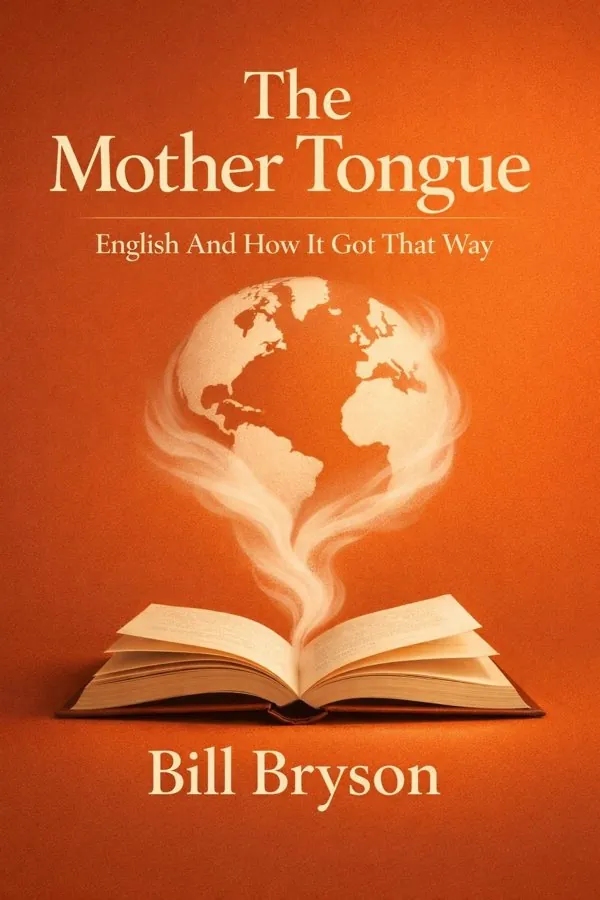
The Mother Tongue: English And How It Got That Way: Summary & Key Insights
by Bill Bryson
 10 min9 chaptersAudio available
Key Takeaways from The Mother Tongue: English And How It Got That Way
Every language looks ancient and inevitable from the inside, but English began as only one branch of a much larger family tree.
Languages are often imagined as fragile possessions, but English became powerful precisely because it kept getting invaded.
If English spelling seems irrational, that is because it usually records historical accidents rather than modern pronunciation.
A language stays alive not by protecting its vocabulary but by inventing and absorbing more of it.
Many people treat grammar as eternal law, but Bryson argues that much of what we call “correct” English is a mixture of genuine structure and later prescription.
What Is The Mother Tongue: English And How It Got That Way About?
The Mother Tongue: English And How It Got That Way by Bill Bryson is a language book spanning 12 pages. English often feels familiar enough to be invisible. We use it constantly, yet rarely stop to ask why it is packed with silent letters, contradictory rules, borrowed words, and accents that can change dramatically within a few miles. In The Mother Tongue, Bill Bryson turns that everyday mystery into a lively history of how English became one of the world’s strangest, richest, and most influential languages. He traces its path from ancient Indo-European roots through invasions, migrations, printing presses, dictionaries, imperial expansion, and modern global media, showing that English was shaped less by purity than by constant collision and adaptation. What makes the book matter is not just the historical sweep, but Bryson’s gift for making language feel human, comic, and alive. He shows that grammar rules are often improvised, spelling is a battlefield of accidents, and many “proper” forms were once dismissed as vulgar. As an American-born writer long immersed in British life and language, Bryson brings an unusually broad perspective to English on both sides of the Atlantic. The result is an entertaining and insightful guide to why English is so messy, flexible, and enduringly powerful.
This FizzRead summary covers all 9 key chapters of The Mother Tongue: English And How It Got That Way in approximately 10 minutes, distilling the most important ideas, arguments, and takeaways from Bill Bryson's work. Also available as an audio summary and Key Quotes Podcast.
The Mother Tongue: English And How It Got That Way
English often feels familiar enough to be invisible. We use it constantly, yet rarely stop to ask why it is packed with silent letters, contradictory rules, borrowed words, and accents that can change dramatically within a few miles. In The Mother Tongue, Bill Bryson turns that everyday mystery into a lively history of how English became one of the world’s strangest, richest, and most influential languages. He traces its path from ancient Indo-European roots through invasions, migrations, printing presses, dictionaries, imperial expansion, and modern global media, showing that English was shaped less by purity than by constant collision and adaptation.
What makes the book matter is not just the historical sweep, but Bryson’s gift for making language feel human, comic, and alive. He shows that grammar rules are often improvised, spelling is a battlefield of accidents, and many “proper” forms were once dismissed as vulgar. As an American-born writer long immersed in British life and language, Bryson brings an unusually broad perspective to English on both sides of the Atlantic. The result is an entertaining and insightful guide to why English is so messy, flexible, and enduringly powerful.
Who Should Read The Mother Tongue: English And How It Got That Way?
This book is perfect for anyone interested in language and looking to gain actionable insights in a short read. Whether you're a student, professional, or lifelong learner, the key ideas from The Mother Tongue: English And How It Got That Way by Bill Bryson will help you think differently.
- ✓Readers who enjoy language and want practical takeaways
- ✓Professionals looking to apply new ideas to their work and life
- ✓Anyone who wants the core insights of The Mother Tongue: English And How It Got That Way in just 10 minutes
Want the full summary?
Get instant access to this book summary and 100K+ more with Fizz Moment.
Get Free SummaryAvailable on App Store • Free to download
Key Chapters
Every language looks ancient and inevitable from the inside, but English began as only one branch of a much larger family tree. Bryson shows that its deepest ancestry lies in the Indo-European language family, whose descendants include Sanskrit, Greek, Latin, the Germanic languages, and the Slavic tongues. That means English did not appear fully formed on the British Isles. It emerged gradually from earlier speech communities, especially the Germanic dialects brought by Angles, Saxons, and Jutes after the Roman era.
This matters because it helps explain both what is familiar in English and what is odd about it. Shared Indo-European roots connect English words like “mother,” “brother,” and “night” to close cousins in German and more distant echoes in other languages. Yet English also developed in isolation and under pressure, which pushed it in unusual directions. Old English, for instance, was far more inflected than modern English, with grammatical endings that later eroded. In other words, today’s English is not the preservation of a fixed original system but the result of centuries of simplification, borrowing, and reshaping.
Bryson’s broader point is that language history is migration history. Words travel because people travel, conquer, trade, marry, and settle. If you understand that English was built from movement rather than purity, many later developments make more sense. Modern speakers still see this in everyday vocabulary: some words feel sturdy and Germanic, others elegant and Latinate, and both belong equally to English.
A useful takeaway is to stop thinking of English as a sealed system with one true form. When you encounter an unfamiliar word, expression, or accent, treat it as part of a very old pattern: English has always grown by contact.
Languages are often imagined as fragile possessions, but English became powerful precisely because it kept getting invaded. Bryson emphasizes that the history of English is inseparable from the history of conquest. Viking incursions brought Old Norse into close contact with Old English, especially in northern and eastern England. Later, the Norman Conquest flooded elite life with French. Instead of destroying English, these pressures transformed it into a richer and more flexible instrument.
The Norse influence was especially intimate because Norse and Old English were related enough to mix easily in everyday life. This left behind many short, essential words such as “sky,” “egg,” “they,” and “take.” These are not decorative imports; they sit at the heart of daily speech. French had a different effect. Because it became the language of administration, law, courtly culture, and prestige, English absorbed thousands of French terms, often alongside existing native ones. That is why English can say both “ask” and “inquire,” “begin” and “commence,” “kingly” and “royal.”
Bryson’s insight is that English gained expressive range through layering. It did not replace one lexicon with another; it kept both. That gave speakers a way to shift tone, class, formality, and emotional force. In practical terms, this is one reason English can sound blunt, poetic, bureaucratic, or intimate with slight changes in word choice.
The actionable lesson is simple: use English’s layered vocabulary deliberately. When writing or speaking, choose between native and borrowed words based on the effect you want. Short Anglo-Saxon words often feel direct and strong; French- or Latin-derived words often sound formal or abstract.
If English spelling seems irrational, that is because it usually records historical accidents rather than modern pronunciation. Bryson delights in showing how silent letters, inconsistent sound patterns, and baffling exceptions emerged from a mix of pronunciation change, regional variation, printing habits, etymological vanity, and educational standardization. English is not uniquely chaotic, but it often asks learners to memorize forms that no longer reflect how people speak.
One major reason is that pronunciation kept moving while spelling froze. The Great Vowel Shift altered the sounds of many common words, but their written forms remained largely in place. Add to that imported words from French, Latin, Greek, and elsewhere, each carrying traces of earlier spelling conventions. Printers and scholars also complicated matters by “correcting” spellings to display prestigious origins. That is how words sometimes acquired letters that had little to do with actual speech.
Bryson helps readers see spelling not as a moral test but as a historical museum. The word “knight” once sounded closer to the way it looks. “Debt” gained a silent b to advertise its connection to Latin debitum. Such examples reveal that writing systems often reflect power and pedigree as much as clarity. This has practical implications for teaching, editing, and communication. Good spelling matters in formal settings, but the book invites us to be less sanctimonious about mistakes and more curious about where conventions came from.
A useful takeaway is to approach difficult spellings through pattern recognition rather than frustration. When you meet an irregular form, ask what history it preserves. That mindset makes English easier to learn and far more interesting to use.
A language stays alive not by protecting its vocabulary but by inventing and absorbing more of it. Bryson shows that English has been spectacularly productive in word formation. It borrows freely, compounds eagerly, converts nouns into verbs, verbs into nouns, and stretches old meanings into new domains. This creativity is not a modern corruption; it is one of English’s defining strengths.
Words enter the language through many routes. Some are imported from other languages through trade, war, science, cuisine, and culture. Others are built internally through prefixes, suffixes, clipping, blending, and compounding. English can create a word like “bookshop” with sturdy simplicity, or produce hybrids and abstractions from Greek and Latin roots for medicine, law, and philosophy. It can also repurpose common terms: “to text,” “to google,” and “to network” show how easily the language turns activities into verbs.
Bryson’s larger point is that word formation reflects how speakers solve problems. When new realities appear, language improvises. Sometimes institutions try to control this process, but ordinary speakers usually win. Slang, jargon, and technological language often begin at the margins before moving inward. In practical communication, this means vocabulary is not merely a set of dictionary-approved items. It is an ongoing negotiation between usefulness, prestige, and habit.
The takeaway is to become a more attentive word observer. Notice how people around you name new tools, trends, and experiences. If you write for others, do not fear clear coinages or modern usages when they genuinely help. English has survived by being inventive, and effective speakers use that inheritance confidently.
Many people treat grammar as eternal law, but Bryson argues that much of what we call “correct” English is a mixture of genuine structure and later prescription. Every language needs patterns so speakers can understand one another, yet many famous English rules were imposed by grammarians trying to tidy up a living language that was never as orderly as they wished. As a result, grammar is partly natural habit and partly social enforcement.
English grammar changed dramatically over time. Old English had more inflections, which allowed freer word order. As those endings faded, English relied more heavily on position and helper words to signal meaning. This made the language structurally simpler in some ways, though not necessarily easier in every respect. Later, schoolroom authorities added rules such as objections to split infinitives or sentence-ending prepositions, often influenced by Latin models that did not fit English comfortably.
Bryson’s point is not that grammar does not matter. Clear grammar is essential for communication. But he distinguishes between rules that support understanding and rules that mainly signal education or class. For example, most readers benefit when pronouns agree clearly with antecedents, but few are actually confused by a natural split infinitive. This distinction is liberating. It allows writers to respect grammar without becoming servants to pedantry.
The actionable lesson is to use grammar as a tool, not a badge. Learn the conventions that improve clarity and credibility, especially in formal contexts, but question rules that exist mainly to intimidate. If a so-called rule makes your sentence clumsy or unnatural, Bryson gives you permission to rethink it.
One of Bryson’s recurring pleasures is puncturing the notion that American English is merely a degraded version of British English. In reality, the two varieties developed side by side under different conditions, preserving different archaisms and generating different innovations. American English did not simply break away from a finished standard; it helped continue the unfinished story of English.
Some forms now labeled “American” were once common in Britain. Others emerged in response to new landscapes, institutions, technologies, and cultural mixtures in North America. Webster’s spelling reforms, frontier vocabulary, contact with Native American languages, and later mass media all shaped a distinct yet fully legitimate branch of English. Bryson also notes that influence runs both ways. British and American English have continuously borrowed from each other through literature, journalism, film, politics, and commerce.
This matters because disputes over “proper” English often confuse familiarity with correctness. A British reader may notice “sidewalk,” “apartment,” or “gotten” as alien, just as an American reader may pause at “lorry,” “flat,” or “amongst.” But such differences are typically variations in convention, not failures of language. For global communication, understanding these distinctions is more useful than policing them.
The actionable takeaway is to match your English to your audience. If you write internationally, be consistent about spelling and vocabulary, and remain aware that alternatives may be equally valid elsewhere. Bryson’s broader lesson is to treat English as plural. Its diversity is a resource, not a defect.
Few languages in history have spread as widely as English, but Bryson makes clear that global dominance does not produce uniformity. As English moved through empire, trade, migration, education, science, and entertainment, it became many things at once: a first language, a second language, a business tool, a literary medium, and a contact language between people who share no native tongue. Each role changed the language.
English spread partly through British imperial power and later through American economic and cultural influence. Yet once established abroad, it stopped belonging solely to Britain or America. Local speakers reshaped pronunciation, syntax, vocabulary, and rhythm to suit their own environments. That is why Indian English, Nigerian English, Singapore English, and many other forms are not flawed copies but adaptive systems with their own conventions and expressive power.
Bryson’s insight is that success made English less centralized. A global language survives by tolerating variation and prioritizing usefulness. This has practical implications for modern readers. In international workplaces, classrooms, and online spaces, communicative success often depends less on perfect adherence to one prestige standard than on clarity, flexibility, and cultural sensitivity. English is strongest when it can be shared without requiring everyone to sound the same.
The takeaway is to adopt a global mindset. If you use English across borders, favor clear structure, plain vocabulary, and patient listening. Be prepared to encounter unfamiliar expressions without assuming they are mistakes. The worldwide story of English is still being written by its users.
The most revealing parts of a language are often the least formal. Bryson explores slang, personal names, place names, and etymologies to show that language is not just a neutral communication system; it is a map of belonging. Slang emerges where speakers want speed, humor, secrecy, rebellion, or solidarity. Names preserve conquest, settlement, aspiration, religion, and misunderstanding. Together, they show how deeply language is woven into identity.
Slang is especially revealing because it exposes the false belief that “real” language exists only in dictionaries. Informal speech renews vocabulary constantly, and even terms once dismissed as crude or temporary can become standard. Names perform a similar function over longer time scales. Place names across Britain and the wider English-speaking world record Celtic roots, Norse settlements, Norman administration, local geography, and generations of sound change. A name may look opaque until history illuminates it.
Bryson’s broader point is that language choices are social choices. The words we use signal region, age, profession, education, and allegiance. This helps explain why debates over usage can become emotionally charged: people hear not only grammar but status and identity. For anyone interested in communication, this is a practical reminder that effective language use requires empathy as well as accuracy.
The actionable takeaway is to listen to informal language and naming patterns as clues. If you want to understand a community, pay attention to what people call themselves, their places, and their everyday experiences. English becomes far more intelligible when you see it as lived culture, not just printed rules.
All Chapters in The Mother Tongue: English And How It Got That Way
About the Author
Bill Bryson is an American-born, British-associated author celebrated for turning complex subjects into lively, accessible books. He first became widely known for humorous travel writing, especially Notes from a Small Island, and later earned global acclaim for works on science, history, language, and everyday life, including A Short History of Nearly Everything, At Home, and The Body. Bryson’s writing is distinguished by wit, curiosity, deep research, and an ability to make ordinary facts feel surprising. Having lived extensively in both the United States and the United Kingdom, he brings a particularly valuable perspective to books about English and cultural difference. In The Mother Tongue, that cross-Atlantic sensibility helps him explain the language’s evolution with warmth, clarity, and comic intelligence.
Get This Summary in Your Preferred Format
Read or listen to the The Mother Tongue: English And How It Got That Way summary by Bill Bryson anytime, anywhere. FizzRead offers multiple formats so you can learn on your terms — all free.
Available formats: App · Audio · PDF · EPUB — All included free with FizzRead
Download The Mother Tongue: English And How It Got That Way PDF and EPUB Summary
Key Quotes from The Mother Tongue: English And How It Got That Way
“Every language looks ancient and inevitable from the inside, but English began as only one branch of a much larger family tree.”
“Languages are often imagined as fragile possessions, but English became powerful precisely because it kept getting invaded.”
“If English spelling seems irrational, that is because it usually records historical accidents rather than modern pronunciation.”
“A language stays alive not by protecting its vocabulary but by inventing and absorbing more of it.”
“Many people treat grammar as eternal law, but Bryson argues that much of what we call “correct” English is a mixture of genuine structure and later prescription.”
Frequently Asked Questions about The Mother Tongue: English And How It Got That Way
The Mother Tongue: English And How It Got That Way by Bill Bryson is a language book that explores key ideas across 9 chapters. English often feels familiar enough to be invisible. We use it constantly, yet rarely stop to ask why it is packed with silent letters, contradictory rules, borrowed words, and accents that can change dramatically within a few miles. In The Mother Tongue, Bill Bryson turns that everyday mystery into a lively history of how English became one of the world’s strangest, richest, and most influential languages. He traces its path from ancient Indo-European roots through invasions, migrations, printing presses, dictionaries, imperial expansion, and modern global media, showing that English was shaped less by purity than by constant collision and adaptation. What makes the book matter is not just the historical sweep, but Bryson’s gift for making language feel human, comic, and alive. He shows that grammar rules are often improvised, spelling is a battlefield of accidents, and many “proper” forms were once dismissed as vulgar. As an American-born writer long immersed in British life and language, Bryson brings an unusually broad perspective to English on both sides of the Atlantic. The result is an entertaining and insightful guide to why English is so messy, flexible, and enduringly powerful.
More by Bill Bryson

You Might Also Like
Browse by Category
Ready to read The Mother Tongue: English And How It Got That Way?
Get the full summary and 100K+ more books with Fizz Moment.