
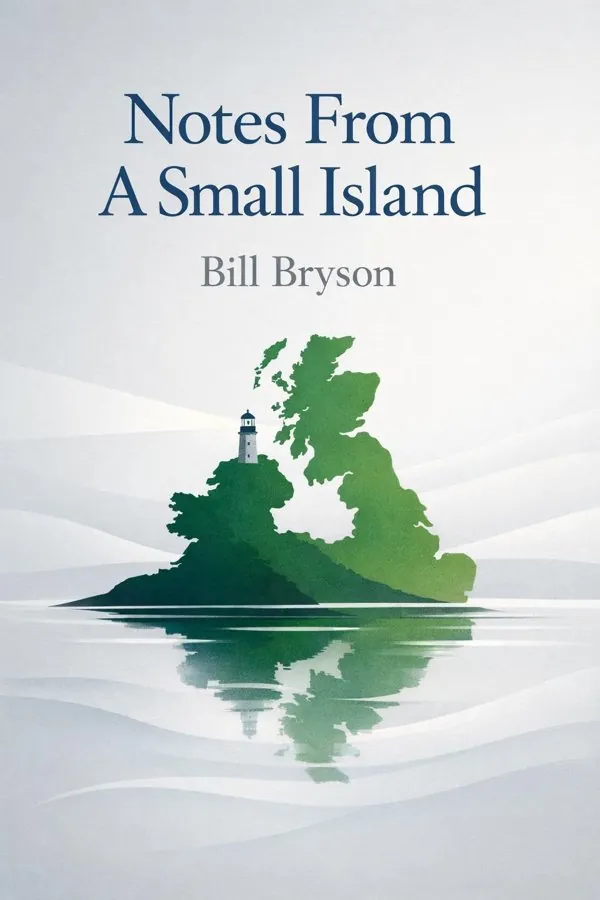
Notes From A Small Island: Summary & Key Insights
by Bill Bryson
 10 min10 chaptersAudio available
Key Takeaways from Notes From A Small Island
A place can become sacred not because it is perfect, but because it holds the memory of who you once were.
History feels most alive when it is embedded in daily life rather than sealed behind museum glass.
The soul of a great city often lies in the tension between exasperation and enchantment.
Beauty becomes more powerful when it carries the pressure of centuries.
A country reveals itself less in famous monuments than in its ordinary stretches.
What Is Notes From A Small Island About?
Notes From A Small Island by Bill Bryson is a travel book spanning 10 pages. What makes a country unforgettable is rarely its official landmarks alone. More often, it is the peculiar habits, overheard conversations, battered train stations, seaside promenades, and small acts of kindness that linger in memory. In Notes From A Small Island, Bill Bryson sets out on a farewell journey across Great Britain before moving back to the United States after two decades abroad. What follows is not a conventional travel guide, but a witty, observant, and deeply affectionate portrait of Britain in all its contradictions: beautiful yet shabby, polite yet eccentric, orderly yet absurd. Bryson writes with the rare authority of both insider and outsider. As an American who made Britain his home, he notices what lifelong residents overlook while understanding the emotional texture of ordinary British life. His account blends history, geography, memoir, and comic social commentary, turning train rides, rainy streets, village hotels, and urban frustrations into sharp reflections on national character. The book matters because it captures not just places, but a way of life, preserving the charm, oddity, and emotional pull of Britain through one man’s immensely entertaining final tour.
This FizzRead summary covers all 10 key chapters of Notes From A Small Island in approximately 10 minutes, distilling the most important ideas, arguments, and takeaways from Bill Bryson's work. Also available as an audio summary and Key Quotes Podcast.
Notes From A Small Island
What makes a country unforgettable is rarely its official landmarks alone. More often, it is the peculiar habits, overheard conversations, battered train stations, seaside promenades, and small acts of kindness that linger in memory. In Notes From A Small Island, Bill Bryson sets out on a farewell journey across Great Britain before moving back to the United States after two decades abroad. What follows is not a conventional travel guide, but a witty, observant, and deeply affectionate portrait of Britain in all its contradictions: beautiful yet shabby, polite yet eccentric, orderly yet absurd.
Bryson writes with the rare authority of both insider and outsider. As an American who made Britain his home, he notices what lifelong residents overlook while understanding the emotional texture of ordinary British life. His account blends history, geography, memoir, and comic social commentary, turning train rides, rainy streets, village hotels, and urban frustrations into sharp reflections on national character. The book matters because it captures not just places, but a way of life, preserving the charm, oddity, and emotional pull of Britain through one man’s immensely entertaining final tour.
Who Should Read Notes From A Small Island?
This book is perfect for anyone interested in travel and looking to gain actionable insights in a short read. Whether you're a student, professional, or lifelong learner, the key ideas from Notes From A Small Island by Bill Bryson will help you think differently.
- ✓Readers who enjoy travel and want practical takeaways
- ✓Professionals looking to apply new ideas to their work and life
- ✓Anyone who wants the core insights of Notes From A Small Island in just 10 minutes
Want the full summary?
Get instant access to this book summary and 100K+ more with Fizz Moment.
Get Free SummaryAvailable on App Store • Free to download
Key Chapters
A place can become sacred not because it is perfect, but because it holds the memory of who you once were. Bryson begins in Dover, where he first arrived in Britain many years earlier, and the choice is meaningful: it frames the entire journey as both travel and reckoning. The white cliffs symbolize entry, exit, continuity, and emotional return. He is not simply revisiting a destination; he is measuring the distance between the younger man who arrived curious and the older man now leaving with deep attachment.
From the start, Bryson shows that travel is never just about geography. Every station, hotel, or street corner carries emotional weight because it is filtered through memory. Dover becomes a reminder that our relationships with places change over time. What first seems foreign can become familiar, even beloved. His humor keeps the tone light, but underneath it lies a serious point: home is often something accumulated gradually through routines, irritations, and quiet loyalties rather than dramatic declarations.
Readers can apply this idea by rethinking their own relationship to familiar places. Instead of chasing only spectacular destinations, notice how meaning gathers in ordinary settings: the local café, the station platform, the route walked every day. Bryson invites us to ask not only where we are going, but what the journey says about who we have become.
Actionable takeaway: revisit a place tied to a turning point in your life and write down what feels different now, both in the place and in yourself.
History feels most alive when it is embedded in daily life rather than sealed behind museum glass. As Bryson moves inland to Canterbury and the English South, he encounters one of Britain’s defining qualities: the coexistence of the ancient and the ordinary. Medieval streets, cathedral towers, and centuries of cultural memory stand beside shops, buses, and crowds of modern life. This layering fascinates him because Britain often treats history not as spectacle, but as background texture.
Bryson’s observations suggest that national character is shaped by physical surroundings. In places like Canterbury, the built environment teaches continuity. Narrow lanes and old stone walls remind residents that they belong to a story larger than themselves. At the same time, Bryson notices the comic mismatch between historical grandeur and contemporary inconvenience, showing how reverence and absurdity can inhabit the same space. This balance is central to his charm as a writer: he admires beauty without becoming sentimental and pokes fun without becoming dismissive.
For modern readers, this idea has practical relevance. We often move through places too quickly to understand their accumulated meaning. Slowing down in older neighborhoods, reading a plaque, or tracing why a town looks the way it does can deepen even a short trip. Bryson demonstrates that curiosity transforms tourism into interpretation.
Actionable takeaway: when visiting any town or city, spend one hour exploring its oldest district on foot and ask how the past still shapes the rhythm, design, and identity of the present.
The soul of a great city often lies in the tension between exasperation and enchantment. Bryson’s London is crowded, inconvenient, expensive, and often absurd, yet it remains irresistible. He captures the city as a place of endless motion, bureaucratic frustration, and public spectacle, while also recognizing its intellectual energy, variety, and magnetic force. London stands in the book as a condensed version of Britain itself: a place capable of inspiring irritation and devotion in equal measure.
What makes Bryson especially insightful is that he does not romanticize urban life. He notices poor service, grimy infrastructure, and the baffling inefficiencies that make ordinary tasks harder than they should be. But he also understands that these flaws coexist with immense richness: bookstores, parks, neighborhoods, museums, accents, and the thrill of being somewhere so layered with history and human drama. His London is not lovable because it works perfectly; it is lovable because it overflows with character.
This chapter offers a broader lesson about evaluating places and institutions. We are often tempted to judge them only by efficiency, convenience, or polish. Bryson reminds us that livability also includes texture, surprise, and emotional resonance. The most memorable places are not always the smoothest ones. Travelers, city dwellers, and even professionals can use this perspective to distinguish between sterile perfection and vivid imperfection.
Actionable takeaway: the next time a place frustrates you, make a list of three qualities that inconvenience cannot erase, and use that list to see complexity instead of only complaint.
Beauty becomes more powerful when it carries the pressure of centuries. In visiting places such as Oxford and Bath, Bryson reflects on a Britain that seems unusually dense with inherited significance. Colleges, crescents, libraries, baths, and squares are not merely pretty; they embody the accumulated labor, ambition, and imagination of generations. Bryson is keenly aware that these places produce a special kind of awe precisely because they remain in use. They are not frozen relics but living environments.
At the same time, he notices the social and cultural implications of this inheritance. Prestigious places can inspire admiration while also reinforcing exclusivity, nostalgia, or a sense of distance. Bryson’s gift is to keep both truths visible. He delights in architectural grace and atmosphere, yet he remains alert to the oddity of societies that preserve grandeur while tolerating modern inconvenience or decline elsewhere. His travel writing therefore becomes a meditation on what nations choose to maintain, celebrate, and neglect.
For readers, the practical insight is that environments shape mood and thought. Spending time in beautiful, historically resonant spaces can sharpen attention and deepen appreciation. But Bryson also warns against passive admiration. We should ask how beauty is sustained, who gets access to it, and what contemporary values it reflects.
Actionable takeaway: visit a public place known for beauty or heritage and observe not just how it looks, but how people behave within it; then consider what the setting encourages, preserves, or excludes.
A country reveals itself less in famous monuments than in its ordinary stretches. As Bryson passes through the Midlands, he turns his attention to places often ignored by glamorous travel narratives. This matters because the Midlands represent the lived middle ground of national life: practical towns, changing industries, uncelebrated landscapes, and communities adapting to economic and cultural shifts. Bryson sees that if London is performance and the countryside is postcard, the Midlands are often where reality resides.
His reflections highlight a central strength of the book: respect for the overlooked. He recognizes that unlovely places can still possess dignity, warmth, and significance. Railway platforms, modest high streets, chain hotels, and weathered neighborhoods become sites of observation rather than dismissal. He also records the tensions of modernization, decline, and uneven development, showing how travel writing can illuminate social change without becoming heavy-handed.
This perspective has broad application beyond travel. In work and life, we often overvalue the exceptional and undervalue the ordinary systems that make everything function. Bryson reminds us that character is often found in maintenance, routine, and resilience. The places people do not boast about may be the best places to understand who they really are.
Actionable takeaway: choose an uncelebrated area near where you live and explore it with the same curiosity you would bring to a famous destination; pay attention to what everyday details reveal about the people who inhabit it.
Hospitality is often most memorable when it comes wrapped in understatement. In the North, especially in Yorkshire, Bryson encounters a regional culture marked by dry humor, forthrightness, and a grounded kind of friendliness. He is alert to differences within Britain, and Yorkshire becomes an example of how local identity can feel distinct without breaking the broader national fabric. The people he meets are often practical, reserved, and funny in ways that resist sentimentality, and this tonal difference delights him.
Bryson’s treatment of northern England pushes back against simplified stereotypes. He does not reduce regional culture to quaintness. Instead, he shows how speech patterns, manners, and local pride create a sense of place every bit as powerful as landscape or architecture. This is one of the book’s quiet arguments: nations are mosaics, and understanding them requires attention to regional texture. A railway delay or pub conversation can reveal as much as a grand monument.
Readers can apply this insight by becoming more attentive to how people communicate values indirectly. Humor, understatement, and local expressions often carry signals about trust, belonging, and social norms. Whether traveling, moving to a new city, or working across teams, paying attention to tone matters. Bryson succeeds because he listens as much as he looks.
Actionable takeaway: in your next conversation with someone from a different region or background, focus on humor, phrasing, and conversational rhythm; these often reveal identity more clearly than explicit statements.
Some landscapes do not merely impress us; they reorganize our inner weather. In the Lake District, Bryson’s affection for Britain becomes especially vivid. The region embodies one of the nation’s greatest gifts: access to beauty through walking. Hills, lakes, changing light, and shifting weather create a form of travel rooted in pace, effort, and sensory attention. Bryson understands that walking is not simply movement but a way of thinking, noticing, and belonging.
His descriptions show why landscape matters beyond aesthetics. A place like the Lake District offers emotional calibration. It slows the mind, sharpens observation, and restores perspective. Bryson also recognizes the democratic quality of such beauty. Unlike elite institutions or private spaces, paths and views can be shared. The walker participates in the landscape rather than consuming it from a distance. This participatory quality distinguishes Bryson from purely descriptive travel writers; he is interested in what places do to the traveler.
There is also a practical lesson here for contemporary life. In an age of speed and digital distraction, walking remains one of the simplest ways to recover attention. You do not need a world-famous national park to benefit from this. Bryson’s example suggests that regular, deliberate walking can reconnect us to our environment and improve mood, reflection, and memory.
Actionable takeaway: schedule a weekly walk without headphones or distractions, and treat it as a practice of observation by noticing five details you would normally miss.
A nation can appear unified from afar while feeling richly plural up close. As Bryson travels into Scotland and Wales, he encounters identities shaped by language, history, landscape, and strong local pride. These regions complicate any simple idea of “Britishness.” Bryson notices differences in architecture, speech, temperament, and political feeling, revealing that the island’s small size hides striking internal variety.
What makes this part of the journey important is Bryson’s sensitivity to layered belonging. Scotland and Wales are connected to Britain yet not reducible to England. Their identities carry memory, grievance, resilience, and cultural confidence. Bryson uses humor, but he does not flatten these distinctions into caricature. Instead, he shows that true affection for a country requires acknowledging its internal tensions and uneven histories. Travel, in this sense, becomes a corrective to lazy generalization.
This idea has wide relevance. We often speak about nations, organizations, or communities as if they were internally uniform. Bryson’s journey reminds us that meaningful understanding requires granularity. In business, education, politics, and personal relationships, broad labels can obscure lived reality. Paying attention to subcultures and regional histories produces more respectful and accurate judgment.
Actionable takeaway: when learning about any country or large group, identify at least three internal identities or regions within it and explore how their histories differ before forming conclusions about the whole.
We often understand what a place has given us only when we are preparing to leave it. As Bryson’s journey comes to an end, the book reveals itself as more than a comic travel memoir. It is a love letter disguised as a complaint. His catalog of inconveniences, oddities, and national habits ultimately strengthens rather than weakens his affection because it proves intimacy. Only someone who has lived within a place deeply can criticize it with such precision and still mourn its loss.
The farewell sections illuminate the book’s central emotional truth: home can be chosen, and chosen homes can shape us as profoundly as native ones. Bryson came from elsewhere, yet Britain altered his sensibility, humor, habits, and loyalties. Leaving means not only changing countries, but loosening a part of his own identity. This gives the book its lasting emotional resonance. The jokes endure, but so does the tenderness.
Readers can take from this a more generous way of thinking about belonging. Attachment does not require perfection, agreement, or origins. It grows through repeated encounters, frustrations survived, beauty noticed, and communities joined. Bryson’s journey encourages gratitude for the places that have quietly formed us.
Actionable takeaway: make a list of three ways a city, country, or community has changed you for the better, especially one you once viewed as temporary, and share that appreciation with someone connected to it.
All Chapters in Notes From A Small Island
About the Author
Bill Bryson is an American-born author whose work spans travel writing, memoir, language, history, and popular science. Born in Des Moines, Iowa, he later moved to Britain, where he lived for many years and developed the cross-cultural perspective that shaped some of his most beloved books. Bryson became famous for combining sharp observation, self-deprecating humor, and clear, engaging prose, making complex or ordinary subjects equally enjoyable to read. His notable works include Notes From A Small Island, A Walk in the Woods, In a Sunburned Country, and A Short History of Nearly Everything. Whether writing about countries, scientific discoveries, or daily life, Bryson has a gift for making readers curious, amused, and more attentive to the world around them.
Get This Summary in Your Preferred Format
Read or listen to the Notes From A Small Island summary by Bill Bryson anytime, anywhere. FizzRead offers multiple formats so you can learn on your terms — all free.
Available formats: App · Audio · PDF · EPUB — All included free with FizzRead
Download Notes From A Small Island PDF and EPUB Summary
Key Quotes from Notes From A Small Island
“A place can become sacred not because it is perfect, but because it holds the memory of who you once were.”
“History feels most alive when it is embedded in daily life rather than sealed behind museum glass.”
“The soul of a great city often lies in the tension between exasperation and enchantment.”
“Beauty becomes more powerful when it carries the pressure of centuries.”
“A country reveals itself less in famous monuments than in its ordinary stretches.”
Frequently Asked Questions about Notes From A Small Island
Notes From A Small Island by Bill Bryson is a travel book that explores key ideas across 10 chapters. What makes a country unforgettable is rarely its official landmarks alone. More often, it is the peculiar habits, overheard conversations, battered train stations, seaside promenades, and small acts of kindness that linger in memory. In Notes From A Small Island, Bill Bryson sets out on a farewell journey across Great Britain before moving back to the United States after two decades abroad. What follows is not a conventional travel guide, but a witty, observant, and deeply affectionate portrait of Britain in all its contradictions: beautiful yet shabby, polite yet eccentric, orderly yet absurd. Bryson writes with the rare authority of both insider and outsider. As an American who made Britain his home, he notices what lifelong residents overlook while understanding the emotional texture of ordinary British life. His account blends history, geography, memoir, and comic social commentary, turning train rides, rainy streets, village hotels, and urban frustrations into sharp reflections on national character. The book matters because it captures not just places, but a way of life, preserving the charm, oddity, and emotional pull of Britain through one man’s immensely entertaining final tour.
More by Bill Bryson


You Might Also Like

The Half Known Life: In Search of Paradise
Pico Iyer
10 min
A Walk in the Woods: Rediscovering America on the Appalachian Trail
Bill Bryson
10 min
How to Travel the World on $50 a Day: Travel Cheaper, Longer, Smarter
Matt Kepnes
10 min
In Xanadu: A Quest
William Dalrymple
10 min
In a Sunburned Country
Bill Bryson
10 min
The Art of Travel
Alain De Botton
10 minBrowse by Category
Ready to read Notes From A Small Island?
Get the full summary and 100K+ more books with Fizz Moment.