
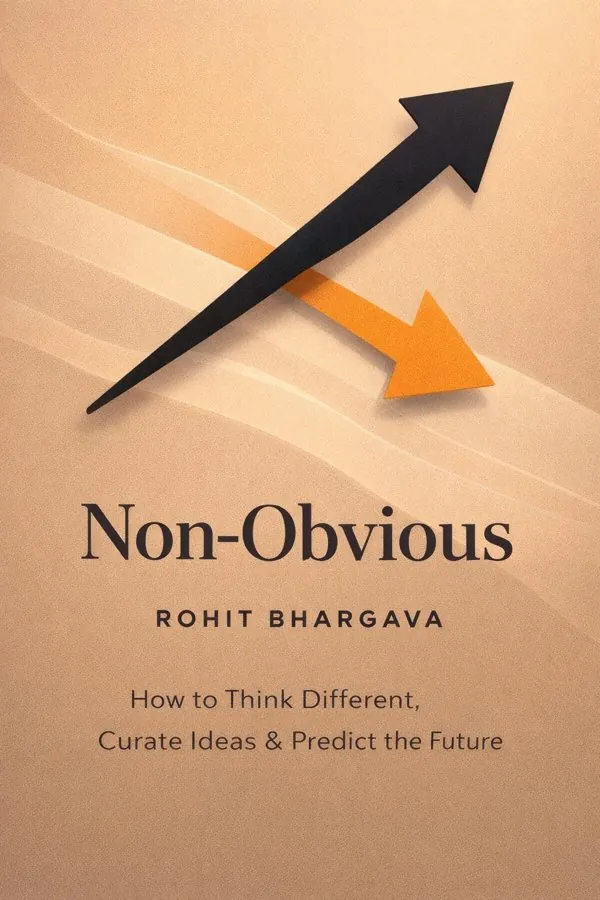
Non-Obvious: How to Think Different, Curate Ideas & Predict the Future: Summary & Key Insights
 10 min6 chaptersAudio available
What Is Non-Obvious: How to Think Different, Curate Ideas & Predict the Future About?
Non-Obvious: How to Think Different, Curate Ideas & Predict the Future by Rohit Bhargava is a future_trends book spanning 6 pages. Non-Obvious explores how to identify emerging trends and think differently about the future. Rohit Bhargava presents a method for curating ideas and recognizing patterns that others overlook, helping readers anticipate change and make better decisions in business and life.
This FizzRead summary covers all 6 key chapters of Non-Obvious: How to Think Different, Curate Ideas & Predict the Future in approximately 10 minutes, distilling the most important ideas, arguments, and takeaways from Rohit Bhargava's work. Also available as an audio summary and Key Quotes Podcast.
Non-Obvious: How to Think Different, Curate Ideas & Predict the Future
Non-Obvious explores how to identify emerging trends and think differently about the future. Rohit Bhargava presents a method for curating ideas and recognizing patterns that others overlook, helping readers anticipate change and make better decisions in business and life.
Who Should Read Non-Obvious: How to Think Different, Curate Ideas & Predict the Future?
This book is perfect for anyone interested in future_trends and looking to gain actionable insights in a short read. Whether you're a student, professional, or lifelong learner, the key ideas from Non-Obvious: How to Think Different, Curate Ideas & Predict the Future by Rohit Bhargava will help you think differently.
- ✓Readers who enjoy future_trends and want practical takeaways
- ✓Professionals looking to apply new ideas to their work and life
- ✓Anyone who wants the core insights of Non-Obvious: How to Think Different, Curate Ideas & Predict the Future in just 10 minutes
Want the full summary?
Get instant access to this book summary and 100K+ more with Fizz Moment.
Get Free SummaryAvailable on App Store • Free to download
Key Chapters
When I talk about trend prediction, many assume it’s about making guesses. They imagine pundits with bold statements and flashy forecasts that rarely come true. But the real work of predicting the future is about quiet observation. It’s about human beings. Every trend begins as a shift in behavior—someone decides to do something a little differently, and others follow. My work has always revolved around understanding that subtle change. Instead of chasing what's next, I listen for what's shifting right now.
The world sends out countless signals every day, from the products people buy to the memes they share. Most of these signals are noise. What separates a 'non-obvious' thinker from the rest is the ability to notice patterns without being blinded by volume. It's about empathy and curiosity—two underappreciated tools in any futurist's arsenal. Empathy helps you understand what motivates people; curiosity pushes you to ask why a certain behavior emerged in the first place.
That’s why I encourage readers to stop thinking of trend prediction as an act of genius and start treating it as an act of perception. The patterns are already there—hidden connections between marketing and culture, between technology and storytelling. When you train yourself to see these intersections, the impossible becomes predictable. This shift in mindset lays the foundation for the system I later call the Haystack Method.
The Haystack Method is my five-step process designed to help anyone become a 'trend curator.' The name reflects the challenge we face: finding meaning in an overwhelming abundance of information. Every day we’re surrounded by data—articles, tweets, photos, ads, conversations. It’s like standing in front of a massive haystack and trying to find the needle that matters. The question is, how do you separate the meaningful from the meaningless?
The first step is Gathering. This is where you commit to collecting ideas from a wide array of sources—not just within your comfort zone. Most people read the same publications, follow the same experts, and consume ideas that reinforce their worldview. Gathering demands openness. The more diverse your inputs, the richer your insights will be. That’s why I read everything from design blogs to food industry reports, from political commentary to science journals.
Next comes Aggregating. Once you’ve gathered, you start connecting dots. At this stage you look for patterns—common ideas or recurring behaviors that link disparate pieces of information. This step requires patience, because often the connections aren't obvious immediately. You’re building cognitive bridges between fields that rarely meet, and that’s where innovation lives.
Elevating is the moment when you begin filtering out noise. Not every interesting idea deserves your attention. Elevating is about focus—removing the superficial trends and tuning into what reveals something deeper about human motivation. Elevation asks the question: what does this say about people?
Naming is how you give identity and life to these patterns. A trend without a name is easily forgotten. Memorable naming transforms abstract patterns into communicable ideas. For instance, when I observed the rise of adults buying coloring books, I coined the term 'Mindful Detachment' to describe the collective yearning for activities that calm the mind amid chaos. Suddenly the trend wasn’t just observable; it was shareable.
Finally, Proving. To be credible, your trend must stand up to evidence. You gather examples, data, and anecdotes that demonstrate how the pattern is manifesting in the real world. Proof transforms intuition into conviction. When you can show that a trend isn’t just your opinion but a verifiable shift in behavior, you turn insight into influence.
+ 4 more chapters — available in the FizzRead app
All Chapters in Non-Obvious: How to Think Different, Curate Ideas & Predict the Future
About the Author
Rohit Bhargava is an author, marketing expert, and founder of the Non-Obvious Company. He is known for his work on trend prediction and storytelling, and has taught marketing and innovation at Georgetown University.
Get This Summary in Your Preferred Format
Read or listen to the Non-Obvious: How to Think Different, Curate Ideas & Predict the Future summary by Rohit Bhargava anytime, anywhere. FizzRead offers multiple formats so you can learn on your terms — all free.
Available formats: App · Audio · PDF · EPUB — All included free with FizzRead
Download Non-Obvious: How to Think Different, Curate Ideas & Predict the Future PDF and EPUB Summary
Key Quotes from Non-Obvious: How to Think Different, Curate Ideas & Predict the Future
“When I talk about trend prediction, many assume it’s about making guesses.”
“The Haystack Method is my five-step process designed to help anyone become a 'trend curator.”
Frequently Asked Questions about Non-Obvious: How to Think Different, Curate Ideas & Predict the Future
Non-Obvious: How to Think Different, Curate Ideas & Predict the Future by Rohit Bhargava is a future_trends book that explores key ideas across 6 chapters. Non-Obvious explores how to identify emerging trends and think differently about the future. Rohit Bhargava presents a method for curating ideas and recognizing patterns that others overlook, helping readers anticipate change and make better decisions in business and life.
More by Rohit Bhargava
You Might Also Like
Futureproof: 9 Rules for Humans in the Age of Automation
Kevin Roose
10 min
The Third Wave
Alvin Toffler
10 min
2030: How Today's Biggest Trends Will Collide and Reshape the Future of Everything
Mauro F. Guillén
10 min
A Very Human Future: Enriching Humanity in a Digitized World
Rohit Talwar, Steve Wells, Alexandra Whittington
10 min
AI 2041: Ten Visions for Our Future
Kai-Fu Lee, Chen Qiufan
10 min
Abundance: The Future Is Better Than You Think
Peter H. Diamandis, Steven Kotler
10 minBrowse by Category
Ready to read Non-Obvious: How to Think Different, Curate Ideas & Predict the Future?
Get the full summary and 100K+ more books with Fizz Moment.