
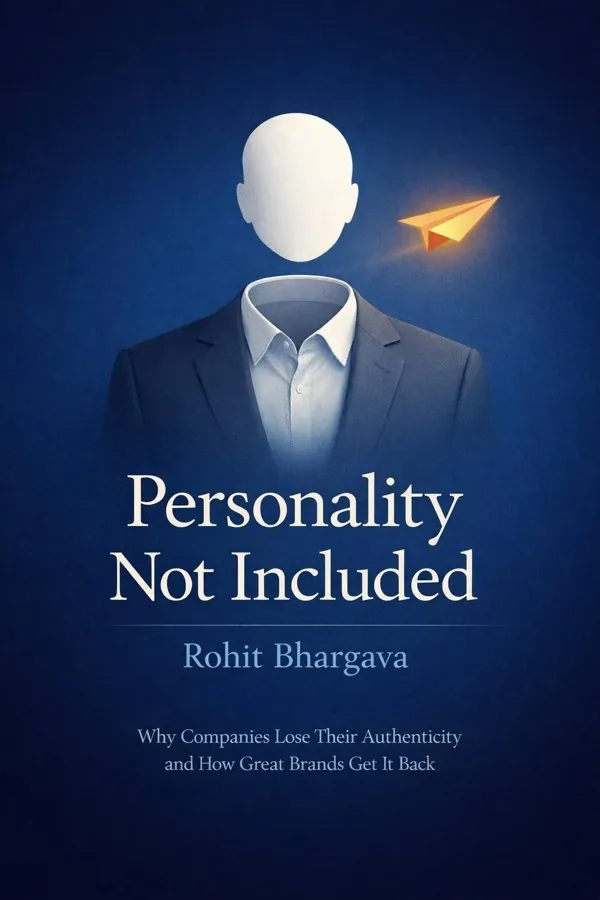
Personality Not Included: Why Companies Lose Their Authenticity and How Great Brands Get It Back: Summary & Key Insights
 10 min9 chaptersAudio available
Key Takeaways from Personality Not Included: Why Companies Lose Their Authenticity and How Great Brands Get It Back
The most memorable brands do not merely look different; they feel different.
Customers are remarkably good at detecting the distance between what a company says and what it really is.
Facts inform, but stories persuade.
Many organizations do not lose personality because they lack creative people; they lose it because systems gradually reward caution over character.
In the age of social media, authenticity is no longer optional because audiences can respond, investigate, and amplify in real time.
What Is Personality Not Included: Why Companies Lose Their Authenticity and How Great Brands Get It Back About?
Personality Not Included: Why Companies Lose Their Authenticity and How Great Brands Get It Back by Rohit Bhargava is a marketing book spanning 6 pages. In a marketplace crowded with polished campaigns, automated responses, and carefully managed public images, many brands still feel strangely forgettable. Rohit Bhargava’s Personality Not Included argues that the problem is not a lack of marketing activity, but a lack of humanity. The book explores why companies often lose their authentic voice as they grow, become more risk-averse, and rely on corporate language that sounds safe but emotionally empty. Bhargava makes the case that personality is not a decorative extra for brands; it is a strategic advantage that helps organizations build trust, stand out, and create lasting emotional connections. What makes this book especially valuable is its practical focus. Rather than offering vague advice about “being authentic,” Bhargava shows how personality can be expressed through communication, storytelling, customer experience, leadership, and culture. Drawing on his experience as a marketing strategist and brand thinker, he explains how great brands become memorable by acting more like real people: distinctive, transparent, and relatable. For marketers, founders, leaders, and anyone trying to make an organization feel more human, this book offers a timely blueprint for reconnecting brand identity with genuine character.
This FizzRead summary covers all 9 key chapters of Personality Not Included: Why Companies Lose Their Authenticity and How Great Brands Get It Back in approximately 10 minutes, distilling the most important ideas, arguments, and takeaways from Rohit Bhargava's work. Also available as an audio summary and Key Quotes Podcast.
Personality Not Included: Why Companies Lose Their Authenticity and How Great Brands Get It Back
In a marketplace crowded with polished campaigns, automated responses, and carefully managed public images, many brands still feel strangely forgettable. Rohit Bhargava’s Personality Not Included argues that the problem is not a lack of marketing activity, but a lack of humanity. The book explores why companies often lose their authentic voice as they grow, become more risk-averse, and rely on corporate language that sounds safe but emotionally empty. Bhargava makes the case that personality is not a decorative extra for brands; it is a strategic advantage that helps organizations build trust, stand out, and create lasting emotional connections.
What makes this book especially valuable is its practical focus. Rather than offering vague advice about “being authentic,” Bhargava shows how personality can be expressed through communication, storytelling, customer experience, leadership, and culture. Drawing on his experience as a marketing strategist and brand thinker, he explains how great brands become memorable by acting more like real people: distinctive, transparent, and relatable. For marketers, founders, leaders, and anyone trying to make an organization feel more human, this book offers a timely blueprint for reconnecting brand identity with genuine character.
Who Should Read Personality Not Included: Why Companies Lose Their Authenticity and How Great Brands Get It Back?
This book is perfect for anyone interested in marketing and looking to gain actionable insights in a short read. Whether you're a student, professional, or lifelong learner, the key ideas from Personality Not Included: Why Companies Lose Their Authenticity and How Great Brands Get It Back by Rohit Bhargava will help you think differently.
- ✓Readers who enjoy marketing and want practical takeaways
- ✓Professionals looking to apply new ideas to their work and life
- ✓Anyone who wants the core insights of Personality Not Included: Why Companies Lose Their Authenticity and How Great Brands Get It Back in just 10 minutes
Want the full summary?
Get instant access to this book summary and 100K+ more with Fizz Moment.
Get Free SummaryAvailable on App Store • Free to download
Key Chapters
The most memorable brands do not merely look different; they feel different. Bhargava argues that personality is the soul behind a brand, the set of qualities that makes it seem human, relatable, and distinct. This is not the same as image, which is the surface a company projects, or reputation, which is what others think of it over time. Personality sits deeper. It shapes tone, behavior, decisions, stories, and the emotional impression people carry away after every interaction.
A company without personality may still be competent, but it often becomes interchangeable. Its website sounds like every competitor’s. Its mission statement is vague. Its customer emails are sterile. In contrast, a brand with personality signals character through consistent choices. Think of the difference between a hotel chain that talks about “delivering optimized hospitality solutions” and one that speaks warmly, solves problems quickly, and makes guests feel genuinely welcomed. The second may use simpler language, but it creates stronger loyalty because people experience a recognizable human presence.
Bhargava’s point is that personality is not fluff. It affects whether people trust you, remember you, and want to recommend you. It also helps guide internal behavior. When a team clearly understands whether the brand is bold, generous, witty, reassuring, or unconventional, decisions become easier and more coherent.
The practical application is to define your brand in human terms. If your company were a person, how would it speak, respond to criticism, celebrate wins, or admit mistakes? Use those answers to shape messaging, customer service, and leadership communication. Actionable takeaway: identify three personality traits your brand should embody, then audit whether your content, service, and culture actually reflect them.
Customers are remarkably good at detecting the distance between what a company says and what it really is. Bhargava calls this distance the authenticity gap: the dangerous space between promise and reality. It appears when organizations make claims that sound inspiring in public but behave differently in practice. The larger this gap becomes, the harder it is for a brand to earn trust, no matter how sophisticated its marketing may be.
This gap often emerges because companies overmanage their communications. Legal teams sanitize language. Executives prefer polished messaging to honest conversation. Departments work in silos, so advertising promises an experience operations cannot deliver. Over time, the brand becomes optimized for appearance rather than truth. A business may claim to value customer care while making support nearly impossible to access, or celebrate innovation while internally rewarding conformity and caution.
Bhargava emphasizes that authenticity does not require perfection. Customers do not expect companies to be flawless; they expect them to be honest, self-aware, and aligned. A restaurant that admits it made a mistake and fixes it quickly can strengthen trust. A technology company that openly explains a service outage and what it is doing to prevent future problems often comes across as more credible than one that hides behind vague public relations language.
Closing the authenticity gap requires operational honesty. Marketing should not invent a personality that the rest of the company cannot support. Instead, communication should reflect lived reality and push the organization to become more consistent.
Actionable takeaway: compare your top five brand promises with the actual customer experience. Wherever there is a mismatch, fix the experience first and the messaging second.
Facts inform, but stories persuade. Bhargava highlights storytelling as one of the most powerful ways to reveal brand personality because stories carry emotion, context, conflict, and meaning. People rarely build loyalty around abstract claims like “quality,” “innovation,” or “customer focus.” They connect to specific moments, examples, and narratives that show what those words mean in real life.
A strong brand story does not have to be dramatic. It may be the origin story of a founder solving a personal problem, a customer success story that shows real transformation, or an internal story about an employee who went beyond policy to help someone. These stories work because they humanize the organization. Instead of talking about values in the abstract, they demonstrate them through action.
Storytelling is also a discipline of selection. Great brands choose stories that reinforce the character they want to be known for. A playful brand shares moments of delight and surprise. A dependable brand highlights consistency under pressure. A mission-driven brand tells stories about impact, not just growth. Over time, these narratives shape public memory.
Importantly, storytelling is not limited to advertising campaigns. It should appear in onboarding, investor communication, press interviews, customer support, social posts, and even product design. Every touchpoint can either deepen the narrative or dilute it.
To apply this idea, companies should build a library of signature stories tied to their values and customer experience. Train employees to tell them naturally rather than reciting scripts. Make sure the stories are real, specific, and repeatable.
Actionable takeaway: collect three true stories from customers or employees that capture your brand values, and start using them in sales, marketing, and internal communication instead of relying only on generic claims.
Many organizations do not lose personality because they lack creative people; they lose it because systems gradually reward caution over character. Bhargava identifies several barriers to personality, including bureaucracy, committee-driven decisions, legal overprotection, fear of controversy, and an obsession with imitation. The result is communication that feels safe but lifeless.
When too many people must approve every message, originality gets stripped away. Bold phrasing becomes bland. Honest opinion becomes jargon. Distinctiveness is treated as risk, while generic language is treated as professionalism. Companies then end up sounding exactly like competitors, all claiming to be trusted leaders offering innovative solutions and world-class service. None of those phrases tell an audience what makes the brand special.
Another barrier is internal fragmentation. One team controls social media, another handles customer service, another writes executive speeches, and none share the same understanding of personality. Customers experience this inconsistency as a lack of authenticity. The website may sound friendly, while support feels robotic and leadership sounds distant.
Bhargava’s deeper insight is that personality requires courage. To sound like someone, you must be willing not to sound like everyone. That means making choices, embracing imperfections, and allowing real people inside the company to shape communication. It also means accepting that not every audience will respond the same way, which is often the price of being memorable.
The practical response is to identify the internal habits that flatten your voice. Review approval processes, language policies, and brand guidelines to see whether they encourage clarity and humanity or suppress them.
Actionable takeaway: eliminate one unnecessary communication layer, ban your ten most overused corporate phrases, and give teams examples of language that sounds more natural, specific, and true to your brand.
A brand cannot convincingly project a personality it does not actually live. One of Bhargava’s most important themes is that external authenticity depends on internal culture. If employees do not understand the brand’s character, do not believe in its values, or are punished for acting human, then no amount of marketing can create genuine connection.
Internal culture shapes countless moments customers never see directly but always feel indirectly: how employees solve problems, whether they are empowered to make exceptions, how leaders communicate in crises, and whether teams collaborate across functions. A company that claims to be caring but treats employees as replaceable resources will struggle to deliver a caring customer experience. A brand that claims to be innovative but operates through fear and rigid hierarchy will rarely feel inventive in the market.
Bhargava suggests that personality should become a mindset, not just a messaging strategy. That means hiring people who fit the brand’s ethos, training them with stories and principles instead of only scripts, and giving them enough trust to express the brand naturally. Some of the strongest brand experiences happen when frontline employees improvise in ways that are consistent with the company’s character.
Leaders are especially important here because they set the emotional tone. If executives speak in abstraction while demanding authenticity from marketing, employees receive mixed signals. But when leaders communicate candidly and model the brand personality themselves, the rest of the organization has permission to do the same.
Actionable takeaway: turn your brand personality into internal behaviors by defining how those traits should appear in hiring, meetings, customer service, and leadership communication, then reward employees who bring them to life.
The pressure to follow industry norms is one of the biggest reasons brands become invisible. Bhargava argues that many companies chase credibility by sounding established, serious, and similar to their peers. Ironically, this often weakens credibility because audiences struggle to tell one brand from another. Distinctiveness, when grounded in truth, is far more persuasive than conformity.
Choosing character over sameness means making conscious decisions about tone, visual identity, customer experience, and public behavior. A financial services company does not have to sound cold to appear trustworthy. A healthcare brand does not have to sound sterile to appear competent. Personality is not the opposite of professionalism; it is what makes professionalism feel human and believable.
Consider two businesses with similar products. One uses generic stock imagery, cautious copy, and a templated support process. The other uses plainspoken language, shares real customer stories, and designs every touchpoint to reinforce simplicity and respect. Even if their offerings are comparable, the second brand will likely feel more credible because its character is easier to recognize and remember.
Bhargava encourages brands to stop asking, “How do successful companies in our category communicate?” and instead ask, “What is the most honest and distinctive way we can communicate who we are?” That shift creates room for originality. It also attracts the right audience more effectively, because clear personality acts like a filter.
Actionable takeaway: identify one area where your brand currently imitates category conventions, then redesign it to express a more specific point of view without sacrificing clarity or trust.
Brands are not judged primarily by what they declare, but by what people experience. Bhargava shows that personality is communicated in every customer touchpoint, from a landing page headline to a billing email, store layout, product packaging, hold music, return policy, or service recovery process. These moments reveal the company’s true character more honestly than mission statements ever can.
This means personality has to be operationalized. It is not enough for the marketing team to create a clever campaign if the buying process is confusing or the support experience feels indifferent. Customers interpret inconsistency as insincerity. On the other hand, when small details align, personality becomes believable. A brand that claims to be simple should make forms shorter, navigation clearer, and instructions easier to follow. A brand that claims to be generous should design flexible policies and empowered service.
Bhargava’s insight here is especially useful because it turns authenticity into a practical management tool. Rather than asking only whether communication sounds right, companies should ask whether systems, policies, and design choices express the same values. This creates a more holistic approach to branding.
Teams can apply this by mapping the customer journey and identifying where personality shows up clearly, where it disappears, and where it is contradicted. Often the biggest gains come not from expensive campaigns, but from improving mundane moments that customers remember intensely because they affect convenience, trust, or respect.
Actionable takeaway: map your customer journey from first contact to post-purchase support, then mark each stage as reinforcing, neutral, or undermining your brand personality, and prioritize fixes where the experience contradicts the promise.
One of the most important lessons in Personality Not Included is that authenticity is not merely a branding trend; it is a durable competitive asset. Bhargava argues that in markets where products are increasingly similar and information is easy to access, emotional trust becomes a major differentiator. Brands with real personality are harder to copy because they are built from culture, values, behavior, and story, not just design elements or taglines.
This matters strategically because personality influences more than marketing performance. It affects recruitment, retention, partnerships, customer advocacy, crisis resilience, and word-of-mouth growth. People want to work for organizations that feel real. Customers are more forgiving when a trusted brand makes a mistake. Partners prefer businesses with a clear identity and consistent behavior. In this sense, authenticity compounds over time.
Bhargava also suggests that companies should resist the temptation to treat personality as a campaign theme that can be switched on for a product launch and then ignored. Audiences quickly notice inconsistency. Authenticity becomes powerful only when sustained through repetition and proof. That requires patience, because trust is earned gradually through aligned actions.
The practical implication is that leaders should see brand personality as an organizational investment. It deserves the same seriousness as product development, service design, and operational excellence. Metrics can include not just awareness, but trust, recommendation, employee advocacy, and consistency across touchpoints.
Actionable takeaway: treat authenticity as a strategic capability by setting long-term goals for trust and consistency, and review major decisions through one question: does this strengthen or weaken the personality we want people to experience?
All Chapters in Personality Not Included: Why Companies Lose Their Authenticity and How Great Brands Get It Back
About the Author
Rohit Bhargava is a marketing expert, author, keynote speaker, and entrepreneur known for his work on brand authenticity, innovation, and consumer insight. He has built a reputation for helping organizations communicate more clearly and act more human in a crowded, skeptical marketplace. Bhargava has worked as a marketing strategist and later founded the Non-Obvious Company, where he focuses on identifying cultural trends and teaching leaders how to think more originally. He is the author of multiple business books and is widely recognized for translating complex branding and trend ideas into practical advice. In Personality Not Included, he combines strategic marketing knowledge with a strong belief that memorable brands are built not just through visibility, but through honesty, character, and emotional connection.
Get This Summary in Your Preferred Format
Read or listen to the Personality Not Included: Why Companies Lose Their Authenticity and How Great Brands Get It Back summary by Rohit Bhargava anytime, anywhere. FizzRead offers multiple formats so you can learn on your terms — all free.
Available formats: App · Audio · PDF · EPUB — All included free with FizzRead
Download Personality Not Included: Why Companies Lose Their Authenticity and How Great Brands Get It Back PDF and EPUB Summary
Key Quotes from Personality Not Included: Why Companies Lose Their Authenticity and How Great Brands Get It Back
“The most memorable brands do not merely look different; they feel different.”
“Customers are remarkably good at detecting the distance between what a company says and what it really is.”
“Bhargava highlights storytelling as one of the most powerful ways to reveal brand personality because stories carry emotion, context, conflict, and meaning.”
“Many organizations do not lose personality because they lack creative people; they lose it because systems gradually reward caution over character.”
“In the age of social media, authenticity is no longer optional because audiences can respond, investigate, and amplify in real time.”
Frequently Asked Questions about Personality Not Included: Why Companies Lose Their Authenticity and How Great Brands Get It Back
Personality Not Included: Why Companies Lose Their Authenticity and How Great Brands Get It Back by Rohit Bhargava is a marketing book that explores key ideas across 9 chapters. In a marketplace crowded with polished campaigns, automated responses, and carefully managed public images, many brands still feel strangely forgettable. Rohit Bhargava’s Personality Not Included argues that the problem is not a lack of marketing activity, but a lack of humanity. The book explores why companies often lose their authentic voice as they grow, become more risk-averse, and rely on corporate language that sounds safe but emotionally empty. Bhargava makes the case that personality is not a decorative extra for brands; it is a strategic advantage that helps organizations build trust, stand out, and create lasting emotional connections. What makes this book especially valuable is its practical focus. Rather than offering vague advice about “being authentic,” Bhargava shows how personality can be expressed through communication, storytelling, customer experience, leadership, and culture. Drawing on his experience as a marketing strategist and brand thinker, he explains how great brands become memorable by acting more like real people: distinctive, transparent, and relatable. For marketers, founders, leaders, and anyone trying to make an organization feel more human, this book offers a timely blueprint for reconnecting brand identity with genuine character.
More by Rohit Bhargava
You Might Also Like

Captivology: The Science of Capturing People's Attention
Ben Parr
10 min
Marketing 5.0: Technology for Humanity
Philip Kotler, Hermawan Kartajaya, Iwan Setiawan
10 min
Marketing Strategy
Paul Fifield
10 min
UnMarketing: Stop Marketing. Start Engaging.
Scott Stratten
10 min
$100M Leads: How to Get Strangers to Want to Buy Your Stuff
Alex Hormozi
10 min
80/20 Sales and Marketing: The Definitive Guide to Working Less and Making More
Perry Marshall
10 minBrowse by Category
Ready to read Personality Not Included: Why Companies Lose Their Authenticity and How Great Brands Get It Back?
Get the full summary and 100K+ more books with Fizz Moment.