
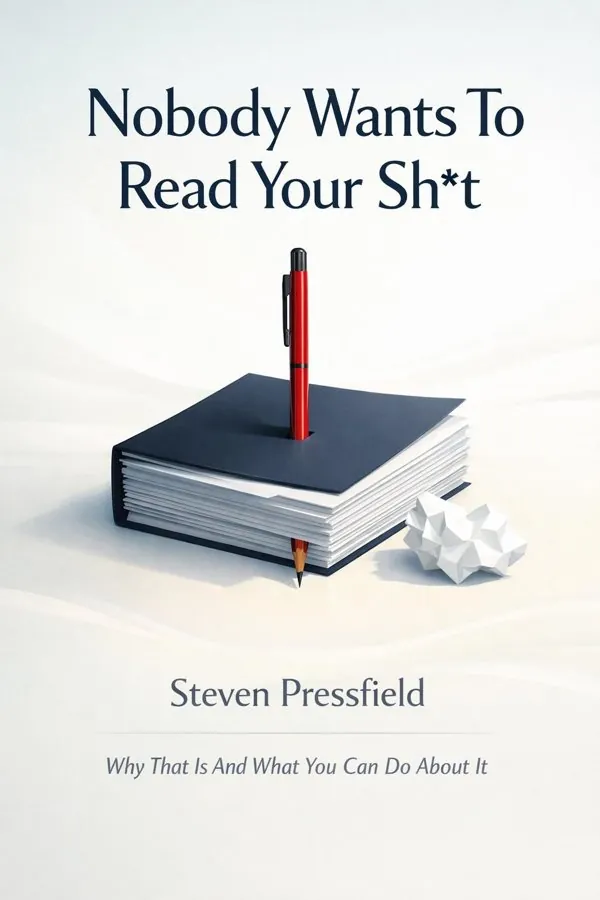
Nobody Wants To Read Your Sh*t: Why That Is And What You Can Do About It: Summary & Key Insights
 10 min11 chaptersAudio available
What Is Nobody Wants To Read Your Sh*t: Why That Is And What You Can Do About It About?
Nobody Wants To Read Your Sh*t: Why That Is And What You Can Do About It by Steven Pressfield is a writing book spanning 11 pages. In this candid and practical guide, Steven Pressfield explores the harsh truth that readers, viewers, and audiences are not inherently interested in anyone’s work — unless it serves them. Drawing from his experiences as a novelist, screenwriter, and creative professional, Pressfield distills lessons on storytelling, communication, and persuasion. He teaches creators how to craft work that captures attention, delivers value, and connects emotionally with its audience.
This FizzRead summary covers all 11 key chapters of Nobody Wants To Read Your Sh*t: Why That Is And What You Can Do About It in approximately 10 minutes, distilling the most important ideas, arguments, and takeaways from Steven Pressfield's work. Also available as an audio summary and Key Quotes Podcast.
Nobody Wants To Read Your Sh*t: Why That Is And What You Can Do About It
In this candid and practical guide, Steven Pressfield explores the harsh truth that readers, viewers, and audiences are not inherently interested in anyone’s work — unless it serves them. Drawing from his experiences as a novelist, screenwriter, and creative professional, Pressfield distills lessons on storytelling, communication, and persuasion. He teaches creators how to craft work that captures attention, delivers value, and connects emotionally with its audience.
Who Should Read Nobody Wants To Read Your Sh*t: Why That Is And What You Can Do About It?
This book is perfect for anyone interested in writing and looking to gain actionable insights in a short read. Whether you're a student, professional, or lifelong learner, the key ideas from Nobody Wants To Read Your Sh*t: Why That Is And What You Can Do About It by Steven Pressfield will help you think differently.
- ✓Readers who enjoy writing and want practical takeaways
- ✓Professionals looking to apply new ideas to their work and life
- ✓Anyone who wants the core insights of Nobody Wants To Read Your Sh*t: Why That Is And What You Can Do About It in just 10 minutes
Want the full summary?
Get instant access to this book summary and 100K+ more with Fizz Moment.
Get Free SummaryAvailable on App Store • Free to download
Key Chapters
My first true education as a writer came not from novels, but from writing thirty-second television commercials. You learn fast in advertising that nobody cares about your clever ideas. Clients want results. Consumers want to avoid boredom. Everyone’s finger is hovering over the button to skip. That pressure, rather than crushing creativity, forged clarity. I learned to strip away everything that didn’t matter.
When you write an ad, you confront the truth instantly: attention is rented, not given. Your message must earn every second it occupies in someone’s day. The same is true for storytelling. The audience doesn’t owe you their interest, so you learn to identify what’s in it for them. You speak in benefits, not features. In other words, you talk about what matters to them, not about yourself.
This discipline taught me an early version of an eternal rule: clarity is kindness. You don’t have time for indulgence. If an idea can’t be communicated in a sentence, it isn’t ready yet. Whether you’re selling toothpaste or telling a story about the fate of an empire, you start with empathy. You look through the audience’s eyes and ask, why should they care? Then you make sure your message answers that question before the first syllable ends.
That’s what advertising drilled into me. Every creative field is, at its core, a conversation with an impatient audience. The artist who forgets that loses not only attention but purpose.
When I moved into screenwriting, I thought I could finally leave the commercial world behind and write with freedom. But Hollywood, too, has its own ruthless filter for self-indulgence. In Hollywood, every story must grab, hold, and reward. Studio readers see hundreds of scripts each month. If your screenplay doesn’t hook on page one, it goes into the recycle bin by page two.
That sounds cruel, but it’s fair. Why? Because readers aren’t sadists—they’re simply overwhelmed. They crave to be transported. Your job as a writer is to construct that emotional elevator and take them up. I learned to think in terms of story architecture: setup, confrontation, resolution. The plot is the vehicle, but emotion is the engine. Conflict isn’t ornament; it’s what makes the ride real.
In screenwriting, I confronted the principle of payoff. You cannot tease the audience without delivering a release. You cannot build structure around moments that don’t construct cumulative emotional force. Every scene, every turn, must earn its place. That’s the professional way. All show, no substance, collapses under scrutiny. What the audience really buys is honesty through structure.
Working in film taught me that the goal is never to show off, but to connect. Every character, every line, must serve the larger emotional arc. The discipline I once resisted was the very thing that taught me freedom: you can say anything, as long as you’ve earned the trust to say it.
+ 9 more chapters — available in the FizzRead app
All Chapters in Nobody Wants To Read Your Sh*t: Why That Is And What You Can Do About It
About the Author
Steven Pressfield is an American author best known for his novels on ancient warfare such as 'Gates of Fire' and for his influential nonfiction works on creativity and resistance, including 'The War of Art'. Before becoming a full-time writer, he worked in advertising, film, and various other fields, experiences that inform his insights into the creative process.
Get This Summary in Your Preferred Format
Read or listen to the Nobody Wants To Read Your Sh*t: Why That Is And What You Can Do About It summary by Steven Pressfield anytime, anywhere. FizzRead offers multiple formats so you can learn on your terms — all free.
Available formats: App · Audio · PDF · EPUB — All included free with FizzRead
Download Nobody Wants To Read Your Sh*t: Why That Is And What You Can Do About It PDF and EPUB Summary
Key Quotes from Nobody Wants To Read Your Sh*t: Why That Is And What You Can Do About It
“My first true education as a writer came not from novels, but from writing thirty-second television commercials.”
“When I moved into screenwriting, I thought I could finally leave the commercial world behind and write with freedom.”
Frequently Asked Questions about Nobody Wants To Read Your Sh*t: Why That Is And What You Can Do About It
Nobody Wants To Read Your Sh*t: Why That Is And What You Can Do About It by Steven Pressfield is a writing book that explores key ideas across 11 chapters. In this candid and practical guide, Steven Pressfield explores the harsh truth that readers, viewers, and audiences are not inherently interested in anyone’s work — unless it serves them. Drawing from his experiences as a novelist, screenwriter, and creative professional, Pressfield distills lessons on storytelling, communication, and persuasion. He teaches creators how to craft work that captures attention, delivers value, and connects emotionally with its audience.
More by Steven Pressfield
You Might Also Like
The Art of Perspective
Christopher Castellani
10 min
Making a Point: The Persnickety Story of English Punctuation
David Crystal
10 min
The Elements Of Eloquence: How To Turn The Perfect English Phrase
Mark Forsyth
10 min
The Pocket Muse: Ideas and Inspirations for Writing
Monica Wood
10 min
A Little Book on Form: An Exploration into the Formal Imagination of Poetry
Robert Hass
10 min
Adventures In The Screen Trade: A Personal View Of Hollywood And Screenwriting
William Goldman
10 minBrowse by Category
Ready to read Nobody Wants To Read Your Sh*t: Why That Is And What You Can Do About It?
Get the full summary and 100K+ more books with Fizz Moment.