
The War of Art: Summary & Key Insights
 10 min9 chapters
Key Takeaways from The War of Art
The greatest obstacle to meaningful work is often not lack of skill, time, or opportunity, but an internal force that seems determined to keep us from doing what matters.
We are trained to read fear as a stop sign, but Pressfield suggests a more provocative interpretation: fear often marks the exact place where our growth lives.
One of Pressfield’s most enduring distinctions is the difference between the amateur mindset and the professional mindset.
Resistance is dangerous partly because it is intelligent.
Pressfield uses the phrase “turning pro” to describe a psychological shift more than a career status.
What Is The War of Art About?
The War of Art by Steven Pressfield is a self-help book published in 2016 spanning 10 pages. Most people think the hardest part of creative work is talent. Steven Pressfield argues otherwise: the real enemy is resistance, the invisible force that keeps us procrastinating, doubting ourselves, and abandoning the work that matters most. In The War of Art, Pressfield gives that inner sabotage a name and treats it like a serious adversary. The book is part manifesto, part field guide, and part wake-up call for anyone who wants to write, build, perform, launch, teach, or create with discipline. Its central claim is simple but powerful: the gap between the life we want and the life we live is often explained by our willingness to face resistance every day. Pressfield writes with unusual authority because he is not speaking as a detached theorist. He spent years struggling before becoming a successful novelist and screenwriter, and his advice carries the weight of lived experience. The result is a short but unusually memorable book that helps readers stop waiting for inspiration and start showing up like professionals, even when fear, distraction, and self-doubt try to win.
This FizzRead summary covers all 9 key chapters of The War of Art in approximately 10 minutes, distilling the most important ideas, arguments, and takeaways from Steven Pressfield's work.
The War of Art
Most people think the hardest part of creative work is talent. Steven Pressfield argues otherwise: the real enemy is resistance, the invisible force that keeps us procrastinating, doubting ourselves, and abandoning the work that matters most. In The War of Art, Pressfield gives that inner sabotage a name and treats it like a serious adversary. The book is part manifesto, part field guide, and part wake-up call for anyone who wants to write, build, perform, launch, teach, or create with discipline. Its central claim is simple but powerful: the gap between the life we want and the life we live is often explained by our willingness to face resistance every day. Pressfield writes with unusual authority because he is not speaking as a detached theorist. He spent years struggling before becoming a successful novelist and screenwriter, and his advice carries the weight of lived experience. The result is a short but unusually memorable book that helps readers stop waiting for inspiration and start showing up like professionals, even when fear, distraction, and self-doubt try to win.
Who Should Read The War of Art?
This book is perfect for anyone interested in self-help and looking to gain actionable insights in a short read. Whether you're a student, professional, or lifelong learner, the key ideas from The War of Art by Steven Pressfield will help you think differently.
- ✓Readers who enjoy self-help and want practical takeaways
- ✓Professionals looking to apply new ideas to their work and life
- ✓Anyone who wants the core insights of The War of Art in just 10 minutes
Want the full summary?
Get instant access to this book summary and 100K+ more with Fizz Moment.
Get Free SummaryAvailable on App Store • Free to download
Key Chapters
The greatest obstacle to meaningful work is often not lack of skill, time, or opportunity, but an internal force that seems determined to keep us from doing what matters. Pressfield calls this force Resistance. It appears whenever we try to pursue a calling, finish a creative project, improve our health, deepen a relationship, or step into a bigger version of ourselves. Resistance is what makes scrolling feel easier than writing, planning feel safer than starting, and perfectionism feel smarter than progress. It is subtle because it rarely announces itself directly. Instead, it disguises itself as fatigue, self-doubt, busyness, or the convenient idea that tomorrow will be a better day to begin.
What makes this concept so useful is that it externalizes a universal struggle. Once you recognize Resistance as a pattern rather than a personal defect, you stop assuming your avoidance means you are lazy or untalented. A novelist facing a blank page, an entrepreneur delaying a launch, and a student putting off an application may all be fighting the same battle. Resistance grows stronger the more important the work is. If a project terrifies you, that may be a clue that it matters deeply.
In practice, this means learning to identify your own recurring forms of avoidance. Notice when you suddenly become interested in cleaning your desk, answering low-value emails, or researching endlessly instead of acting. Those are not neutral habits; they are symptoms of Resistance at work.
Actionable takeaway: Make a list of the three activities you use most often to avoid your most important work, and treat them as warning signs that Resistance has entered the room.
We are trained to read fear as a stop sign, but Pressfield suggests a more provocative interpretation: fear often marks the exact place where our growth lives. The projects that matter most tend to awaken the strongest anxiety because they threaten the identity we have grown comfortable with. Writing the book, asking for funding, changing careers, sharing art publicly, or speaking honestly in a relationship all carry emotional risk. We fear judgment, failure, exposure, and even success. Yet that fear is frequently evidence that the work has meaning.
This idea matters because many people wait to feel ready before beginning. They assume confidence must come first. Pressfield reverses the order. Readiness is not a prerequisite; it is often the result of repeated action. The musician gains confidence by practicing and performing. The writer becomes less afraid by writing pages, not by imagining a future state of fearlessness. Fear does not disappear before the work begins. It often shrinks only after we have begun.
A practical example is the person who has talked for years about starting a podcast or a business but keeps polishing the concept instead of releasing anything. The intense discomfort may not mean the idea is wrong. It may mean the idea matters enough to expose them to real stakes. When viewed this way, fear becomes directional information.
Actionable takeaway: Ask yourself, “What task am I avoiding precisely because it matters?” Then do the smallest concrete version of that task today, such as outlining one page, sending one email, or publishing one imperfect draft.
One of Pressfield’s most enduring distinctions is the difference between the amateur mindset and the professional mindset. The amateur works when inspiration strikes, protects comfort, and often confuses intention with commitment. The professional shows up consistently, whether inspired or not. This is not about being joyless or mechanical. It is about understanding that serious work requires structure, repetition, and the ability to work through mood. Professionals do not ask every morning whether they feel like doing the work. They begin because beginning is part of the job.
This idea is liberating because it removes creativity from the realm of mystery and places it in the realm of practice. A writer who sits down at 7 a.m. each day for two hours has a far better chance of producing something meaningful than one who waits for a perfect emotional state. The same is true for fitness, sales, research, design, or any long-term pursuit. Discipline creates the conditions in which quality can emerge.
Professionalism also means accepting imperfection. A professional does not expect every session to be brilliant. Some days will produce clumsy drafts, weak ideas, or slow progress. That does not invalidate the process. Showing up repeatedly builds momentum, strengthens identity, and gradually lowers the emotional drama around work.
In everyday life, this could mean setting office hours for your creative project, keeping promises to yourself, and measuring success by consistency before results. A person who writes 500 words a day will eventually finish a manuscript. A person who only writes when inspired may spend years talking about one.
Actionable takeaway: Create a fixed daily or weekly appointment for your most important work and treat it as non-negotiable, just as you would a meeting with someone you respect.
Resistance is dangerous partly because it is intelligent. It rarely appears as obvious refusal. More often, it takes socially acceptable forms that look productive from the outside. Pressfield points to behaviors like excessive preparation, endless revision, compulsive busyness, and the constant search for new tools, courses, or systems. These can feel responsible, but they often allow us to stay near the work without actually doing it. The person who spends six months building a website before offering a service may be delaying exposure. The aspiring novelist who color-codes notes for years may be avoiding the vulnerable act of drafting scenes.
Perfectionism is one of the most seductive masks. It lets us frame avoidance as high standards. But in practice, perfectionism frequently means withholding work until it can no longer be criticized, which of course never happens. Another mask is victimhood: telling ourselves the conditions are not right, the market is unfair, or others had advantages we lack. Some obstacles are real, but Resistance exploits them by turning them into permanent excuses.
The solution is not self-punishment but honesty. Ask whether a given activity moves the work forward or merely relieves anxiety about the work. Research, planning, and organizing all have their place, but only when they lead to execution. A useful test is simple: can you point to something tangible created today?
Actionable takeaway: At the end of each work session, record one sentence answering this question: “What did I produce, submit, or complete?” If the answer is vague, you may be feeding Resistance instead of defeating it.
Pressfield uses the phrase “turning pro” to describe a psychological shift more than a career status. You do not turn pro when someone gives you a title, a contract, or public recognition. You turn pro when you decide that your calling deserves mature, sustained commitment. That means taking responsibility for your schedule, your standards, your craft, and your emotional weather. The amateur says, “I’ll do it when life calms down.” The professional says, “Life may never calm down, so I will build a way of working inside reality as it is.”
This mindset matters beyond the arts. A teacher turning pro might stop waiting for institutional approval and begin refining lesson plans with deliberate discipline. A founder turning pro might stop hiding in ideation and start making sales calls. A person turning pro in personal growth might stop consuming motivational content and begin doing the uncomfortable daily actions that change behavior.
Turning pro also means detaching identity from short-term outcomes. Professionals take losses, criticism, and dry spells seriously, but not personally. They do not interpret one bad day as evidence that they are frauds. Instead, they return the next day. This resilience is not natural talent; it is trained through repetition and perspective.
Many people think commitment should feel dramatic. In reality, it often looks ordinary: starting on time, protecting focus, learning from feedback, and continuing after disappointment. That quiet steadiness is what separates dreamers from finishers.
Actionable takeaway: Write a brief personal contract that states when, where, and how often you will do your important work for the next 30 days, and sign it as if you were entering a professional agreement.
We often assume self-doubt is the only enemy of achievement, but Pressfield warns that ego can be just as destructive. Ego makes the work about image rather than service, control rather than contribution, validation rather than truth. When ego dominates, we become overly concerned with how we appear, whether others approve, and whether the final result confirms a flattering identity. This creates paralysis. If your project must prove you are gifted, original, important, or superior, then every draft becomes terrifying. The stakes become impossibly personal.
A healthier orientation is to see yourself as a worker in service to the work itself. This does not mean suppressing ambition. It means loosening the grip of self-consciousness so the task can come first. The writer serves the story. The entrepreneur serves the customer. The coach serves the athlete’s progress. The artist serves the piece. In this frame, criticism becomes information instead of humiliation, and revision becomes part of craft instead of a threat to identity.
This idea can be deeply practical. Suppose you are afraid to post your ideas online because you worry they are not brilliant enough. Ego says, “If it is not exceptional, do not risk looking ordinary.” Service says, “If this helps or resonates with someone, share it.” One mindset narrows action; the other enables it.
Actionable takeaway: Before beginning your next session, answer one question in writing: “Who or what does this work serve besides my ego?” Let that answer guide the way you show up.
Many people romanticize creativity as a force that arrives unpredictably, but Pressfield argues that regular practice is what invites inspiration. The act of sitting down consistently, especially under self-imposed structure, signals seriousness. Over time, the mind learns the rhythm. What once felt impossible becomes more accessible because the body, attention, and imagination are being trained to cooperate. Routine does not suffocate creativity; it creates a container for it.
This helps explain why creative breakthroughs often happen in the middle of disciplined work rather than in moments of passive waiting. A painter enters the studio every morning and eventually stumbles into a new visual language. A scholar reads and writes at set times and begins to see patterns. A songwriter who works daily discovers that not every session produces magic, but enough do to make the habit invaluable. Routine increases the odds of encounter.
There is also a psychological benefit. When you have a ritual, less energy is spent deciding whether to begin. You remove negotiation. Your cue might be making coffee, clearing the desk, putting your phone in another room, or starting at the same time every day. These signals reduce friction and help transition from ordinary life into focused effort.
The point is not to create a perfect routine but a repeatable one. Even twenty-five protected minutes can become a powerful practice if honored consistently. Momentum grows from regularity more than intensity.
Actionable takeaway: Design a simple pre-work ritual with three steps, such as time, place, and cue, and repeat it for one week to train your mind to enter work mode with less resistance.
One reason The War of Art resonates so deeply is that it treats creative work as more than productivity. Pressfield suggests that many forms of meaningful work carry a larger purpose. Whether one interprets this spiritually, morally, or psychologically, the idea is powerful: our gifts are not meant to remain dormant. To ignore a genuine calling is not merely inefficient; it can feel like a betrayal of something essential within us. That sense of vocation gives discipline emotional depth. We are not just checking tasks off a list; we are participating in the fullest expression of our capacities.
This perspective is especially useful when motivation fades. Goals built only on applause, money, or external proof can collapse during hard stretches. But when the work feels connected to service, truth, beauty, contribution, or inner necessity, endurance becomes more possible. A therapist may persist because clients need healing. A writer may persist because certain stories need telling. A founder may persist because the problem being solved genuinely matters.
Of course, purpose can also create pressure if misunderstood. The point is not to become grandiose about your mission. It is to remember that important work often asks something serious of us. We rise to it by honoring the call in practical ways: scheduling, practicing, learning, and finishing.
Actionable takeaway: Write a short purpose statement for your project beginning with the words, “This work matters because…,” and place it somewhere visible for moments when motivation weakens.
Reflection is valuable, but Pressfield’s central prescription is action. Resistance thrives in abstraction, where possibilities remain untested and identity remains protected. It weakens when work becomes concrete. A page drafted, a proposal sent, a workout completed, a prototype built, a difficult conversation initiated: these acts puncture the fantasy world where fear dominates. Action creates evidence. It proves that movement is possible even before confidence arrives.
This is why overthinking can become a trap. We tell ourselves we need more clarity, the right strategy, or a better emotional state. But many forms of clarity emerge only after engagement. Writers discover their themes by drafting. Founders discover product-market fit by shipping and listening. Artists discover direction by making work, not by endlessly theorizing what their work should be. Action generates feedback, and feedback generates refinement.
A practical application is to shrink the task until motion becomes easier. Instead of “finish the chapter,” write for fifteen minutes. Instead of “launch the business,” call one potential customer. Instead of “reinvent my life,” apply for one opportunity. Small action is not trivial. It is often the bridge between intention and identity. Repeated often enough, it becomes a system for defeating paralysis.
The deeper lesson is that courage is behavioral before it is emotional. We do not feel brave and then act. Often, we act while still afraid, and the action itself begins to create bravery.
Actionable takeaway: Choose one project you have been postponing and define the next step so narrowly that it can be completed in under ten minutes, then do it before the day ends.
All Chapters in The War of Art
About the Author
Steven Pressfield is an American author of historical fiction, screenplays, and nonfiction focused on creativity, discipline, and professional development. He is best known in the self-help space for The War of Art, a modern classic about overcoming procrastination and self-sabotage, and in fiction for bestselling novels such as Gates of Fire and The Legend of Bagger Vance. Before finding literary success, Pressfield spent years working a range of jobs and struggling to establish himself as a writer, an experience that deeply shaped his thinking about perseverance and craft. His books are widely read by writers, artists, entrepreneurs, athletes, and business leaders because they combine blunt motivation with hard-earned practical insight. Pressfield’s work consistently emphasizes discipline, courage, and the daily battle required to fulfill one’s calling.
Get This Summary in Your Preferred Format
Read or listen to the The War of Art summary by Steven Pressfield anytime, anywhere. FizzRead offers multiple formats so you can learn on your terms — all free.
Available formats: App · Audio · PDF · EPUB — All included free with FizzRead
Download The War of Art PDF and EPUB Summary
Key Quotes from The War of Art
“The greatest obstacle to meaningful work is often not lack of skill, time, or opportunity, but an internal force that seems determined to keep us from doing what matters.”
“We are trained to read fear as a stop sign, but Pressfield suggests a more provocative interpretation: fear often marks the exact place where our growth lives.”
“One of Pressfield’s most enduring distinctions is the difference between the amateur mindset and the professional mindset.”
“Resistance is dangerous partly because it is intelligent.”
“Pressfield uses the phrase “turning pro” to describe a psychological shift more than a career status.”
Frequently Asked Questions about The War of Art
The War of Art by Steven Pressfield is a self-help book that explores key ideas across 9 chapters. Most people think the hardest part of creative work is talent. Steven Pressfield argues otherwise: the real enemy is resistance, the invisible force that keeps us procrastinating, doubting ourselves, and abandoning the work that matters most. In The War of Art, Pressfield gives that inner sabotage a name and treats it like a serious adversary. The book is part manifesto, part field guide, and part wake-up call for anyone who wants to write, build, perform, launch, teach, or create with discipline. Its central claim is simple but powerful: the gap between the life we want and the life we live is often explained by our willingness to face resistance every day. Pressfield writes with unusual authority because he is not speaking as a detached theorist. He spent years struggling before becoming a successful novelist and screenwriter, and his advice carries the weight of lived experience. The result is a short but unusually memorable book that helps readers stop waiting for inspiration and start showing up like professionals, even when fear, distraction, and self-doubt try to win.
More by Steven Pressfield
Do the Work
Steven Pressfield
10 min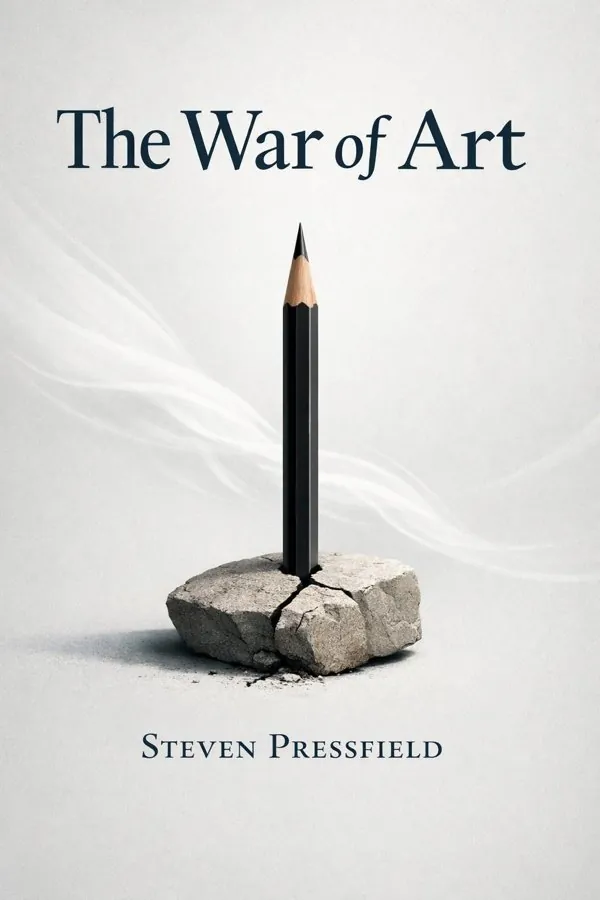
The War of Art: Break Through the Blocks and Win Your Inner Creative Battles
Steven Pressfield
10 min
Nobody Wants To Read Your Sh*t: Why That Is And What You Can Do About It
Steven Pressfield
10 min
Turning Pro: Tap Your Inner Power and Create Your Life's Work
Steven Pressfield
10 minYou Might Also Like
Browse by Category
Ready to read The War of Art?
Get the full summary and 100K+ more books with Fizz Moment.