
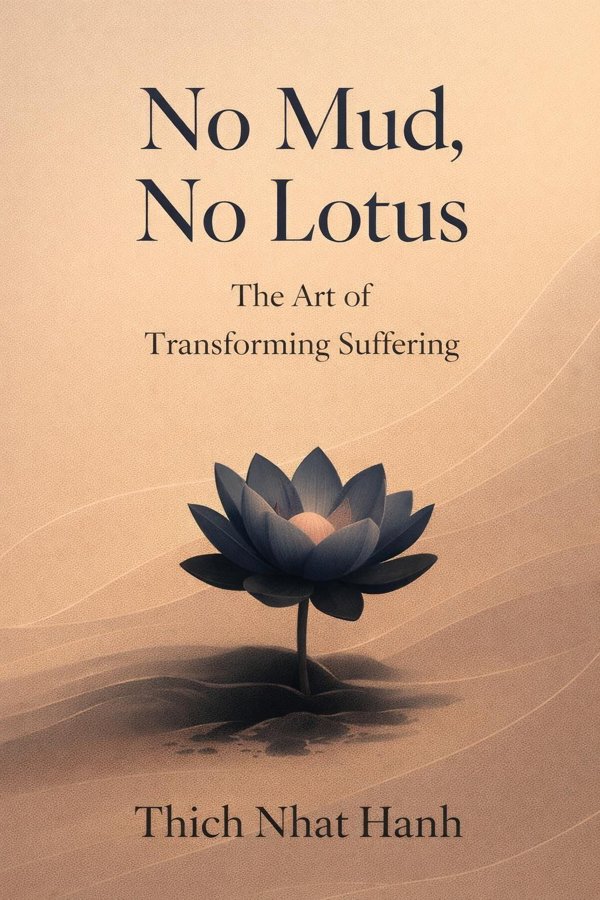
No Mud, No Lotus: The Art of Transforming Suffering: Summary & Key Insights
 10 min10 chaptersAudio available
Key Takeaways from No Mud, No Lotus: The Art of Transforming Suffering
One of the book’s most liberating insights is that suffering is not an abnormal mistake in human life; it is part of the human condition.
Happiness becomes more meaningful when we understand what gives rise to it.
What we refuse to feel often ends up controlling us.
Our wounds can isolate us, but they can also open us.
Healing often begins not with analysis, but with the body.
What Is No Mud, No Lotus: The Art of Transforming Suffering About?
No Mud, No Lotus: The Art of Transforming Suffering by Thich Nhat Hanh is a eastern_wisdom book spanning 11 pages. In No Mud, No Lotus, Thich Nhat Hanh offers a simple but radical teaching: suffering is not something to erase before life can become meaningful. It is part of the very ground from which peace, compassion, and joy can grow. Rather than treating pain as a personal failure or an interruption to happiness, he invites readers to meet it with mindfulness, tenderness, and understanding. The book shows that when we stop resisting our discomfort, we begin to transform our relationship to it. What makes this message so powerful is its practicality. Thich Nhat Hanh does not speak in abstractions alone; he offers concrete meditations, breathing practices, and daily reflections that help readers calm difficult emotions, listen more deeply, and reconnect with life in the present moment. His approach is gentle, accessible, and profoundly humane. As one of the world’s most respected Buddhist teachers and the founder of Plum Village, Thich Nhat Hanh brought decades of contemplative experience to this work. No Mud, No Lotus matters because it speaks to a universal truth: we do not need to wait for a pain-free life to begin living wisely and well.
This FizzRead summary covers all 10 key chapters of No Mud, No Lotus: The Art of Transforming Suffering in approximately 10 minutes, distilling the most important ideas, arguments, and takeaways from Thich Nhat Hanh's work. Also available as an audio summary and Key Quotes Podcast.
No Mud, No Lotus: The Art of Transforming Suffering
In No Mud, No Lotus, Thich Nhat Hanh offers a simple but radical teaching: suffering is not something to erase before life can become meaningful. It is part of the very ground from which peace, compassion, and joy can grow. Rather than treating pain as a personal failure or an interruption to happiness, he invites readers to meet it with mindfulness, tenderness, and understanding. The book shows that when we stop resisting our discomfort, we begin to transform our relationship to it.
What makes this message so powerful is its practicality. Thich Nhat Hanh does not speak in abstractions alone; he offers concrete meditations, breathing practices, and daily reflections that help readers calm difficult emotions, listen more deeply, and reconnect with life in the present moment. His approach is gentle, accessible, and profoundly humane.
As one of the world’s most respected Buddhist teachers and the founder of Plum Village, Thich Nhat Hanh brought decades of contemplative experience to this work. No Mud, No Lotus matters because it speaks to a universal truth: we do not need to wait for a pain-free life to begin living wisely and well.
Who Should Read No Mud, No Lotus: The Art of Transforming Suffering?
This book is perfect for anyone interested in eastern_wisdom and looking to gain actionable insights in a short read. Whether you're a student, professional, or lifelong learner, the key ideas from No Mud, No Lotus: The Art of Transforming Suffering by Thich Nhat Hanh will help you think differently.
- ✓Readers who enjoy eastern_wisdom and want practical takeaways
- ✓Professionals looking to apply new ideas to their work and life
- ✓Anyone who wants the core insights of No Mud, No Lotus: The Art of Transforming Suffering in just 10 minutes
Want the full summary?
Get instant access to this book summary and 100K+ more with Fizz Moment.
Get Free SummaryAvailable on App Store • Free to download
Key Chapters
One of the book’s most liberating insights is that suffering is not an abnormal mistake in human life; it is part of the human condition. Thich Nhat Hanh draws on the Buddhist idea of dukkha, often translated as suffering, unsatisfactoriness, or instability. This does not refer only to dramatic pain such as grief, illness, or loss. It also includes the subtle unease that comes from change, uncertainty, and the fact that nothing can be permanently held onto. We suffer when we expect life to stay fixed, when we cling to pleasure, or when we believe discomfort should not be happening.
This perspective changes the conversation. Instead of asking, “How do I eliminate suffering forever?” the wiser question becomes, “How do I relate to suffering skillfully?” In modern life, many people distract themselves from discomfort through work, entertainment, shopping, or constant digital stimulation. Yet avoidance often strengthens distress because what is ignored continues operating beneath the surface. Anxiety grows, anger hardens, and loneliness deepens.
Thich Nhat Hanh encourages us to begin by recognizing suffering without shame. A tense body, an irritated tone of voice, a restless mind, or emotional numbness can all be signals asking for attention. If you are upset after a conflict, for example, the first step is not to prove you are right. It is to pause and admit: suffering is here.
That recognition is already an act of wisdom. When we stop treating pain as an enemy, we create the conditions for healing. Actionable takeaway: the next time discomfort arises, name it gently—“This is suffering; this is stress; this is fear”—and let honest recognition replace denial.
Happiness becomes more meaningful when we understand what gives rise to it. Thich Nhat Hanh’s central metaphor is the lotus flower, a sacred Buddhist symbol that grows from mud. The lesson is clear: joy, insight, and compassion do not appear in spite of suffering alone, but often through our encounter with it. Without mud, there is no lotus. Without difficulty, we may never develop patience, humility, forgiveness, or depth.
This is not a romantic glorification of pain. The book does not suggest we should seek suffering or pretend it is pleasant. Instead, it teaches that when suffering is held with mindfulness, it can become fertile ground for transformation. A person who has known loneliness may become more sensitive to others who feel excluded. Someone who has faced failure may become less arrogant and more resilient. A family that endures hardship together may discover a deeper bond than comfort alone could create.
In everyday terms, think of exercise. The strain of training is not the final goal, but it contributes to strength. Similarly, emotional pain can become part of our awakening when we learn from it rather than collapsing beneath it. The crucial difference lies in how we respond. If we resist, numb, or resent suffering, the mud remains mud. If we attend to it with care, the lotus begins to grow.
This idea helps dissolve perfectionism. Many people believe they must fix themselves before they can be worthy of peace. Thich Nhat Hanh reverses that logic: our imperfections, wounds, and struggles can become the path itself. Actionable takeaway: reflect on one hardship that has taught you something valuable, and write down the “lotus” that may be emerging from that “mud.”
What we refuse to feel often ends up controlling us. Thich Nhat Hanh presents mindfulness as the essential tool for turning toward suffering without being overwhelmed by it. Mindfulness is the practice of being fully aware of what is happening in the present moment—within the body, in the emotions, and around us—without immediately judging, suppressing, or reacting. It is not passive observation. It is a form of loving attention.
When painful feelings arise, the usual impulse is to escape. We scroll, snack, lash out, or stay busy. But mindfulness interrupts that cycle. Through conscious breathing and calm awareness, we learn to notice sensations and emotions as they are. For example, instead of saying, “I am angry,” we may quietly recognize, “Anger is present.” This small shift creates space. The emotion is real, but it is not the whole of who we are.
Thich Nhat Hanh often compares mindfulness to a caring mother holding a crying baby. The crying does not need to be silenced immediately. It first needs to be held. Likewise, a difficult feeling such as fear or sadness can soften when it is met with patient awareness. A few mindful breaths during a stressful meeting, a quiet walk after upsetting news, or five minutes of sitting with your hand on your heart can keep pain from escalating into reactivity.
Mindfulness does not magically erase suffering, but it changes the quality of our relationship to it. We become less afraid of our own inner weather. Actionable takeaway: when a strong emotion appears, stop for three slow breaths and silently say, “Breathing in, I know this feeling is here. Breathing out, I hold it with care.”
Our wounds can isolate us, but they can also open us. One of Thich Nhat Hanh’s most important teachings is that when we truly understand our own suffering, we become more capable of understanding the suffering of others. This is the beginning of compassion. Compassion is not pity, and it is not sentimental kindness. It is the deep recognition that pain is shared, and that another person’s difficult behavior may arise from causes we do not yet see.
This matters especially in relationships. If someone speaks harshly, we usually respond with defensiveness or counterattack. But mindfulness reveals another possibility: perhaps that person is carrying fear, grief, frustration, or unmet needs. This does not mean we excuse harmful behavior or abandon boundaries. It means we respond from understanding rather than blind reaction. Compassion protects both wisdom and humanity.
Thich Nhat Hanh also reminds us that self-compassion is necessary. Many people are far harsher with themselves than they would ever be with a friend. They replay mistakes, resent their emotional struggles, or demand constant productivity. Yet healing requires the ability to say, “I am suffering, and I deserve care.” When we practice this inwardly, our compassion outwardly becomes more stable and less performative.
A practical example is conflict at home. Before continuing an argument, you might pause and ask yourself, “What hurt is alive in me right now? What hurt might be alive in the other person?” That question can change tone, timing, and outcome.
Compassion is not weakness; it is transformed understanding. Actionable takeaway: the next time someone upsets you, pause before reacting and ask, “What suffering might be behind this?” then respond more slowly and deliberately.
Healing often begins not with analysis, but with the body. Thich Nhat Hanh emphasizes practical methods for caring for suffering as it arises, and one of the most accessible is mindful breathing. Conscious breathing anchors attention, calms the nervous system, and gives us a stable place from which to meet difficult emotions. When pain feels abstract or overwhelming, returning to the breath brings us home.
The book encourages readers not to fight emotions such as anger, despair, jealousy, or fear. Instead, we can recognize them, embrace them, and soothe them. This is a disciplined practice. If anger arises, for instance, Thich Nhat Hanh does not advise suppressing it or expressing it recklessly. He recommends first stepping away from harmful speech or action, then breathing with awareness: “Breathing in, I know anger is here. Breathing out, I smile to my anger.” The smile is not denial; it is a gesture of nonviolence toward oneself.
Other supportive practices include walking meditation, resting in silence, mindful eating, or simply placing attention on physical sensations. A person spiraling into anxiety can pause, feel the feet on the ground, lengthen the exhale, and observe tension in the chest without feeding catastrophic thoughts. These simple acts restore dignity and choice.
The larger lesson is that emotions are energies to be cared for, not enemies to be conquered. When handled skillfully, they lose some of their power to dominate behavior. This can prevent regrettable emails, impulsive arguments, and self-destructive habits.
Actionable takeaway: create a short personal calming ritual for difficult moments—three deep breaths, relaxed shoulders, and one compassionate phrase you can repeat whenever strong emotion takes hold.
Many people assume acceptance means resignation, but Thich Nhat Hanh shows that true acceptance is the beginning of transformation. We cannot heal what we refuse to acknowledge. When we deny pain, minimize it, or insist that life should be different before we can be at peace, we add a second layer of suffering to the first. Resistance hardens the experience. Acceptance softens it enough for wisdom to enter.
Acceptance here means seeing clearly: this is what is happening now. It does not mean liking it, approving of it, or giving up. If you are grieving, acceptance means admitting your heart is broken rather than pretending you are fine. If you are burned out, it means recognizing your limits instead of pushing through until collapse. If a relationship is strained, it means honestly seeing the hurt that exists rather than hiding behind routine.
Understanding and acceptance go together. The more deeply we understand the causes and conditions behind suffering, the less trapped we feel by blame. Perhaps your anxiety is worsened by exhaustion, isolation, and constant stimulation. Perhaps your resentment comes from unspoken needs. Perhaps another person’s coldness reflects their own unresolved pain. Understanding does not remove responsibility, but it makes wise response possible.
This teaching is especially relevant in a culture obsessed with instant fixing. Not every wound can be solved quickly. Some forms of healing begin with sitting still enough to tell the truth about what is here. From that place, compassionate action becomes more realistic and sustainable.
Actionable takeaway: choose one ongoing difficulty in your life and write a one-sentence statement of honest acceptance beginning with, “Right now, the truth is...” Then ask, “What caring next step becomes possible from this truth?”
One of Thich Nhat Hanh’s most distinctive insights is the teaching of interbeing: nothing exists independently, and no one suffers alone. Our lives are shaped by countless relationships, conditions, inheritances, and environments. This means personal suffering is never purely personal. It is connected to family history, social systems, culture, community, and the emotional climate around us. Seeing this does not erase individual responsibility, but it relieves the illusion that we are isolated, self-contained beings.
This has two powerful effects. First, it reduces shame. If you struggle with fear, anger, or sadness, those feelings may be influenced by ancestral trauma, social pressure, or collective anxiety—not just private weakness. Second, it deepens responsibility. Because we inter-are, the way we speak, listen, consume, and respond affects others. Our peace contributes to collective peace; our unprocessed anger can spill outward.
In practical life, interbeing can be seen in the family. A parent’s stress affects a child. A child’s pain affects the whole household. In the workplace, one person’s calm presence can change the tone of a meeting, just as one person’s hostility can poison it. On a larger scale, social division, injustice, and violence are not separate from inner suffering; they both express and reinforce it.
The teaching also encourages gratitude. Even our healing is supported by others: teachers, friends, therapists, communities, and the natural world. We do not transform suffering alone.
When we realize our connectedness, compassion becomes less optional and more logical. Actionable takeaway: during a difficult moment, ask, “What conditions may be contributing to this suffering, in me and around me?” Let that wider view replace self-blame with awareness and wiser action.
If suffering is unavoidable, joy must be cultivated. Thich Nhat Hanh is careful not to let spiritual practice become heavy or grim. The purpose of facing suffering is not to become preoccupied with pain, but to become more available to life. Happiness, in his teaching, is often found in simple, present-moment experiences that we overlook when the mind is restless or future-focused: breathing, walking, drinking tea, hearing birds, feeling sunlight, or sharing a peaceful meal.
This may seem modest, but it is deeply radical in a culture that ties happiness to achievement, consumption, and comparison. Thich Nhat Hanh argues that many conditions for happiness are already available, yet we miss them because we are trapped in worries, regrets, and mental habits of dissatisfaction. Gratitude interrupts this pattern. It does not deny suffering; it balances it. We can acknowledge pain while also recognizing what nourishes us.
A person dealing with stress at work can still pause to appreciate a cool breeze, a supportive friend, or ten quiet minutes before bed. A family under strain can still create moments of connection through shared breathing or a phone-free dinner. Joy is not a reward after all problems are solved. It is a source of strength that helps us endure and transform them.
Thich Nhat Hanh also distinguishes wholesome joy from distraction. Mindless pleasure can numb pain temporarily, but mindful joy restores presence. The more often we touch peaceful moments, the more resilient we become when difficulty returns.
Actionable takeaway: begin or end each day by naming three real conditions of happiness already present in your life, however small, and let gratitude become part of your daily training.
Suffering becomes heavier when it is carried alone. Thich Nhat Hanh stresses that transformation is supported by sangha, or community—a circle of people committed to mindful living, compassionate presence, and mutual understanding. While solitary practice matters, human beings are relational. We need spaces where we can be seen without being judged, listened to without being fixed, and supported without being controlled.
Community healing begins with deep listening. In the book’s spirit, listening is not waiting for your turn to speak or searching for flaws in another person’s words. It is listening with the intention to relieve suffering. That means setting aside the urge to interrupt, defend, advise, or win. When people feel genuinely heard, their pain often softens on its own. This is true in friendships, families, workplaces, and partnerships.
Mindful communication is equally important. Before speaking, we can ask: Is what I’m about to say true? Is it necessary? Is it kind? This simple filter can prevent countless misunderstandings. If conflict arises, Thich Nhat Hanh’s teachings suggest slowing down, breathing first, and speaking from lived feeling rather than accusation. “I feel hurt and I want to understand” opens a conversation very differently from “You always do this.”
A practical application might be a weekly family check-in where each person speaks without interruption for a few minutes. In professional settings, it could mean beginning difficult discussions with a pause for breathing and clear intention. Over time, these habits create trust.
Community does not remove suffering, but it gives us strength, perspective, and belonging. Actionable takeaway: choose one relationship this week and practice deep listening for ten uninterrupted minutes, with the sole aim of understanding rather than responding.
We often lose our lives by living everywhere except where we are. Thich Nhat Hanh returns repeatedly to the present moment as the place where suffering can be understood and peace can be touched. The past may contain regret and the future may contain fear, but transformation happens only now. This is not a cliché in his teaching; it is a concrete instruction. If we are not present to our body, breath, and mind, we cannot recognize suffering clearly or respond wisely.
The present moment is also where life’s wonders are available. Even in difficult times, there may be moments of stability, beauty, or connection. When the mind is caught in mental narratives, we miss them. A cup of tea becomes just fuel. A conversation becomes background noise. A walk becomes transit between obligations. Mindfulness restores immediacy. It reminds us that life is not happening later, after conditions improve. It is unfolding now.
This principle is especially helpful for those trapped in chronic rumination. If you repeatedly replay an old hurt or rehearse a feared future, grounding in present experience can interrupt the cycle. Feel the breath. Notice sounds. Sense your posture. Attend to what is actually here rather than what the mind is producing. This does not solve every problem, but it reestablishes contact with reality, and that contact is stabilizing.
To live fully in the present also means not postponing kindness, rest, appreciation, or reconciliation. The moment to practice peace is the moment you realize peace is absent.
Actionable takeaway: pick one ordinary activity today—walking, washing dishes, drinking water—and do it with full attention, using it as training in returning to the present moment.
All Chapters in No Mud, No Lotus: The Art of Transforming Suffering
About the Author
Thich Nhat Hanh (1926–2022) was a Vietnamese Zen Buddhist monk, teacher, poet, and peace activist whose work helped introduce mindfulness to millions around the world. Ordained as a monk in Vietnam, he became a leading voice for engaged Buddhism, a path that applies meditation and compassion to personal and social suffering. During the Vietnam War, he advocated for peace and humanitarian action, which led to decades of exile from his homeland. He later founded Plum Village in France, which became one of the world’s best-known mindfulness practice communities. Over the course of his life, he wrote more than 100 books on meditation, ethics, relationships, and healing. Revered for his gentle clarity and practical wisdom, Thich Nhat Hanh remains one of the most influential spiritual teachers of the modern era.
Get This Summary in Your Preferred Format
Read or listen to the No Mud, No Lotus: The Art of Transforming Suffering summary by Thich Nhat Hanh anytime, anywhere. FizzRead offers multiple formats so you can learn on your terms — all free.
Available formats: App · Audio · PDF · EPUB — All included free with FizzRead
Download No Mud, No Lotus: The Art of Transforming Suffering PDF and EPUB Summary
Key Quotes from No Mud, No Lotus: The Art of Transforming Suffering
“One of the book’s most liberating insights is that suffering is not an abnormal mistake in human life; it is part of the human condition.”
“Happiness becomes more meaningful when we understand what gives rise to it.”
“What we refuse to feel often ends up controlling us.”
“Our wounds can isolate us, but they can also open us.”
“Healing often begins not with analysis, but with the body.”
Frequently Asked Questions about No Mud, No Lotus: The Art of Transforming Suffering
No Mud, No Lotus: The Art of Transforming Suffering by Thich Nhat Hanh is a eastern_wisdom book that explores key ideas across 10 chapters. In No Mud, No Lotus, Thich Nhat Hanh offers a simple but radical teaching: suffering is not something to erase before life can become meaningful. It is part of the very ground from which peace, compassion, and joy can grow. Rather than treating pain as a personal failure or an interruption to happiness, he invites readers to meet it with mindfulness, tenderness, and understanding. The book shows that when we stop resisting our discomfort, we begin to transform our relationship to it. What makes this message so powerful is its practicality. Thich Nhat Hanh does not speak in abstractions alone; he offers concrete meditations, breathing practices, and daily reflections that help readers calm difficult emotions, listen more deeply, and reconnect with life in the present moment. His approach is gentle, accessible, and profoundly humane. As one of the world’s most respected Buddhist teachers and the founder of Plum Village, Thich Nhat Hanh brought decades of contemplative experience to this work. No Mud, No Lotus matters because it speaks to a universal truth: we do not need to wait for a pain-free life to begin living wisely and well.
More by Thich Nhat Hanh
The Miracle of Mindfulness: An Introduction to the Practice of Meditation
Thich Nhat Hanh
10 min
The Heart of Understanding: Commentaries on the Prajñāpāramitā Heart Sutra
Thich Nhat Hanh
10 min
Anger: Wisdom for Cooling the Flames
Thich Nhat Hanh
10 min
Savor: Mindful Eating, Mindful Life
Thich Nhat Hanh, Lilian Cheung
10 minYou Might Also Like
A New Earth
Eckhart Tolle
10 min
The Daily Stoic
Ryan Holiday, Stephen Hanselman
10 min
Buddhism: Plain and Simple
Steve Hagen
10 min
Enchiridion
Epictetus
10 min
The Book of Tea
Kakuzō Okakura
10 min
The Light We Give: How Sikh Wisdom Can Transform Your Life
Simran Jeet Singh
10 minBrowse by Category
Ready to read No Mud, No Lotus: The Art of Transforming Suffering?
Get the full summary and 100K+ more books with Fizz Moment.