
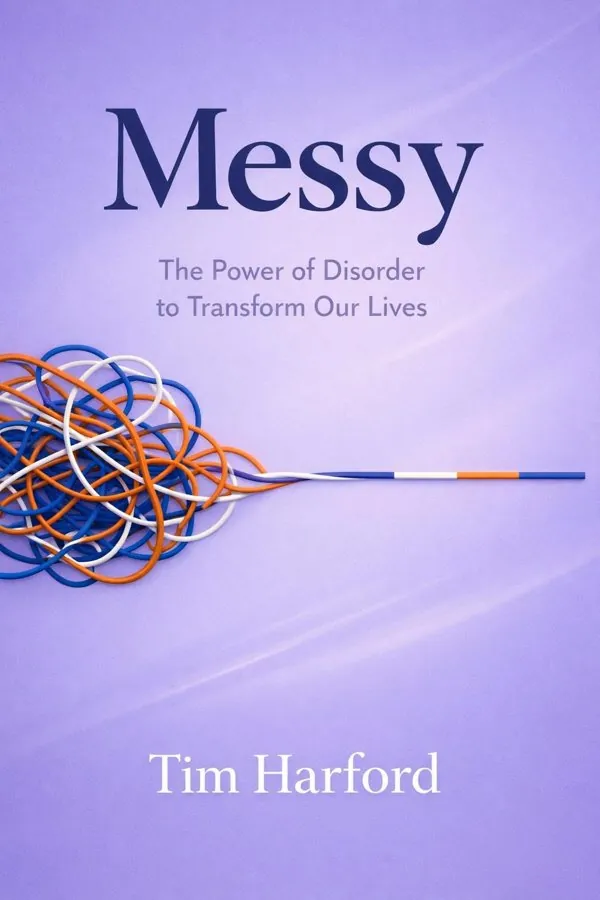
Messy: The Power of Disorder to Transform Our Lives: Summary & Key Insights
by Tim Harford
 10 min10 chaptersAudio available
What Is Messy: The Power of Disorder to Transform Our Lives About?
Messy: The Power of Disorder to Transform Our Lives by Tim Harford is a creativity book spanning 10 pages. Messy: The Power of Disorder to Transform Our Lives explores how embracing disorder, improvisation, and unpredictability can enhance creativity, resilience, and success. Economist and journalist Tim Harford argues that tidiness and rigid structure often stifle innovation, while messiness fosters adaptability and problem-solving in work, art, and personal life.
This FizzRead summary covers all 10 key chapters of Messy: The Power of Disorder to Transform Our Lives in approximately 10 minutes, distilling the most important ideas, arguments, and takeaways from Tim Harford's work. Also available as an audio summary and Key Quotes Podcast.
Messy: The Power of Disorder to Transform Our Lives
Messy: The Power of Disorder to Transform Our Lives explores how embracing disorder, improvisation, and unpredictability can enhance creativity, resilience, and success. Economist and journalist Tim Harford argues that tidiness and rigid structure often stifle innovation, while messiness fosters adaptability and problem-solving in work, art, and personal life.
Who Should Read Messy: The Power of Disorder to Transform Our Lives?
This book is perfect for anyone interested in creativity and looking to gain actionable insights in a short read. Whether you're a student, professional, or lifelong learner, the key ideas from Messy: The Power of Disorder to Transform Our Lives by Tim Harford will help you think differently.
- ✓Readers who enjoy creativity and want practical takeaways
- ✓Professionals looking to apply new ideas to their work and life
- ✓Anyone who wants the core insights of Messy: The Power of Disorder to Transform Our Lives in just 10 minutes
Want the full summary?
Get instant access to this book summary and 100K+ more with Fizz Moment.
Get Free SummaryAvailable on App Store • Free to download
Key Chapters
When we picture creativity, it’s tempting to imagine the genius working in serene isolation, everything in its place. Yet, in reality, creativity feeds off disorder. Jazz offers our first lesson here. The essence of jazz lies in improvisation—a conversation between musicians that thrives on unpredictability. When Keith Jarrett performed one of his legendary concerts on a poorly tuned piano, that very imperfection forced him to experiment differently, producing sounds that became transcendent. That is the paradox of mess: constraints and chaos do not crush originality; they often ignite it.
The same holds true for writers and artists. When Brian Eno and David Bowie collaborated on the *Berlin Trilogy*, Eno introduced deliberate disruptions—random lyric assignments, misfiring synthesizers—to break habitual thinking patterns. The creativity didn’t come from control; it emerged because of interruptions. By introducing disorder, Eno forced novelty into the process. We tend to forget that creativity is not the result of clear plans alone but arises from engaging with complications we did not foresee.
What’s really happening here is the mind’s dance with uncertainty. In structured environments, we rely on routines that hide our blind spots. But when disorder intrudes—when we are forced to adapt—the brain becomes more active, searching new pathways. It’s uncomfortable, yes, but it’s also the crucible in which originality forms.
Disorder pushes you to be present, forcing genuine problem-solving instead of automated responses. The cluttered studio, the half-finished ideas, the chaotic notes—all invite connections that a clean workspace might never spark. The messy artist isn’t lazy; they are living in a fertile ecosystem of cognitive infection, where ideas bump into one another until something unexpected takes root. That’s the creative power of mess.
The corporate world prizes systems. Consistency, efficiency, best practices—words that sound reassuring but can quietly suffocate innovation. In reality, the most effective teams often thrive on a bit of chaos. Consider the story of Building 20 at MIT, a makeshift structure assembled during World War II. It was messy, temporary, and wildly disorganized. Yet within its walls, some of the century’s most visionary breakthroughs emerged—radar, linguistics, even the foundations of the modern audio speaker. Why? Because the environment was fluid. People from different disciplines collided—physicists next to architects next to psychologists—and those collisions produced intellectual crossfire.
Strict order isolates. When everyone works in their tidy cubicles, with strictly defined processes, creativity is boxed in. A messy environment, by contrast, facilitates serendipity. When management loosens its grip, people start experimenting, sharing half-formed ideas, stumbling upon collaborative sparks. The result is not chaos—but emergence.
Even organizations that seem controlled thrive on invisible disorder. Google’s famous “20 percent time” or Amazon’s allowance for small, independent teams create structured disorder—spaces for mess and autonomy within larger systems. Successful companies recognize that stable efficiency must coexist with productive turbulence.
Of course, mess has to be managed. We need enough disorder to stimulate creativity but not so much that it paralyzes. The key insight is that leadership must trust flexibility, not micromanage it. This balance allows workplaces to evolve with the world rather than freeze in administrative amber. Embrace some clutter; let noise fertilize your next breakthrough.
+ 8 more chapters — available in the FizzRead app
All Chapters in Messy: The Power of Disorder to Transform Our Lives
About the Author
Tim Harford is a British economist, journalist, and broadcaster known for his work on behavioral economics and the hidden forces shaping everyday life. He writes the 'Undercover Economist' column for the Financial Times and has authored several bestselling books, including 'The Undercover Economist' and 'Adapt'.
Get This Summary in Your Preferred Format
Read or listen to the Messy: The Power of Disorder to Transform Our Lives summary by Tim Harford anytime, anywhere. FizzRead offers multiple formats so you can learn on your terms — all free.
Available formats: App · Audio · PDF · EPUB — All included free with FizzRead
Download Messy: The Power of Disorder to Transform Our Lives PDF and EPUB Summary
Key Quotes from Messy: The Power of Disorder to Transform Our Lives
“When we picture creativity, it’s tempting to imagine the genius working in serene isolation, everything in its place.”
“Consistency, efficiency, best practices—words that sound reassuring but can quietly suffocate innovation.”
Frequently Asked Questions about Messy: The Power of Disorder to Transform Our Lives
Messy: The Power of Disorder to Transform Our Lives by Tim Harford is a creativity book that explores key ideas across 10 chapters. Messy: The Power of Disorder to Transform Our Lives explores how embracing disorder, improvisation, and unpredictability can enhance creativity, resilience, and success. Economist and journalist Tim Harford argues that tidiness and rigid structure often stifle innovation, while messiness fosters adaptability and problem-solving in work, art, and personal life.
More by Tim Harford
Adapt: Why Success Always Starts With Failure
Tim Harford
10 min
The Data Detective: Ten Easy Rules to Make Sense of Statistics
Tim Harford
10 min
The Logic of Life: The Rational Economics of an Irrational World
Tim Harford
10 min
The Undercover Economist: Exposing Why the Rich Are Rich, the Poor Are Poor—and Why You Can Never Buy a Decent Used Car!
Tim Harford
10 minYou Might Also Like
Dimensions Of Creativity
Margaret A. Boden
10 min
How to Fly a Horse: The Secret History of Creation, Invention, and Discovery
Kevin Ashton
10 min
Imagine: How Creativity Works
Jonah Lehrer
10 min
The Accidental Creative: How to Be Brilliant at a Moment's Notice
Todd Henry
10 min
The Origins of Creativity
Edward O. Wilson
10 min
Wired to Create: Unraveling the Mysteries of the Creative Mind
Scott Barry Kaufman, Carolyn Gregoire
10 minBrowse by Category
Ready to read Messy: The Power of Disorder to Transform Our Lives?
Get the full summary and 100K+ more books with Fizz Moment.