
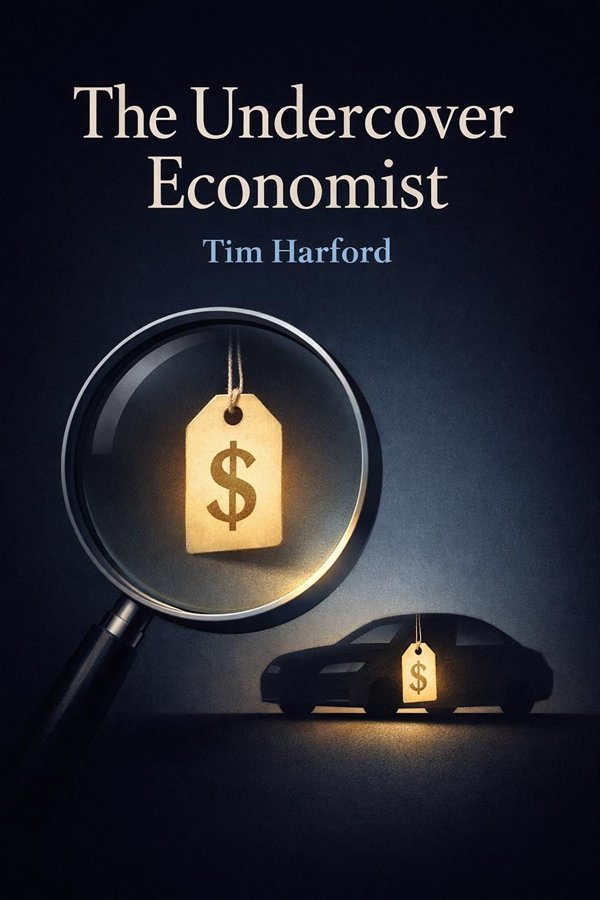
The Undercover Economist: Exposing Why the Rich Are Rich, the Poor Are Poor—and Why You Can Never Buy a Decent Used Car!: Summary & Key Insights
by Tim Harford
 10 min10 chaptersAudio available
Key Takeaways from The Undercover Economist: Exposing Why the Rich Are Rich, the Poor Are Poor—and Why You Can Never Buy a Decent Used Car!
A cup of coffee can reveal more about economics than a university lecture.
Markets do not break down only because people are selfish; they often break down because people know different things.
The same product rarely has just one true price.
A functioning market depends not just on supply and demand, but on believable signals.
Some of the most important economic effects never show up on a receipt.
What Is The Undercover Economist: Exposing Why the Rich Are Rich, the Poor Are Poor—and Why You Can Never Buy a Decent Used Car! About?
The Undercover Economist: Exposing Why the Rich Are Rich, the Poor Are Poor—and Why You Can Never Buy a Decent Used Car! by Tim Harford is a economics book spanning 9 pages. What if economics is not really about money, stock markets, or complicated equations, but about the hidden rules shaping almost everything you do? In The Undercover Economist, Tim Harford shows that ordinary life is full of economic puzzles: why coffee in one location costs far more than the same cup elsewhere, why supermarkets are designed the way they are, why traffic gets worse, why poor countries stay poor, and why buying a used car feels like stepping into a trap. Harford’s gift is his ability to make these questions feel vivid, practical, and surprisingly personal. Rather than teaching economics through jargon, he teaches it through observation. He reveals how scarcity, incentives, information gaps, and market power quietly influence prices, choices, and social outcomes. The book matters because it gives readers a sharper way to interpret the world around them. It explains not only how markets succeed, but also how they fail—and what that means for fairness, policy, and everyday decision-making. As a Financial Times columnist and one of the most respected popular economists of his generation, Harford brings both authority and clarity, making this an ideal introduction to economic thinking for curious readers.
This FizzRead summary covers all 10 key chapters of The Undercover Economist: Exposing Why the Rich Are Rich, the Poor Are Poor—and Why You Can Never Buy a Decent Used Car! in approximately 10 minutes, distilling the most important ideas, arguments, and takeaways from Tim Harford's work. Also available as an audio summary and Key Quotes Podcast.
The Undercover Economist: Exposing Why the Rich Are Rich, the Poor Are Poor—and Why You Can Never Buy a Decent Used Car!
What if economics is not really about money, stock markets, or complicated equations, but about the hidden rules shaping almost everything you do? In The Undercover Economist, Tim Harford shows that ordinary life is full of economic puzzles: why coffee in one location costs far more than the same cup elsewhere, why supermarkets are designed the way they are, why traffic gets worse, why poor countries stay poor, and why buying a used car feels like stepping into a trap. Harford’s gift is his ability to make these questions feel vivid, practical, and surprisingly personal.
Rather than teaching economics through jargon, he teaches it through observation. He reveals how scarcity, incentives, information gaps, and market power quietly influence prices, choices, and social outcomes. The book matters because it gives readers a sharper way to interpret the world around them. It explains not only how markets succeed, but also how they fail—and what that means for fairness, policy, and everyday decision-making. As a Financial Times columnist and one of the most respected popular economists of his generation, Harford brings both authority and clarity, making this an ideal introduction to economic thinking for curious readers.
Who Should Read The Undercover Economist: Exposing Why the Rich Are Rich, the Poor Are Poor—and Why You Can Never Buy a Decent Used Car!?
This book is perfect for anyone interested in economics and looking to gain actionable insights in a short read. Whether you're a student, professional, or lifelong learner, the key ideas from The Undercover Economist: Exposing Why the Rich Are Rich, the Poor Are Poor—and Why You Can Never Buy a Decent Used Car! by Tim Harford will help you think differently.
- ✓Readers who enjoy economics and want practical takeaways
- ✓Professionals looking to apply new ideas to their work and life
- ✓Anyone who wants the core insights of The Undercover Economist: Exposing Why the Rich Are Rich, the Poor Are Poor—and Why You Can Never Buy a Decent Used Car! in just 10 minutes
Want the full summary?
Get instant access to this book summary and 100K+ more with Fizz Moment.
Get Free SummaryAvailable on App Store • Free to download
Key Chapters
A cup of coffee can reveal more about economics than a university lecture. Harford begins with a simple but powerful observation: businesses do not charge prices based only on costs. They charge based on what scarce advantages they control. A coffee shop near a busy train station can charge much more than an identical shop on a quiet side street, not because the beans are better, but because the location is valuable and customers have fewer alternatives. That extra earning power is what economists call rent.
Scarcity appears everywhere. Prime real estate, access to customers, prestigious qualifications, and even time can generate rents. The key insight is that value often comes less from effort alone than from controlling something limited that others want. This helps explain why some people, firms, and neighborhoods earn outsized rewards while others struggle even when they work just as hard.
Harford also shows that competition affects how much rent can be captured. If too many cafés cluster around the station, prices fall. If only one dominates the location, it gains leverage. The same logic applies to housing markets, job markets, and elite universities. Scarcity is not just a background condition; it shapes bargaining power.
For readers, this changes how we interpret prices. A high price is not always a sign of high quality. Often it is a signal that someone controls access to something scarce. Actionable takeaway: when evaluating a price, ask not only “What does this cost to produce?” but “What scarce advantage is the seller monetizing?” That question will help you negotiate better, choose smarter, and spot where real power lies.
Markets do not break down only because people are selfish; they often break down because people know different things. Harford uses the used-car market to illustrate one of economics’ most famous problems: asymmetric information. Sellers usually know whether a car is reliable or a lemon, while buyers can only guess. Because buyers fear being cheated, they become unwilling to pay top prices. That drives honest sellers out of the market, leaving more bad cars behind and making distrust even worse.
This problem extends far beyond cars. Employers know less about job candidates than candidates know about themselves. Insurance companies know less about your health risks than you do. Landlords know more about a property than tenants. Online marketplaces constantly wrestle with this issue, which is why reviews, warranties, inspections, return policies, and brand reputations matter so much. They are not just conveniences; they are tools for restoring confidence when knowledge is uneven.
Harford’s deeper point is that trust has an economic structure. Good markets depend on mechanisms that reduce hidden information. A certified mechanic’s inspection, a professional license, or a money-back guarantee can all increase trade by narrowing the information gap. Without such signals, perfectly willing buyers and sellers may fail to make beneficial deals.
This idea also explains why some markets feel frustrating or unfair. When one side has better information, caution replaces confidence, and overall value shrinks. Actionable takeaway: before making any important purchase or agreement, identify what the other side probably knows that you do not—and find a credible signal, expert review, or contractual safeguard that helps close that gap.
The same product rarely has just one true price. Harford shows that businesses often try to charge different customers different amounts, not out of randomness, but because each customer’s willingness to pay is different. Airlines are the classic example: one passenger pays a premium to travel at a convenient time on short notice, while another gets a bargain by booking early and accepting restrictions. The seat may be almost identical, yet the prices diverge dramatically.
This practice, known as price discrimination, is central to modern commerce. Student discounts, coupons, premium versions, loyalty programs, software subscriptions, and movie ticket pricing all reflect attempts to sort customers by how much they value convenience, flexibility, status, or urgency. Companies are constantly searching for ways to capture more of what economists call consumer surplus—the gap between what you would have been willing to pay and what you actually pay.
Harford does not present this simply as exploitation. Price discrimination can sometimes expand access. A museum that charges tourists more and locals less may stay financially viable while still serving the community. Cheap standby tickets, off-peak pricing, and budget service tiers can make goods available to people who otherwise could not afford them. Still, it can also feel unfair, especially when firms use data to become more precise in targeting customers.
The practical lesson is that pricing is often strategic, not fixed. Sellers want to learn what kind of buyer you are. Actionable takeaway: never assume the posted price is the only possible price. Look for timing advantages, discounts, alternate packages, or lower-service versions. If you can make yourself appear more price-sensitive and flexible, you may avoid paying the premium reserved for customers in a hurry.
A functioning market depends not just on supply and demand, but on believable signals. Harford explains that many institutions we take for granted—brands, degrees, guarantees, uniforms, labels, and even expensive storefronts—exist partly to send messages. They tell buyers, employers, or clients that a seller or worker is credible, competent, or committed. In uncertain environments, these signals reduce hesitation and make exchange possible.
But not all signals are equally useful. A signal only works if it is difficult for low-quality participants to fake. A warranty matters because a poor manufacturer is less likely to afford repeated repairs. A respected university degree has signaling value because gaining admission and completing the coursework requires effort and ability. Reputation systems on online platforms matter because repeated public feedback makes dishonesty costly.
This helps explain why appearances can be economically rational. A bank branch in a prime location or a law firm with polished offices may partly be buying trust. The expense itself becomes a signal that the business expects to be around long enough to justify the investment. Of course, signals can also mislead. Stylish branding and confident language can mimic credibility without substance, which is why good markets combine signaling with verification.
For individuals, signaling also affects careers. Your résumé, punctuality, communication style, and body of work all transmit information before anyone knows you well. Actionable takeaway: whether you are buying, hiring, or presenting yourself, focus on signals that are costly to fake and easy to verify. Trust evidence with real stakes behind it, and build your own credibility through consistent, observable proof rather than empty claims.
Some of the most important economic effects never show up on a receipt. Harford explores externalities, which occur when a decision affects people who are not directly part of the transaction. When a factory pollutes a river, nearby residents bear costs that the factory may not pay. When someone gets vaccinated, others benefit from reduced disease spread. In both cases, private choices create wider social consequences.
Markets are powerful, but they are not magical. Prices work well only when they reflect the true costs and benefits of actions. If drivers can crowd roads without paying for the congestion they cause, cities get traffic jams. If landlords neglect insulation while tenants pay the heating bill, energy is wasted. If companies emit pollution for free, products can seem cheaper than they really are because part of the bill has been shifted onto the public.
Harford’s contribution is to make this concept concrete rather than abstract. He shows that many policy debates are really arguments about invisible spillovers. Congestion charges, pollution taxes, smoking restrictions, and property rules are all attempts to align private incentives with social outcomes. Externalities explain why some problems persist even when individuals are behaving rationally from their own narrow perspective.
For everyday life, this idea encourages broader thinking. Your choices often affect neighbors, coworkers, and strangers in ways that prices may not capture. Actionable takeaway: when making decisions—as a consumer, manager, voter, or citizen—ask, “Who else is affected, and are those costs or benefits included in the price?” That question helps you recognize when market outcomes need adjustment rather than blind trust.
People do not always do what is moral, wise, or expected; they often do what the system rewards. One of Harford’s most useful lessons is that incentives quietly steer behavior in nearly every environment. Teachers respond to testing systems, executives respond to bonus structures, politicians respond to electoral pressures, and consumers respond to taxes, fees, and convenience. If you want to understand outcomes, do not just look at what people say they value—look at what they are paid, punished, or praised for.
This perspective explains why well-meaning policies can backfire. A target designed to improve performance can lead people to game the metric instead of improving the underlying reality. Sales teams may push the wrong products if commissions are skewed. Hospitals may prioritize measurable outcomes over unmeasured care. Employees may avoid helpful risks if penalties for failure are too severe. In each case, the behavior is not irrational; it is adaptive.
Harford is especially strong at showing how incentives operate through institutions. Rules matter because they create rewards and constraints. That is why economics often feels less sentimental than other ways of thinking: it assumes behavior responds to structure. Yet this is not cynical. It is practical. If incentives are well designed, they can channel self-interest into productive results.
This lesson is useful in parenting, management, policy, and personal productivity. The question is not simply whether people know what is right, but whether the surrounding system makes the right action attractive and sustainable. Actionable takeaway: whenever behavior frustrates you, stop blaming personality first. Map the incentives. Then redesign the environment so the desired behavior becomes the easiest or most rewarding option.
Prosperity often grows not from self-sufficiency, but from dependence organized through trade. Harford explains that individuals and countries become richer when they specialize in what they do relatively well and exchange with others for the rest. This is the logic of comparative advantage, one of economics’ most elegant ideas. Even if one country is better at producing everything, trade can still benefit both sides because what matters is relative efficiency, not absolute superiority.
This principle helps explain globalization. Coffee beans, microchips, clothing, software, and machinery are produced through global networks because specialization increases productivity. Trade allows workers, firms, and nations to focus effort where it is most valuable. Consumers gain through lower prices and greater variety, while producers gain access to larger markets.
Harford does not ignore the tensions. Trade creates winners and losers, and adjustment can be painful. Industries decline, jobs move, and communities can be disrupted. But the answer is not to pretend trade has no value. The better response is to recognize both realities at once: trade expands wealth overall, yet its gains are not automatically shared fairly.
On a personal level, the same principle applies to time and effort. You gain by specializing in your strengths and relying on others for complementary skills. Trying to do everything yourself often wastes energy.
Actionable takeaway: when evaluating trade, outsourcing, or collaboration, ask where comparative advantage lies. Focus on what you do best relative to alternatives, and exchange for the rest. Wealth grows when effort is allocated intelligently rather than spread thinly across every possible task.
Poor countries are not poor simply because their people lack talent or effort. Harford argues that persistent poverty usually reflects deeper structural problems: weak institutions, insecure property rights, corruption, missing infrastructure, limited access to markets, and systems that fail to reward productive activity. In such environments, entrepreneurship becomes risky, investment becomes scarce, and long-term planning gives way to short-term survival.
This insight matters because it challenges simplistic explanations. Sending aid or copying policies from rich countries is rarely enough if the institutional foundations are fragile. A farmer will not invest in better equipment if land rights are uncertain. A business will struggle to grow if bribes are unavoidable, roads are unreliable, or courts cannot enforce contracts. Schools and hospitals matter, but they operate inside broader systems that determine whether effort turns into progress.
Harford’s treatment of development economics is valuable because it combines empathy with realism. He resists romantic stories and easy fixes. Economic development is difficult because many constraints interact at once, and reforms can fail when they ignore local incentives and institutions. What seems irrational from outside may be adaptive inside a broken system.
This has lessons beyond international development. Even within organizations or neighborhoods, people flourish when rules are stable, rewards are predictable, and investments are protected. Prosperity requires trust in the future.
Actionable takeaway: when thinking about poverty—globally or locally—look past individual choices alone. Ask what institutions support or undermine productive behavior. Lasting improvement usually comes not from one dramatic intervention, but from building reliable systems that make effort, saving, exchange, and innovation worthwhile.
Free markets are powerful tools, but they are not self-justifying answers to every problem. Harford argues that government has an essential role whenever markets fail to produce efficient or fair outcomes. This includes dealing with externalities, preventing monopolies, protecting property rights, enforcing contracts, and providing public goods such as roads, policing, and basic legal systems. Without these foundations, markets can become chaotic, exploitative, or inaccessible.
The point is not that government is always wise. Harford is alert to bureaucracy, political incentives, and unintended consequences. Poorly designed regulation can stifle innovation or protect insiders. Yet the opposite extreme—assuming markets can fix everything on their own—is equally naive. Many of the conditions that allow markets to function well are themselves created and maintained by public institutions.
This balance is one of the book’s strengths. Harford avoids ideological simplicity. He treats economics as a way of diagnosing problems, not as a slogan for or against government. In some cases, intervention improves outcomes by making prices more honest or competition more real. In others, restraint is wiser. The key is to ask what problem actually exists and whether policy addresses it without creating bigger distortions.
For citizens, this is a useful framework for evaluating public debates. Instead of asking whether government is good or bad in general, ask what function it is serving, what incentives it faces, and what alternative arrangement would work better. Actionable takeaway: judge policy pragmatically. Support government action where it corrects clear market failures, creates trustworthy rules, or protects broad welfare—and remain skeptical when intervention mainly benefits concentrated interests.
All Chapters in The Undercover Economist: Exposing Why the Rich Are Rich, the Poor Are Poor—and Why You Can Never Buy a Decent Used Car!
About the Author
Tim Harford is a British economist, journalist, broadcaster, and bestselling author known for translating complex economic ideas into clear, engaging stories for general readers. He is best known for his long-running “Undercover Economist” column in the Financial Times, where he explores the hidden logic behind everyday events, markets, and policy debates. Harford has also presented BBC Radio programs including More or Less, which examines statistics and public claims with clarity and skepticism. Educated at Oxford, he has built a reputation as one of the most accessible popular economists writing today. His books, which range from economics to decision-making and innovation, are valued for their wit, practicality, and intellectual rigor. Harford’s work consistently helps readers think more carefully about incentives, uncertainty, and the systems shaping modern life.
Get This Summary in Your Preferred Format
Read or listen to the The Undercover Economist: Exposing Why the Rich Are Rich, the Poor Are Poor—and Why You Can Never Buy a Decent Used Car! summary by Tim Harford anytime, anywhere. FizzRead offers multiple formats so you can learn on your terms — all free.
Available formats: App · Audio · PDF · EPUB — All included free with FizzRead
Download The Undercover Economist: Exposing Why the Rich Are Rich, the Poor Are Poor—and Why You Can Never Buy a Decent Used Car! PDF and EPUB Summary
Key Quotes from The Undercover Economist: Exposing Why the Rich Are Rich, the Poor Are Poor—and Why You Can Never Buy a Decent Used Car!
“A cup of coffee can reveal more about economics than a university lecture.”
“Markets do not break down only because people are selfish; they often break down because people know different things.”
“The same product rarely has just one true price.”
“A functioning market depends not just on supply and demand, but on believable signals.”
“Some of the most important economic effects never show up on a receipt.”
Frequently Asked Questions about The Undercover Economist: Exposing Why the Rich Are Rich, the Poor Are Poor—and Why You Can Never Buy a Decent Used Car!
The Undercover Economist: Exposing Why the Rich Are Rich, the Poor Are Poor—and Why You Can Never Buy a Decent Used Car! by Tim Harford is a economics book that explores key ideas across 10 chapters. What if economics is not really about money, stock markets, or complicated equations, but about the hidden rules shaping almost everything you do? In The Undercover Economist, Tim Harford shows that ordinary life is full of economic puzzles: why coffee in one location costs far more than the same cup elsewhere, why supermarkets are designed the way they are, why traffic gets worse, why poor countries stay poor, and why buying a used car feels like stepping into a trap. Harford’s gift is his ability to make these questions feel vivid, practical, and surprisingly personal. Rather than teaching economics through jargon, he teaches it through observation. He reveals how scarcity, incentives, information gaps, and market power quietly influence prices, choices, and social outcomes. The book matters because it gives readers a sharper way to interpret the world around them. It explains not only how markets succeed, but also how they fail—and what that means for fairness, policy, and everyday decision-making. As a Financial Times columnist and one of the most respected popular economists of his generation, Harford brings both authority and clarity, making this an ideal introduction to economic thinking for curious readers.
More by Tim Harford
Adapt: Why Success Always Starts With Failure
Tim Harford
10 min
The Data Detective: Ten Easy Rules to Make Sense of Statistics
Tim Harford
10 min
The Logic of Life: The Rational Economics of an Irrational World
Tim Harford
10 min
Messy: The Power of Disorder to Transform Our Lives
Tim Harford
10 minYou Might Also Like

Business Adventures
John Brooks
10 min
Nudge
Richard H. Thaler, Cass R. Sunstein
10 min
The Hitchhiker"s Guide to the Galaxy
Douglas Adams
10 minThe Muqaddimah
Ibn Khaldun
10 minThe Outsiders
William N. Thorndike
10 min
A Little History of Economics
Niall Kishtainy
10 minBrowse by Category
Ready to read The Undercover Economist: Exposing Why the Rich Are Rich, the Poor Are Poor—and Why You Can Never Buy a Decent Used Car!?
Get the full summary and 100K+ more books with Fizz Moment.