
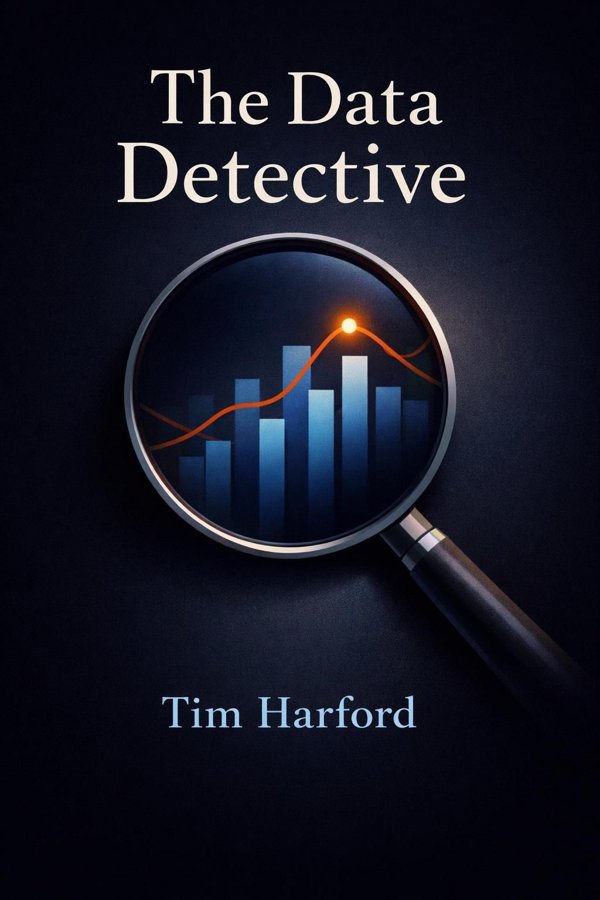
The Data Detective: Ten Easy Rules to Make Sense of Statistics: Summary & Key Insights
by Tim Harford
 10 min10 chaptersAudio available
What Is The Data Detective: Ten Easy Rules to Make Sense of Statistics About?
The Data Detective: Ten Easy Rules to Make Sense of Statistics by Tim Harford is a popular_sci book spanning 10 pages. In this book, economist and journalist Tim Harford explores how to think clearly about data and statistics in a world overflowing with information. He presents ten simple rules that help readers interpret numbers wisely, avoid common biases, and make better decisions based on evidence rather than emotion. Through engaging examples and accessible explanations, Harford shows how data can illuminate truth when used responsibly.
This FizzRead summary covers all 10 key chapters of The Data Detective: Ten Easy Rules to Make Sense of Statistics in approximately 10 minutes, distilling the most important ideas, arguments, and takeaways from Tim Harford's work. Also available as an audio summary and Key Quotes Podcast.
The Data Detective: Ten Easy Rules to Make Sense of Statistics
In this book, economist and journalist Tim Harford explores how to think clearly about data and statistics in a world overflowing with information. He presents ten simple rules that help readers interpret numbers wisely, avoid common biases, and make better decisions based on evidence rather than emotion. Through engaging examples and accessible explanations, Harford shows how data can illuminate truth when used responsibly.
Who Should Read The Data Detective: Ten Easy Rules to Make Sense of Statistics?
This book is perfect for anyone interested in popular_sci and looking to gain actionable insights in a short read. Whether you're a student, professional, or lifelong learner, the key ideas from The Data Detective: Ten Easy Rules to Make Sense of Statistics by Tim Harford will help you think differently.
- ✓Readers who enjoy popular_sci and want practical takeaways
- ✓Professionals looking to apply new ideas to their work and life
- ✓Anyone who wants the core insights of The Data Detective: Ten Easy Rules to Make Sense of Statistics in just 10 minutes
Want the full summary?
Get instant access to this book summary and 100K+ more with Fizz Moment.
Get Free SummaryAvailable on App Store • Free to download
Key Chapters
The first rule asks you to pause and observe your emotional reaction when you encounter a surprising or disturbing statistic. Whether it’s a chart showing rising crime, a poll predicting an election upset, or a study challenging your beliefs, chances are your emotions flare before your reason does. Anger, disbelief, relief—these are all data points about you. I begin here because emotion is the hidden filter through which all data passes. When you feel indignant that the numbers ‘must be wrong,’ that’s your first clue that bias may be doing the interpreting, not reason.
In countless studies, we see how people interpret facts selectively—seeing only what confirms their prior worldview. I tell the story of how polarization can distort even our grasp of arithmetic: when given statistical problems tied to political identity, participants get answers wrong not because they don’t understand math, but because emotions override calculation. To search your feelings is not to suppress them—it’s to recognize their influence. Once you admit that each datum sparks an emotional reaction, you can start to separate the feeling from the fact.
I’ve found that the best data detectives engage curiosity rather than outrage. When you see a surprising statistic, instead of asking, “Can that be true?” ask “Why do I feel that way?” It turns every encounter with data into an opportunity for introspection. It’s the emotional humility that prepares the ground for intellectual clarity.
Personal anecdotes are powerful because they feel undeniable. If your friend lost her job, statistics showing low unemployment seem irrelevant. Yet good reasoning demands that we recognize how limited our experience can be. I once explored the mismatch between personal impressions and statistical realities: for example, when crime feels like it’s rising because we encountered a shocking news story, even though data might show the opposite trend. The stories we live are true, but they’re not the whole story.
This rule isn’t about rejecting experience—it’s about placing it in context. Numbers can reveal patterns invisible to any individual. When I worked with data analysts, I noticed that the most insightful among them never dismissed anecdotes outright; they treated them as clues, starting points for deeper exploration rather than verdicts. Your experience is valuable, but it’s one pixel in a vast picture. When you realize that your life doesn’t contradict or confirm statistics but complements them, you start to see data as a way of expanding empathy, understanding truths larger than your own.
+ 8 more chapters — available in the FizzRead app
All Chapters in The Data Detective: Ten Easy Rules to Make Sense of Statistics
About the Author
Tim Harford is a British economist, journalist, and broadcaster known for his work on behavioral economics and data interpretation. He writes the 'Undercover Economist' column for the Financial Times and hosts the BBC radio show 'More or Less', which focuses on making sense of statistics. Harford has authored several bestselling books that make complex economic ideas accessible to general readers.
Get This Summary in Your Preferred Format
Read or listen to the The Data Detective: Ten Easy Rules to Make Sense of Statistics summary by Tim Harford anytime, anywhere. FizzRead offers multiple formats so you can learn on your terms — all free.
Available formats: App · Audio · PDF · EPUB — All included free with FizzRead
Download The Data Detective: Ten Easy Rules to Make Sense of Statistics PDF and EPUB Summary
Key Quotes from The Data Detective: Ten Easy Rules to Make Sense of Statistics
“The first rule asks you to pause and observe your emotional reaction when you encounter a surprising or disturbing statistic.”
“Personal anecdotes are powerful because they feel undeniable.”
Frequently Asked Questions about The Data Detective: Ten Easy Rules to Make Sense of Statistics
The Data Detective: Ten Easy Rules to Make Sense of Statistics by Tim Harford is a popular_sci book that explores key ideas across 10 chapters. In this book, economist and journalist Tim Harford explores how to think clearly about data and statistics in a world overflowing with information. He presents ten simple rules that help readers interpret numbers wisely, avoid common biases, and make better decisions based on evidence rather than emotion. Through engaging examples and accessible explanations, Harford shows how data can illuminate truth when used responsibly.
More by Tim Harford

Adapt: Why Success Always Starts With Failure
Tim Harford
10 min
The Logic of Life: The Rational Economics of an Irrational World
Tim Harford
10 min
Messy: The Power of Disorder to Transform Our Lives
Tim Harford
10 min
The Undercover Economist: Exposing Why the Rich Are Rich, the Poor Are Poor—and Why You Can Never Buy a Decent Used Car!
Tim Harford
10 minYou Might Also Like

Structures: Or Why Things Don"t Fall Down
J.E. Gordon
10 min
The Road to Wigan Pier
George Orwell
10 min
Bonk: The Curious Coupling of Science and Sex
Mary Roach
10 min
First Bite: How We Learn to Eat
Bee Wilson
10 min
In Pursuit Of The Unknown: 17 Equations That Changed The World
Ian Stewart
10 min
Napoleon's Buttons: 17 Molecules That Changed History
Penny Le Couteur and Jay Burreson
10 minBrowse by Category
Ready to read The Data Detective: Ten Easy Rules to Make Sense of Statistics?
Get the full summary and 100K+ more books with Fizz Moment.