
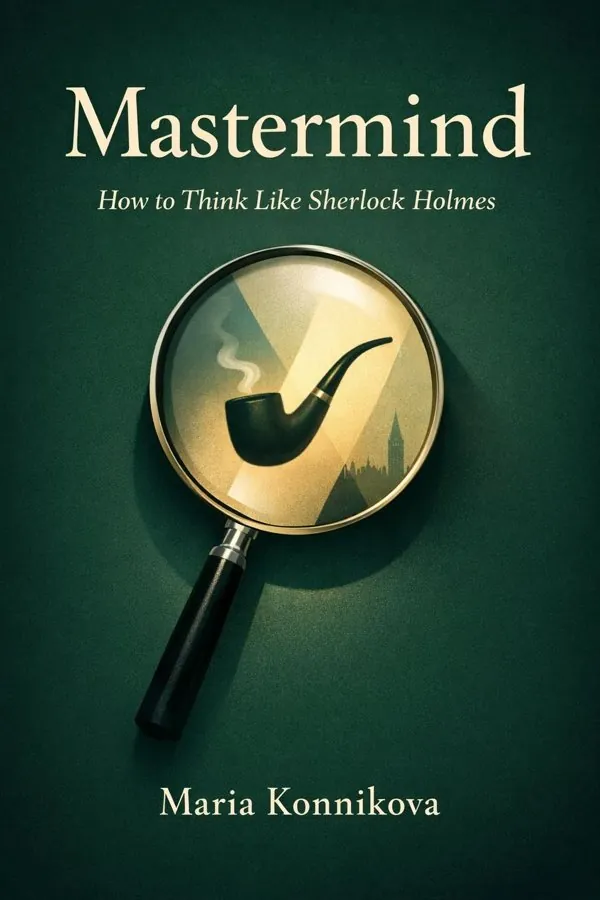
Mastermind: How to Think Like Sherlock Holmes: Summary & Key Insights
 10 min12 chaptersAudio available
What Is Mastermind: How to Think Like Sherlock Holmes About?
Mastermind: How to Think Like Sherlock Holmes by Maria Konnikova is a cognition book spanning 12 pages. In this book, Maria Konnikova explores the psychology of observation, deduction, and mindfulness through the lens of Sherlock Holmes. Drawing on cognitive science and behavioral research, she demonstrates how Holmes’s methods can be applied to everyday thinking, decision-making, and creativity. The book blends storytelling with scientific insight to teach readers how to sharpen their attention, improve memory, and think more rationally.
This FizzRead summary covers all 12 key chapters of Mastermind: How to Think Like Sherlock Holmes in approximately 10 minutes, distilling the most important ideas, arguments, and takeaways from Maria Konnikova's work. Also available as an audio summary and Key Quotes Podcast.
Mastermind: How to Think Like Sherlock Holmes
In this book, Maria Konnikova explores the psychology of observation, deduction, and mindfulness through the lens of Sherlock Holmes. Drawing on cognitive science and behavioral research, she demonstrates how Holmes’s methods can be applied to everyday thinking, decision-making, and creativity. The book blends storytelling with scientific insight to teach readers how to sharpen their attention, improve memory, and think more rationally.
Who Should Read Mastermind: How to Think Like Sherlock Holmes?
This book is perfect for anyone interested in cognition and looking to gain actionable insights in a short read. Whether you're a student, professional, or lifelong learner, the key ideas from Mastermind: How to Think Like Sherlock Holmes by Maria Konnikova will help you think differently.
- ✓Readers who enjoy cognition and want practical takeaways
- ✓Professionals looking to apply new ideas to their work and life
- ✓Anyone who wants the core insights of Mastermind: How to Think Like Sherlock Holmes in just 10 minutes
Want the full summary?
Get instant access to this book summary and 100K+ more with Fizz Moment.
Get Free SummaryAvailable on App Store • Free to download
Key Chapters
Sherlock Holmes’s mind is no mysterious gift—it’s a cultivated state of awareness. He represents what deliberate thought looks like when guided by curiosity and reason. When I describe the Holmesian mind, I mean a mode of consciousness that constantly questions assumptions, sees connections where others see noise, and uses awareness itself as a tool of analysis. Unlike Watson, who perceives instinctively and often impulsively, Holmes approaches the world as a system of interlocking clues awaiting interpretation. Every observation, no matter how trivial, becomes a potential hypothesis to test.
Cognitive research tells us that most of our mental life occurs on autopilot. Psychologists call this the difference between System 1 and System 2 thinking—fast, automatic perception versus slow, reflective reasoning. Holmes lives primarily in System 2, yet he trains System 1 to serve it. This training doesn’t just involve thinking hard—it involves thinking well. He maintains curiosity even when tired, observes patterns even when they appear meaningless, and resists rushing to closure. The Holmesian mind is a disciplined observer of its own processes, constantly aware that perception is filtered through bias and expectation.
When I reflect on Holmes’s mental discipline, I see parallels with what psychologists describe as 'metacognition'—the capacity to think about our own thinking. That’s what makes the Holmesian approach revolutionary. He doesn’t just solve problems; he examines how his mind solves them. He treats attention as an instrument that must be tuned, sustained, and protected from distortion. By cultivating this kind of awareness, we can begin to inhabit that same clear-headed, reflective mindset—one capable of separating fact from conjecture, signal from noise, and insight from impulse.
Holmes once compared the human brain to an attic—a storage room with limited space. Some people, he observed, stuff it haphazardly with random furniture until there’s no room to move; others furnish it with care, arranging every object where it can be easily found. That analogy may sound quaint, but it aligns beautifully with modern cognitive science. Our brains have vast capacities, yet what truly matters is not volume of knowledge, but organization.
We are constantly tempted to cram our 'mental attic' with noise—trivia, half-formed opinions, redundant information. The cost is cognitive clutter. Holmes’s attic, by contrast, is architecturally deliberate. He selects knowledge that serves his purposes and integrates it into mental schemas that make retrieval effortless. His method exemplifies what psychologists call 'structured encoding': the practice of linking new data to well-defined frameworks, enhancing memory through association.
Holmes’s attic metaphor also teaches an ethical lesson about attention. Every moment of focus is a form of interior design. What you allow into your attic determines what you can later create. Random curiosity is wasteful; disciplined curiosity is creative. Holmes doesn’t know everything—he famously claims ignorance of certain trivialities—but what he does know, he knows thoroughly. That principle encourages us to audit our own mental spaces. What do we store because it’s useful, and what do we keep simply because it’s familiar? Once we begin this process, the attic ceases to be a burden and becomes a laboratory for thought.
+ 10 more chapters — available in the FizzRead app
All Chapters in Mastermind: How to Think Like Sherlock Holmes
About the Author
Maria Konnikova is a Russian-American writer and psychologist known for her work on human behavior, decision-making, and the psychology of thinking. She holds a Ph.D. in psychology from Columbia University and has written for The New Yorker, The Atlantic, and other major publications. Her books combine narrative storytelling with scientific research to explore how the mind works.
Get This Summary in Your Preferred Format
Read or listen to the Mastermind: How to Think Like Sherlock Holmes summary by Maria Konnikova anytime, anywhere. FizzRead offers multiple formats so you can learn on your terms — all free.
Available formats: App · Audio · PDF · EPUB — All included free with FizzRead
Download Mastermind: How to Think Like Sherlock Holmes PDF and EPUB Summary
Key Quotes from Mastermind: How to Think Like Sherlock Holmes
“Sherlock Holmes’s mind is no mysterious gift—it’s a cultivated state of awareness.”
“Holmes once compared the human brain to an attic—a storage room with limited space.”
Frequently Asked Questions about Mastermind: How to Think Like Sherlock Holmes
Mastermind: How to Think Like Sherlock Holmes by Maria Konnikova is a cognition book that explores key ideas across 12 chapters. In this book, Maria Konnikova explores the psychology of observation, deduction, and mindfulness through the lens of Sherlock Holmes. Drawing on cognitive science and behavioral research, she demonstrates how Holmes’s methods can be applied to everyday thinking, decision-making, and creativity. The book blends storytelling with scientific insight to teach readers how to sharpen their attention, improve memory, and think more rationally.
More by Maria Konnikova


You Might Also Like
A Field Guide to Lies: Critical Thinking in the Information Age
Daniel J. Levitin
10 min
A Theory of Cognitive Dissonance
Leon Festinger
10 min
Black-And-White Thinking: The Burden of a Binary Brain in a Complex World
Kevin Dutton
10 min
Born Liars: Why We Can’t Live Without Deceit
Ian Leslie
10 min
Collective Illusions: Conformity, Complicity, and the Science of Why We Make Bad Decisions
Todd Rose
10 min
Concrete Mathematics: A Foundation for Computer Science
Ronald L. Graham, Donald E. Knuth, Oren Patashnik
10 minBrowse by Category
Ready to read Mastermind: How to Think Like Sherlock Holmes?
Get the full summary and 100K+ more books with Fizz Moment.