
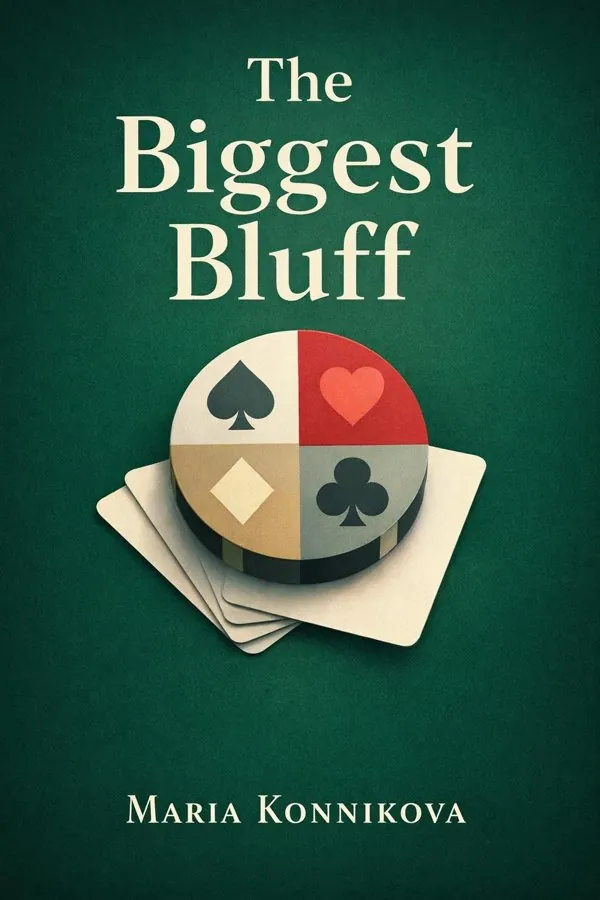
The Biggest Bluff: How I Learned to Pay Attention, Master Myself, and Win: Summary & Key Insights
 10 min9 chaptersAudio available
Key Takeaways from The Biggest Bluff: How I Learned to Pay Attention, Master Myself, and Win
A frustrating outcome is not always proof of a bad decision.
Expertise is often quieter than beginners expect.
Pressure does not create character so much as expose it.
Beginners often assume that learning is mostly about acquiring information.
One of the book’s central claims is both liberating and uncomfortable: luck matters, often more than we want to believe.
What Is The Biggest Bluff: How I Learned to Pay Attention, Master Myself, and Win About?
The Biggest Bluff: How I Learned to Pay Attention, Master Myself, and Win by Maria Konnikova is a psychology book spanning 10 pages. What if the best way to understand life’s uncertainty was to sit down at a poker table? In The Biggest Bluff, Maria Konnikova turns an unlikely personal experiment into a rich exploration of psychology, decision-making, and self-mastery. Starting as a complete novice, she enters the high-pressure world of professional poker under the guidance of legendary player Erik Seidel. What begins as a curiosity soon becomes a serious investigation into how people think, react, and often sabotage themselves when outcomes are unclear. The book matters because it challenges a comforting illusion: that good decisions always lead to good results, and bad outcomes mean we failed. Konnikova shows that luck, variance, emotion, attention, and discipline shape outcomes far more than most people admit. Poker becomes her laboratory for studying fear, ego, resilience, and strategic thinking. Konnikova brings unusual authority to this subject. She is both a trained psychologist and a gifted storyteller, able to connect scientific insight with vivid personal experience. The result is a memoir with practical value: a smart, engaging guide to making better choices when you can never control the cards you are dealt.
This FizzRead summary covers all 9 key chapters of The Biggest Bluff: How I Learned to Pay Attention, Master Myself, and Win in approximately 10 minutes, distilling the most important ideas, arguments, and takeaways from Maria Konnikova's work. Also available as an audio summary and Key Quotes Podcast.
The Biggest Bluff: How I Learned to Pay Attention, Master Myself, and Win
What if the best way to understand life’s uncertainty was to sit down at a poker table? In The Biggest Bluff, Maria Konnikova turns an unlikely personal experiment into a rich exploration of psychology, decision-making, and self-mastery. Starting as a complete novice, she enters the high-pressure world of professional poker under the guidance of legendary player Erik Seidel. What begins as a curiosity soon becomes a serious investigation into how people think, react, and often sabotage themselves when outcomes are unclear.
The book matters because it challenges a comforting illusion: that good decisions always lead to good results, and bad outcomes mean we failed. Konnikova shows that luck, variance, emotion, attention, and discipline shape outcomes far more than most people admit. Poker becomes her laboratory for studying fear, ego, resilience, and strategic thinking.
Konnikova brings unusual authority to this subject. She is both a trained psychologist and a gifted storyteller, able to connect scientific insight with vivid personal experience. The result is a memoir with practical value: a smart, engaging guide to making better choices when you can never control the cards you are dealt.
Who Should Read The Biggest Bluff: How I Learned to Pay Attention, Master Myself, and Win?
This book is perfect for anyone interested in psychology and looking to gain actionable insights in a short read. Whether you're a student, professional, or lifelong learner, the key ideas from The Biggest Bluff: How I Learned to Pay Attention, Master Myself, and Win by Maria Konnikova will help you think differently.
- ✓Readers who enjoy psychology and want practical takeaways
- ✓Professionals looking to apply new ideas to their work and life
- ✓Anyone who wants the core insights of The Biggest Bluff: How I Learned to Pay Attention, Master Myself, and Win in just 10 minutes
Want the full summary?
Get instant access to this book summary and 100K+ more with Fizz Moment.
Get Free SummaryAvailable on App Store • Free to download
Key Chapters
A frustrating outcome is not always proof of a bad decision. That insight sits at the heart of Konnikova’s journey. She begins the book in a period of uncertainty, after setbacks that made life feel random and unfair. Like many people, she wanted to know whether success was mostly earned or mostly given by chance. Poker offered the perfect testing ground because it compresses life’s ambiguity into visible form: you make a decision with incomplete information, and then the world reveals an outcome you cannot fully control.
What Konnikova discovers early is that people are naturally drawn to “resulting,” the habit of judging choices purely by what happened afterward. If a risky move works, we call it brilliant. If it fails, we call it foolish. But in poker, and in life, this is deeply misleading. A well-reasoned choice can lose because of bad luck. A careless choice can win because the right card happened to arrive.
This distinction matters far beyond the casino. A job rejection does not always mean you chose the wrong career path. A successful investment does not always reflect skill. A difficult conversation that ends badly may still have been necessary and wise. The key is to evaluate the quality of the process, not just the result.
Konnikova’s first breakthrough is realizing that uncertainty does not make careful thinking useless. It makes careful thinking more important. The right response to a bad hand is not self-pity or magical thinking, but better observation, cleaner reasoning, and emotional steadiness.
Actionable takeaway: After any major outcome, ask two separate questions: “Was my decision process sound?” and “What role did luck play?” Keeping those questions apart will make you wiser, calmer, and more accurate over time.
Expertise is often quieter than beginners expect. When Konnikova begins training with poker legend Erik Seidel, she does not encounter flashy bravado or mystical secrets. She encounters discipline, patience, and an almost unnerving calm. Seidel teaches her that poker is not about dramatic gestures. It is about paying attention, staying grounded, and making small edges count over time.
This mentorship becomes one of the book’s most powerful themes. Seidel does not simply teach rules and probabilities; he teaches a way of seeing. He helps Konnikova slow down, notice details, and separate emotion from analysis. He models a rare kind of confidence: not the loud certainty of someone trying to dominate a room, but the quiet poise of someone who knows that uncertainty is unavoidable and does not need to be feared.
That lesson applies to any field where stakes are high and information is incomplete. A good manager watches patterns before reacting. A good investor avoids emotional swings. A good negotiator listens more than they speak. In each case, the real advantage is not theatrical intelligence but disciplined perception.
Konnikova also learns that the best mentors do more than transfer knowledge. They shape habits of mind. Seidel’s influence helps her build routines for reflection, restraint, and review. He demonstrates that mastery is less about dazzling moments than about consistency under pressure.
In a culture obsessed with hacks and shortcuts, this is a useful corrective. Sustainable performance grows from attention, preparation, and repetition. The most valuable teachers are often the ones who help you notice what you normally miss.
Actionable takeaway: Find one area where you want to improve and seek a mentor, model, or expert voice who emphasizes process over performance. Study how they think, not just what they achieve.
Pressure does not create character so much as expose it. As Konnikova learns the basics of poker, she quickly discovers that the game is a mirror for the mind. Every hand forces a player to confront impulse, fear, overconfidence, and the temptation to invent stories from limited evidence. Poker is not just a card game; it is a live demonstration of human cognition under stress.
Because Konnikova is trained in psychology, she is especially alert to the biases that appear at the table. There is confirmation bias, where players see what supports their hunch and ignore what contradicts it. There is loss aversion, where the pain of losing chips can distort strategy. There is the illusion of control, where people overestimate their influence over random events. And there is ego, perhaps the most expensive bias of all, pushing players to defend an image rather than make the best move.
What makes poker so educational is its speed and clarity. In ordinary life, bad thinking can remain hidden for years. In poker, weak reasoning often shows up quickly, especially over repeated play. That is why Konnikova comes to value the table as a training ground for sharper judgment.
Readers can use the same principle without ever touching a deck of cards. Any high-feedback environment can teach better thinking: sales calls, investing decisions, athletic performance, even difficult conversations. The goal is to observe how your mind behaves when stakes rise. Do you rush? Freeze? Rationalize? Avoid?
The deeper lesson is that self-knowledge is strategic. You cannot think clearly if you do not know how your thinking goes wrong. Improvement begins when you stop treating your reactions as facts and start treating them as data.
Actionable takeaway: In a stressful situation this week, pause and name the bias or emotion most likely influencing you. Labeling your mental state is a simple way to reduce its power.
Beginners often assume that learning is mostly about acquiring information. Konnikova discovers that real learning also requires humiliation, confusion, and repeated mistakes. Her early experiences at the poker table are full of uncertainty. She misreads opponents, struggles with pace, and confronts the gap between theoretical understanding and real-time execution. That gap is where growth begins.
What makes these early struggles so valuable is that they expose a common fantasy: that intelligence in one domain automatically transfers into competence in another. Konnikova is highly educated and analytically gifted, but poker does not reward credentials. It rewards adaptation. She has to become comfortable not knowing, asking basic questions, and revising assumptions in public.
This is a crucial lesson for ambitious people. Many of us resist beginnerhood because it threatens our identity. We prefer situations where we look capable. But that preference slows development. The fastest learners are often the ones most willing to be visibly imperfect. They treat errors not as verdicts on their worth but as information about what to practice next.
Konnikova gradually learns to review hands, identify leaks in her thinking, and approach errors with curiosity rather than shame. Instead of asking, “Why am I bad at this?” she learns to ask, “What exactly did I miss?” That shift is subtle but powerful. It turns failure from a personal wound into a strategic resource.
The same mindset matters in leadership, creativity, and personal change. Progress usually begins after the ego loosens its grip. If you can survive feeling foolish, you gain access to skills that pride would have denied you.
Actionable takeaway: Choose one area where you have avoided being a beginner. Spend one hour this week practicing badly but deliberately, then write down one mistake and one lesson from the experience.
One of the book’s central claims is both liberating and uncomfortable: luck matters, often more than we want to believe. Konnikova explores this idea through the concept of variance, the natural swings that occur even when someone is skilled. In poker, a superior player can make excellent decisions and still lose for long stretches. That reality is hard to accept because people crave a just world where effort and talent are quickly rewarded.
The danger of ignoring chance is not only philosophical; it is practical. If you underestimate luck, you become arrogant when things go well and self-destructive when they do not. You may assume success proves mastery, or that setbacks mean you are cursed or incompetent. Both reactions distort learning.
Konnikova shows that strong players respect randomness without surrendering to it. They know they cannot control cards, opponents, or short-term outcomes. What they can control is preparation, emotional regulation, bankroll management, and decision quality. This balance is the book’s intellectual core: accept uncertainty fully, but never use it as an excuse for sloppy thinking.
The lesson transfers easily to daily life. Hiring decisions, romantic timing, market trends, health events, and creative careers all contain far more luck than most post-hoc stories acknowledge. Recognizing that fact can make us more humble, less judgmental, and more resilient. It can also improve risk management. If outcomes are noisy, then safety margins matter.
Understanding chance does not weaken ambition. It strengthens it by making expectations more realistic and strategy more durable. You stop demanding guarantees from a world that does not offer them.
Actionable takeaway: The next time you succeed or fail, list three factors you controlled and three you did not. This habit will help you build accountability without illusion.
Talent collapses quickly when emotion takes the wheel. In poker, this breakdown has a name: tilt. Tilt is the state in which frustration, anger, embarrassment, or overexcitement hijacks judgment. Konnikova learns that even technically strong players can self-destruct after a bad beat or a bruised ego. The game rewards not the person who feels nothing, but the person who can feel deeply without becoming governed by those feelings.
This is where self-mastery becomes more important than strategy charts. Under pressure, the mind wants relief more than accuracy. A player who just lost a painful hand may chase losses, force action, or abandon patience simply to escape discomfort. In life, the same pattern appears when we send impulsive emails, make reactive purchases, or double down on a bad decision because admitting error hurts.
Konnikova works to recognize her emotional triggers and create space between feeling and response. She learns routines, reflection practices, and mental habits that make stability possible. Crucially, she does not frame emotion as weakness. Emotion is information. The danger arises when unexamined emotion masquerades as reason.
This lesson is especially relevant in a world engineered to provoke reaction. Social media, workplace stress, and constant comparison push people toward impulsiveness. The person who can pause, breathe, and return to first principles has a meaningful advantage.
Emotional control is not about becoming cold. It is about becoming usable to yourself in high-stakes moments. Calm is not passivity; it is preserved agency.
Actionable takeaway: Create a personal anti-tilt ritual for stressful moments: pause for sixty seconds, name what you are feeling, and ask, “What would the best version of me do next?” Practiced consistently, this can prevent costly reactions.
Breakthroughs rarely arrive as sudden miracles. More often, they emerge when disciplined process finally compounds. As Konnikova gains experience, she begins to see a shift in her play. She is no longer simply trying to survive each hand. She starts thinking in ranges, probabilities, position, table dynamics, and long-term expectation. The game slows down because her mind becomes more organized.
This turning point matters because it reveals how expertise actually develops. Improvement is not linear. For a long time, effort can feel invisible. Then, with enough repetition and reflection, perception changes. You begin to recognize patterns that once looked like chaos. What felt overwhelming becomes legible.
Konnikova’s progress also shows that confidence built on process is different from confidence built on outcomes. If you rely on winning to feel capable, variance will destabilize you. But if you trust your preparation and reasoning, you can endure losses without falling apart. This is a sturdier, more adult form of confidence.
The idea applies to writing, business, parenting, and leadership. You may not see immediate results from better habits, clearer thinking, or improved preparation. But those changes alter the quality of your decisions, and over time, better decisions change trajectories. The visible “turning point” is often just the delayed effect of invisible consistency.
Konnikova does not portray progress as easy or permanent. Growth requires maintenance. But she demonstrates that uncertainty becomes less intimidating when you develop a reliable internal method for meeting it.
Actionable takeaway: Instead of asking whether you are improving, identify one process metric you can track for a month, such as hours practiced, decisions reviewed, or emotional reactions managed. Measure the behaviors that lead to mastery, not just the results.
Success becomes dangerous when it flatters the ego faster than it deepens wisdom. As Konnikova starts achieving meaningful results in the poker world, including tournament wins and professional recognition, she faces a new challenge: how to interpret success without becoming captive to it. Winning is thrilling, but it can also distort judgment if it leads you to overestimate your understanding or attach your identity too tightly to performance.
One of the book’s strongest insights is that external victories are incomplete measures of mastery. In poker, someone can win a hand with terrible play. Someone else can lose despite near-perfect strategy. If you define winning too narrowly, you will become emotionally volatile and strategically confused. Real progress includes better attention, better discipline, better recovery from setbacks, and greater awareness of one’s own blind spots.
Konnikova’s reflections broaden the meaning of victory. Poker gives her money and status, but more importantly, it gives her a framework for living with uncertainty. She becomes more observant, less reactive, and more precise in the stories she tells herself about what happens. That transformation matters far beyond the felt table.
This broader definition of winning can reshape personal goals. In work, a promotion is not the only sign of growth. In relationships, “winning” an argument may harm the bond. In health, a number on a scale may hide better habits that matter more. Mature success includes internal development, not just visible outcomes.
Actionable takeaway: Redefine one current goal using both outcome and process terms. For example, do not aim only to “close the deal” or “get the raise”; also aim to prepare thoroughly, communicate clearly, and respond calmly under pressure.
The deepest lesson of The Biggest Bluff is that poker is not really about cards. It is about how to live when certainty is impossible. Every important decision we make involves incomplete information: choosing a career, trusting a partner, launching a project, making an investment, changing direction after a setback. We want guarantees, but life offers probabilities.
Konnikova argues that the answer is neither reckless risk-taking nor fearful paralysis. The answer is trained attention. Notice what is happening inside you. Notice the evidence available. Notice what you are assuming, what you are ignoring, and what story you are telling yourself. Then act as wisely as you can while accepting that some part of the outcome will always remain outside your control.
This philosophy has moral as well as practical force. It makes us less smug about success and less cruel about failure. If luck is real, then humility should accompany achievement. If uncertainty is universal, then resilience should accompany disappointment. We become better decision-makers and better human beings when we stop pretending the world is simpler than it is.
What Konnikova ultimately masters is not poker alone but a more stable relationship with uncertainty itself. She learns to prepare seriously, observe carefully, and let go of fantasies of control. That combination is rare and powerful.
For readers, the book offers a way to replace anxiety with engagement. You do not need certainty to act well. You need clarity, self-command, and the willingness to think in probabilities.
Actionable takeaway: Before your next big decision, write down the information you know, the information you do not know, and the risks you are willing to accept. This simple exercise can turn vague anxiety into strategic thinking.
All Chapters in The Biggest Bluff: How I Learned to Pay Attention, Master Myself, and Win
About the Author
Maria Konnikova is a Russian-American writer, psychologist, and bestselling author whose work focuses on human behavior, cognition, and decision-making. She earned her Ph.D. in psychology from Columbia University, where she studied under renowned psychologist Walter Mischel. Konnikova is known for bringing rigorous psychological research to a broad audience through elegant, narrative-driven nonfiction. She has written for major publications including The New Yorker, The Atlantic, and The New York Times. Her books often explore the hidden forces that shape judgment, bias, and self-control. In The Biggest Bluff, she combines memoir, psychology, and game theory to examine luck, skill, and uncertainty through her unexpected journey into professional poker, showcasing both her analytical depth and storytelling talent.
Get This Summary in Your Preferred Format
Read or listen to the The Biggest Bluff: How I Learned to Pay Attention, Master Myself, and Win summary by Maria Konnikova anytime, anywhere. FizzRead offers multiple formats so you can learn on your terms — all free.
Available formats: App · Audio · PDF · EPUB — All included free with FizzRead
Download The Biggest Bluff: How I Learned to Pay Attention, Master Myself, and Win PDF and EPUB Summary
Key Quotes from The Biggest Bluff: How I Learned to Pay Attention, Master Myself, and Win
“A frustrating outcome is not always proof of a bad decision.”
“Expertise is often quieter than beginners expect.”
“Pressure does not create character so much as expose it.”
“Beginners often assume that learning is mostly about acquiring information.”
“One of the book’s central claims is both liberating and uncomfortable: luck matters, often more than we want to believe.”
Frequently Asked Questions about The Biggest Bluff: How I Learned to Pay Attention, Master Myself, and Win
The Biggest Bluff: How I Learned to Pay Attention, Master Myself, and Win by Maria Konnikova is a psychology book that explores key ideas across 9 chapters. What if the best way to understand life’s uncertainty was to sit down at a poker table? In The Biggest Bluff, Maria Konnikova turns an unlikely personal experiment into a rich exploration of psychology, decision-making, and self-mastery. Starting as a complete novice, she enters the high-pressure world of professional poker under the guidance of legendary player Erik Seidel. What begins as a curiosity soon becomes a serious investigation into how people think, react, and often sabotage themselves when outcomes are unclear. The book matters because it challenges a comforting illusion: that good decisions always lead to good results, and bad outcomes mean we failed. Konnikova shows that luck, variance, emotion, attention, and discipline shape outcomes far more than most people admit. Poker becomes her laboratory for studying fear, ego, resilience, and strategic thinking. Konnikova brings unusual authority to this subject. She is both a trained psychologist and a gifted storyteller, able to connect scientific insight with vivid personal experience. The result is a memoir with practical value: a smart, engaging guide to making better choices when you can never control the cards you are dealt.
More by Maria Konnikova
You Might Also Like
The Body Keeps the Score
Bessel van der Kolk
10 min
Surrounded by Idiots
Thomas Erikson
10 min
Emotional Intelligence
Daniel Goleman
10 min
Attached
Amir Levine
10 min
Why Does He Do That
Lundy Bancroft
10 min
Women Who Run with the Wolves
Clarissa Pinkola Estés
10 minBrowse by Category
Ready to read The Biggest Bluff: How I Learned to Pay Attention, Master Myself, and Win?
Get the full summary and 100K+ more books with Fizz Moment.