
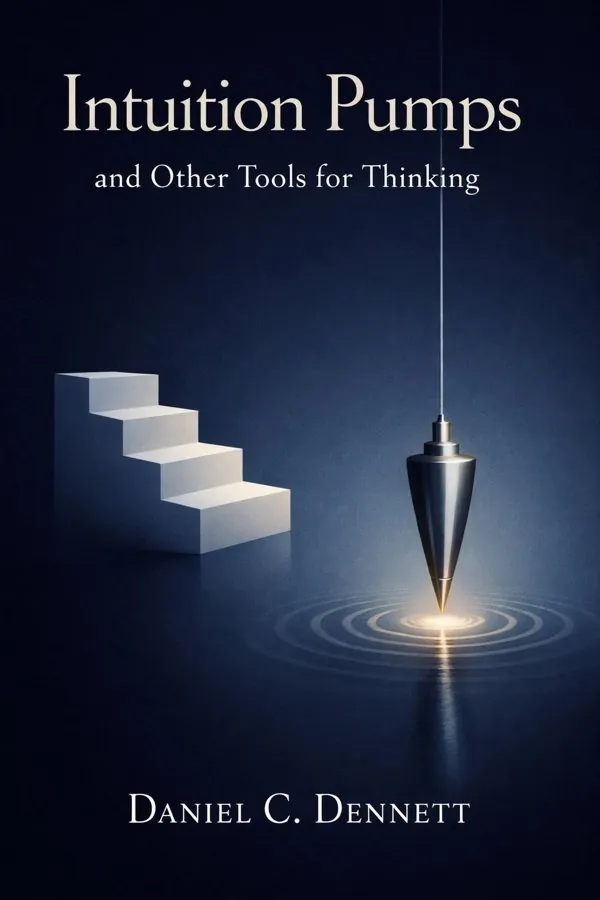
Intuition Pumps and Other Tools for Thinking: Summary & Key Insights
 10 min10 chaptersAudio available
What Is Intuition Pumps and Other Tools for Thinking About?
Intuition Pumps and Other Tools for Thinking by Daniel C. Dennett is a cognition book spanning 10 pages. In this book, philosopher Daniel C. Dennett presents a collection of thought experiments, conceptual tools, and mental models designed to help readers think more clearly about complex ideas in philosophy, science, and everyday reasoning. Drawing on decades of work in cognitive science and philosophy of mind, Dennett introduces 'intuition pumps'—imaginative devices that stimulate critical thinking and reveal hidden assumptions in our reasoning.
This FizzRead summary covers all 10 key chapters of Intuition Pumps and Other Tools for Thinking in approximately 10 minutes, distilling the most important ideas, arguments, and takeaways from Daniel C. Dennett's work. Also available as an audio summary and Key Quotes Podcast.
Intuition Pumps and Other Tools for Thinking
In this book, philosopher Daniel C. Dennett presents a collection of thought experiments, conceptual tools, and mental models designed to help readers think more clearly about complex ideas in philosophy, science, and everyday reasoning. Drawing on decades of work in cognitive science and philosophy of mind, Dennett introduces 'intuition pumps'—imaginative devices that stimulate critical thinking and reveal hidden assumptions in our reasoning.
Who Should Read Intuition Pumps and Other Tools for Thinking?
This book is perfect for anyone interested in cognition and looking to gain actionable insights in a short read. Whether you're a student, professional, or lifelong learner, the key ideas from Intuition Pumps and Other Tools for Thinking by Daniel C. Dennett will help you think differently.
- ✓Readers who enjoy cognition and want practical takeaways
- ✓Professionals looking to apply new ideas to their work and life
- ✓Anyone who wants the core insights of Intuition Pumps and Other Tools for Thinking in just 10 minutes
Want the full summary?
Get instant access to this book summary and 100K+ more with Fizz Moment.
Get Free SummaryAvailable on App Store • Free to download
Key Chapters
I like to think of cognitive tools as the mental equivalents of screwdrivers and flashlights: reliable instruments that make reasoning more precise and humane. One of my favorite examples is Rapoport’s Rules—guidelines for engaging your intellectual opponents with respect and depth. The first principle is to restate your opponent’s position so clearly that the opponent says, ‘Yes, that’s what I meant.’ Only after you’ve built this bridge of understanding can critique begin.
Why stress charity in argument? Because misunderstanding is the root of bad philosophy. When we confront an idea, our reflex is often to attack it—or worse, to caricature it. But philosophy, done well, is cooperation disguised as argumentation. Occam’s Razor functions similarly. It urges us to prefer simplicity, not because simplicity is always true, but because it keeps our explanatory machinery from getting bogged down.
Then there’s Sturgeon’s Law: ninety percent of everything is crud. It reminds us to focus our analysis on the worthwhile minority of strong ideas rather than wasting time on poor reasoning. These tools work together as a mental hygiene system. They prevent clutter, foster clarity, and keep our intuitions from slumping into dogma.
For me, these are not mere slogans; they are habits cultivated over decades in research. When we use Rapoport’s Rules in conversation, we model empathy and precision—qualities essential for any productive philosophical inquiry. When we wield Occam’s Razor, we resist the temptation to glorify complications. And when we remember Sturgeon’s Law, we accept imperfection as a constant—because thinking is evolution, not perfection.
An intuition pump, at its core, is a structured provocation—a way to make you feel the contours of an idea rather than merely think about it abstractly. Philosophers have always relied on them: Descartes had his evil demon, Locke had his tabula rasa, and today we have Chinese Rooms and Twin Earths. These mental devices let us strip problems to their essentials, then rebuild understanding from the inside out.
However, intuition pumps can mislead just as powerfully as they enlighten. A well-wrought thought experiment illuminates hidden assumptions, but a poorly designed one merely reinforces prejudice. The famous ‘Chinese Room’ argument against artificial intelligence, for instance, pumps some people’s intuitions toward skepticism about machine understanding—but it also leverages intuitions about human meaning that are themselves flawed.
The discipline lies not in abandoning intuition pumps, but in learning to test them—running variants, flipping assumptions, and seeing where intuition breaks. Done right, a thought experiment becomes a miniature laboratory of cognition. You don’t just reason about the world; you observe the machinery of your own thought at work.
That’s why I say: be playful, but rigorous. Treat your intuitions with care—they’re strong motors, but easily misfired. Philosophy doesn’t advance by killing intuition; it advances by calibrating it.
+ 8 more chapters — available in the FizzRead app
All Chapters in Intuition Pumps and Other Tools for Thinking
About the Author
Daniel Clement Dennett is an American philosopher, writer, and cognitive scientist known for his research on the philosophy of mind, science, and biology, particularly as those fields relate to evolutionary theory and cognitive science. He is a co-director of the Center for Cognitive Studies at Tufts University and one of the most influential contemporary thinkers in analytic philosophy.
Get This Summary in Your Preferred Format
Read or listen to the Intuition Pumps and Other Tools for Thinking summary by Daniel C. Dennett anytime, anywhere. FizzRead offers multiple formats so you can learn on your terms — all free.
Available formats: App · Audio · PDF · EPUB — All included free with FizzRead
Download Intuition Pumps and Other Tools for Thinking PDF and EPUB Summary
Key Quotes from Intuition Pumps and Other Tools for Thinking
“I like to think of cognitive tools as the mental equivalents of screwdrivers and flashlights: reliable instruments that make reasoning more precise and humane.”
“An intuition pump, at its core, is a structured provocation—a way to make you feel the contours of an idea rather than merely think about it abstractly.”
Frequently Asked Questions about Intuition Pumps and Other Tools for Thinking
Intuition Pumps and Other Tools for Thinking by Daniel C. Dennett is a cognition book that explores key ideas across 10 chapters. In this book, philosopher Daniel C. Dennett presents a collection of thought experiments, conceptual tools, and mental models designed to help readers think more clearly about complex ideas in philosophy, science, and everyday reasoning. Drawing on decades of work in cognitive science and philosophy of mind, Dennett introduces 'intuition pumps'—imaginative devices that stimulate critical thinking and reveal hidden assumptions in our reasoning.
More by Daniel C. Dennett

You Might Also Like
A Field Guide to Lies: Critical Thinking in the Information Age
Daniel J. Levitin
10 min
A Theory of Cognitive Dissonance
Leon Festinger
10 min
Black-And-White Thinking: The Burden of a Binary Brain in a Complex World
Kevin Dutton
10 min
Born Liars: Why We Can’t Live Without Deceit
Ian Leslie
10 min
Collective Illusions: Conformity, Complicity, and the Science of Why We Make Bad Decisions
Todd Rose
10 min
Concrete Mathematics: A Foundation for Computer Science
Ronald L. Graham, Donald E. Knuth, Oren Patashnik
10 minBrowse by Category
Ready to read Intuition Pumps and Other Tools for Thinking?
Get the full summary and 100K+ more books with Fizz Moment.