
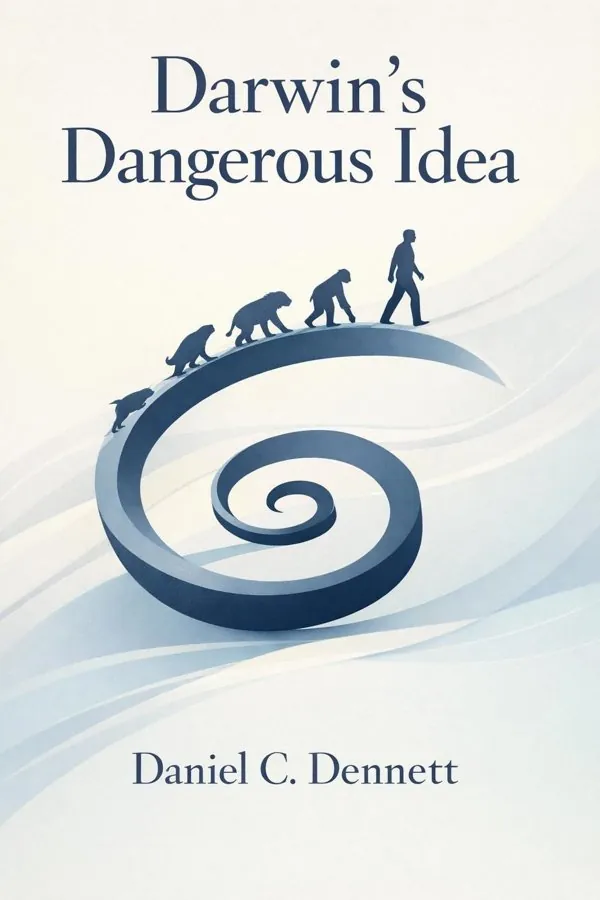
Darwin's Dangerous Idea: Evolution and the Meanings of Life: Summary & Key Insights
 10 min11 chaptersAudio available
What Is Darwin's Dangerous Idea: Evolution and the Meanings of Life About?
Darwin's Dangerous Idea: Evolution and the Meanings of Life by Daniel C. Dennett is a popular_sci book spanning 11 pages. This book explores Charles Darwin’s theory of evolution as a universal algorithmic process that reshapes our understanding of life, mind, and meaning. Dennett argues that natural selection is a powerful and dangerous idea because it challenges traditional views of purpose and design, extending its implications far beyond biology into philosophy, ethics, and human culture.
This FizzRead summary covers all 11 key chapters of Darwin's Dangerous Idea: Evolution and the Meanings of Life in approximately 10 minutes, distilling the most important ideas, arguments, and takeaways from Daniel C. Dennett's work. Also available as an audio summary and Key Quotes Podcast.
Darwin's Dangerous Idea: Evolution and the Meanings of Life
This book explores Charles Darwin’s theory of evolution as a universal algorithmic process that reshapes our understanding of life, mind, and meaning. Dennett argues that natural selection is a powerful and dangerous idea because it challenges traditional views of purpose and design, extending its implications far beyond biology into philosophy, ethics, and human culture.
Who Should Read Darwin's Dangerous Idea: Evolution and the Meanings of Life?
This book is perfect for anyone interested in popular_sci and looking to gain actionable insights in a short read. Whether you're a student, professional, or lifelong learner, the key ideas from Darwin's Dangerous Idea: Evolution and the Meanings of Life by Daniel C. Dennett will help you think differently.
- ✓Readers who enjoy popular_sci and want practical takeaways
- ✓Professionals looking to apply new ideas to their work and life
- ✓Anyone who wants the core insights of Darwin's Dangerous Idea: Evolution and the Meanings of Life in just 10 minutes
Want the full summary?
Get instant access to this book summary and 100K+ more with Fizz Moment.
Get Free SummaryAvailable on App Store • Free to download
Key Chapters
Darwin’s concept of natural selection is dangerous because it threatens the comforting notion that order and purpose must originate from a conscious mind. Before Darwin, design implied a designer; the complexity of life seemed impossible without one. Then Darwin showed how blind variation and selective retention—a simple mechanical process—could, over time, generate the intricate structures we see in nature. This revelation doesn’t just transform biology; it upends humanity’s oldest metaphysical assumptions.
To understand the danger, imagine living in a world where every apparent pattern hides no deliberate plan behind it. For centuries, thinkers from Aristotle to Paley saw purpose as intrinsic to nature. Darwin punctured this view with one simple insight: adaptation is the product of a mindless, algorithmic process. Once internalized, this realization ripples outward. It challenges theology, philosophy, and ethics, dissolving the imagined boundary between the purposeful and the accidental.
The idea is dangerous not because it destroys meaning, but because it relocates it. Meaning becomes emergent—constructed by processes rather than imposed from above. For many this is unsettling; yet, it’s the same unsettling truth that liberates science. If blind processes can create sight, if purposeless variations can generate purpose, then our quest to understand life becomes not an act of worship but of discovery. Darwin’s idea threatens any worldview built on design from intention, and that’s precisely why it’s revolutionary.
The centerpiece of my argument is that evolution itself operates as an algorithm. An algorithm is an iterative procedure that, given certain inputs and constraints, inevitably yields results. In Darwin’s case, the ingredients are heritable variation, differential survival, and time. Run this algorithm long enough, and what emerges is design without intelligence.
This view is unsettling because it demands that we see intelligence as a product, not the originator, of design. In algorithmic terms, evolution doesn’t plan; it explores. It doesn’t foresee; it filters. Its only rule is that those who survive pass on their traits. The algorithm is oblivious, yet through billions of iterations, it crafts wings, eyes, minds, and societies.
I want you to grasp how profoundly this idea reshapes our concept of creativity. The algorithmic perspective implies that complexity arises from simplicity—without invoking mystery or supernatural intervention. When we extend this reasoning beyond biology, we begin to see algorithms everywhere: in neural networks, genetic codes, and even cultural systems. They are engines of creation that operate without foresight, producing what looks like design through feedback and iteration.
Darwin’s algorithm reminds us that progress doesn’t need a planner. It only needs replication, variation, and competition. The so-called creativity of evolution is real, but it is the creativity of a process—not of a mind. And in that realization lies a new kind of wonder.
+ 9 more chapters — available in the FizzRead app
All Chapters in Darwin's Dangerous Idea: Evolution and the Meanings of Life
About the Author
Daniel Clement Dennett is an American philosopher, writer, and cognitive scientist known for his research on philosophy of mind, science, and biology. He is Distinguished Professor of Arts and Sciences and Director of the Center for Cognitive Studies at Tufts University.
Get This Summary in Your Preferred Format
Read or listen to the Darwin's Dangerous Idea: Evolution and the Meanings of Life summary by Daniel C. Dennett anytime, anywhere. FizzRead offers multiple formats so you can learn on your terms — all free.
Available formats: App · Audio · PDF · EPUB — All included free with FizzRead
Download Darwin's Dangerous Idea: Evolution and the Meanings of Life PDF and EPUB Summary
Key Quotes from Darwin's Dangerous Idea: Evolution and the Meanings of Life
“Darwin’s concept of natural selection is dangerous because it threatens the comforting notion that order and purpose must originate from a conscious mind.”
“The centerpiece of my argument is that evolution itself operates as an algorithm.”
Frequently Asked Questions about Darwin's Dangerous Idea: Evolution and the Meanings of Life
Darwin's Dangerous Idea: Evolution and the Meanings of Life by Daniel C. Dennett is a popular_sci book that explores key ideas across 11 chapters. This book explores Charles Darwin’s theory of evolution as a universal algorithmic process that reshapes our understanding of life, mind, and meaning. Dennett argues that natural selection is a powerful and dangerous idea because it challenges traditional views of purpose and design, extending its implications far beyond biology into philosophy, ethics, and human culture.
More by Daniel C. Dennett
You Might Also Like

Structures: Or Why Things Don"t Fall Down
J.E. Gordon
10 min
The Road to Wigan Pier
George Orwell
10 min
Bonk: The Curious Coupling of Science and Sex
Mary Roach
10 min
First Bite: How We Learn to Eat
Bee Wilson
10 min
In Pursuit Of The Unknown: 17 Equations That Changed The World
Ian Stewart
10 min
Napoleon's Buttons: 17 Molecules That Changed History
Penny Le Couteur and Jay Burreson
10 minBrowse by Category
Ready to read Darwin's Dangerous Idea: Evolution and the Meanings of Life?
Get the full summary and 100K+ more books with Fizz Moment.