
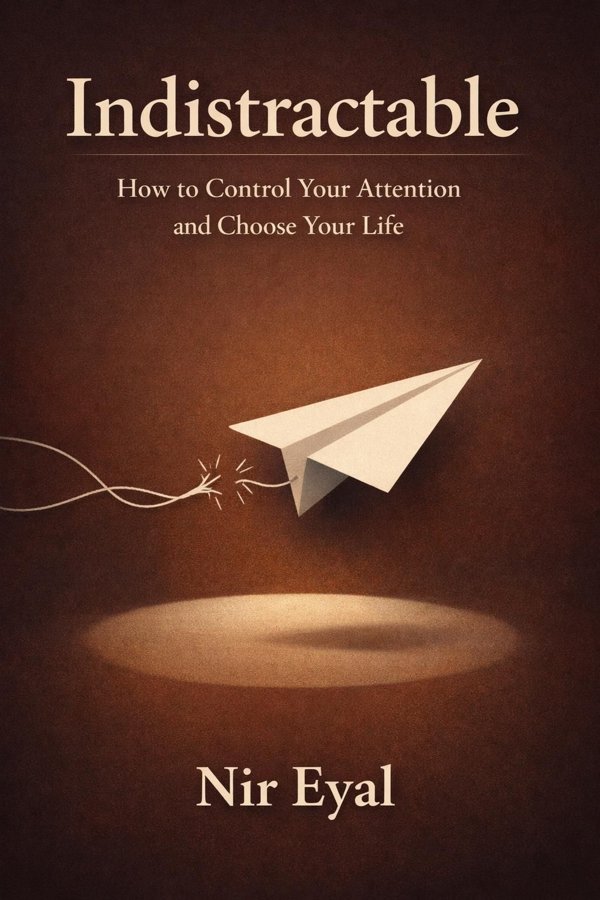
Indistractable: How to Control Your Attention and Choose Your Life: Summary & Key Insights
by Nir Eyal
 10 min10 chaptersAudio available
Key Takeaways from Indistractable: How to Control Your Attention and Choose Your Life
Most people think distraction is something that happens to them, but Eyal’s central insight is more unsettling: distraction usually starts from within.
If you want to become indistractable, you must learn to work with your internal triggers rather than pretending they do not exist.
Not all distractions come from inside.
People often say they do not have time for what matters, but Eyal argues that the deeper issue is that they have not clearly decided how their time will be spent.
Even with better awareness and better schedules, temptation does not disappear.
What Is Indistractable: How to Control Your Attention and Choose Your Life About?
Indistractable: How to Control Your Attention and Choose Your Life by Nir Eyal is a productivity book spanning 10 pages. In a world engineered to capture every spare second of attention, staying focused can feel like an act of resistance. In Indistractable, Nir Eyal argues that distraction is not simply a technology problem or a matter of weak willpower. It is a deeper behavioral challenge rooted in how we respond to discomfort, uncertainty, boredom, and the countless internal and external triggers competing for our attention. The book offers a practical framework for becoming “indistractable,” not by rejecting modern life, but by learning how to make deliberate choices about what we do and why we do it. Eyal combines behavioral psychology, habit research, and real-world case studies to show how people can align their daily actions with their true values. He explains why to-do lists often fail, how digital tools become escape routes, and what individuals, families, and organizations can do to create environments that support focus. As the author of Hooked and a recognized expert in behavioral design, Eyal brings unusual credibility to the topic: he understands both how products capture attention and how people can reclaim it. The result is a sharp, useful guide for anyone who wants to stop reacting and start choosing.
This FizzRead summary covers all 10 key chapters of Indistractable: How to Control Your Attention and Choose Your Life in approximately 10 minutes, distilling the most important ideas, arguments, and takeaways from Nir Eyal's work. Also available as an audio summary and Key Quotes Podcast.
Indistractable: How to Control Your Attention and Choose Your Life
In a world engineered to capture every spare second of attention, staying focused can feel like an act of resistance. In Indistractable, Nir Eyal argues that distraction is not simply a technology problem or a matter of weak willpower. It is a deeper behavioral challenge rooted in how we respond to discomfort, uncertainty, boredom, and the countless internal and external triggers competing for our attention. The book offers a practical framework for becoming “indistractable,” not by rejecting modern life, but by learning how to make deliberate choices about what we do and why we do it.
Eyal combines behavioral psychology, habit research, and real-world case studies to show how people can align their daily actions with their true values. He explains why to-do lists often fail, how digital tools become escape routes, and what individuals, families, and organizations can do to create environments that support focus. As the author of Hooked and a recognized expert in behavioral design, Eyal brings unusual credibility to the topic: he understands both how products capture attention and how people can reclaim it. The result is a sharp, useful guide for anyone who wants to stop reacting and start choosing.
Who Should Read Indistractable: How to Control Your Attention and Choose Your Life?
This book is perfect for anyone interested in productivity and looking to gain actionable insights in a short read. Whether you're a student, professional, or lifelong learner, the key ideas from Indistractable: How to Control Your Attention and Choose Your Life by Nir Eyal will help you think differently.
- ✓Readers who enjoy productivity and want practical takeaways
- ✓Professionals looking to apply new ideas to their work and life
- ✓Anyone who wants the core insights of Indistractable: How to Control Your Attention and Choose Your Life in just 10 minutes
Want the full summary?
Get instant access to this book summary and 100K+ more with Fizz Moment.
Get Free SummaryAvailable on App Store • Free to download
Key Chapters
Most people think distraction is something that happens to them, but Eyal’s central insight is more unsettling: distraction usually starts from within. We tend to blame buzzing phones, noisy coworkers, or addictive apps, yet these are often just surfaces. Underneath them is a desire to escape an uncomfortable feeling—boredom, anxiety, uncertainty, loneliness, or mental fatigue. In Eyal’s model, all behavior is driven by the urge to move away from discomfort and toward relief. That means distraction is not just a time-management problem; it is an emotion-management problem.
This distinction matters because it changes where solutions should begin. If you try to eliminate every external distraction without understanding the internal state that makes distraction appealing, you will keep finding new ways to avoid difficult tasks. A person who closes social media may suddenly organize their desk, refresh email, or start researching irrelevant details. The object changes, but the urge remains the same.
Eyal contrasts distraction with “traction.” Traction is any action that moves you toward what you intended to do. Distraction is any action that pulls you away from it. The same activity can be traction or distraction depending on whether it was planned. Watching a movie with your family can be traction if that is how you chose to spend the evening. Watching clips alone while avoiding a meaningful task is distraction.
The practical implication is powerful: stop asking only, “What distracted me?” and start asking, “What discomfort was I trying not to feel?” That question reveals the true source of the problem. Actionable takeaway: the next time you get distracted, pause and name the feeling that came just before it. Building awareness of that moment is the first step toward controlling it.
If you want to become indistractable, you must learn to work with your internal triggers rather than pretending they do not exist. Eyal shows that every distraction has an emotional spark. That spark may be tiny—a flash of uncertainty while writing, a dip of boredom during a meeting, a moment of insecurity after posting online—but it is often enough to send us searching for relief. The click, check, snack, scroll, or side task is simply the behavior we use to soothe ourselves.
Eyal encourages readers to observe these triggers with curiosity instead of shame. Shame tends to make distraction worse because it adds another layer of discomfort, which we then try to escape as well. A better approach is to notice what is happening in the body and mind. Are you restless? Overwhelmed? Afraid of doing something badly? Once identified, the trigger loses some of its power.
He suggests practical methods for mastering internal triggers. One is to “surf the urge,” meaning you notice the craving to escape without immediately acting on it. Like a wave, the urge rises, peaks, and falls. Another is to reframe discomfort as a normal part of meaningful work. Concentration is often uncomfortable because effort is uncomfortable. That does not mean something is wrong; it means you are engaged in something that matters.
Imagine you are writing a report and suddenly feel tempted to check messages. Instead of obeying the impulse, you take ten seconds to note the sensation: “I feel uncertain because I do not know how to phrase this section.” That awareness opens another option—you can continue, ask for help later, or sketch a rough draft instead of fleeing.
Actionable takeaway: create a short script for moments of urge, such as “This is discomfort, not danger. I can sit with it for one minute.” Repeating it helps weaken impulsive habits.
Not all distractions come from inside. The world is full of external triggers designed to prompt action—notifications, pings, headlines, reminders, open tabs, colleagues dropping by, and even well-meaning family members. Eyal does not deny their power. Instead, he argues that once we understand internal triggers, we are better prepared to manage the external ones with structure and intention.
External triggers become dangerous when they dictate our agenda. Many people wake up and immediately surrender their day to incoming demands: emails, texts, app alerts, calendar nudges, and social feeds. The result is a reactive life, where attention is constantly redirected by what others want right now. Eyal’s point is not that all triggers are bad. Some are useful prompts, like a reminder to take medication or attend an important meeting. The challenge is to distinguish between triggers that serve your values and triggers that hijack them.
Practical strategies include turning off nonessential notifications, removing tempting apps from your phone’s home screen, using website blockers during focus periods, and creating physical signals that protect concentration. At work, that might mean closing your door, using headphones, or setting clear office hours. At home, it might mean charging devices outside the bedroom or agreeing on phone-free meals.
The goal is not digital purity; it is design. You want an environment where the default supports your intentions instead of undermining them. For example, if you find yourself reflexively opening a news app, move it off your phone and access it only from a browser at a scheduled time. If your inbox keeps breaking focus, check it at two designated points in the day rather than continuously.
Actionable takeaway: audit your top five external triggers this week and decide which to remove, reduce, or reschedule so that your environment works for your priorities, not against them.
People often say they do not have time for what matters, but Eyal argues that the deeper issue is that they have not clearly decided how their time will be spent. Good intentions are not enough. If you do not plan your time, someone else—or some device—will plan it for you. His solution is “timeboxing,” a method of allocating specific blocks of time to the activities that reflect your values.
This approach differs from the endless to-do list, which often becomes a guilt-generating catalog of hopes. To-do lists tell you what might be done; timeboxing tells you when it will be done. That shift matters because time is the true unit of life. If you say family, health, deep work, or learning are important, your calendar should reflect those commitments. Otherwise, your stated values and lived behavior remain disconnected.
Eyal recommends starting with your values in three domains: you, your relationships, and your work. Then build a weekly schedule that gives each a place. That might mean blocking 7:00–7:30 a.m. for exercise, 9:00–11:00 a.m. for strategic work, 12:30–1:00 p.m. for a walk, and 6:30–8:00 p.m. for family time. The schedule is not a prison; it is a visible expression of your priorities. It can and should be adjusted as you learn what works.
Timeboxing also reduces decision fatigue. When a task has a place on the calendar, you spend less energy negotiating with yourself in the moment. You are not asking, “Should I do this now?” You are simply following a plan made in a calmer state.
Actionable takeaway: create a timeboxed week based on your values, then review it every seven days. Do not aim for perfection; aim for a schedule that makes your priorities visible and doable.
Even with better awareness and better schedules, temptation does not disappear. That is why Eyal introduces the idea of “pacts,” precommitments that make distraction more difficult. A pact is a decision made in advance to limit your future behavior when your willpower is likely to be weaker. Rather than trusting your future self to resist every impulse, you create structures that reduce the need for resistance.
Eyal describes several kinds of pacts. An effort pact adds friction to distraction, such as logging out of social media after each use, deleting time-wasting apps, or placing your phone in another room while working. A price pact creates a consequence for breaking your commitment, like donating money to a cause you dislike if you fail to complete a focus session. An identity pact strengthens behavior by connecting it to self-image: instead of saying, “I’m trying not to get distracted,” you say, “I am indistractable.”
These methods work because they acknowledge a basic truth of human behavior: environment and commitment often outperform motivation. If your phone is beside you, your inbox is open, and there is no cost to drifting off-task, distraction becomes easy. If distractions require extra effort or carry a meaningful consequence, you are more likely to stay aligned with your intentions.
A simple example is using an app blocker during a 90-minute writing block and telling a colleague you will send a draft by noon. Now the barrier is both technical and social. You have reduced opportunity and increased accountability.
Actionable takeaway: choose one recurring distraction and design a pact around it today. Make the unwanted behavior slower, costlier, or inconsistent with the identity you want to build.
Many people assume distraction at work is a personal failing, but Eyal makes a broader point: workplace culture often creates the very conditions that fragment attention. Constant meetings, unclear priorities, always-on messaging, and fear-driven responsiveness push employees into reactive behavior. In such environments, people are rewarded for looking busy rather than doing meaningful, concentrated work.
A key issue is psychological safety. When employees feel they cannot speak openly about overload, broken processes, or unreasonable expectations, distraction becomes a coping mechanism. They multitask in meetings, respond instantly to everything, and hide behind busyness because focused work can appear risky or selfish. Eyal argues that teams become more indistractable when they normalize honest conversations about what work deserves uninterrupted attention.
He also challenges the assumption that the fastest response is always the best response. Immediate availability can feel productive, but it often destroys the conditions required for problem-solving, creativity, and quality. Teams need clear norms: when communication is urgent, which channel to use, when meetings are necessary, and when people are expected to protect deep work time.
For example, a team might adopt meeting-free mornings, shared expectations around response times, and agendas for every meeting. Managers might judge outcomes rather than visible online presence. Individuals can support this by communicating their focus blocks clearly and by batching shallow tasks together rather than scattering them through the day.
The larger lesson is that distraction is not just an individual issue to be solved privately. It is often a systems issue shaped by incentives and culture. Actionable takeaway: identify one workplace norm that undermines concentration—such as constant chat interruptions or unnecessary meetings—and start a conversation about replacing it with a more deliberate agreement.
Distraction does not only reduce productivity; it can quietly erode intimacy. Eyal emphasizes that attention is one of the clearest ways we show care. When we glance at our phones during meals, half-listen to a partner while checking email, or mentally drift during family time, we send a message even if we do not mean to: something else matters more right now. Over time, these small fractures can weaken trust, warmth, and presence.
The book reframes relationships as a major domain of traction. Time with loved ones should not be what remains after work and digital noise have taken their share. It should be intentionally protected. This means planning for connection rather than assuming it will happen naturally. Just as people schedule meetings or workouts, they can schedule date nights, walks, device-free dinners, or time to play with children.
Eyal also suggests that relationships often become casualties of internal triggers. We may check our phone in the middle of conversation not because the content is urgent, but because vulnerability, boredom, or emotional intensity makes us uneasy. In that sense, being present with others also requires skill in managing discomfort.
Practical changes can make a big difference. Couples might agree to keep phones out of the bedroom. Families might create a basket for devices during meals. Friends might choose activities that reduce split attention, such as walks instead of sitting with screens nearby. The specific rule matters less than the shared commitment to attention.
Actionable takeaway: choose one recurring moment in your relationships—a dinner, evening hour, or weekly outing—and make it fully device-free. Protecting even one pocket of undivided attention can strengthen connection more than occasional grand gestures.
Parents often worry that technology is stealing their children’s attention, but Eyal argues that the solution is not blanket restriction alone. Children, like adults, are drawn to distractions for reasons that often involve unmet psychological needs. If a child feels powerless, lonely, stressed, or chronically judged, screens may become a reliable refuge. The issue is not just the device; it is the experience the device is replacing.
Eyal draws on self-determination theory, which highlights three core human needs: autonomy, competence, and relatedness. When children feel they have some control over their choices, can make progress at things they care about, and feel connected to others, they are less likely to seek endless escape in digital stimulation. This means parents should think beyond rules and toward relationship and environment.
That does not mean boundaries are unnecessary. Clear limits around screen use, bedtime, homework, and family time are important. But those boundaries work better when children understand the reasoning behind them and participate in setting them. Collaborative problem-solving gives them ownership. For example, instead of simply imposing a one-hour gaming limit, a parent might ask: what schedule feels fair, what responsibilities must come first, and what happens if the agreement is broken?
Modeling also matters. Children quickly notice when adults preach focus but remain glued to their own devices. A household culture of attention is more persuasive than lectures.
Actionable takeaway: involve your child in creating a simple media agreement that includes shared rules, reasons behind them, and consequences. When children help shape the system, they are more likely to respect it and learn self-regulation rather than mere compliance.
A refreshing aspect of Indistractable is that Eyal avoids simplistic technology blame. He knows better than most how products are designed to capture attention, yet he resists the idea that people are helpless victims. Technology can absolutely amplify distraction, but it can also support learning, connection, health, and creative work. The key question is whether we use it consciously or let it use us automatically.
This balanced perspective matters because moral panic rarely leads to durable behavior change. If we declare all tech harmful, we ignore the benefits it brings and avoid confronting our own habits. Eyal argues for responsibility without fatalism. Companies should be held accountable for manipulative design, but individuals still need practical strategies to govern their own attention.
A useful way to think about tools is to ask whether they are serving traction or distraction. Email, messaging apps, social platforms, streaming services, and smartphones are not inherently one or the other. Their value depends on timing, purpose, and boundaries. A messaging app can help coordinate a project; it can also destroy concentration when checked every three minutes. A video platform can teach a new skill; it can also become an escape hatch from difficult work.
This mindset invites redesign rather than rejection. You can keep helpful tools while changing how you engage with them: scheduled use, no notifications, separate devices for work and leisure, or home-screen layouts that reduce temptation.
Actionable takeaway: choose one technology you use daily and write a clear rule for it, such as when you will use it, for how long, and for what purpose. A tool becomes safer the moment its role in your life is defined.
Becoming indistractable is not a one-time fix. Eyal presents it as an ongoing practice of self-awareness, planning, experimentation, and repair. There will be days when you follow your schedule well and days when you drift. The goal is not to create a flawless life free of interruptions. The goal is to respond to reality without abandoning your values.
One reason many productivity systems fail is that people interpret setbacks as proof that the system does not work—or worse, that they do not work. Eyal encourages a more iterative mindset. When distraction happens, treat it as data. What triggered it? Was your schedule unrealistic? Was the task unclear? Did you need rest, support, or a stronger boundary? This approach replaces self-criticism with learning.
Sustaining indistractability also depends on identity. When you begin to see yourself as someone who protects attention, honors commitments, and chooses deliberately, your behavior becomes more stable. Identity does not eliminate effort, but it gives effort direction. A person who says, “I am the kind of person who does what they plan,” is more likely to recover after a lapse than someone who sees themselves as chronically scattered.
Regular reflection is essential. Weekly reviews, calendar audits, and small experiments help you refine the system over time. You may discover that certain hours are best for deep work, certain environments trigger distraction, or certain commitments need to be reduced altogether.
Actionable takeaway: end each week with a ten-minute review. Ask what pulled you toward traction, what pulled you into distraction, and what one adjustment would make the next week easier. Small refinements, repeated consistently, create lasting control.
All Chapters in Indistractable: How to Control Your Attention and Choose Your Life
About the Author
Nir Eyal is an author, lecturer, and behavioral design expert known for his work on habits, technology, and human attention. He is the bestselling author of Hooked: How to Build Habit-Forming Products and Indistractable, two books that examine opposite sides of the same question: how behaviors are shaped and how people can take control of them. Eyal has taught at Stanford Graduate School of Business and has advised entrepreneurs, product teams, and organizations on psychology-driven design. His writing combines academic research, business insight, and practical application, making complex behavioral science accessible to a broad audience. What sets Eyal apart is his dual perspective: he understands how products capture attention, but he is equally interested in helping people use that knowledge to live with more focus, intention, and autonomy.
Get This Summary in Your Preferred Format
Read or listen to the Indistractable: How to Control Your Attention and Choose Your Life summary by Nir Eyal anytime, anywhere. FizzRead offers multiple formats so you can learn on your terms — all free.
Available formats: App · Audio · PDF · EPUB — All included free with FizzRead
Download Indistractable: How to Control Your Attention and Choose Your Life PDF and EPUB Summary
Key Quotes from Indistractable: How to Control Your Attention and Choose Your Life
“Most people think distraction is something that happens to them, but Eyal’s central insight is more unsettling: distraction usually starts from within.”
“If you want to become indistractable, you must learn to work with your internal triggers rather than pretending they do not exist.”
“The world is full of external triggers designed to prompt action—notifications, pings, headlines, reminders, open tabs, colleagues dropping by, and even well-meaning family members.”
“People often say they do not have time for what matters, but Eyal argues that the deeper issue is that they have not clearly decided how their time will be spent.”
“Even with better awareness and better schedules, temptation does not disappear.”
Frequently Asked Questions about Indistractable: How to Control Your Attention and Choose Your Life
Indistractable: How to Control Your Attention and Choose Your Life by Nir Eyal is a productivity book that explores key ideas across 10 chapters. In a world engineered to capture every spare second of attention, staying focused can feel like an act of resistance. In Indistractable, Nir Eyal argues that distraction is not simply a technology problem or a matter of weak willpower. It is a deeper behavioral challenge rooted in how we respond to discomfort, uncertainty, boredom, and the countless internal and external triggers competing for our attention. The book offers a practical framework for becoming “indistractable,” not by rejecting modern life, but by learning how to make deliberate choices about what we do and why we do it. Eyal combines behavioral psychology, habit research, and real-world case studies to show how people can align their daily actions with their true values. He explains why to-do lists often fail, how digital tools become escape routes, and what individuals, families, and organizations can do to create environments that support focus. As the author of Hooked and a recognized expert in behavioral design, Eyal brings unusual credibility to the topic: he understands both how products capture attention and how people can reclaim it. The result is a sharp, useful guide for anyone who wants to stop reacting and start choosing.
More by Nir Eyal
You Might Also Like



Browse by Category
Ready to read Indistractable: How to Control Your Attention and Choose Your Life?
Get the full summary and 100K+ more books with Fizz Moment.