
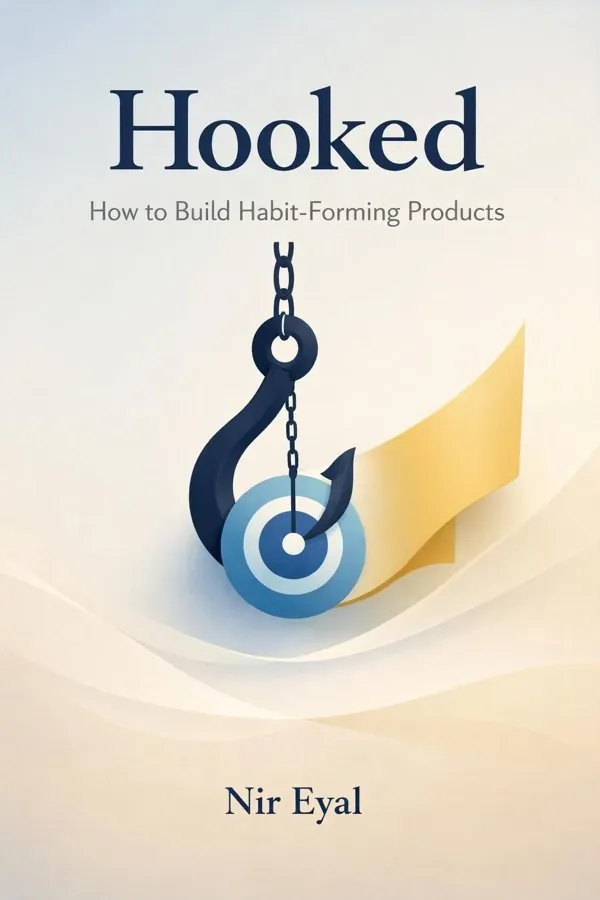
Hooked: How to Build Habit-Forming Products: Summary & Key Insights
by Nir Eyal
 10 min9 chaptersAudio available
Key Takeaways from Hooked: How to Build Habit-Forming Products
The most powerful products do not rely on constant persuasion; they become routine.
No habit begins in a vacuum; something must prompt the behavior.
People do not do what is best; they do what is easiest in the moment.
Predictability satisfies, but unpredictability compels.
The moment users put something of themselves into a product, that product becomes harder to leave.
What Is Hooked: How to Build Habit-Forming Products About?
Hooked: How to Build Habit-Forming Products by Nir Eyal is a marketing book spanning 8 pages. Why do some products become part of our daily routines while others are quickly forgotten? In Hooked, Nir Eyal answers that question by showing how successful companies design products that users return to again and again, often with little conscious effort. Drawing from behavioral psychology, neuroscience, and years of work in the technology world, Eyal introduces the Hook Model, a four-step process made up of Trigger, Action, Variable Reward, and Investment. Together, these stages explain how habits are formed and reinforced over time. What makes this book especially valuable is its blend of theory and application. Eyal does not simply describe why habits exist; he shows product builders, marketers, founders, and creators how to intentionally design experiences that fit into users’ lives. He also raises an important ethical question: when is habit-forming design helpful, and when does it become manipulative? As an author, lecturer, and expert in behavioral design, Eyal brings both credibility and clarity to a topic that shapes modern business. Hooked matters because in a world crowded with choices, the products that win are often the ones that become habits.
This FizzRead summary covers all 9 key chapters of Hooked: How to Build Habit-Forming Products in approximately 10 minutes, distilling the most important ideas, arguments, and takeaways from Nir Eyal's work. Also available as an audio summary and Key Quotes Podcast.
Hooked: How to Build Habit-Forming Products
Why do some products become part of our daily routines while others are quickly forgotten? In Hooked, Nir Eyal answers that question by showing how successful companies design products that users return to again and again, often with little conscious effort. Drawing from behavioral psychology, neuroscience, and years of work in the technology world, Eyal introduces the Hook Model, a four-step process made up of Trigger, Action, Variable Reward, and Investment. Together, these stages explain how habits are formed and reinforced over time.
What makes this book especially valuable is its blend of theory and application. Eyal does not simply describe why habits exist; he shows product builders, marketers, founders, and creators how to intentionally design experiences that fit into users’ lives. He also raises an important ethical question: when is habit-forming design helpful, and when does it become manipulative? As an author, lecturer, and expert in behavioral design, Eyal brings both credibility and clarity to a topic that shapes modern business. Hooked matters because in a world crowded with choices, the products that win are often the ones that become habits.
Who Should Read Hooked: How to Build Habit-Forming Products?
This book is perfect for anyone interested in marketing and looking to gain actionable insights in a short read. Whether you're a student, professional, or lifelong learner, the key ideas from Hooked: How to Build Habit-Forming Products by Nir Eyal will help you think differently.
- ✓Readers who enjoy marketing and want practical takeaways
- ✓Professionals looking to apply new ideas to their work and life
- ✓Anyone who wants the core insights of Hooked: How to Build Habit-Forming Products in just 10 minutes
Want the full summary?
Get instant access to this book summary and 100K+ more with Fizz Moment.
Get Free SummaryAvailable on App Store • Free to download
Key Chapters
The most powerful products do not rely on constant persuasion; they become routine. That is the central insight behind Nir Eyal’s Hook Model, a framework for understanding how companies build products people use repeatedly without needing heavy advertising every time. The model consists of four steps: Trigger, Action, Variable Reward, and Investment. When users move through this cycle often enough, the behavior becomes increasingly automatic.
The brilliance of the Hook Model is that it explains how engagement compounds. A trigger prompts behavior. An action is taken because it is easy and promises a benefit. A variable reward creates anticipation and emotional payoff. Then an investment by the user, such as adding data, building a profile, following others, or storing preferences, increases the likelihood of returning. Each loop strengthens the user’s connection to the product while reducing the company’s reliance on paid re-engagement.
Consider how a social media app works. A notification appears, acting as a trigger. The user opens the app, which is the action. Inside, they find an unpredictable mix of likes, comments, messages, or interesting posts, which serves as the variable reward. They then post, comment, or update their profile, creating investment that improves the product for future use. The next trigger becomes more effective because something personal now awaits them.
This model is useful far beyond apps. Fitness platforms, educational products, media services, and even internal workplace tools can use the same cycle. The key is not manipulation but relevance. Products succeed when they repeatedly solve a meaningful need in a way that feels easy and satisfying.
Actionable takeaway: Map your product experience against the four Hook steps and identify where the loop is weak, unclear, or missing.
No habit begins in a vacuum; something must prompt the behavior. Eyal argues that triggers are the starting point of all user action, and understanding them is essential for building habit-forming products. He distinguishes between external triggers and internal triggers. External triggers are cues in the environment, such as push notifications, emails, icons, ads, or a friend’s recommendation. Internal triggers are more powerful: they are emotional states or recurring situations that drive people to seek relief, stimulation, or connection.
External triggers are useful when a product is new because users have not yet formed an automatic association. A reminder email from a language-learning app may prompt a lesson. A red badge on a messaging app may draw attention. Over time, however, the goal is for the product to become linked with an internal trigger. People open Instagram when bored, check email when uncertain, use meditation apps when anxious, or turn to music when they need emotional regulation.
This distinction matters because external triggers are costly and limited, while internal triggers can drive repeated use almost indefinitely. To identify the right internal trigger, product teams must understand the user’s pain point. What discomfort, question, or desire sends them looking for a solution? The best products attach themselves to frequent emotions such as loneliness, stress, curiosity, indecision, or fear of missing out.
For example, a budgeting app should not merely remind users to log expenses. It should connect to the internal trigger of financial anxiety and position itself as the easiest path to regaining control. Similarly, a professional networking platform may be triggered by career uncertainty rather than by generic emails.
Actionable takeaway: Identify the emotional or situational discomfort your product addresses, then design external triggers that gradually connect users to that deeper internal trigger.
People do not do what is best; they do what is easiest in the moment. In Hooked, Eyal explains that after a trigger comes action, defined as the simplest behavior done in anticipation of a reward. This idea draws heavily on behavioral psychology, especially B.J. Fogg’s model that behavior occurs when motivation, ability, and a prompt converge at the same time. If an action is too complicated, even highly motivated users may abandon it.
This is why successful products reduce friction relentlessly. Logging in should be simple. Navigation should be obvious. Buttons should be clear. The desired behavior should require as little effort as possible. If a user wants to watch a video, they should not face a five-step setup. If they want to purchase a product, checkout should feel almost effortless. Convenience is not a nice extra; it is central to habit formation.
Eyal emphasizes that motivation can come from seeking pleasure, avoiding pain, seeking hope, avoiding fear, seeking social acceptance, or avoiding rejection. But even strong motivation has limits. That is why ability matters so much. Reducing time, money, physical effort, mental effort, social deviance, or non-routine behavior makes action more likely.
Think of a search engine. The user experiences uncertainty, types a few words, and gets immediate value. The action is extremely simple. Or consider a ride-sharing app: open the app, enter a destination, tap once. The low effort supports frequent repetition.
Teams often fail because they add features instead of simplifying behavior. More options can lower ability by increasing confusion. The right question is not, “What else can we make users do?” but “What is the easiest next action that moves them forward?”
Actionable takeaway: Audit your core user journey and remove one major source of friction so the desired action becomes simpler, faster, and more intuitive.
Predictability satisfies, but unpredictability compels. One of Eyal’s most memorable arguments is that variable rewards are especially effective because the brain is highly responsive to uncertainty. When users know they might receive something valuable, but cannot predict exactly when or what, they are more likely to stay engaged. This principle appears in everything from social feeds to games to email inboxes.
Eyal identifies three broad categories of variable rewards. Rewards of the tribe are social rewards, such as recognition, validation, attention, and belonging. Likes, comments, shares, and replies all fit here. Rewards of the hunt involve searching for resources or information, such as discovering useful content, deals, opportunities, or answers. Search engines, news feeds, and shopping platforms often use this type. Rewards of the self relate to mastery, competence, and completion. Progress bars, streaks, achievements, and personal records tap into this desire.
The key is not randomness for its own sake. A variable reward must still be relevant to the user’s motivation. If a user opens a product and repeatedly finds noise instead of value, trust erodes. But when the reward is meaningful and somewhat unpredictable, anticipation grows. This explains why people refresh social media, check messages repeatedly, or return to online marketplaces.
A language app, for example, can combine self-rewards through progress tracking and tribe rewards through peer comparisons. A content platform can use hunt rewards by offering an always-changing stream of useful material tailored to user interests. The variable element keeps the experience fresh.
Designers should use this carefully. The aim is not addiction through empty stimulation but sustained engagement through meaningful discovery, recognition, or progress.
Actionable takeaway: Identify which type of variable reward best fits your product and redesign the user experience so each return visit offers fresh but relevant value.
The moment users put something of themselves into a product, that product becomes harder to leave. In Hooked, Eyal explains that investment is the fourth step in the cycle and a crucial reason habits become durable over time. Unlike rewards, which users receive immediately, investments are actions that improve the service for the future. They may include saving preferences, uploading content, following people, building a reputation, inviting friends, or accumulating data and history.
Investment works for several reasons. First, it increases the likelihood of a return because users want to realize value from what they have already put in. Second, it stores value inside the product, making switching costs higher. Third, it often personalizes the experience, which makes the next interaction more relevant. The more tailored the experience becomes, the less replaceable the product feels.
Take a music streaming service. If users create playlists, follow artists, and train recommendation algorithms through listening behavior, their future experience improves. The service feels uniquely theirs. Similarly, a project management tool becomes sticky once teams have built workflows, assigned responsibilities, and uploaded files. Leaving means losing context and convenience.
A smart investment does not ask for too much too early. If a product demands heavy setup before proving value, users may quit. Instead, the request for investment should come after a satisfying reward, when the user is more willing to contribute. This sequence is central to the Hook Model.
For marketers and product builders, the lesson is to design investments that create genuine user benefit, not busywork. The best investments deepen relevance while paving the way for stronger future triggers.
Actionable takeaway: After delivering value, ask users for a small contribution that personalizes the next experience and increases the product’s usefulness over time.
A single great experience rarely creates a habit; repetition does. Eyal emphasizes that the Hook Model is not a one-time event but a loop that strengthens with each pass. As users move through Trigger, Action, Variable Reward, and Investment repeatedly, the behavior requires less conscious thought. Eventually, external prompts become less necessary because internal triggers take over.
This continuous motion is what separates products people occasionally use from products woven into daily life. Early on, a product may depend heavily on paid acquisition, reminders, and promotional messaging. But if the experience is designed well, users start returning for their own reasons. They begin to think of the product when they feel a certain emotion or encounter a recurring need. At that point, the habit loop is doing the work.
Consider a note-taking app. At first, an onboarding email may remind users to capture ideas. Over time, if the app proves fast and reliable, users begin opening it automatically whenever inspiration strikes or they fear forgetting something. Their stored notes become investments, the possibility of rediscovering useful ideas becomes a variable reward, and the internal trigger becomes mental overload or creative urgency.
The loop also explains why shallow engagement tactics fail. If the reward is weak, the user will not invest. If the action is cumbersome, the loop breaks. If triggers are irrelevant, users never start. Strong habit-forming products align every stage so the next cycle becomes easier and more natural.
For businesses, this means retention is often a design challenge, not just a marketing problem. Habit formation depends on repeated successful interactions that meet real needs. The companies that understand this build durable customer relationships rather than short-lived spikes in attention.
Actionable takeaway: Focus on improving repeat usage, not just first-time acquisition, by designing each Hook stage to lead naturally into the next.
The ability to shape habits is powerful, and power always raises ethical questions. Eyal does not ignore the darker side of behavioral design. Instead, he argues that habit-forming techniques should be used responsibly, especially because they can influence attention, routines, and emotional states at scale. A product that successfully builds habits can improve lives, but it can also exploit vulnerabilities if designed without care.
Eyal suggests an important moral test: would the maker use the product themselves, and does it materially improve the user’s life? This framing pushes designers and founders to ask whether they are solving a genuine problem or simply engineering compulsion. A meditation app that helps reduce stress, a health platform that encourages exercise, or a learning tool that supports long-term growth may justify habit-forming design because repeated use benefits the user. By contrast, products that maximize engagement while delivering little real value risk crossing into manipulation.
This issue is especially relevant in social media, gaming, and advertising-driven platforms. Features like endless scrolling, notifications, and streaks can drive usage, but if they are optimized solely for time spent rather than user well-being, trust may erode. Ethical design also matters commercially. Users are more likely to remain loyal to products they feel serve them rather than exploit them.
Teams should therefore define success carefully. Metrics such as retention and daily active users are important, but they should be balanced with indicators of user satisfaction, outcomes, and long-term trust. Responsible product design asks not only, “Can we make this habit-forming?” but also, “Should we?” and “For whose benefit?”
Actionable takeaway: Use the Hook Model only for products that genuinely improve users’ lives, and evaluate success with both engagement metrics and user well-being in mind.
People do not build habits around products just because they are clever; they build habits around products that repeatedly solve meaningful problems. One of Eyal’s most practical insights is that the best opportunities for habit-forming products lie in frequent pain points. To find these opportunities, entrepreneurs and teams must study what people already do, what frustrations they experience, and which workarounds they have adopted.
A useful starting point is to ask what users do right before they turn to your product or a competing solution. What emotion or task is present? Are they bored, anxious, curious, lonely, rushed, or uncertain? Existing habits reveal unmet needs. If people constantly switch between tools, create spreadsheets, send reminder emails to themselves, or rely on memory for important tasks, those frictions may signal an opportunity to build a better habit-forming solution.
Eyal encourages creators to focus on behaviors that occur frequently enough to become habits. A product used once a year will struggle to become embedded in daily life, no matter how well designed it is. Frequency matters because habits are formed through repetition. This is why messaging, entertainment, productivity, learning, and health routines are fertile ground: they connect to recurring needs.
For example, a meal-planning app has stronger habit potential if it addresses the recurring stress of deciding what to cook each day, not just occasional recipe browsing. A workplace communication platform succeeds when it becomes the default response to coordination uncertainty. In both cases, the product attaches itself to a problem people face often.
The strategic lesson is that habit-forming design should begin with the user’s pain, not the company’s growth target. Growth follows when the solution becomes indispensable.
Actionable takeaway: Interview users to uncover recurring frustrations and design your product around a need that appears frequently enough to support true habit formation.
Habit-forming design is not magic; it can be tested, measured, and improved. Eyal proposes practical ways for teams to evaluate whether their product has the characteristics needed to build habits. One useful approach is the Habit Testing process: identify habitual users, codify what they do, modify the experience based on those patterns, and then test changes systematically. This moves the Hook Model from theory into operational practice.
The first step is to define what a habitual user looks like. Depending on the product, that might mean someone who returns multiple times per week, creates content regularly, or relies on the service during key moments. Once these users are identified, teams should study their paths. What triggered them? Which actions were easiest? What rewards kept them engaged? What investments did they make that others did not?
This analysis often reveals surprising truths. A feature the team thought was central may matter less than a simple onboarding step. A particular notification may be effective for retention, while another causes fatigue. Users who become loyal may all complete a certain investment early, such as following five accounts, saving ten items, or customizing their dashboard.
From there, teams can improve the product intentionally. They can simplify actions, refine triggers, adjust rewards, or redesign investment prompts. Importantly, Eyal’s framework encourages iterative learning rather than guesswork. Habit formation should be approached with evidence and experimentation.
This idea is especially valuable for startups and marketers, who often chase growth hacks instead of understanding behavior deeply. Sustainable retention comes from disciplined observation and continuous refinement of the user journey.
Actionable takeaway: Identify your most loyal users, study the behaviors they share, and use those insights to redesign the product experience for everyone else.
All Chapters in Hooked: How to Build Habit-Forming Products
About the Author
Nir Eyal is an author, lecturer, and behavioral design expert known for his work on the psychology of habits, technology, and attention. He has taught at Stanford University’s Graduate School of Business and has advised startups, entrepreneurs, and major companies on how products influence user behavior. Eyal became widely recognized for Hooked, in which he introduced the Hook Model, a framework explaining how habit-forming products are designed. He later expanded his exploration of attention and behavior in Indistractable, a book focused on how people can regain control over their focus in an increasingly distracting world. His writing combines research from psychology, neuroscience, and business strategy, making complex ideas accessible and highly practical for product builders, marketers, and modern knowledge workers.
Get This Summary in Your Preferred Format
Read or listen to the Hooked: How to Build Habit-Forming Products summary by Nir Eyal anytime, anywhere. FizzRead offers multiple formats so you can learn on your terms — all free.
Available formats: App · Audio · PDF · EPUB — All included free with FizzRead
Download Hooked: How to Build Habit-Forming Products PDF and EPUB Summary
Key Quotes from Hooked: How to Build Habit-Forming Products
“The most powerful products do not rely on constant persuasion; they become routine.”
“No habit begins in a vacuum; something must prompt the behavior.”
“People do not do what is best; they do what is easiest in the moment.”
“Predictability satisfies, but unpredictability compels.”
“The moment users put something of themselves into a product, that product becomes harder to leave.”
Frequently Asked Questions about Hooked: How to Build Habit-Forming Products
Hooked: How to Build Habit-Forming Products by Nir Eyal is a marketing book that explores key ideas across 9 chapters. Why do some products become part of our daily routines while others are quickly forgotten? In Hooked, Nir Eyal answers that question by showing how successful companies design products that users return to again and again, often with little conscious effort. Drawing from behavioral psychology, neuroscience, and years of work in the technology world, Eyal introduces the Hook Model, a four-step process made up of Trigger, Action, Variable Reward, and Investment. Together, these stages explain how habits are formed and reinforced over time. What makes this book especially valuable is its blend of theory and application. Eyal does not simply describe why habits exist; he shows product builders, marketers, founders, and creators how to intentionally design experiences that fit into users’ lives. He also raises an important ethical question: when is habit-forming design helpful, and when does it become manipulative? As an author, lecturer, and expert in behavioral design, Eyal brings both credibility and clarity to a topic that shapes modern business. Hooked matters because in a world crowded with choices, the products that win are often the ones that become habits.
More by Nir Eyal
You Might Also Like
Captivology: The Science of Capturing People's Attention
Ben Parr
10 min
Marketing 5.0: Technology for Humanity
Philip Kotler, Hermawan Kartajaya, Iwan Setiawan
10 min
Marketing Strategy
Paul Fifield
10 min
UnMarketing: Stop Marketing. Start Engaging.
Scott Stratten
10 min
$100M Leads: How to Get Strangers to Want to Buy Your Stuff
Alex Hormozi
10 min
80/20 Sales and Marketing: The Definitive Guide to Working Less and Making More
Perry Marshall
10 minBrowse by Category
Ready to read Hooked: How to Build Habit-Forming Products?
Get the full summary and 100K+ more books with Fizz Moment.