
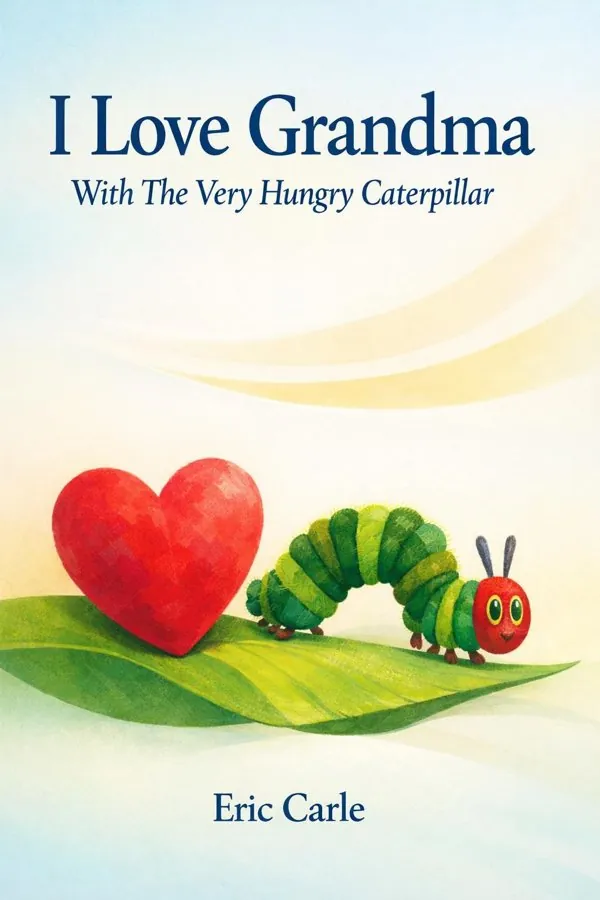
I Love Grandma With The Very Hungry Caterpillar: Summary & Key Insights
by Eric Carle
 10 min9 chaptersAudio available
Key Takeaways from I Love Grandma With The Very Hungry Caterpillar
One of childhood’s deepest pleasures is not found in grand events but in shared attention.
This book honors that nurturing quality by presenting Grandma as a source of comfort, delight, and steady affection.
Children often learn best not from formal instruction, but from relationship-rich moments that feel natural and alive.
Love becomes more powerful when it is noticed and named.
Children do not need complicated language to understand profound emotions.
What Is I Love Grandma With The Very Hungry Caterpillar About?
I Love Grandma With The Very Hungry Caterpillar by Eric Carle is a parenting book spanning 4 pages. I Love Grandma With The Very Hungry Caterpillar is a small picture book with a surprisingly big emotional purpose: it celebrates the warmth, safety, fun, and tenderness that many children associate with their grandmothers. Using the instantly recognizable charm of Eric Carle’s beloved caterpillar and his bright, textured collage art, the book turns a simple declaration of love into a meaningful family reading experience. Rather than telling a complex plot, it offers a series of affectionate observations about what makes Grandma special, helping young children name feelings they may sense but not yet know how to express. That simplicity is exactly why the book matters. For parents, grandparents, and caregivers, it creates an easy opening for conversations about gratitude, family bonds, and intergenerational love. For children, it reassures them that being cared for, taught, and delighted by a grandparent is something worth celebrating. Eric Carle was uniquely qualified to create this kind of story. Across decades of work, he mastered the art of speaking to children with gentleness, clarity, and visual wonder. Here, he uses that same gift to honor one of childhood’s most enduring relationships: the loving bond between a child and Grandma.
This FizzRead summary covers all 9 key chapters of I Love Grandma With The Very Hungry Caterpillar in approximately 10 minutes, distilling the most important ideas, arguments, and takeaways from Eric Carle's work. Also available as an audio summary and Key Quotes Podcast.
I Love Grandma With The Very Hungry Caterpillar
I Love Grandma With The Very Hungry Caterpillar is a small picture book with a surprisingly big emotional purpose: it celebrates the warmth, safety, fun, and tenderness that many children associate with their grandmothers. Using the instantly recognizable charm of Eric Carle’s beloved caterpillar and his bright, textured collage art, the book turns a simple declaration of love into a meaningful family reading experience. Rather than telling a complex plot, it offers a series of affectionate observations about what makes Grandma special, helping young children name feelings they may sense but not yet know how to express.
That simplicity is exactly why the book matters. For parents, grandparents, and caregivers, it creates an easy opening for conversations about gratitude, family bonds, and intergenerational love. For children, it reassures them that being cared for, taught, and delighted by a grandparent is something worth celebrating. Eric Carle was uniquely qualified to create this kind of story. Across decades of work, he mastered the art of speaking to children with gentleness, clarity, and visual wonder. Here, he uses that same gift to honor one of childhood’s most enduring relationships: the loving bond between a child and Grandma.
Who Should Read I Love Grandma With The Very Hungry Caterpillar?
This book is perfect for anyone interested in parenting and looking to gain actionable insights in a short read. Whether you're a student, professional, or lifelong learner, the key ideas from I Love Grandma With The Very Hungry Caterpillar by Eric Carle will help you think differently.
- ✓Readers who enjoy parenting and want practical takeaways
- ✓Professionals looking to apply new ideas to their work and life
- ✓Anyone who wants the core insights of I Love Grandma With The Very Hungry Caterpillar in just 10 minutes
Want the full summary?
Get instant access to this book summary and 100K+ more with Fizz Moment.
Get Free SummaryAvailable on App Store • Free to download
Key Chapters
One of childhood’s deepest pleasures is not found in grand events but in shared attention. I Love Grandma With The Very Hungry Caterpillar captures that truth beautifully by showing that what makes time with Grandma memorable is not extravagance, but presence. The child’s affection comes through in simple, happy observations that suggest delight in being with Grandma, noticing what she does, and feeling special in her company. That emotional energy echoes the spirit of The Very Hungry Caterpillar itself: curiosity, eagerness, and openness to experience.
This idea matters because children often define love through time and attention. A grandparent who listens, reads, walks, bakes, or simply sits nearby is giving more than an activity; they are creating belonging. The book gently reminds adults that children rarely need perfection. They need warmth, rhythm, and connection. A visit to the garden, a snack at the table, or a familiar routine can become deeply meaningful when it is shared with affection.
For families, this has practical value. Grandparents do not need to entertain constantly or spend money to be memorable. Parents can also use the book to help children anticipate visits with Grandma, reflect on favorite shared moments, or create traditions of their own. Even when distance separates family members, small rituals like video calls, mailed drawings, or bedtime recordings can preserve that sense of togetherness.
The deeper message is simple: love grows through repeated moments of joyful attention. What a child remembers is often not what happened, but how it felt to be with someone who was fully there. Actionable takeaway: create one regular, repeatable Grandma tradition—reading a book, sharing fruit, drawing together, or taking a short walk—and let consistency turn ordinary time into lasting emotional security.
A grandmother’s love often feels different not because it is greater than a parent’s love, but because it carries a distinct emotional texture: patience without hurry, tenderness without demand, and wisdom without pressure. This book honors that nurturing quality by presenting Grandma as a source of comfort, delight, and steady affection. The child’s admiration suggests that Grandma’s presence is reassuring, a place where love is felt in actions as much as words.
Children thrive when they are surrounded by adults who make them feel safe and seen. Grandmothers often contribute to this by offering slower rhythms, gentle encouragement, and a special form of emotional availability. They may hold family stories, favorite recipes, songs, habits, or ways of speaking that root a child in continuity. In a fast-moving world, that kind of care becomes even more valuable. It teaches children that love can be calm, dependable, and deeply attentive.
The book also helps adults reflect on how nurturing is expressed. It is not only in hugs and praise, but in preparing a snack, noticing a child’s mood, saving a drawing, repeating a favorite game, or remembering what matters to them. Parents reading this book with their children can ask, “What makes Grandma kind?” or “How does Grandma help you feel better?” Such questions strengthen emotional vocabulary and gratitude.
For grandparents, the lesson is affirming: the quiet ways they care are not small. They are formative. A child may not articulate it fully, but they absorb the patience, softness, and security that Grandma provides. These experiences shape how children understand trust, family, and love.
Actionable takeaway: after reading, invite a child to describe three caring things Grandma does. Then turn one of those into a thank-you note, drawing, or voice message so affection becomes both recognized and expressed.
Children often learn best not from formal instruction, but from relationship-rich moments that feel natural and alive. I Love Grandma With The Very Hungry Caterpillar points toward this kind of learning by linking love with shared discovery. In the world of Eric Carle, wonder is never separate from growth, and Grandma becomes a guide who helps children notice, explore, and understand their surroundings. Her wisdom is not presented as lectures or rules, but as a gentle way of being in the world.
This matters because grandparents often teach through ordinary life. A grandmother may explain how flowers grow, why birds visit the yard, how dough changes in the oven, or what happened when she was young. These moments teach facts, yes, but they also teach attention, patience, memory, and curiosity. A child learns that the world is full of details worth noticing. In this sense, Grandma is not just a caregiver; she is a bridge between generations and a guide to meaning.
The Caterpillar’s presence reinforces the theme of transformation. Just as the caterpillar grows through stages, children also grow through conversations, observation, and repeated shared experiences. Grandmothers can support this by asking questions instead of always giving answers: “What do you notice?” “What do you think will happen next?” “Why do you think that changed?” This invites children into active discovery.
Parents can apply this lesson by treating visits with Grandma as educational in the broadest sense. Family traditions, nature walks, recipe-making, gardening, and storytelling all become forms of learning. These are especially powerful because they are emotionally anchored; children remember what they learn when it is connected to someone they love.
Actionable takeaway: choose one simple “Grandma discovery ritual,” such as planting seeds, looking for insects, baking together, or sharing old photos, and use it to nurture both curiosity and connection.
Love becomes more powerful when it is noticed and named. One of the most meaningful aspects of I Love Grandma With The Very Hungry Caterpillar is that it gives children language for appreciation. The book is, at heart, an expression of gratitude. It tells young readers that the love, care, fun, and comfort they receive from Grandma are worth recognizing aloud. That is a valuable lesson, because children often feel affection deeply long before they know how to communicate it.
Gratitude in families is not about politeness alone. It is about helping children understand that relationships are built from giving, receiving, and acknowledging care. When a child says, “I love Grandma because she reads with me,” or “Grandma makes me feel safe,” they are doing more than offering a compliment. They are developing awareness of emotional support and learning to value the people who provide it.
This can have lasting effects. Children who practice gratitude tend to become more reflective, empathetic, and emotionally expressive. They begin to understand that family members contribute in different ways and that love deserves response, not assumption. Grandparents, in turn, often feel deeply seen when children express affection through small gestures such as drawings, notes, hugs, or remembered routines.
The book offers a natural opportunity for family rituals centered on appreciation. It can be read before Mother’s Day, birthdays, family gatherings, or everyday visits. Parents might ask children to complete the sentence, “I love Grandma because…” and write down their answers. Even very young children can participate through pictures or spoken messages.
The larger contribution of the book is that it makes gratitude feel joyful rather than forced. It links appreciation with warmth, memory, and love.
Actionable takeaway: after reading, help a child create one concrete expression of gratitude for Grandma today—a card, a phone call, a recorded message, or a simple sentence shared face-to-face.
Children do not need complicated language to understand profound emotions. In fact, the opposite is often true: the clearest words can carry the deepest meaning. Eric Carle’s book demonstrates this by using simple, affectionate text to communicate love, admiration, and connection in a way that very young readers can absorb. The emotional effectiveness of the book comes from its clarity. It trusts that children can feel the truth of a message without needing it explained at length.
This is one reason picture books matter so much in early childhood. They offer emotional rehearsal. A child hears a phrase about loving Grandma and begins to connect that phrase to real experiences: being comforted, playing together, laughing, learning, or feeling safe. Simple wording creates accessibility, repetition creates memory, and emotional resonance creates understanding.
Adults can learn from this. When talking to young children about family relationships, it helps to use direct, concrete language: “Grandma takes care of you,” “Grandma loves spending time with you,” “You feel happy when Grandma visits.” These statements help children identify emotions and relationships without confusion. They are especially useful for children who are still developing verbal skills.
The book also models how affection can be expressed through repeated reading. Children often want the same book again and again, and each repetition strengthens emotional association. Over time, they may begin to recite phrases, point to meaningful images, or connect the book to real life. That is how simple text becomes part of family culture.
For parents, teachers, and grandparents, the lesson is practical: do not underestimate the power of short, loving sentences. Young children often understand more from heartfelt simplicity than from elaborate explanation.
Actionable takeaway: borrow the book’s approach by helping a child complete short emotional sentences such as “I love Grandma when…,” “Grandma helps me…,” and “With Grandma, I feel…,” using their own simple words.
Before children can fully explain what they feel, they often see and sense it. That is why illustration is not just decoration in a picture book; it is part of the meaning. In I Love Grandma With The Very Hungry Caterpillar, Eric Carle’s iconic collage artwork helps communicate warmth, playfulness, and affection in a way words alone could not. The familiar visual world of the Caterpillar invites children in, while the bold colors and textured forms create a mood of safety, delight, and attention.
Young readers are highly responsive to visual cues. A bright page can signal excitement. A soft expression can convey tenderness. Repetition of familiar imagery can create comfort. Carle understood this deeply. His art makes emotions visible without overexplaining them. In a book centered on Grandma, that visual language helps children feel the relationship as much as understand it.
This offers practical insight for adults reading with children. Rather than rushing through the text, pause to talk about what the pictures show. Ask, “What do you think is happening here?” “How does this picture feel?” “What colors do you notice?” This strengthens visual literacy and emotional literacy at the same time. Children learn that stories are made not only of events, but of moods, gestures, and atmosphere.
The book can also inspire creative extension activities. A child might make a collage for Grandma, draw a favorite shared moment, or create a “Grandma page” filled with colors and objects that remind them of her. These activities help children process affection through making, which is especially useful for early learners.
Carle’s contribution here is subtle but important: he reminds us that children read with their eyes, feelings, and memories all at once.
Actionable takeaway: during your next read-aloud, spend as much time discussing the illustrations as the text, then invite the child to create a picture of something they love doing with Grandma.
Children feel secure when love becomes predictable. One of the quiet truths behind this book is that a strong bond with Grandma is often built through recurring rituals: a certain greeting, a snack, a story, a walk, a song, or a phrase repeated at bedtime. The book celebrates Grandma not as an abstract idea, but as someone whose loving presence is felt in repeated, memorable moments. That pattern matters because children experience stability through routine.
Family rituals do more than organize time. They tell children, “This relationship is dependable.” A weekly visit, a seasonal tradition, or a familiar activity can become emotionally anchoring, especially in times of change. Grandparents often excel at this because they bring continuity. They may preserve customs across years, reminding children that they are part of a story larger than the present moment.
The beauty of rituals is that they do not need to be elaborate. Reading one favorite book every visit, sharing orange slices, watering plants together, or saying a special goodbye can become deeply meaningful. For long-distance families, rituals can still thrive through Sunday video calls, mailed postcards, or recorded stories. What matters most is repetition linked to affection.
This is particularly helpful for children navigating transitions such as starting school, moving homes, or adjusting to family changes. A familiar grandmother ritual can serve as an emotional anchor. It offers reassurance that some forms of love remain steady.
The book invites adults to see these small customs as valuable rather than trivial. In a child’s memory, rituals often become the shape love takes.
Actionable takeaway: identify one simple Grandma ritual you can repeat consistently—such as a weekly call, a shared book, or a special snack—and protect it long enough for it to become part of the child’s emotional world.
A child’s sense of self is built not only through parents, but through the wider web of loving relationships around them. I Love Grandma With The Very Hungry Caterpillar highlights the special role grandparents can play in that process. Grandma represents more than affection; she often embodies family history, continuity, and belonging. Through her, a child may come to understand where they come from, what their family values, and how love is passed down across generations.
This is especially important in modern family life, where routines can be rushed and generations sometimes live far apart. Grandmothers can provide something unique: perspective. They may share stories about the parent as a child, describe family traditions, teach inherited skills, or offer emotional steadiness shaped by experience. These interactions help children feel rooted. They begin to understand that they are part of an ongoing family story, not just an isolated present.
The book supports this by framing Grandma as worthy of admiration and celebration. It gives emotional prominence to a relationship that is sometimes assumed rather than explored in children’s books. That matters because naming a bond strengthens it.
Families can build on this by creating opportunities for story-sharing. Looking at old photographs, cooking a family recipe, discussing traditions, or recording Grandma’s memories can all deepen a child’s sense of identity. Even simple conversations like “What games did you play when you were little?” can open rich intergenerational exchange.
The broader takeaway is that children become more secure when they know they are loved across generations. They do not just inherit traits or traditions; they inherit a sense of being held in a larger circle of care.
Actionable takeaway: ask Grandma to share one family story, memory, or tradition with the child this week, and preserve it in a drawing, note, voice recording, or photo caption.
Some books are read once and forgotten, while others become emotional objects that carry memory long after the final page. I Love Grandma With The Very Hungry Caterpillar belongs to the second category. Because it is brief, warm, and giftable, it naturally lends itself to rituals of sharing: birthdays, visits, bedtime, holidays, or simple moments of affection between child and grandparent. Over time, the book can become more than a story. It can become a keepsake tied to a relationship.
This is one of the underrated powers of children’s literature. A picture book can hold memories of a voice, a lap, a routine, and a stage of childhood. Its physical presence matters. A worn corner, an inscription inside the cover, or a child’s repeated request to hear it again can transform a small book into a family artifact. In that sense, the emotional value of the book expands beyond its text.
Eric Carle’s work often functions this way because it combines iconic imagery with developmental accessibility. Children recognize the Caterpillar, adults trust the author, and families feel invited to share the book across generations. That shared cultural familiarity adds to its staying power.
There are practical ways to deepen this effect. Grandparents can write a personal note inside the book. Parents can date the first reading. Children can add a drawing or a handprint. A family might take a photo each time Grandma reads it at a different age. These gestures turn reading into remembrance.
The book’s lasting contribution is not only that it celebrates Grandma, but that it can become part of what Grandma leaves behind: a memory of love made tangible through pages.
Actionable takeaway: turn the book into a keepsake by adding a handwritten note, date, or shared memory inside the cover, so future readings carry both story and family history.
All Chapters in I Love Grandma With The Very Hungry Caterpillar
About the Author
Eric Carle (1929–2021) was a celebrated American author and illustrator whose picture books shaped the reading lives of millions of children around the world. He is best known for The Very Hungry Caterpillar, first published in 1969, which became an international classic. Carle’s signature style combined hand-painted tissue-paper collage with simple, rhythmic text, creating books that were visually distinctive and developmentally engaging for young readers. Across a long career, he wrote and illustrated many beloved titles that explored nature, growth, counting, color, and everyday wonder. His work is widely admired for respecting children’s intelligence while speaking to them with warmth and clarity. In books like I Love Grandma With The Very Hungry Caterpillar, Carle’s enduring gift is clear: he could turn simple ideas into lasting emotional experiences.
Get This Summary in Your Preferred Format
Read or listen to the I Love Grandma With The Very Hungry Caterpillar summary by Eric Carle anytime, anywhere. FizzRead offers multiple formats so you can learn on your terms — all free.
Available formats: App · Audio · PDF · EPUB — All included free with FizzRead
Download I Love Grandma With The Very Hungry Caterpillar PDF and EPUB Summary
Key Quotes from I Love Grandma With The Very Hungry Caterpillar
“One of childhood’s deepest pleasures is not found in grand events but in shared attention.”
“This book honors that nurturing quality by presenting Grandma as a source of comfort, delight, and steady affection.”
“Children often learn best not from formal instruction, but from relationship-rich moments that feel natural and alive.”
“Love becomes more powerful when it is noticed and named.”
“Children do not need complicated language to understand profound emotions.”
Frequently Asked Questions about I Love Grandma With The Very Hungry Caterpillar
I Love Grandma With The Very Hungry Caterpillar by Eric Carle is a parenting book that explores key ideas across 9 chapters. I Love Grandma With The Very Hungry Caterpillar is a small picture book with a surprisingly big emotional purpose: it celebrates the warmth, safety, fun, and tenderness that many children associate with their grandmothers. Using the instantly recognizable charm of Eric Carle’s beloved caterpillar and his bright, textured collage art, the book turns a simple declaration of love into a meaningful family reading experience. Rather than telling a complex plot, it offers a series of affectionate observations about what makes Grandma special, helping young children name feelings they may sense but not yet know how to express. That simplicity is exactly why the book matters. For parents, grandparents, and caregivers, it creates an easy opening for conversations about gratitude, family bonds, and intergenerational love. For children, it reassures them that being cared for, taught, and delighted by a grandparent is something worth celebrating. Eric Carle was uniquely qualified to create this kind of story. Across decades of work, he mastered the art of speaking to children with gentleness, clarity, and visual wonder. Here, he uses that same gift to honor one of childhood’s most enduring relationships: the loving bond between a child and Grandma.
More by Eric Carle
You Might Also Like

Never Enough
Jennifer Breheny Wallace
10 min
Bluey: Sleepytime
Joe Brumm
10 min
In My Heart: A Book of Feelings
Jo Witek
10 min
Love From The Crayons
Drew Daywalt, Oliver Jeffers
10 min
Pete The Cat: Big Easter Adventure
James Dean, Kimberly Dean
10 min
Smart Money Smart Kids: Raising the Next Generation to Win with Money
Dave Ramsey, Rachel Cruze
10 minBrowse by Category
Ready to read I Love Grandma With The Very Hungry Caterpillar?
Get the full summary and 100K+ more books with Fizz Moment.