
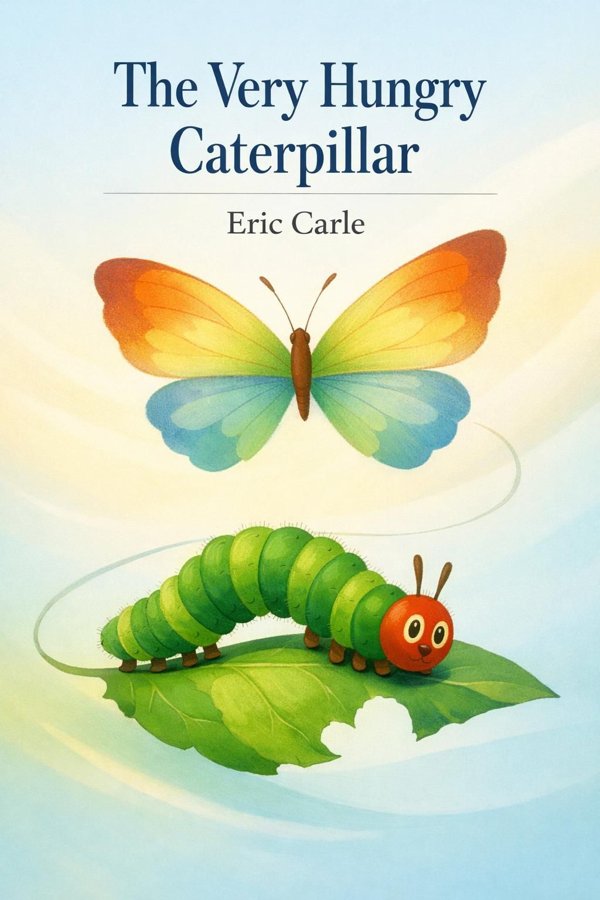
The Very Hungry Caterpillar: Summary & Key Insights
by Eric Carle
 10 min8 chaptersAudio available
Key Takeaways from The Very Hungry Caterpillar
Every meaningful transformation starts with something almost too small to notice.
Hunger in this story is more than appetite; it is a symbol of curiosity.
Children often feel safest when the world has structure, and The Very Hungry Caterpillar provides that structure through beautifully clear patterns.
The result is immediate: stomachache.
Modern life often celebrates constant activity, but The Very Hungry Caterpillar reminds us that growth also depends on stillness.
What Is The Very Hungry Caterpillar About?
The Very Hungry Caterpillar by Eric Carle is a general book. The Very Hungry Caterpillar by Eric Carle is one of the most beloved children’s books ever published, yet its brilliance lies in how much it accomplishes with extraordinary simplicity. At first glance, it is the story of a tiny caterpillar hatching from an egg and eating its way through a growing assortment of foods before transforming into a beautiful butterfly. But beneath that playful journey is a rich early-learning experience that introduces children to counting, days of the week, sequencing, growth, self-regulation, and the wonder of change. The book matters because it respects young readers: it teaches without preaching and delights without overwhelming. Its die-cut pages, vivid collage illustrations, and rhythmic structure invite participation, making reading feel like discovery. Eric Carle, a master of picture-book storytelling and visual design, created a work that has reached generations of families, classrooms, and libraries around the world. This is not just a charming story about hunger. It is a child’s first lesson in transformation, pattern, and the joy of learning through art.
This FizzRead summary covers all 8 key chapters of The Very Hungry Caterpillar in approximately 10 minutes, distilling the most important ideas, arguments, and takeaways from Eric Carle's work. Also available as an audio summary and Key Quotes Podcast.
The Very Hungry Caterpillar
The Very Hungry Caterpillar by Eric Carle is one of the most beloved children’s books ever published, yet its brilliance lies in how much it accomplishes with extraordinary simplicity. At first glance, it is the story of a tiny caterpillar hatching from an egg and eating its way through a growing assortment of foods before transforming into a beautiful butterfly. But beneath that playful journey is a rich early-learning experience that introduces children to counting, days of the week, sequencing, growth, self-regulation, and the wonder of change. The book matters because it respects young readers: it teaches without preaching and delights without overwhelming. Its die-cut pages, vivid collage illustrations, and rhythmic structure invite participation, making reading feel like discovery. Eric Carle, a master of picture-book storytelling and visual design, created a work that has reached generations of families, classrooms, and libraries around the world. This is not just a charming story about hunger. It is a child’s first lesson in transformation, pattern, and the joy of learning through art.
Who Should Read The Very Hungry Caterpillar?
This book is perfect for anyone interested in general and looking to gain actionable insights in a short read. Whether you're a student, professional, or lifelong learner, the key ideas from The Very Hungry Caterpillar by Eric Carle will help you think differently.
- ✓Readers who enjoy general and want practical takeaways
- ✓Professionals looking to apply new ideas to their work and life
- ✓Anyone who wants the core insights of The Very Hungry Caterpillar in just 10 minutes
Want the full summary?
Get instant access to this book summary and 100K+ more with Fizz Moment.
Get Free SummaryAvailable on App Store • Free to download
Key Chapters
Every meaningful transformation starts with something almost too small to notice. The opening of The Very Hungry Caterpillar makes this idea tangible: an egg rests quietly on a leaf under moonlight, and from that tiny beginning emerges a creature with enormous appetite and potential. For young readers, this is a reassuring message. Growth does not arrive fully formed. It starts with one small life, one first movement, one first need.
Eric Carle uses this simple beginning to mirror how children themselves grow. A child starts with limited language, coordination, and understanding, but develops through repeated experiences. The caterpillar does not become a butterfly immediately. It first exists as something humble, vulnerable, and unfinished. That arc helps children see becoming as natural rather than frustrating. Adults reading the story can use this as an opportunity to normalize patience and incremental progress.
This idea also has practical educational value. Parents and teachers can connect the story to a child’s own development: learning to tie shoes, count to ten, or read a sentence all begin with awkward first steps. In classrooms, the story can support lessons about life cycles and personal goal-setting. At home, it can help frame everyday effort in a positive way. Instead of asking, “Why aren’t you there yet?” adults can ask, “What small step are you taking today?”
The book’s emotional wisdom is that beginnings deserve respect. The egg is not insignificant because it is small; it contains everything that will later unfold. That perspective can shape how children think about themselves and how adults guide them.
Actionable takeaway: Use the caterpillar’s journey to help children identify one small beginning in their own lives and celebrate it as the first stage of something bigger.
Hunger in this story is more than appetite; it is a symbol of curiosity. The caterpillar keeps moving forward because it wants, seeks, and explores. That instinct captures one of the central truths of childhood: young minds learn best when they are actively reaching toward the world rather than passively receiving information.
As the caterpillar eats through one food after another, children encounter an irresistible pattern of discovery. Each turn of the page brings something new, inviting anticipation and participation. This structure mirrors how children naturally engage with learning. They ask what comes next, compare what changed, and delight in repetition with variation. Eric Carle turns curiosity into the engine of both plot and pedagogy.
In practical terms, the book models a powerful approach to teaching. Instead of overwhelming children with abstract lessons, it embeds concepts in an unfolding adventure. Counting becomes exciting because it is attached to apples, pears, plums, and strawberries. Sequencing matters because it reveals progress. Even the physical design of the pages invites tactile exploration. Curiosity is not treated as distraction; it is treated as the path to understanding.
Adults can apply this lesson beyond reading time. If a child is fascinated by bugs, weather, trucks, or baking, that interest can become the doorway to language, math, and science. Curiosity gives learning emotional energy. When children feel that exploration is welcome, they engage more deeply and retain more.
The story quietly suggests that appetite for experience is healthy. The caterpillar’s search is not wrong; it is part of becoming. The goal is not to suppress curiosity but to guide it toward meaning.
Actionable takeaway: Follow a child’s natural interests and build learning around what already sparks their curiosity, just as the story builds knowledge through the caterpillar’s eager exploration.
Children often feel safest when the world has structure, and The Very Hungry Caterpillar provides that structure through beautifully clear patterns. The caterpillar eats one apple on Monday, two pears on Tuesday, three plums on Wednesday, and so on. This repeated progression does more than create rhythm. It teaches children that events can be organized, expected, and understood.
Pattern recognition is one of the foundations of early learning. Before children can grasp more complex reasoning, they learn to detect repetition, sequence, and change. Eric Carle’s story supports this developmental step almost effortlessly. The days of the week follow a logical order. The number of foods increases. The visual layout reinforces the counting. The child begins to anticipate what is coming, and that anticipation creates both confidence and engagement.
This matters because understanding patterns helps children navigate far more than stories. Daily routines, songs, language sounds, and mathematical ideas all depend on recognizing recurring structures. A child who notices “Monday means one food, Tuesday means two” is practicing mental organization in a playful context. Repeated readings strengthen this skill, making the book especially valuable in homes and classrooms.
Adults can extend this pattern-based learning in practical ways. They can ask children what they think comes next, create fruit-counting games, map the week with household activities, or compare the story’s sequence to daily routines like brushing teeth or bedtime. Pattern awareness supports memory, prediction, and early problem-solving.
What makes the book effective is that it never turns this into a dry lesson. The pattern is pleasurable. It gives children the delight of mastering a system while still enjoying a story.
Actionable takeaway: Use repeated books, routines, and songs to help children identify patterns, then ask simple prediction questions to build confidence and early reasoning.
One of the book’s most memorable moments comes when the caterpillar shifts from fruit to a chaotic feast of cake, ice cream, pickle, cheese, salami, lollipop, pie, sausage, cupcake, and watermelon. The result is immediate: stomachache. In a child-friendly way, Eric Carle introduces a timeless truth that actions have consequences, especially when desire outruns balance.
What makes this lesson effective is its tone. The story does not shame the caterpillar or moralize harshly. It simply shows cause and effect. The caterpillar eats too much rich food and feels unwell. Then, after eating a green leaf, it feels better. This sequence offers children a concrete model of self-correction rather than punishment. The message is not “wanting is bad.” It is “choices affect how you feel.”
This distinction is important for both emotional and physical development. Young children are just beginning to understand their bodies, impulses, and limits. The book provides language for discussing overindulgence, discomfort, and recovery in a calm, accessible way. Adults can use it to talk about nutrition, moderation, and listening to one’s body without turning food into anxiety.
Beyond eating, the theme applies broadly. Too much screen time, too little sleep, too much rushing, or too little rest can all lead to feeling out of balance. Children benefit from learning that excess is not a moral failure but a signal. We can notice discomfort, make adjustments, and return to health.
The green leaf moment is especially wise. It emphasizes that restoration often comes through a simple reset, not dramatic intervention. The story makes room for mistakes and for repair.
Actionable takeaway: When children experience the consequences of overdoing something, help them connect the feeling to the choice and identify one simple, healthy reset.
Modern life often celebrates constant activity, but The Very Hungry Caterpillar reminds us that growth also depends on stillness. After all the eating and movement, the caterpillar builds a cocoon and stays inside for more than two weeks. This pause is not a delay in the story’s progress. It is the essential stage that makes transformation possible.
For children, this can be a profound lesson. Not every important change is visible. Sometimes growth happens in quiet spaces: during sleep, reflection, healing, or repetition. A child learning a new skill may appear stuck, only to show sudden improvement later. The cocoon offers a vivid image for these hidden processes. It tells young readers that waiting is not empty and that rest can be productive.
Adults can apply this insight in how they support children. There is often pressure to accelerate learning, overschedule activities, and measure development constantly. This book suggests a gentler truth: periods of pause are part of healthy becoming. A child may need downtime after stimulation, comfort after challenge, or silence before confidence appears.
This idea also supports emotional resilience. Children who struggle with impatience or frustration can benefit from seeing that even the caterpillar cannot skip stages. The butterfly emerges only after enough time has passed. In this sense, the story becomes a first lesson in trusting process.
At home or in school, readers can connect the cocoon stage to naps, bedtime, quiet reading, mindful breathing, or simply taking a break after a busy day. These are not interruptions to growth. They support it.
The book’s deeper wisdom is that becoming beautiful often looks like stopping for a while. In a culture of hurry, that is a meaningful countermessage.
Actionable takeaway: Treat rest, quiet time, and slow progress as essential parts of development, and remind children that important changes often happen before anyone can see them.
The final reveal of the butterfly is so satisfying because the story has prepared children to see change as both natural and wondrous. The caterpillar does not abandon its identity; it fulfills it. This is a subtle but powerful message about growth, especially for children who are constantly changing in body, ability, and understanding.
Eric Carle’s ending frames transformation not as loss but as emergence. The caterpillar’s earlier stages matter, yet they are not the end of the story. This helps children understand that becoming someone new does not erase who they were before. It builds on it. The hungry caterpillar, the cocoon, and the butterfly all belong to one continuous life.
Practically, this message can support conversations about developmental milestones, school transitions, and emotional growth. A child moving to a new classroom, learning to make friends, or overcoming fear may feel uncertain about change. The story offers a comforting metaphor: change can feel strange, but it can also reveal capacities that were there all along.
The book also cultivates awe. The butterfly is not only different; it is beautiful. That emphasis matters because children benefit from seeing growth as exciting rather than threatening. Adults can reinforce this by noticing positive changes in a child’s life: greater patience, stronger language, new independence, or kinder behavior. Naming these transformations helps children appreciate their own development.
On a broader level, the book fosters respect for the natural world. Metamorphosis becomes a doorway into science, observation, and wonder. Children learn that real life contains astonishing processes worth noticing.
Actionable takeaway: Use transitions and milestones as opportunities to remind children that change can uncover new strengths, and help them name one beautiful way they are growing.
Some books are read; The Very Hungry Caterpillar is also touched, counted, watched, and almost tasted through imagination. Its enduring success comes partly from how fully it engages the senses. The bright painted collage, the holes in the pages, the varied shapes of foods, and the repeated sounds of the text make reading an interactive experience rather than a passive one.
This multisensory quality matters because young children learn with their whole bodies. Abstract instruction often means little until it is connected to sight, sound, movement, and touch. Eric Carle understood this deeply. The visual design does not simply decorate the story; it teaches. Children see quantity, sequence, and scale. They physically turn pages with anticipation. They recognize foods by shape and color. The book invites participation at every step.
For parents and educators, this is a useful reminder that learning deepens when multiple senses are involved. Counting fruit is more memorable when children point to each item. Vocabulary sticks better when linked to pictures and actions. Storytime becomes more effective when children are asked to predict, trace, imitate, and respond.
This principle extends beyond books. Lessons about nature can involve outdoor observation. Lessons about food can include sorting or tasting. Lessons about language can include songs and gestures. The more channels through which a child experiences an idea, the stronger the understanding often becomes.
The story’s format also supports independence. Because the pages themselves offer clues, even very young children can begin to navigate the narrative with confidence. They are not just listeners; they are participants in meaning-making.
Actionable takeaway: Choose or create learning experiences that involve seeing, touching, saying, and doing so children can build understanding through active engagement.
It is easy to underestimate a picture book because of its brevity, but simplicity is often a mark of mastery. The Very Hungry Caterpillar proves that a short, child-friendly narrative can hold multiple layers of meaning at once. On the surface, it is a fun story about a caterpillar eating food. Underneath, it teaches number concepts, time, biological change, moderation, sequencing, and emotional reassurance about growth.
This is one reason the book has endured across generations. It meets children where they are while offering more than first appears. A toddler may enjoy naming foods. A preschooler may grasp counting and weekdays. An adult may appreciate the life-cycle metaphor and the elegant design. Great children’s literature works this way: it remains accessible without becoming shallow.
There is a practical lesson here for anyone teaching or communicating. Complex ideas do not always need complex language. In fact, clarity, repetition, and strong imagery often make concepts more memorable. Whether explaining routines to children, introducing classroom topics, or sharing family values, simple storytelling can be more powerful than lengthy instruction.
The book also reminds adults to pay attention to what children revisit. Repetition is often a sign of rich learning, not limited imagination. Each rereading can reveal a new layer of understanding, and the familiar structure gives children a sense of mastery.
In a broader cultural sense, the story demonstrates the importance of art that is both approachable and meaningful. Its simplicity opens the door; its depth keeps it relevant.
Actionable takeaway: Do not dismiss simple language or short forms; use clear, repeated, image-rich storytelling to communicate important ideas in ways children can truly absorb.
All Chapters in The Very Hungry Caterpillar
About the Author
Eric Carle was a celebrated American author, illustrator, and designer whose picture books shaped the reading lives of millions of children. Born in 1929 in Syracuse, New York, he spent part of his childhood in Germany before returning to the United States as an adult. He worked as a graphic designer and in advertising before turning to children’s books, where his distinctive collage style became instantly recognizable. Carle’s breakthrough came with The Very Hungry Caterpillar, published in 1969, which became one of the most famous picture books in the world. Across his career, he created books that combined striking visual art with simple, engaging early-learning concepts. His work remains a cornerstone of childhood literacy and imaginative education.
Get This Summary in Your Preferred Format
Read or listen to the The Very Hungry Caterpillar summary by Eric Carle anytime, anywhere. FizzRead offers multiple formats so you can learn on your terms — all free.
Available formats: App · Audio · PDF · EPUB — All included free with FizzRead
Download The Very Hungry Caterpillar PDF and EPUB Summary
Key Quotes from The Very Hungry Caterpillar
“Every meaningful transformation starts with something almost too small to notice.”
“Hunger in this story is more than appetite; it is a symbol of curiosity.”
“Children often feel safest when the world has structure, and The Very Hungry Caterpillar provides that structure through beautifully clear patterns.”
“One of the book’s most memorable moments comes when the caterpillar shifts from fruit to a chaotic feast of cake, ice cream, pickle, cheese, salami, lollipop, pie, sausage, cupcake, and watermelon.”
“Modern life often celebrates constant activity, but The Very Hungry Caterpillar reminds us that growth also depends on stillness.”
Frequently Asked Questions about The Very Hungry Caterpillar
The Very Hungry Caterpillar by Eric Carle is a general book that explores key ideas across 8 chapters. The Very Hungry Caterpillar by Eric Carle is one of the most beloved children’s books ever published, yet its brilliance lies in how much it accomplishes with extraordinary simplicity. At first glance, it is the story of a tiny caterpillar hatching from an egg and eating its way through a growing assortment of foods before transforming into a beautiful butterfly. But beneath that playful journey is a rich early-learning experience that introduces children to counting, days of the week, sequencing, growth, self-regulation, and the wonder of change. The book matters because it respects young readers: it teaches without preaching and delights without overwhelming. Its die-cut pages, vivid collage illustrations, and rhythmic structure invite participation, making reading feel like discovery. Eric Carle, a master of picture-book storytelling and visual design, created a work that has reached generations of families, classrooms, and libraries around the world. This is not just a charming story about hunger. It is a child’s first lesson in transformation, pattern, and the joy of learning through art.
More by Eric Carle
You Might Also Like
Duct Tape Marketing: The World's Most Practical Small Business Marketing Guide
John Jantsch
10 minDusk, Night, Dawn: On Revival and Courage
Anne Lamott
10 minFinish Big: How Great Entrepreneurs Exit Their Companies on Top
Bo Burlingham
10 minFirst As Tragedy, Then As Farce
Slavoj Zizek
10 minFirst Principles: What America's Founders Learned from the Greeks and Romans and How That Shaped Our Country
Thomas E. Ricks
10 minGood Habits, Bad Habits: The Science of Making Positive Changes That Stick
Wendy Wood
10 minBrowse by Category
Ready to read The Very Hungry Caterpillar?
Get the full summary and 100K+ more books with Fizz Moment.