
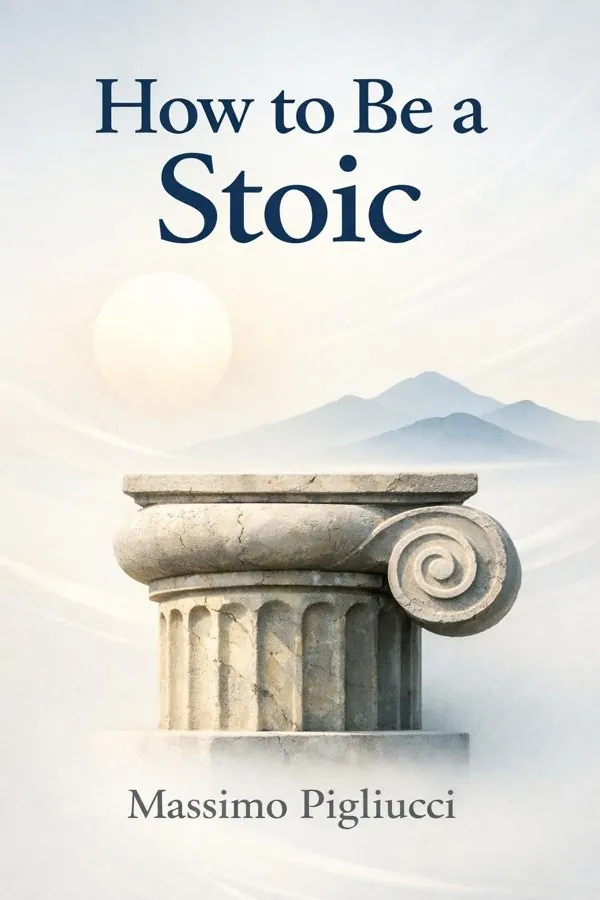
How to Be a Stoic: Using Ancient Philosophy to Live a Modern Life: Summary & Key Insights
 10 min9 chaptersAudio available
What Is How to Be a Stoic: Using Ancient Philosophy to Live a Modern Life About?
How to Be a Stoic: Using Ancient Philosophy to Live a Modern Life by Massimo Pigliucci is a eastern_wisdom book spanning 9 pages. In this accessible and engaging guide, philosopher Massimo Pigliucci explores how Stoic philosophy can help people navigate the challenges of modern life. Drawing on the teachings of Epictetus, Seneca, and Marcus Aurelius, Pigliucci offers practical advice on cultivating virtue, resilience, and rationality. The book blends ancient wisdom with contemporary examples, showing how Stoicism can foster tranquility and moral clarity in a complex world.
This FizzRead summary covers all 9 key chapters of How to Be a Stoic: Using Ancient Philosophy to Live a Modern Life in approximately 10 minutes, distilling the most important ideas, arguments, and takeaways from Massimo Pigliucci's work. Also available as an audio summary and Key Quotes Podcast.
How to Be a Stoic: Using Ancient Philosophy to Live a Modern Life
In this accessible and engaging guide, philosopher Massimo Pigliucci explores how Stoic philosophy can help people navigate the challenges of modern life. Drawing on the teachings of Epictetus, Seneca, and Marcus Aurelius, Pigliucci offers practical advice on cultivating virtue, resilience, and rationality. The book blends ancient wisdom with contemporary examples, showing how Stoicism can foster tranquility and moral clarity in a complex world.
Who Should Read How to Be a Stoic: Using Ancient Philosophy to Live a Modern Life?
This book is perfect for anyone interested in eastern_wisdom and looking to gain actionable insights in a short read. Whether you're a student, professional, or lifelong learner, the key ideas from How to Be a Stoic: Using Ancient Philosophy to Live a Modern Life by Massimo Pigliucci will help you think differently.
- ✓Readers who enjoy eastern_wisdom and want practical takeaways
- ✓Professionals looking to apply new ideas to their work and life
- ✓Anyone who wants the core insights of How to Be a Stoic: Using Ancient Philosophy to Live a Modern Life in just 10 minutes
Want the full summary?
Get instant access to this book summary and 100K+ more with Fizz Moment.
Get Free SummaryAvailable on App Store • Free to download
Key Chapters
Stoicism begins for me — and perhaps for many others — with Epictetus, the former slave who became one of antiquity’s most lucid moral teachers. His core insight, the dichotomy of control, changed everything about how I saw the world. According to Epictetus, the first step toward wisdom is to distinguish between what is up to us and what is not. Our thoughts, decisions, and actions are ours; our reputation, health, and the behavior of others are not. Freedom follows from this distinction, because suffering multiplies when we try to control the uncontrollable.
When I applied this principle to my own frustrations — in academia, relationships, and daily irritations — I discovered that serenity depends less on external success than on internal alignment. If I were criticized unfairly, my impulse was to defend myself. Stoicism taught me to examine that impulse rationally: was the criticism within my control? No. Was my response? Absolutely. By focusing on my own intentions and actions, the chaos outside lost its power.
Epictetus was not preaching passivity; he was teaching strategic action. To act well, we must first discern where our agency truly lies. In modern terms, this is similar to cognitive behavioral therapy, which also draws from Stoic reasoning. The practice is simple but profound — pause before reacting, ask yourself: is this within my control? That question is not a retreat from engagement; it is engagement purified of illusion.
The Stoics held that virtue — encompassing wisdom, courage, justice, and temperance — is the only true good. Everything else, from wealth to health, they called 'preferred indifferents': desirable perhaps, but not determinant of moral worth. This radical idea unsettled me at first. Could virtue alone suffice for happiness? Stoicism insists it can, because virtue is the harmonious expression of reason in action.
In our age of constant measurement — of success, status, achievement — Stoicism redefines the metric. The question is not ‘Did I win?’ but ‘Did I act rightly?’ Marcus Aurelius reminds us that the good life is one lived in accordance with nature, meaning our rational and social nature as human beings. Courage without justice corrodes into aggression; wisdom without temperance decays into cunning. Virtue is not a checklist but a coherence of soul.
I began to see this during moments of ordinary moral tension — when faced with the temptation to react harshly or to compromise integrity for convenience. Each small test is an opportunity to practice virtue. And practice, indeed, is the essence of Stoicism. Virtue is not innate; it is cultivated daily through reasoned choice. We become good by doing good, steadily, imperfectly, but intentionally.
+ 7 more chapters — available in the FizzRead app
All Chapters in How to Be a Stoic: Using Ancient Philosophy to Live a Modern Life
About the Author
Massimo Pigliucci is an Italian-American philosopher, biologist, and author. He is a professor of philosophy at the City College of New York and a prominent advocate for Stoic philosophy in the modern era. His work often bridges science and philosophy, focusing on ethics, rationality, and the practical application of ancient wisdom.
Get This Summary in Your Preferred Format
Read or listen to the How to Be a Stoic: Using Ancient Philosophy to Live a Modern Life summary by Massimo Pigliucci anytime, anywhere. FizzRead offers multiple formats so you can learn on your terms — all free.
Available formats: App · Audio · PDF · EPUB — All included free with FizzRead
Download How to Be a Stoic: Using Ancient Philosophy to Live a Modern Life PDF and EPUB Summary
Key Quotes from How to Be a Stoic: Using Ancient Philosophy to Live a Modern Life
“Stoicism begins for me — and perhaps for many others — with Epictetus, the former slave who became one of antiquity’s most lucid moral teachers.”
“The Stoics held that virtue — encompassing wisdom, courage, justice, and temperance — is the only true good.”
Frequently Asked Questions about How to Be a Stoic: Using Ancient Philosophy to Live a Modern Life
How to Be a Stoic: Using Ancient Philosophy to Live a Modern Life by Massimo Pigliucci is a eastern_wisdom book that explores key ideas across 9 chapters. In this accessible and engaging guide, philosopher Massimo Pigliucci explores how Stoic philosophy can help people navigate the challenges of modern life. Drawing on the teachings of Epictetus, Seneca, and Marcus Aurelius, Pigliucci offers practical advice on cultivating virtue, resilience, and rationality. The book blends ancient wisdom with contemporary examples, showing how Stoicism can foster tranquility and moral clarity in a complex world.
More by Massimo Pigliucci
You Might Also Like
A New Earth
Eckhart Tolle
10 min
The Daily Stoic
Ryan Holiday, Stephen Hanselman
10 min
Buddhism: Plain and Simple
Steve Hagen
10 min
Enchiridion
Epictetus
10 min
The Book of Tea
Kakuzō Okakura
10 min
The Light We Give: How Sikh Wisdom Can Transform Your Life
Simran Jeet Singh
10 minBrowse by Category
Ready to read How to Be a Stoic: Using Ancient Philosophy to Live a Modern Life?
Get the full summary and 100K+ more books with Fizz Moment.