
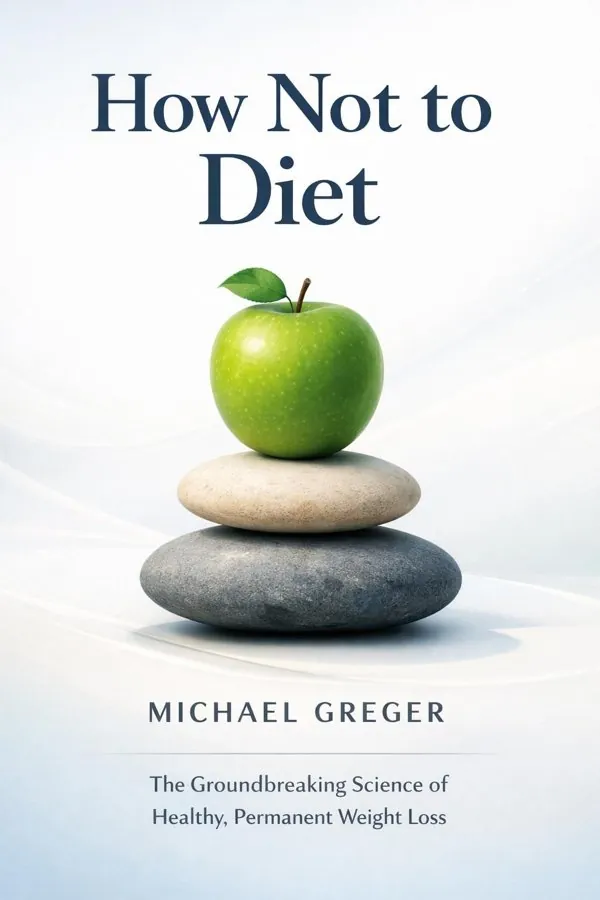
How Not to Diet: The Groundbreaking Science of Healthy, Permanent Weight Loss: Summary & Key Insights
 10 min8 chaptersAudio available
Key Takeaways from How Not to Diet: The Groundbreaking Science of Healthy, Permanent Weight Loss
One of the book’s most important insights is that body weight is not governed by simple math alone.
A powerful idea runs through the entire book: your stomach measures volume better than your brain measures calories.
A recurring theme in How Not to Diet is that whole plant foods are uniquely suited to healthy weight loss because they align with the body’s natural satiety systems.
Not all foods affect appetite and weight regulation equally.
One of the book’s most practical sections focuses on the “twenty-one tweaks,” a set of small evidence-based habits that can meaningfully improve weight-loss results over time.
What Is How Not to Diet: The Groundbreaking Science of Healthy, Permanent Weight Loss About?
How Not to Diet: The Groundbreaking Science of Healthy, Permanent Weight Loss by Michael Greger is a nutrition book spanning 7 pages. In How Not to Diet, physician and nutrition expert Michael Greger takes on one of the most frustrating problems in modern health: why lasting weight loss is so difficult, and what actually works. Rather than offering another trendy eating plan, Greger examines the scientific evidence behind appetite, metabolism, fat storage, food quality, and long-term behavior change. His central claim is both simple and radical: sustainable weight loss is less about restriction and willpower than about building a way of eating that naturally lowers calorie intake while improving fullness, health, and satisfaction. What makes this book stand out is its scope. Greger draws from thousands of studies to evaluate everything from calorie density and whole plant foods to meal timing, sleep, gut bacteria, and common diet myths. He does not just ask how to lose weight quickly, but how to do it safely, permanently, and in a way that supports overall well-being. As the founder of NutritionFacts.org and the bestselling author of How Not to Die, Greger brings both medical training and a deep commitment to evidence-based nutrition. The result is a rigorous, practical guide for readers who want a smarter path to healthy weight loss.
This FizzRead summary covers all 8 key chapters of How Not to Diet: The Groundbreaking Science of Healthy, Permanent Weight Loss in approximately 10 minutes, distilling the most important ideas, arguments, and takeaways from Michael Greger's work. Also available as an audio summary and Key Quotes Podcast.
How Not to Diet: The Groundbreaking Science of Healthy, Permanent Weight Loss
In How Not to Diet, physician and nutrition expert Michael Greger takes on one of the most frustrating problems in modern health: why lasting weight loss is so difficult, and what actually works. Rather than offering another trendy eating plan, Greger examines the scientific evidence behind appetite, metabolism, fat storage, food quality, and long-term behavior change. His central claim is both simple and radical: sustainable weight loss is less about restriction and willpower than about building a way of eating that naturally lowers calorie intake while improving fullness, health, and satisfaction.
What makes this book stand out is its scope. Greger draws from thousands of studies to evaluate everything from calorie density and whole plant foods to meal timing, sleep, gut bacteria, and common diet myths. He does not just ask how to lose weight quickly, but how to do it safely, permanently, and in a way that supports overall well-being. As the founder of NutritionFacts.org and the bestselling author of How Not to Die, Greger brings both medical training and a deep commitment to evidence-based nutrition. The result is a rigorous, practical guide for readers who want a smarter path to healthy weight loss.
Who Should Read How Not to Diet: The Groundbreaking Science of Healthy, Permanent Weight Loss?
This book is perfect for anyone interested in nutrition and looking to gain actionable insights in a short read. Whether you're a student, professional, or lifelong learner, the key ideas from How Not to Diet: The Groundbreaking Science of Healthy, Permanent Weight Loss by Michael Greger will help you think differently.
- ✓Readers who enjoy nutrition and want practical takeaways
- ✓Professionals looking to apply new ideas to their work and life
- ✓Anyone who wants the core insights of How Not to Diet: The Groundbreaking Science of Healthy, Permanent Weight Loss in just 10 minutes
Want the full summary?
Get instant access to this book summary and 100K+ more with Fizz Moment.
Get Free SummaryAvailable on App Store • Free to download
Key Chapters
One of the book’s most important insights is that body weight is not governed by simple math alone. While calories do matter, Greger argues that the popular advice to “eat less and move more” is too shallow to explain why people gain weight and struggle to lose it. Hunger, satiety hormones, food engineering, sleep, stress, habits, genetics, and the physical structure of food all influence how much we eat and how full we feel. In other words, the body is not a machine that responds to calorie numbers in a vacuum.
Greger shows that modern food environments are designed to overpower natural appetite regulation. Highly processed foods are often calorie-dense, easy to chew, rapidly absorbed, and poor at triggering fullness. This combination can cause people to consume more energy before their bodies recognize they have eaten enough. By contrast, foods rich in water, fiber, and intact plant structure tend to slow eating and enhance satiety.
This shift in perspective matters because it moves the conversation away from blame. If certain foods are biologically easier to overeat, then failure is not always a lack of discipline; it may be the predictable result of an unhealthy food environment. That is empowering, because it means we can change our surroundings and choices rather than endlessly fighting our own biology.
A practical application is to stop focusing only on portion control and instead examine which foods make portion control unnecessary. Replacing processed snacks, meats, cheeses, and sugary desserts with beans, vegetables, fruits, and intact grains can reduce spontaneous calorie intake without constant counting.
Actionable takeaway: Stop thinking only in terms of “how much” you eat and start asking “what kind of foods make it easiest for me to feel full on fewer calories?”
A powerful idea runs through the entire book: your stomach measures volume better than your brain measures calories. Greger argues that calorie density, the number of calories in a given weight of food, is one of the most effective concepts for sustainable weight loss. If you can eat foods that physically fill the stomach without packing in too many calories, you gain a major advantage.
Low-calorie-density foods are typically rich in water and fiber, such as vegetables, fruits, soups, beans, and intact whole grains. These foods allow people to eat satisfying portions while consuming fewer calories overall. High-calorie-density foods, by contrast, include oils, cheese, processed snacks, fried foods, and desserts. Because they deliver many calories in a small volume, they can leave people underfilled and prone to overeating.
Greger emphasizes that this is not about starvation. In fact, calorie density works because it lets people eat more food by weight, not less. A large salad with beans, vegetables, and a vinegar-based dressing may contain far fewer calories than a small fast-food meal, yet it can create more fullness. Similarly, broth-based soups, oatmeal, berries, steamed potatoes, and lentil stews can be deeply satisfying without being caloric traps.
This principle can reshape meal planning. Start meals with water-rich foods like salads, fruit, or vegetable soup. Build plates around foods that are naturally bulky and fibrous. Minimize ingredients that concentrate calories, especially oils and processed fats, which add energy rapidly without much satiety.
Actionable takeaway: Design every meal around low-calorie-density foods first, and let higher-calorie foods become accents rather than the foundation of your plate.
A recurring theme in How Not to Diet is that whole plant foods are uniquely suited to healthy weight loss because they align with the body’s natural satiety systems. Greger does not present plant-based eating as a moral slogan or a fad. He frames it as a practical, evidence-based strategy built on fiber, water content, nutrient density, and lower calorie density.
Whole plant foods such as beans, vegetables, fruits, intact grains, and potatoes are generally high in bulk and low in calories relative to their weight. They also require more chewing, digest more slowly, and often produce a steadier post-meal response than refined and animal-based foods. Fiber is especially important because it adds fullness, supports digestive health, and may help regulate blood sugar and appetite.
Greger is careful to distinguish whole plant foods from processed vegan products. A diet of fries, vegan cookies, and refined flour foods may be technically plant-based but not especially helpful for weight management. The goal is not just to remove animal products but to center meals on minimally processed plants.
Practical examples include swapping chicken for lentils in a stew, replacing breakfast pastries with oatmeal and berries, choosing bean chili instead of beef chili, and building lunches around grain bowls, soups, or big salads. These changes do more than cut calories. They improve nutritional quality, which can make weight loss less punishing and more sustainable.
Actionable takeaway: Build most meals from minimally processed plant foods, especially beans, vegetables, fruits, and intact grains, so your diet naturally promotes fullness and health at the same time.
Not all foods affect appetite and weight regulation equally. Greger explores a wide range of so-called boosters and inhibitors, showing that some choices may subtly support fat loss while others make it harder to maintain a healthy weight. The point is not to search for miracle ingredients, but to understand which foods and habits improve the odds.
On the helpful side, Greger highlights foods associated with greater satiety and better weight control, such as legumes, whole grains, vinegar, certain spices, and high-fiber staples. Beans are especially valuable because they combine protein, fiber, and slow digestion. Vinegar may help reduce blood sugar spikes and improve meal satisfaction for some people. Spicy foods may slightly increase thermogenesis or slow eating, though the effects are modest.
On the hindering side, Greger warns about calorie-concentrated foods that are easy to overconsume, especially oil, sugary beverages, refined grains, and ultra-processed snacks. Liquid calories are a particular problem because the body often does a poor job compensating for them. A smoothie, soda, or fancy coffee drink can add substantial calories without producing the same fullness as intact foods.
The practical lesson is to look beyond labels like “healthy” or “natural.” Nuts, dried fruit, granola, juices, and plant-based desserts can all fit into a nutritious lifestyle, but they are easier to overeat than fresh fruit, beans, or steamed vegetables. Weight loss improves when daily defaults are built around the most filling foods.
Actionable takeaway: Make high-fiber, low-calorie-density foods your routine staples, and treat oils, sugary drinks, and ultra-processed foods as occasional extras rather than everyday essentials.
One of the book’s most practical sections focuses on the “twenty-one tweaks,” a set of small evidence-based habits that can meaningfully improve weight-loss results over time. Greger’s larger message is that lasting transformation rarely comes from a single heroic effort. It comes from repeating manageable behaviors until they become automatic.
These tweaks include strategies such as drinking water before meals, prioritizing breakfast quality, eating slowly, front-loading calories earlier in the day, choosing foods that require chewing, and improving sleep. On their own, each change may seem modest. Together, they can reduce hunger, improve meal satisfaction, and prevent the kind of decision fatigue that derails diets.
A major advantage of this approach is psychological. Extreme plans often collapse because they demand constant motivation. Small habits are easier to sustain because they fit into ordinary life. For example, putting pre-cut vegetables at eye level in the fridge, keeping fruit visible on the counter, or routinely starting dinner with a salad are changes that reduce reliance on willpower.
Greger’s method encourages experimentation. Not every tweak will matter equally for every person. Some may benefit most from reducing late-night eating; others may see more progress from changing breakfast, adding beans daily, or eliminating sugary drinks. The goal is not perfection, but a system that makes healthier behavior more likely.
Actionable takeaway: Choose two or three simple habits you can repeat every day for the next month, and let consistency, not intensity, become your weight-loss strategy.
A striking lesson from the book is that weight management is not just about what happens on the plate. It is also shaped by what happens in the gut, the bedroom, and the rhythm of daily life. Greger explains that gut microbes help process food, produce metabolic byproducts, and may influence hunger, inflammation, and body weight. Diets rich in fiber appear to support a healthier microbiome, while highly processed diets can undermine it.
This matters because whole plant foods do more than reduce calorie intake directly. They also feed beneficial gut bacteria, which may produce compounds linked to better metabolic health. Beans, whole grains, vegetables, and fruits help create an internal environment that supports rather than fights weight control.
Beyond the microbiome, Greger stresses the importance of sleep and stress. Poor sleep can disrupt hormones related to hunger and satiety, making high-calorie foods more appealing and reducing self-control. Chronic stress can drive emotional eating and reinforce cravings for calorie-dense comfort foods. Exercise, while not always a powerful standalone weight-loss tool, supports long-term maintenance, mood, and overall health.
In practical terms, a person who eats well but sleeps five hours a night, sits all day, and lives in constant stress may still struggle. Sustainable weight loss requires a broader systems view. Better meals matter, but so do regular sleep, movement, stress management, and digestive health.
Actionable takeaway: Support weight loss beyond food by prioritizing fiber-rich meals, consistent sleep, daily movement, and stress-reducing routines that make healthy choices easier.
Many diets fail because they are built like temporary projects. Greger argues that if a strategy cannot be followed for years, it is unlikely to produce permanent results. The real challenge is not losing weight for a few weeks, but creating a way of eating and living that you do not need to “go off” later.
This is why the book rejects quick fixes and extreme restriction. Crash diets may produce short-term losses, but they often increase hunger, reduce satisfaction, and set the stage for rebound weight gain. A sustainable approach has to satisfy three conditions: it must be nutritionally sound, physically filling, and psychologically livable.
Greger also broadens the conversation beyond personal appearance. Weight loss should serve health, energy, mobility, disease prevention, and quality of life. He links dietary choices to larger ethical and environmental considerations as well, suggesting that diets centered on whole plant foods can benefit animals and the planet in addition to the individual. For some readers, that bigger sense of purpose may strengthen commitment.
A long-term mindset changes decision-making. Instead of asking, “How fast can I lose ten pounds?” the better question becomes, “What way of eating would I still be happy to follow next year?” That shift encourages habits that are satisfying enough to last: hearty soups, bean-based meals, fruit for dessert, simple home cooking, and routines that reduce temptation.
Actionable takeaway: Choose only weight-loss strategies you can realistically imagine practicing for the long run, because permanence comes from repeatable habits, not temporary sacrifice.
What you eat is crucial, but Greger argues that when and how you eat can also influence body weight. The body appears to process food differently across the day, and appetite cues are affected by meal timing, speed, and eating context. This means that weight loss may improve not only by changing food choices, but by changing eating patterns.
Greger discusses evidence suggesting that front-loading calories earlier in the day may be beneficial for some people. A more substantial breakfast and lunch, paired with a lighter dinner, may align better with circadian rhythms and improve satiety. Late-night eating can be especially problematic when it involves mindless snacking, fatigue-driven cravings, or ultra-processed comfort foods.
Eating speed matters too. Fast eating can outpace the body’s fullness signals, leading people to consume more before realizing they have had enough. Slowing down, chewing thoroughly, and eating without screens can make meals more satisfying and reduce accidental overeating. Foods that require more chewing, such as apples, carrots, beans, and intact grains, can naturally help.
A practical routine might include eating breakfast instead of skipping it, planning a filling fiber-rich lunch, setting a cut-off time for kitchen snacking, and taking at least twenty minutes for main meals. Even simple changes such as putting utensils down between bites or beginning with a salad can increase awareness and fullness.
Actionable takeaway: Improve appetite control by eating more deliberately, emphasizing earlier meals, and reducing rushed or late-night eating that disconnects you from natural fullness cues.
All Chapters in How Not to Diet: The Groundbreaking Science of Healthy, Permanent Weight Loss
About the Author
Michael Greger, M.D., is a physician, bestselling author, and internationally known speaker on nutrition, lifestyle medicine, and public health. He is the founder of NutritionFacts.org, a nonprofit organization dedicated to reviewing and sharing the latest evidence-based research on diet and disease prevention. Greger is widely recognized for making complex nutrition science accessible to general readers through books, lectures, videos, and articles. His bestselling works include How Not to Die, How Not to Diet, and How Not to Age. Across his work, he advocates for practical, research-backed dietary strategies, with a strong emphasis on whole plant foods. His reputation rests on his ability to synthesize large volumes of scientific literature and translate them into actionable advice for healthier, longer lives.
Get This Summary in Your Preferred Format
Read or listen to the How Not to Diet: The Groundbreaking Science of Healthy, Permanent Weight Loss summary by Michael Greger anytime, anywhere. FizzRead offers multiple formats so you can learn on your terms — all free.
Available formats: App · Audio · PDF · EPUB — All included free with FizzRead
Download How Not to Diet: The Groundbreaking Science of Healthy, Permanent Weight Loss PDF and EPUB Summary
Key Quotes from How Not to Diet: The Groundbreaking Science of Healthy, Permanent Weight Loss
“One of the book’s most important insights is that body weight is not governed by simple math alone.”
“A powerful idea runs through the entire book: your stomach measures volume better than your brain measures calories.”
“A recurring theme in How Not to Diet is that whole plant foods are uniquely suited to healthy weight loss because they align with the body’s natural satiety systems.”
“Not all foods affect appetite and weight regulation equally.”
“One of the book’s most practical sections focuses on the “twenty-one tweaks,” a set of small evidence-based habits that can meaningfully improve weight-loss results over time.”
Frequently Asked Questions about How Not to Diet: The Groundbreaking Science of Healthy, Permanent Weight Loss
How Not to Diet: The Groundbreaking Science of Healthy, Permanent Weight Loss by Michael Greger is a nutrition book that explores key ideas across 8 chapters. In How Not to Diet, physician and nutrition expert Michael Greger takes on one of the most frustrating problems in modern health: why lasting weight loss is so difficult, and what actually works. Rather than offering another trendy eating plan, Greger examines the scientific evidence behind appetite, metabolism, fat storage, food quality, and long-term behavior change. His central claim is both simple and radical: sustainable weight loss is less about restriction and willpower than about building a way of eating that naturally lowers calorie intake while improving fullness, health, and satisfaction. What makes this book stand out is its scope. Greger draws from thousands of studies to evaluate everything from calorie density and whole plant foods to meal timing, sleep, gut bacteria, and common diet myths. He does not just ask how to lose weight quickly, but how to do it safely, permanently, and in a way that supports overall well-being. As the founder of NutritionFacts.org and the bestselling author of How Not to Die, Greger brings both medical training and a deep commitment to evidence-based nutrition. The result is a rigorous, practical guide for readers who want a smarter path to healthy weight loss.
More by Michael Greger
You Might Also Like
Eating by the Seasons Cookbook: Seasonal Produce-Focused Recipes
Clare Foster
10 min
From Crook to Cook: Platinum Recipes from Tha Boss Dogg's Kitchen
Snoop Dogg with Ryan Ford
10 min
Juicing for Beginners: The Essential Guide to Juicing Recipes and Juicing for Weight Loss
Rockridge Press
10 min
The Food Therapist: Break Bad Habits, Eat with Intention, and Indulge Without Worry
Shira Lenchewski
10 min
The Mediterranean Diet Meal Plan: A 4-Week Meal Plan for Optimal Health and Weight Loss
Various Contributors
10 min
The Well Plated Cookbook: Simple, Wholesome Recipes for Everyday Meals
Erin Clarke
10 minBrowse by Category
Ready to read How Not to Diet: The Groundbreaking Science of Healthy, Permanent Weight Loss?
Get the full summary and 100K+ more books with Fizz Moment.